Vermont Rules for a 10-Year-Old Rider
A 10-year-old may be eager to ride, but Vermont’s rules depend on where the machine will be used. A child who cannot yet take the state safety course faces important limits on trails, public land and road crossings. Here’s how to separate those restrictions from the narrower possibility of riding on private family land, and how to plan a safer first ride.
Where a 10-Year-Old May Ride
The key distinction is between riding on private land and using public roads, public land or an organized trail system. A 10-year-old should not assume that permission to ride on one property also makes the child eligible to ride on a nearby trail or road.
Vermont’s ATV safety course has a minimum age of 12. Because a 10-year-old cannot complete the course and earn the certificate, the child cannot meet the training requirement that applies to young riders on regulated riding areas. The course’s age limit is explained in Vermont’s Minimum Course Age of 12.
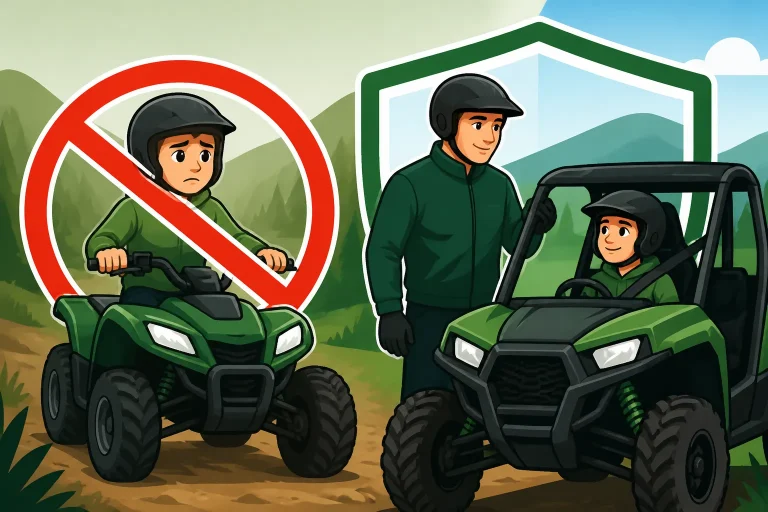
A 10-year-old should not operate an ATV on a VASA trail, a public trail or a designated town-road route. VASA corridors often cross private property, but that does not make them ordinary private land where a child can ride without meeting trail requirements. The system operates through designated corridors and landowner permission; a rider needs to follow the applicable access and training rules. See Vermont ATV Trails: The VASA System for how that network works.
| Where the child would ride | What a 10-year-old should expect |
|---|---|
| VASA trail or other managed trail | Not eligible to ride independently as an operator; the safety-course age requirement is a barrier |
| Public land | Do not assume riding is allowed; follow the specific land and access rules |
| Town road or designated route | A 10-year-old cannot use the road-crossing rule available to older children |
| Land owned by a parent or guardian | A limited possibility, subject to the family-land rules, permission and safe supervision |
| Someone else’s private property | Get the landowner’s permission and confirm that the child is legally allowed to operate there |
The private-property distinction is not a blanket exemption for every place with a private owner. A privately owned parcel might be part of a managed trail corridor, or it may be subject to access conditions. Confirm the location and the applicable rules before riding. For the family-land exception, see Vermont Course Exception on Family Land and Riding on Land Your Parents Own.
Even on family land, the exception does not remove the need to judge whether the child and machine are a safe match. A parent’s permission is not a substitute for direct supervision, protective equipment, a suitable riding area or the machine manufacturer’s age and size guidance.
Rules a 10-Year-Old Cannot Meet Yet
The safety-course requirement is the clearest practical limit. Vermont’s course is not available to children under 12, so a 10-year-old cannot use a completed Vermont certificate to qualify for riding where that training is required. The certificate requirement is separate from registration and trail access: having a registered machine or a trail decal does not make a child eligible to ride on a trail if the child does not meet the age and training rules.
Under-16 riders are also subject to supervision requirements. These rules do not make every location available to a 10-year-old; they apply when a young rider is otherwise eligible to ride. An adult riding nearby cannot override an age restriction or create an exception for a public route. For the details, see Vermont Supervision Rules Under 16.
A 10-year-old also cannot use Vermont’s road-crossing allowance for a 12-year-old. Do not plan a ride that requires the child to cross a highway or town road on the ATV, even with an adult present. A crossing rule is not permission to ride along the road or use a route that is otherwise closed to the child. The age distinction is covered in Vermont ATV Crossing Rules at Age 12.
Keep these rules separate when planning:
- Training: A 10-year-old cannot yet take Vermont’s ATV safety course.
- Supervision: Being with an adult does not waive location or age restrictions.
- Crossings: The rules that allow a 12-year-old to cross in limited circumstances do not apply to a 10-year-old.
- Trail access: A registration or trail access decal does not replace the rider’s age and training eligibility. See Vermont Requires Registration Plus a TAD.
- Passengers: Permission for a child to ride as a passenger is not permission for the child to operate. Use only a machine designed to carry a passenger, and follow the manufacturer’s seating and safety requirements.
If a family is unsure whether a particular private parcel qualifies for an exception, check the rule for that specific land and riding arrangement before starting the engine. A trail that crosses a family-owned parcel, for example, may still be part of a managed corridor with separate access conditions.
Planning a Private-Land Ride
If the ride is on land owned by a parent or guardian and the applicable exception allows it, make the first ride short, controlled and away from roads, trails and other people. Choose a broad, level area with a clear view, firm ground and enough room to stop without approaching a ditch, tree, fence, pond or driveway.
Before the child rides, check:
- The exact location. Confirm that the area is private family land and not a public route, public parcel or managed trail corridor.
- The machine. Follow the manufacturer’s age, size and passenger guidance. A child should be able to reach and operate the controls comfortably while seated.
- The riding surface. Avoid steep slopes, mud, loose gravel, water crossings and obstacles that could cause a loss of control.
- The supervision plan. Keep the adult close enough to intervene, not simply somewhere else on the property. Explain a stop signal and make sure the child can stop the machine reliably.
- The protective equipment. Use a properly fitted helmet and the required protective gear. Vermont’s helmet rules apply to riders and passengers; see Vermont ATV Helmet Law for Every Rider.
A helmet should fit securely, stay fastened and carry a safety label that meets the applicable standard. If shopping for one, including through Amazon, check the model’s certification and fit rather than relying on a product title or a child’s age alone. Protective equipment can reduce some risks, but it cannot make an unsuitable machine or riding area safe.
For a first ride, keep the engine off while explaining the controls and practicing how to mount and dismount. If the child cannot reach the controls, follow instructions, or stop consistently, do not continue. Avoid carrying a passenger while the child is learning to operate. A second person changes the machine’s balance and adds another safety responsibility.
Do not let a private-land ride drift onto a road, public trail or neighboring parcel. If the planned route reaches a road, stop and arrange a different route rather than assuming an adult can escort the child across. Ask the landowner before riding on anyone else’s property, even if the area appears open or connects to a familiar trail.
What to Check Before the Next Birthday
At age 12, a child may become eligible to take Vermont’s ATV safety course, but turning 12 does not automatically allow riding everywhere. The child still needs to complete the course when required, follow supervision rules that apply to riders under 16, and meet the access requirements for the land or trail. A certificate does not open a road or trail that is closed to ATVs.
Before planning a ride after the child turns 12, check the course requirements, the rules for the intended route and any applicable trail access requirements. The safety certificate is distinct from registration and a trail access decal. Each item addresses a different part of riding eligibility. See Vermont Safety Certificates That Never Expire for certificate information and Vermont Out-of-State Machines Still Need a TAD for trail access context.
For now, the practical approach is straightforward: keep a 10-year-old’s operation to a location where the family-land rules allow it, and do not use public roads, public land or managed trails as a workaround. When the child is old enough for the course, confirm the rules again for the exact machine and location. Rules for young riders are specific enough that a quick check is safer than relying on what another family does or on a trail’s apparent connection to private property.
Disclaimer
This article is for general informational purposes only and does not constitute professional advice. Laws, prices and regulations vary by location and change over time. Consult a qualified professional for guidance on your specific situation.