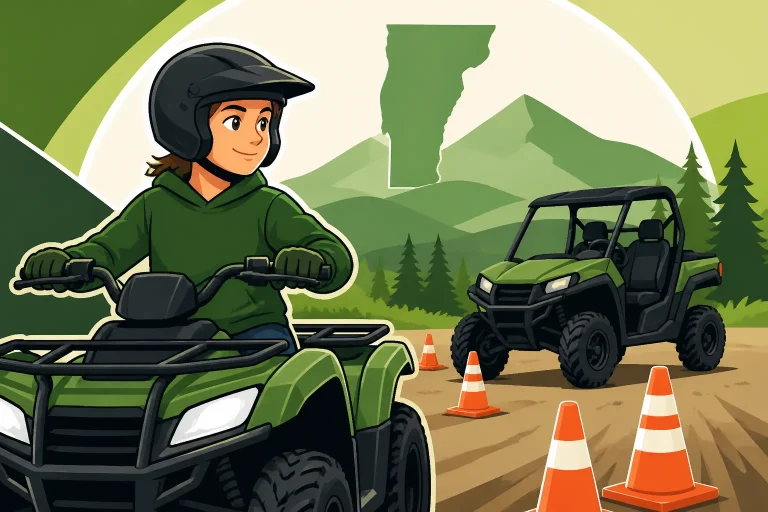
Vermont Riders Under 16 Need an Adult
Vermont Riders Under 16 Need an Adult
A young rider’s age can affect more than which machine they should use. In Vermont, riders under 16 need adult supervision, and safety-course, trail-access, registration and road-use rules may apply separately. The practical challenge is knowing which requirements travel together and which do not. Here’s how to plan a ride without assuming that an adult’s presence makes every route or machine permissible.
What adult supervision means in Vermont
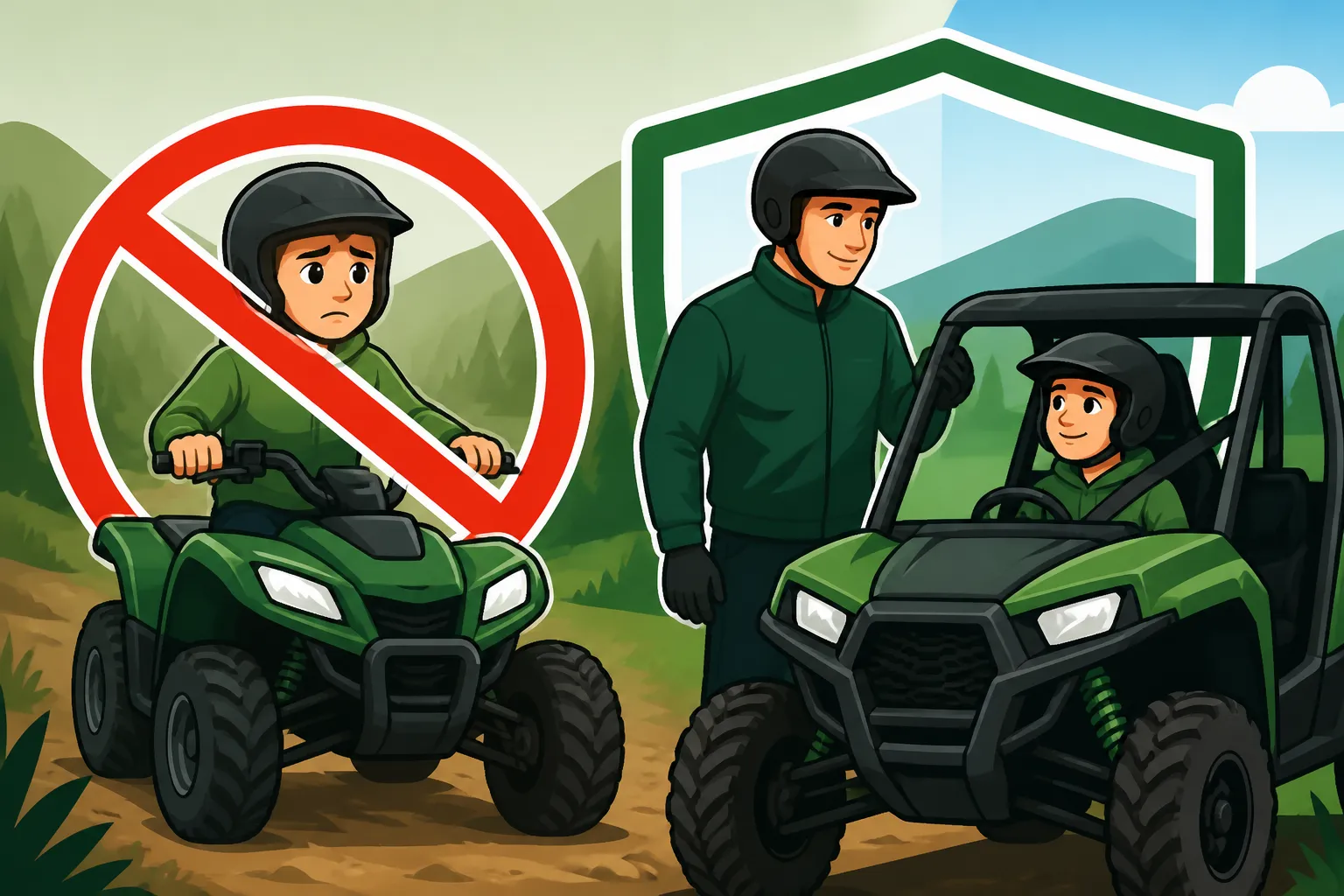
For a rider under 16, adult supervision is a legal requirement—not simply a good idea. The supervising person must be an adult who meets Vermont’s qualifications, and the young rider must remain under that person’s direct supervision while operating. Do not assume that an adult who is at the trailhead, at home or riding somewhere else on the property counts.
The key idea is that the supervisor needs to be able to monitor the rider and respond if something goes wrong. A parent riding just ahead or behind on the same route may be in a position to supervise; an adult who sends a young rider off alone while waiting at a meeting point is not providing the same oversight. The precise legal interpretation can depend on the circumstances, so check the current rule before a ride rather than relying on a general description of what “direct” means.
The adult also has to be eligible to supervise. Vermont’s requirements should be checked for the supervisor’s age and driver’s-license status. A person being a parent, guardian or experienced rider does not automatically establish that they meet the legal qualification. If the adult’s license is suspended, restricted or otherwise not current, confirm whether they can supervise before taking a young rider out.
For an overview of the age-based rule, see Vermont Supervision Rules Under 16. The details of who qualifies are covered in Who Can Legally Supervise a Rider Under 16 and Vermont Supervisor License Requirements. These points matter for visitors as well as Vermont residents: being familiar with another state’s rules does not necessarily satisfy Vermont’s requirements.
Direct supervision is more than being nearby
A useful way to plan is to ask whether the adult can actually see, communicate with and assist the young rider throughout the ride. If the terrain, vegetation, distance or group size makes that difficult, change the plan. Keep the young rider within a range where the adult can intervene, and avoid splitting the group so that the adult and child become separated.
“Direct supervision” should not be treated as a promise that an adult will be somewhere in the general area. A young rider on a different trail, far ahead around blind corners, or out of sight for long periods may not be receiving meaningful supervision. The safer approach is to keep the rider close enough for the adult to give immediate direction and to stop if conditions become unsafe.
The adult should be focused on supervising, not just included in the group. A supervisor who is towing a trailer, managing several riders at once, or dealing with another problem may not be able to give a young rider the attention the rule expects. For a group outing, assign one capable adult to stay with the younger rider and make sure the rest of the group understands that the adult may need to slow down or turn back.
The practical details of this requirement are discussed in Direct Supervision by Someone Eighteen. Do not use that concept as a substitute for checking the current statutory wording, especially if the ride involves a public road, a crossing or a machine with a different legal classification.
An adult’s presence does not grant permission to ride anywhere
Supervision answers one question: whether the young rider may operate under an adult’s oversight. It does not itself grant permission to ride on private land, a VASA corridor, a town road, a state property or any other place. Each location has its own access rules.
Before setting out, confirm both that the rider can legally operate and that the route is open to the machine. On private land, obtain the landowner’s permission. On club corridors, check the applicable access requirements and closures. On a town road, confirm that the road has been designated for ATV use and that local restrictions allow the planned ride. A supervising adult cannot authorize a route that is closed or use a machine where it is not permitted.
Supervision is separate from safety training
A young rider may need adult supervision and also need to meet Vermont’s safety-training requirements. These are separate obligations. Having a parent or other adult along does not automatically replace a required safety certificate, and completing a course does not cancel the under-16 supervision rule.
Vermont’s rules generally require riders under 18 to complete an approved ATV safety course, subject to any applicable exceptions. Confirm which course and certificate Vermont accepts before riding. The age at which a rider can take the course is another separate issue; check the current minimum-age requirements rather than assuming that every child can enroll immediately.
The broad requirement is explained in Vermont ATV Safety Course Required Under 18, and Vermont’s Minimum Course Age of 12 addresses course age. Course requirements and exceptions can depend on where and how the machine is being used. For example, rules may treat riding on a parent’s land or supervised instruction differently from riding on a public trail. Do not assume an exception applies just because the rider is with family or is taking part in an informal lesson. Confirm the exact conditions first.
A certificate also does not function as a general riding permit. It shows that the rider has met a training requirement; it does not provide trail access, register the machine, satisfy insurance obligations or make a closed road open. Think of training as one item in a wider checklist.
A simple pre-ride check
Before leaving, confirm each of the following:
- Rider’s age: Is the operator under 16, under 18, or in another age group with different requirements?
- Adult eligibility: Is the supervising adult old enough and otherwise qualified under Vermont’s current rule?
- Supervision plan: Will the adult stay close enough to monitor and assist throughout the ride?
- Training: Does the rider need a safety certificate, and does the certificate meet Vermont’s requirements?
- Machine: Is the machine appropriate for the rider’s size, ability and experience?
- Access: Is the route open to that type of machine, and has the required permission or access credential been obtained?
- Equipment: Are helmets and other required equipment available and properly fitted?
- Conditions: Do weather, trail conditions, traffic or the rider’s fatigue call for a shorter or simpler outing?
This list helps prevent a common mistake: checking only one requirement. A child’s course certificate, an adult’s presence or a valid registration may each be important, but none should be treated as proof that every other requirement has been met.
The machine and the route still matter
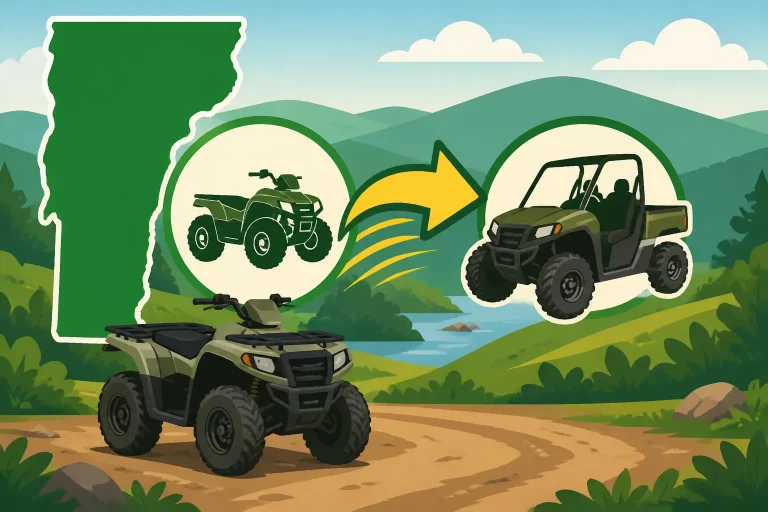
Vermont’s terminology can be confusing because riders often use “ATV” as a general term for several off-road machines. The legal classification may depend on the vehicle’s design and specifications. A side-by-side or utility vehicle may fall under a different class than a small quad, and the applicable registration or access rules can differ. Check the machine’s classification before applying a rule that you have heard about another vehicle. Vermont ATV Versus ASV Classes explains why the distinction can matter.
A machine that is legally classified differently is not automatically suitable for a young rider. Consider the manufacturer’s age guidance, the operator’s reach and strength, the machine’s controls, passenger seating and the terrain. A large machine can be difficult for a young operator to control even if it has a passenger seat and an adult is riding nearby. Do not carry a child as a passenger unless the machine is designed and equipped for passengers and all applicable rules are met.
| Planning question | What to verify | What an adult’s presence does not do |
|---|---|---|
| Can the rider operate? | Age-based supervision and training rules | It does not automatically excuse a missing certificate |
| Is the machine eligible? | Vehicle classification, registration and equipment | It does not make an unsuitable machine safe |
| Can the group use the route? | Landowner permission, trail access and road designation | It does not open a closed trail or town road |
| Can the machine be used on a VASA corridor? | Required registration and Trail Access Decal, plus current access rules | It does not replace the required decal |
| Can the rider travel on a town road? | Current state law, town designation and local restrictions | It does not authorize travel on an undesignated road |
| Is the ride ready to begin? | Helmet, other required gear, machine condition and conditions | It does not replace equipment or safe judgment |
Trail access and the TAD
For a ride on Vermont’s VASA trail system, check the access requirements separately from the child-supervision rule. In general, the relevant machine needs proper registration and a Trail Access Decal for the applicable trail access. The adult’s registration or decal does not cover a different machine simply because the adult is riding with its operator.
Start with Vermont Requires Registration Plus a TAD for the relationship between registration and trail access. Visitors should also review Vermont Out-of-State Machines Still Need a TAD rather than assuming that a home-state registration alone provides access to Vermont trails. Check the current requirements and any club-specific information before traveling, since corridors can close or change.
A TAD is not permission to ride every place in Vermont. It is related to access on the participating trail network. Landowner permission, trail conditions, club rules and closures remain important. A rider with a decal still needs to stay on the authorized route, follow posted signs and respect gates.
Town roads and crossings
Town-road access is a separate issue again. Vermont towns decide whether particular roads are open to ATV travel, and a road’s status can change. A road that is open in one town may not be open in the next. Check the posted route and local rules before planning a route that uses pavement or passes through a village.
See Vermont ATV Road Rules: Towns Decide for the town-designation issue, and Vermont ATV Crossing Rules at Age 12 for age-related crossing considerations. A crossing rule is not a general right to travel along a road. Likewise, an adult riding beside a child does not turn a closed road into an authorized route.
This distinction is especially important when a trail meets a road. Stop and check signs before entering the road, follow the applicable crossing procedure, and do not continue along the road unless that use is permitted. If a young rider is unsure what a sign means, the adult should stop the group and explain before proceeding.
Private land and state property
Permission to ride on private land must come from the landowner or someone authorized to grant it. A family relationship, an old habit of using a route or the absence of a gate does not necessarily establish current permission. Confirm that the permission applies to the specific land, route and machine.
State land is not a general substitute for a closed private trail. Access rules vary by property and activity, and ATV use may be restricted. Check the rules for the particular area rather than assuming that a public ownership label means riding is allowed.
Plan the ride around the young rider
Legal compliance is the starting point. A good ride also matches the young rider’s ability to the machine, terrain, distance and group pace. An adult can meet a supervision requirement and still make a poor choice by taking an inexperienced child onto a demanding corridor or a long ride with no easy way to turn back.
Choose a machine the rider can control
Before riding, make sure the young operator can comfortably reach the controls and use them without stretching or shifting position unsafely. They should be able to steer, brake and stop the machine in a controlled way. If the rider cannot manage the controls while wearing the required gear, choose a more suitable machine or wait.
The machine’s power and size should fit the operator’s experience, not just their age or confidence. A rider who has only practiced in an open area may not be ready for narrow trails, steep grades, loose surfaces, traffic or a busy group ride. Begin with a controlled setting and build skills gradually.
Do not let a young rider use a passenger seat as a shortcut around operator limits. A passenger must have a designated seat and be able to follow the machine manufacturer’s instructions. The operator must remain in control, and the adult should not treat a passenger ride as an alternative to checking the rules that apply to that child and machine.
Set clear rules before the engine starts
A short briefing helps the child understand what to do when the group stops, gets separated or encounters a hazard. Keep instructions simple and agree on them before moving. Useful points include:
- Stay within sight or other agreed contact with the supervising adult.
- Stop when the adult signals, and do not pass the adult without permission.
- Do not leave the marked route or go around a closed gate.
- Slow down near homes, animals, other trail users and road crossings.
- Stop in a safe place if the machine behaves unexpectedly or the rider feels tired.
- Do not ride through water, mud or an obstacle unless the adult has checked that it is safe and permitted.
Use a pace that allows the adult to observe the child, not one that merely keeps the group moving. If several adults and children are riding together, agree in advance who is responsible for each young rider. Avoid a situation where every adult assumes another person is watching.
Make protective gear part of the plan
Check current Vermont equipment requirements for the place and type of riding. Helmets are central to a safer ride, and a helmet must fit the rider rather than simply be available. The strap should be secured, and the helmet should not shift around when the rider moves. Use eye protection where needed, and choose clothing that protects against branches, debris, weather and contact with hot or moving parts.
A young rider may outgrow a helmet or other gear faster than an adult. Recheck fit before each season and after a significant impact. Do not use damaged equipment or assume that a helmet that fits over a hat will fit correctly without it. The adult should also bring suitable gear, because a supervisor who is unprepared may have trouble helping if the ride becomes cold, wet or uncomfortable.
Keep the machine in sound condition. Check brakes, tires, controls, lights where applicable and any required safety equipment before setting off. Secure loose items and make sure the machine is not overloaded. A pre-ride check is especially useful when a vehicle has been stored for winter or has not been used recently.
Adapt to trail and weather conditions
Trail conditions can change after rain, during mud season or following a storm. A route that was manageable on a dry day may become slippery, rutted or obstructed. Check current club information and posted signs, and turn back if conditions are beyond the rider’s ability. Riding around a muddy or damaged section can widen the route and harm the trail; stay on the marked corridor and follow closure directions.
Plan a conservative distance. Young riders may tire sooner than the adults in the group, and fatigue can affect judgment and control. Schedule breaks, bring water, and leave enough time to return without rushing. A ride that ends early because the child is tired is a better outcome than pressing on until the rider becomes inattentive.
A practical checklist for families and visiting riders
The rules are easier to manage when you treat the ride as several separate checks rather than one yes-or-no question. A family planning a ride should verify the rider, supervisor, machine and route. Visitors should add a check of their home-state paperwork and Vermont access requirements.
Use this checklist before loading the machines:
- Confirm the child’s age and role. Is the child operating or riding as a passenger? Operator rules and passenger rules are not interchangeable.
- Confirm supervisor eligibility. Check the current Vermont requirements for the adult, including age and license qualifications.
- Keep supervision direct. Plan the route and group formation so the adult can monitor the young rider and respond promptly.
- Check training requirements. Verify whether the child needs an accepted safety certificate and whether an exception genuinely applies.
- Identify the vehicle class. Confirm whether the machine is treated as an ATV, ASV or another category for registration and access purposes.
- Check registration and insurance. Make sure the machine’s documents and required coverage are in order for the intended use.
- Verify trail access. For a VASA corridor, check the applicable TAD and current club access information.
- Verify road access separately. Check town designations, signs and restrictions; do not assume the trail route continues onto a road.
- Confirm permission. Obtain landowner approval where required and respect state-property restrictions.
- Inspect the machine and gear. Check controls, brakes, tires, helmet fit and other required equipment.
- Agree on a stop plan. Tell the young rider how to respond if separated, tired, confused or faced with a closed route.
- Be ready to turn around. Conditions, rider fatigue or an unexpected closure may make the planned route unsuitable.
For an organized ride or a trip with a club, contact the responsible club or organizer before arriving. Ask whether the route is currently open, what documents they expect riders to carry, and whether there are restrictions on age, machine type or group size. If an answer affects whether a young person can ride, get clarification rather than relying on a casual assumption.
The same approach applies when renting or borrowing a machine. Ask who is responsible for confirming the operator’s age, training, supervision and access requirements. A rental agreement or an adult’s permission does not override state rules, and the machine may have specific age or passenger restrictions. Read the operator instructions and ask the provider about questions before the ride begins.
When the group includes riders with different abilities, plan for the least experienced operator. That may mean using a shorter route, avoiding a road connection or splitting into separate groups with qualified adults. Do not create a fast group and assume the child can keep up. The supervising adult’s first responsibility is to the young rider, even if the rest of the group has to wait.
Frequently Asked Questions
Can a parent supervise a rider under 16?
A parent can supervise if they meet Vermont’s requirements for an eligible adult supervisor and provide direct supervision. Being the child’s parent alone does not establish that every requirement has been met.
Does adult supervision replace the safety-course requirement?
No. Supervision and training are separate issues. Check whether the rider needs a Vermont-accepted safety certificate and whether a specific exception applies.
Does an adult need to ride on the same machine?
The important issue is whether the adult provides the required direct supervision, not simply whether they share a machine. Plan so the adult can monitor and assist the young rider, and check the current rule for the specific circumstances.
Can a supervised rider use any Vermont trail or road?
No. Supervision does not create access rights. The route must be open to the machine, and applicable registration, TAD, landowner-permission and town-road rules still apply.
Disclaimer
This article is for general informational purposes only and does not constitute professional advice. Laws, prices and regulations vary by location and change over time. Consult a qualified professional for guidance on your specific situation.