Taking the Course at Twelve
Taking an ATV safety course at twelve can give a young rider time to build knowledge before riding, but the certificate is only one part of Vermont’s rules. Parents and caregivers also need to understand supervision, machine suitability, registration, and trail access. Here’s how to think about the course at age twelve and what to check before planning a ride.
What taking the course at twelve means
Twelve is the minimum age to take Vermont’s ATV safety course. That makes it possible for a young person to complete training before the later teen years, rather than waiting until a ride or trip is already planned. The course covers safety knowledge and helps riders understand the responsibilities that come with operating an ATV.
The minimum age to take a course is not the same as an all-purpose permission to ride. A course certificate does not automatically authorize a twelve-year-old to operate every machine, ride on every trail, or ride without an adult. Vermont has a separate supervision rule for riders under sixteen, and other requirements can apply depending on where and how the machine is used.
The state’s training requirement generally applies to riders under eighteen, subject to exceptions. The age threshold matters: a rider does not simply stop needing a certificate at sixteen. The details of the requirement and its exceptions are covered in Vermont ATV Safety Course Required Under 18 and Vermont Safety Course Binds at 18, Not 16.
A practical way to remember the distinctions is:
- Course eligibility: A young person can take the course starting at twelve.
- Training requirement: Riders under eighteen generally need to meet the applicable safety-course requirement, unless an exception applies.
- Supervision: Riders under sixteen must follow Vermont’s adult-supervision rule.
- Access: Registration, trail-access requirements, landowner permission, and local rules still apply.
These are separate checks, not interchangeable ways of meeting one requirement. Completing the course is a useful step, but it does not substitute for adult oversight or the paperwork and permissions needed for a particular ride.
Why starting at twelve can help
A twelve-year-old may benefit from learning before riding regularly. A course can provide a structured introduction to safe habits, risk awareness, and the rules a rider is expected to follow. It also gives a parent or caregiver a chance to discuss what the young person understands and where more practice or supervision is needed.
That does not mean every twelve-year-old is ready to ride. Readiness depends on more than age or a certificate. Consider the child’s attention, judgment, physical ability to operate the controls, willingness to follow instructions, and response to changing conditions. A rider who can answer course questions correctly may still need close coaching in real terrain.
Separate training from permission to ride
It helps to treat the certificate as proof of training rather than a permission slip. Before a ride, check the rider’s age, the machine’s suitability, the required adult supervision, and the rules for the specific land or trail. For managed trail access, a registered machine may also need a Vermont Trail Access Decal. The requirements are explained in Vermont Requires Registration Plus a TAD.
If a family is considering riding only on land it owns, do not assume that the course and supervision rules disappear. Vermont has specific exceptions, and their scope matters. Review Vermont Course Exception on Family Land and confirm that the circumstances actually fit before relying on an exception.
How the course and certificate fit together
The course is training; the certificate is the record that the rider completed the required training. Keep the distinction clear when planning a ride. A child may have completed the course but still need an adult directly supervising, while a rider who has not taken a course may not meet the requirement for riding outside an applicable exception.
Vermont safety certificates do not expire, according to the state’s course information. A certificate earned at twelve can therefore remain useful as the rider grows older. Keep a copy in a place where it can be found, and make sure the name and identifying information on the record are accurate. For details about confirming a certificate, see Vermont Safety Certificate Lookup and Printing Your Vermont Safety Certificate.
A certificate’s long-term validity does not mean every riding rule stays the same. The rider’s age changes, local routes and access conditions can change, and the machine may be replaced. Recheck the rules each time the situation changes instead of relying on the course completion date as proof that all other requirements have been met.
| Question | What the course or certificate addresses | What it does not settle |
|---|---|---|
| Can a twelve-year-old take the course? | Twelve is the minimum course age. | Whether the rider is ready for a particular machine or ride. |
| Does passing the course allow a child to ride alone? | It documents safety training. | Vermont’s supervision requirement for riders under sixteen. |
| Does a certificate expire? | Vermont safety certificates do not expire. | Whether current route, access, or operating rules have changed. |
| Does the certificate provide trail access? | It helps meet the training requirement where that requirement applies. | Registration, a TAD, landowner permission, and local access rules. |
| Does it cover every machine? | It provides a record of course completion. | Whether a specific machine is appropriate or permitted for the rider. |
Keep proof easy to retrieve
After the course, save the certificate in a durable format. A paper copy can be kept with important vehicle documents; a digital copy can be stored somewhere a parent or caregiver can retrieve it. If the rider’s name, date of birth, or other details appear incorrectly, ask the course provider or relevant state contact how to correct the record.
Before a ride, make sure the adult responsible for the child knows where the proof is. A certificate that exists but cannot be located can turn a straightforward check into a delay. Keep copies secure and avoid sharing personal information unnecessarily.
If the rider completed a course outside Vermont, do not assume that the certificate is automatically accepted. Check the state’s current acceptance rules before relying on it. Out-of-State Safety Courses Vermont Will Count covers that question. Reciprocity for a machine’s registration is a separate issue from recognition of safety training; for visiting riders, see Vermont Reciprocity for Out-of-State Machines.
Preparing a twelve-year-old for the course
A child does not need to arrive knowing how to ride, but it helps to be ready to listen, ask questions, and take safety seriously. Before enrolling, check the course’s current eligibility, format, registration process, and any requirements for a parent or guardian. These practical details can vary by provider, so confirm them directly rather than relying on an old listing or another family’s experience.
Talk about the purpose of the course in plain language. It is not a race or a test of bravery. It is a chance to learn when not to ride, how to reduce risk, and why rules apply even when a trail looks empty or familiar. A young person should understand that following adult direction is part of safe riding, not an optional extra.
Useful preparation includes:
- Review the age and enrollment requirements. Confirm that the rider meets the current minimum age and that the course is available in the chosen format.
- Plan for focused learning. Choose a time when the child is rested and can give the material attention.
- Invite questions. Encourage the rider to ask about unfamiliar terms, hazards, or rules rather than guessing.
- Discuss real situations. Talk through what the child should do if the adult is out of sight, the machine behaves unexpectedly, or the route is blocked.
- Set expectations before riding. Make clear that passing the course does not mean the child is ready to ride without supervision.
Parents can also prepare by learning the same basic material. That makes it easier to reinforce course lessons on later rides. It also helps adults recognize when a young rider is taking a shortcut, such as following a friend onto an unapproved route or riding beyond the adult’s view.
Do not treat the certificate as a riding assessment
A course certificate shows completion, but parents still need to judge whether the child can safely manage the particular machine. A large, powerful ATV may be inappropriate even for a young person who has completed training. Check the manufacturer’s age and fit guidance, and make sure the rider can reach and operate the controls properly without stretching or losing stability.
The machine should match the rider, not the other way around. A child who struggles to reach the controls, keep a stable position, or respond quickly to instructions should not be placed on a machine that demands more ability. A smaller machine is not automatically safe either: it must be maintained and used according to its instructions, with suitable protective equipment.
Practice should be gradual and supervised. If the child is new to riding, start in a controlled area where the adult can observe closely and stop the ride immediately. Do not use a public road or an unfamiliar trail as the place to discover whether the rider can handle the controls.
Make family expectations explicit
Before the first ride, agree on simple rules the child can repeat back. For example: stay within sight of the supervising adult, stop when asked, do not leave the marked route, and do not carry a passenger unless the machine and rules allow it. The precise rules for a ride depend on the place and machine, but a young rider should know that an adult’s instruction takes priority.
A child should also know what to do if separated. Set a clear meeting point or stopping procedure, and explain not to continue farther in search of the group. On remote routes, this conversation matters as much as it does on a short practice ride.
Supervision and choosing a suitable ride
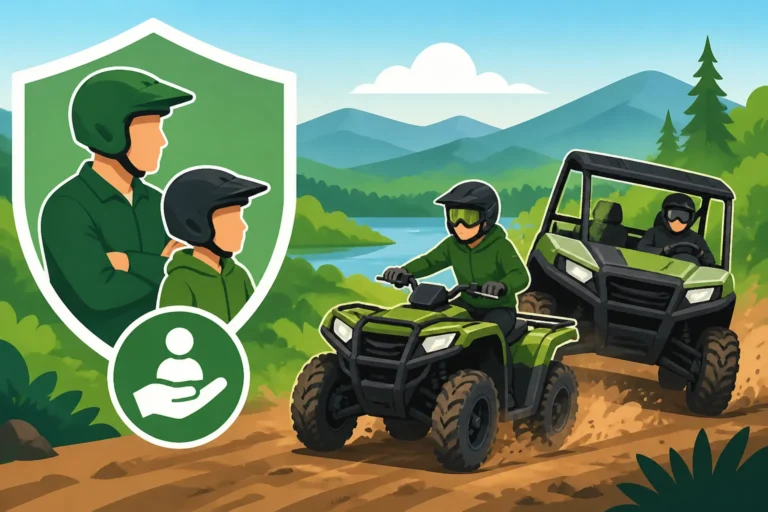
Vermont requires direct adult supervision for riders under sixteen. The supervising adult must meet the applicable requirements, and “direct” should not be treated as permission to send a child ahead where the adult cannot monitor them. Read What Direct Supervision Means and Who Can Legally Supervise a Rider Under 16 before relying on a particular arrangement.
For a twelve-year-old, plan the route and riding conditions around the child, not the most experienced adult in the group. A route that feels easy to an adult may involve steep grades, mud, water, narrow corridors, or sudden traffic. A child may need shorter rides, frequent stops, and a slower pace. If the adult cannot maintain effective supervision on the route, choose another activity or ride somewhere more manageable.
Adult supervision is active, not just nearby
A responsible supervisor should be close enough to observe the child and respond if something goes wrong. The adult should know where the child is, be able to communicate instructions, and be prepared to stop the ride. A group leader far ahead, an adult on a different route, or a person who cannot intervene is not a sensible substitute for direct supervision.
The adult should also be capable of supervising. Riding another machine while distracted, managing several children across a wide area, or letting a young rider disappear around blind corners can make supervision ineffective. Think through the route, group size, communication, and terrain before starting.
If the rider is using a machine with passengers or riding in a group, check the specific restrictions that apply. A child should not carry a passenger simply because there is a second seat. The machine must be designed for passengers, and applicable age and safety rules still matter. Vermont ATV Rules for Passengers explains the separate passenger considerations.
Plan around the least experienced rider
A good family ride is not measured by distance. It is measured by whether everyone can ride within their ability and return safely. Choose routes with conditions the child can handle, and be willing to turn around when terrain or weather makes the ride unsuitable.
Before setting out, check:
- Whether the route is open to ATVs and whether the machine is allowed there.
- Whether the family has the registration and trail-access credentials required for that route.
- Whether landowner permission is needed and has been granted.
- Whether the child can remain in the supervisor’s view and hearing.
- Whether the route has hazards that may be difficult for a young rider.
- Whether the group has enough time and fuel to return without rushing.
A youth rider’s training certificate does not open private land or convert a closed route into an approved one. Vermont’s trail system relies heavily on permission and managed access. Riders should follow marked corridors and any club or landowner instructions, even when a shortcut looks harmless.
Stop when conditions change
A safe plan can become unsuitable after rain, during a sudden change in visibility, or when a mechanical issue appears. A child may be reluctant to admit that they are tired or nervous, especially in a group. Adults should check in regularly and make it easy for the young rider to ask for a break or stop.
If a trail becomes muddy or damaged, do not pressure a child to push through. Turning back protects the rider and the trail. The course teaches safety concepts, but judgment in the moment remains an adult responsibility.
What the course does not replace
Taking the course is one part of preparing a young rider. It does not replace the rules for registration, trail access, insurance, equipment, local road use, or landowner permission. It also does not eliminate the need for a parent or caregiver to decide whether the child is physically and mentally ready for a ride.
Registration and trail access are separate
A machine may need Vermont registration, and machines using the managed trail network may need a Trail Access Decal. A decal is not the same as a registration, and the course certificate is not either one. Check the machine’s status before hauling it to a trailhead. The distinction is covered in The Plate and the TAD Vermont Trails Require.
Visitors should check their own paperwork rather than assuming that an out-of-state plate resolves every Vermont access requirement. Vermont recognizes certain registrations for reciprocity purposes, but trail access requirements can still apply. Details for riders from neighboring states are available in Vermont Reciprocity With New Hampshire, Vermont Reciprocity With Maine, and Vermont Reciprocity With Quebec.
Land access and routes matter
Vermont’s ATV trails are not a blanket invitation to ride anywhere in the woods. Much of the trail network crosses private land with permission, and access can change. A young rider should learn to stay on marked corridors, respect gates, and never follow an unmarked track simply because another machine has used it.
Road riding is a different question from trail riding. Towns determine whether certain roads are open, and local conditions or ordinances may place additional limits on use. Do not assume that a course certificate grants a right to ride on a town road. Check Vermont ATV Road Rules by Town and the relevant town’s current information before planning a route that includes roads.
Equipment and protective gear remain essential
Training does not make protective equipment optional. Use properly fitted gear and inspect the machine before each ride. The rider should know how to stop, where the controls are, and what to do if the machine does not feel right. Adults should check that protective equipment fits the child now, not merely that it was purchased for them earlier.
A simple pre-ride check can catch preventable problems:
- Confirm that the machine is in safe operating condition and that the controls work.
- Check the tires, brakes, lights, and other basic equipment relevant to the machine and ride.
- Confirm that the rider’s protective gear fits and is secured correctly.
- Review the route, supervision plan, and agreed stop signals.
- Make sure the required documents and access credentials are available.
The adult should not expect a twelve-year-old to identify every mechanical problem. The child can learn to notice obvious issues, but the supervising adult remains responsible for checking the machine and deciding whether it is safe to use.
Planning the next step after training
Once the course is complete, pause before booking a long ride or joining a large group. The next step is to combine the training with a realistic assessment of the rider, the machine, and the route. A short supervised practice session may be more useful than immediately attempting a full day on unfamiliar trails.
Keep a record of course completion, then confirm whether the certificate meets the current Vermont requirement. If the rider completed training through a provider outside the state, check acceptance before traveling. If the family relies on an exception, confirm the specific conditions instead of assuming that the child’s age or the location of the ride is enough.
A sensible progression might look like this:
- Complete the course and save proof. Make sure the rider and adult can retrieve the certificate.
- Check the rules for the rider’s age. Confirm training and supervision requirements, including any exception the family believes applies.
- Match the machine to the child. Follow manufacturer guidance and assess fit, reach, control, and judgment.
- Choose an appropriate practice area. Use a place where riding is permitted and an adult can supervise directly.
- Check access and paperwork. Confirm registration, decal needs, permission, and local route rules.
- Start with a short ride. Keep the pace and terrain manageable, and stop if the rider or conditions are not right.
If the child is not ready to ride, completing a course is still useful. It builds understanding that can guide future decisions. There is no benefit in rushing from a certificate to a difficult ride merely because the rider is now eligible to take the course.
The strongest outcome is not simply that a twelve-year-old has a card or certificate. It is that the child understands the limits of their experience, follows adult direction, respects trail access, and can speak up when something feels unsafe. Those habits matter on every ride, regardless of the rider’s age.
Frequently Asked Questions
Can a child take Vermont’s ATV safety course at twelve?
Yes. Twelve is the minimum age to take the Vermont ATV safety course. Taking the course does not by itself determine whether the child may ride a particular machine or route.
Does a twelve-year-old need an adult while riding?
Vermont’s supervision rule applies to riders under sixteen. Check the current requirements for who may supervise and what direct supervision means before riding.
Does the certificate expire when the rider turns sixteen?
Vermont safety certificates do not expire. However, the certificate does not replace other requirements, and riders under eighteen generally remain subject to the applicable course requirement unless an exception applies.
Does a course certificate let a child use Vermont trails?
No. Training is separate from registration, trail-access requirements, landowner permission, and route rules. Check each requirement for the machine and trail before riding.
Can an out-of-state safety course count in Vermont?
It may depend on whether Vermont recognizes that course. Confirm acceptance with the appropriate state source before relying on an out-of-state certificate.
Disclaimer
This article is for general informational purposes only and does not constitute professional advice. Laws, prices and regulations vary by location and change over time. Consult a qualified professional for guidance on your specific situation.