Vermont Reciprocity for Out-of-State Machines
An out-of-state registration can make your machine legal to ride at home, but it does not automatically open every Vermont trail or road. The key is to separate registration reciprocity from trail access, insurance, safety rules and local route permissions. This guide explains what to check before you travel, what paperwork to carry and how to avoid arriving at a trailhead with one important requirement missing.
What reciprocity means in Vermont
Reciprocity is recognition of a machine’s registration from another state or jurisdiction. It can let a visitor operate a properly registered ATV or UTV in Vermont without first registering it again with the Vermont DMV. That recognition is useful, but it is not a blanket permission to ride anywhere.
Think of a Vermont ride as having several separate checks:
- Is the machine registered or otherwise lawfully identified for use? Your home registration may satisfy this part if Vermont recognizes it and it is current.
- Does the machine have the required insurance? A home-state policy is not automatically enough just because it covers the machine elsewhere.
- Does the riding area require a trail-access decal or other pass? Vermont’s VASA trail system has requirements separate from vehicle registration.
- Are you allowed on the specific route? A trail, private corridor, town road and state property can each have different access rules.
- Do the rider and machine meet applicable safety and equipment rules? Age, supervision, helmets, lights and other requirements may still apply.
A valid home registration answers only the first question. It does not replace a Vermont Trail Access Decal, provide permission from a landowner, or make a town road open to ATVs.
That distinction is especially important because many Vermont trails run across private land with landowner permission. A machine may be correctly registered and insured and still be turned away if its rider lacks the required trail access or is attempting to use a closed corridor. For an overview of the pass itself, see Vermont TAD: The Trail Access Decal Explained.
Registration recognition is not the same as trail reciprocity
Visitors often use “reciprocity” to mean, “Can I bring my machine and ride?” In practice, that question has more than one answer. Vermont may recognize the registration issued where the machine is based, while the trail system separately requires a TAD for access.
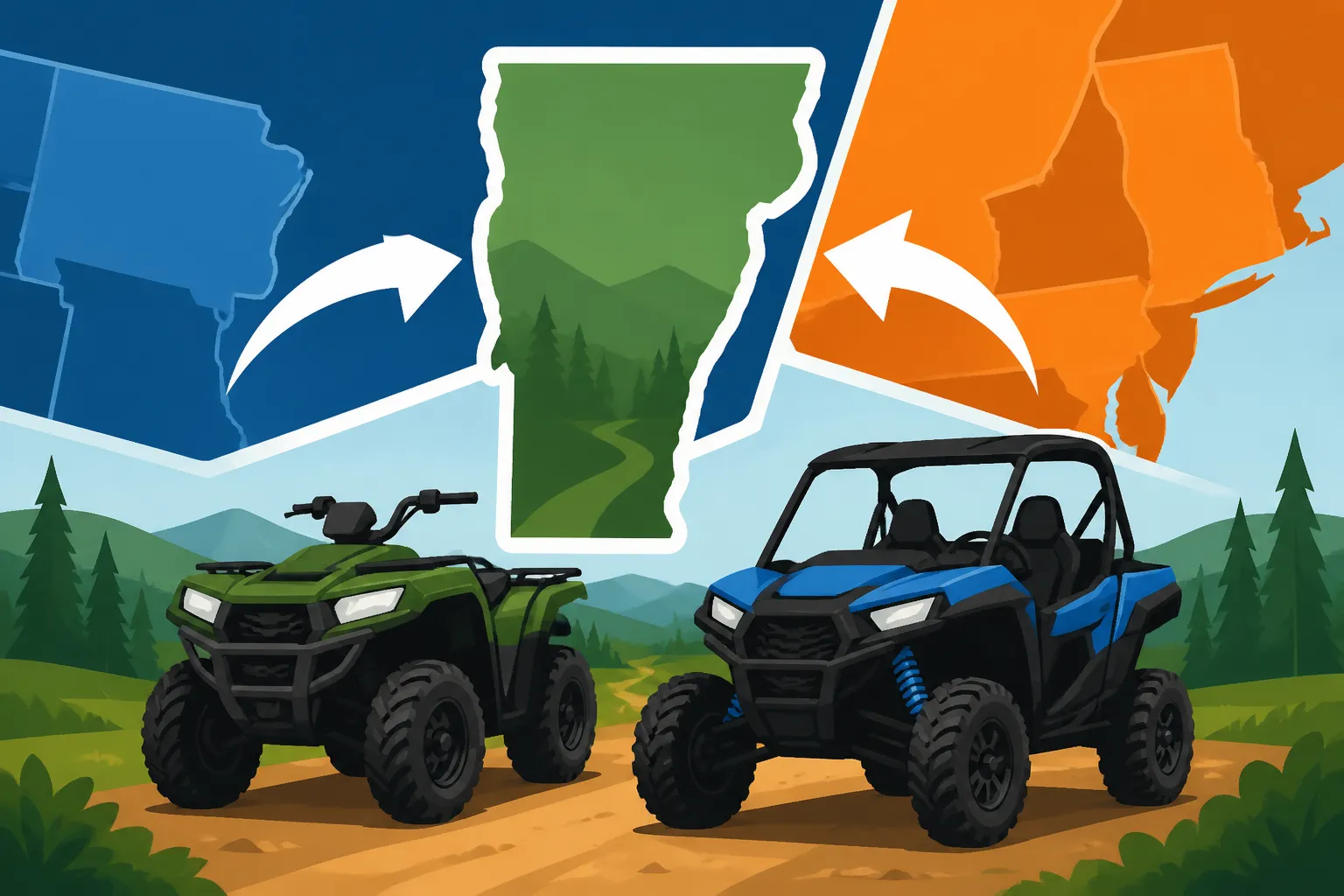
The distinction matters whether you arrive from a nearby state or travel a longer distance. A New Hampshire plate, a Maine registration, a New York registration or a Quebec document does not by itself answer whether the machine can use a particular Vermont trail. You also need to check the trail-access requirements and the route’s current status.
| Requirement | What it generally addresses | Does home-state registration replace it? |
|---|---|---|
| Registration or other accepted proof of lawful status | Whether the machine is properly registered or identified | It may satisfy this part if Vermont recognizes the document and it is current |
| Vermont Trail Access Decal | Access to eligible VASA trails | No |
| Liability insurance | Financial responsibility for covered use | No; confirm that your policy applies to the Vermont riding you plan |
| Landowner or club access | Permission to use a private corridor or managed trail | No |
| Town-road designation | Whether a particular road is open to ATV use | No |
| Rider safety requirements | Training, supervision and protective-equipment rules | No |
For the broader requirements that still apply after you cross the border, see Vermont Reciprocity for Out-of-State Machines is not the right link for this article, so start with Vermont ATV Insurance Requirements and Vermont ATV Road Rules by Town. Your home registration can be valid while a route remains off-limits.
What to check on your home registration
Before making travel plans, confirm that the paperwork you carry is current, belongs to the machine you will bring and is the type Vermont recognizes. Do not rely only on a plate, a renewal reminder, a sales receipt or a screenshot of an online account. Carry the registration document or other proof your issuing jurisdiction provides, and make sure the machine’s identifying information matches.
Match the machine to its paperwork
Check the vehicle identification or serial number on the machine against the number on the registration. Also check the owner’s name, registration status and expiration date. If the machine is borrowed, leased, rented, owned by a business or registered to someone who will not be riding, bring documents that explain your authority to use it.
A discrepancy can create a delay even when the underlying registration is valid. Common examples include:
- The machine has been replaced, but the registration still lists the previous one.
- A name changed after a move or sale.
- The registration document shows a different serial number than the machine.
- The registration expired before the trip.
- A dealer plate, temporary permit or other short-term document is being used without confirming whether it applies in Vermont.
- The owner is not present, and the rider has no written permission or rental paperwork.
If you recently moved, do not assume your old address makes the registration invalid, but do check the issuing jurisdiction’s rules and update it if required. If the machine was purchased shortly before the trip, allow time to sort out the registration and proof of ownership at home rather than expecting Vermont trail staff to resolve it at the trailhead. Registering at Home Before You Visit is a useful place to start.
Do not assume a plate tells the whole story
A plate is useful as a visible identifier, but it may not prove that the registration remains active or that the plate belongs to the machine you are riding. Carry the underlying registration record. A phone photo can be a backup, but a paper copy is sensible where cell service is weak or a device battery fails.
A small waterproof document sleeve can keep the registration, insurance card and emergency contacts together. If you buy one through Amazon, choose a closure that can tolerate mud and rain, and keep the documents protected from direct spray. The important part is not where the sleeve came from; it is being able to produce readable paperwork without unpacking half your gear.
Special cases deserve an extra check
Some machines do not fit the ordinary “one owner, one plate, one registration card” situation. For example, a machine may be registered in another person’s name, held under a lien, used by a business, or covered by temporary paperwork. Cross-border purchases can also involve documents that are unfamiliar to a trail steward or officer.
If the registration is not straightforward, contact the relevant Vermont agency, trail-access organization or riding-area contact before leaving. Explain the exact situation and ask what documents to carry. For Quebec visitors, the dedicated guide Vermont Reciprocity With Quebec can help frame the border-specific questions. Visitors from nearby states can also review Vermont Reciprocity With New Hampshire and Vermont Reciprocity With Maine.
The TAD: the separate requirement visitors often miss
For riding on eligible VASA trails, an out-of-state machine generally needs the applicable Vermont Trail Access Decal. The TAD is not a replacement registration, and it is not simply a sticker that makes every Vermont road or parcel open to you. It is a separate access requirement tied to the trail system.
This is the most common source of confusion for visitors who have already done the registration paperwork. They arrive with a current plate and insurance, then assume those documents cover trail access. They do not. The TAD requirement exists independently of whether a machine is registered in Vermont or another jurisdiction. For the visitor-specific details, see Vermont Out-of-State Machines Still Need a TAD.
Buy the right decal for the right machine
Check the current visitor category and the current instructions before ordering. The type of machine, the number of machines and whether you are ordering for an additional machine can affect which option applies. If you travel with two ATVs, for example, do not assume one decal covers both simply because they belong to the same family or are carried on the same trailer.
The rules and amounts associated with decals can change, so verify them through the official VASA or club process before paying. The guide Vermont TAD for a Visitor’s Machine explains the visitor-focused issue, while Vermont Visitors Buying a TAD Online can help you plan where to get one.
A useful pre-trip check is to confirm all of the following:
- The decal is the correct one for an out-of-state machine.
- Each machine that needs a decal has one.
- You know where it must be displayed.
- You have allowed enough time for delivery, if ordering ahead.
- You know whether a local club or retailer can help if you need to buy in person.
- The specific trail or corridor you intend to ride accepts the access arrangement you have.
Do not treat a decal order confirmation as proof that the decal itself is properly displayed. Follow the current placement directions. If the sticker is damaged, missing or attached incorrectly, ask the issuing organization what to do rather than improvising a new location.
A TAD does not guarantee every route is open
A trail-access decal does not override a closure, landowner request, club restriction or seasonal condition. Clubs may close or reroute corridors because of wet ground, washouts, maintenance or changes in permission. A route that appeared open in an older map, a saved phone route or a social-media post may no longer be available.
Check current trail information close to your departure date. If you are planning a long ride, identify a backup route and a way to stop before entering a closed or private section. For a route-level explanation, see Which Trails a Visitor Decal Opens for You.
A phone mount bought through Amazon can help keep a map visible, but it cannot substitute for a current map or reliable route information. Download or save what you need before entering a dead zone, secure the device against vibration and rain, and carry a backup plan. Trail access depends on the actual corridor rules, not on what a navigation app happens to display.
Insurance and rider rules still apply
Registration reciprocity does not carry your insurance policy or rider eligibility into Vermont automatically. Check your policy and the rules for the riding area before you travel. A policy can cover ordinary use at home while excluding certain off-road, competitive, commercial or rented-machine activity.
Confirm the policy covers the trip you are taking
Call your insurer or review the policy documents to confirm that the named machine is covered for ATV or UTV use in Vermont. Ask specifically whether coverage applies to off-road trail riding and to any road segments you expect to use. Do not infer coverage from a general statement that you have “full coverage” or from a policy that covers a different vehicle.
Liability coverage is a particularly important question. Vermont has insurance requirements for ATV operation, and an out-of-state policy must be suitable for the activity. Confirm the applicable requirements and whether your policy meets them rather than guessing based on what your home state requires. Keep proof of insurance with your registration and make sure it identifies the machine you are riding. Carrying Both Plate and Decal can help you think through the practical documents and markings to have ready.
Ask your insurer questions such as:
- Does the policy cover this exact ATV or UTV?
- Does it cover recreational trail riding in Vermont?
- Does coverage apply on a town road that is legally open to ATVs?
- Are there restrictions on passengers, drivers, age or machine modifications?
- Is the machine covered while being transported, stored or used by another household member?
- What proof should I carry if asked?
If you are renting rather than bringing your own machine, clarify which insurance the rental company provides, what the policy excludes and whether you are expected to provide separate coverage. A rental waiver and an insurance policy are not the same thing.
Training and supervision are not waived by registration
A machine’s home registration does not exempt its riders from Vermont’s age, training or supervision rules. This matters especially when children or teenagers are part of the group. Check the current requirements for the rider’s age, the machine and the kind of land or trail involved. If the rider completed training elsewhere, confirm that Vermont will recognize the certificate and carry proof of completion.
The rules can differ depending on the rider’s age and whether an exception applies. Do not assume that a family-land exception, an instructor exception or a home-state training card applies to a public or club trail. Review Vermont ATV Safety Course Required Under 18 and Vermont Supervision Rules Under 16 before bringing a young rider.
Helmets and other protective equipment are another separate matter. A rider who is legally permitted to operate the machine still needs to meet the applicable equipment rules. If a passenger is involved, make sure the machine is designed for that passenger and that the person can sit securely and use the required protection.
Carry documents where they can be reached
Put registration, insurance and any required training proof in a secure, accessible place. A sealed pouch in a gear bag is better than a loose paper on the machine, where rain, mud or a spill can destroy it. Keep copies on a phone only as a backup; signal and battery life should never be the only way you can show important information.
An Amazon-bought power bank can be useful for a long day if you rely on a phone for maps or digital documents. Charge it before departure, protect it from water, and do not let the device replace paper copies or offline route information. The practical goal is redundancy: you should be able to show the essential documents even if a phone is lost or dead.
Road access is local, even when registration is recognized
Vermont registration reciprocity does not create a statewide network of roads open to ATVs and UTVs. Town-road access is governed locally. A route may be open in one town and closed in the next, and a road’s general appearance does not tell you whether ATV use is allowed.
A town may designate particular roads or segments under its local process. The designation can have conditions, including route limits, operating hours, seasons, speed restrictions or other rules. An open segment may end at a town line, bridge, intersection or posted closure. Follow the signs and current town information rather than treating a road as open because another rider used it last season.
Check the actual route, not only the town name
Before riding on a public road, confirm that the exact segment is designated for ATV use and that your machine and rider meet the applicable conditions. Ask where the route begins and ends, whether it connects to the trail or destination you want, and whether there are restrictions that apply at the time you plan to ride.
A map can help, but route maps can be outdated or difficult to interpret. Look for official signs, confirm with the town or local riding organization and stop if the marking is unclear. Do not assume that a Class 4 road, dirt road, logging road or road that looks lightly traveled is automatically open. Use the dedicated guide Can You Ride an ATV on the Road in Vermont? for the larger road-access picture.
Pay particular attention when crossing or entering a road. A legal crossing is not the same as permission to travel along the road. Use the approved crossing location, yield as required and avoid extending a brief crossing into an unapproved road ride.
Town rules can add conditions to a route
Even where a road is open, local ordinances may regulate speed, hours, seasons, noise or other conduct. These local rules can change, and neighboring towns may take different approaches. Ask about the rules for each town on your route, not just the town where you park or stay.
Keep in mind that a town-road designation also does not grant access to nearby private land or a VASA corridor. A route may be open for a short connection but end at a gate or property boundary. Do not ride around a closure, use an unmarked bypass or follow another machine off the authorized route.
Visitors planning to use public roads should also verify that their insurance and equipment are appropriate for that use. A plate accepted for registration purposes does not make a machine road-legal in every context, and local route permission does not remove general safety obligations.
Planning a trip from another state or Quebec
A smooth visit starts before you put the machine on the trailer. The right sequence is to confirm the route and access requirements, then match your documents and equipment to that plan. This saves time and helps avoid paying for travel only to discover that your intended corridor is closed or your machine is missing a required decal.
Use this pre-trip sequence
- Choose a specific riding area. Decide whether you are riding VASA trails, a town route, private property with permission, or a combination.
- Check current access information. Confirm that the corridors are open and that the planned route is suitable for your machine and group.
- Confirm registration recognition. Check that your home registration is current and that the machine’s details match the document.
- Arrange the correct TAD. If your ride includes eligible VASA trails, confirm the visitor requirements and obtain a decal for each machine that needs one.
- Verify insurance. Make sure the policy covers the machine and the Vermont activities you plan.
- Review rider rules. Check training, supervision, helmet and passenger requirements for everyone riding.
- Check local road rules. If the route uses town roads, verify each road segment and any local conditions.
- Pack documents and backups. Carry registration, insurance proof, training records where needed, contact information and an offline map.
- Recheck just before departure. Weather, landowner requests and maintenance can change trail access.
Visitors from New Hampshire and Maine may find it tempting to rely on familiar regional practices. Still, Vermont’s trail-access decal and town-road systems have their own requirements. The specific guides Vermont Reciprocity With New Hampshire and Vermont Reciprocity With Maine can help you focus your checks. Visitors from New York should also review Vermont Reciprocity With New York.
Quebec visitors should plan for border paperwork too
For a Quebec-registered machine, there are two separate questions: what documentation is needed to bring the machine across the border, and what Vermont requires for riding after entry. Do not treat registration recognition as a substitute for customs or border requirements. Confirm the current import and travel documentation with the appropriate border authorities, then separately check trail access, insurance and local riding rules in Vermont.
Keep the original registration and any purchase, ownership or temporary-use documents with you. If a machine is financed, borrowed or owned by someone who is not travelling, ask in advance whether additional authorization is sensible or required for the border crossing. For Vermont-specific registration recognition, see Vermont Reciprocity With Quebec; for the border side of a machine purchase, see Importing an ATV From Quebec Into Vermont.
A machine’s ability to cross a border and its eligibility for a particular Vermont trail are not the same thing. Plan both parts independently, and do not wait until the trailhead to discover that one document is missing.
Use tools as support, not as authority
A digital map, phone app or route file can make a trip easier, especially in places where cell coverage is poor. But maps can lag behind closures and permission changes. Save the current map before leaving, confirm the route with the local club or access contact and follow posted signs when they differ from a saved route.
If you purchase a phone mount through Amazon, check that it fits your handlebar or cab, holds the device firmly over rough ground and does not obstruct controls or visibility. A secure mount is a convenience, not a safety guarantee. Keep the phone protected, carry a paper backup and be willing to turn around when the corridor is not clearly open.
Common mistakes and a simple arrival checklist
Most reciprocity problems are preventable. They happen when riders treat “my machine is registered” as the end of the process or rely on information that was accurate for a different town, trail or season.
Mistakes to avoid
- Assuming a home plate replaces the TAD. Registration and trail access are different requirements.
- Buying one decal for several machines. Confirm what is required for each machine you plan to ride.
- Assuming all trails are open because the access decal is valid. The decal does not cancel a closure or replace landowner permission.
- Relying on an old map or saved route. Recheck current conditions and closures before entering a corridor.
- Treating a town road as open because it is paved or unpaved. Verify the exact segment and its designation.
- Carrying only a phone image of documents. Keep accessible paper copies where practical.
- Assuming insurance covers every kind of use. Confirm trail riding, road segments, passengers and any relevant exclusions.
- Ignoring youth rules because the machine is registered elsewhere. Rider age, training and supervision requirements still matter.
- Bringing a machine with mismatched paperwork. Compare the serial number and owner information before the trip.
- Assuming a border crossing settles Vermont access. Customs, registration, insurance and trail access are distinct checks.
Before you unload
At the staging area, take a moment to confirm that the plate or required identifier is secure and visible, the TAD is displayed as directed, and your documents are accessible. Check the trail map and any signs at the entrance. Confirm that the route is open for your machine and that everyone in the group understands where the trail ends or changes.
If you are unsure whether a route is open, ask before riding it. A local club, landowner contact or town office may be able to clarify the status. If no one can confirm access, choose a route that is clearly authorized rather than testing the boundary. Respecting a closure protects the riding opportunity for the next visitor as well as for local riders.
A practical document set usually includes:
- Current registration or accepted proof of lawful status
- Proof of insurance that applies to the machine and planned use
- TAD or other required trail-access proof
- Training or safety-course proof when applicable
- Permission or rental documents if the machine is borrowed or rented
- A current map and contact details for the riding area
Carry only what you need, but make sure it is readable and easy to retrieve. Mud, gloves and a busy trailhead are poor conditions for searching through a trailer for a registration card.
The bottom line for out-of-state riders
Vermont reciprocity can save a visitor from registering a machine a second time, but it does not make the rest of the trip automatic. Treat registration, TAD access, insurance, rider requirements and local route permission as separate checks. Confirm each one for the machine and the riding area you have chosen.
The safest approach is to plan around a specific trail or route, verify the current requirements with the relevant Vermont source, and carry proof for every part of the trip. If your registration is unusual, your machine is borrowed or your route includes a town road or border crossing, ask questions before travelling. A little preparation is much easier than trying to fix a paperwork or access problem at the gate.
Disclaimer
This article is for general informational purposes only and does not constitute professional advice. Laws, prices and regulations vary by location and change over time. Consult a qualified professional for guidance on your specific situation.