Vermont Farm Land Riding Permission
Riding an ATV or UTV on Vermont farmland can seem straightforward, especially when a field or woods is close to home. But owning a machine, knowing a farmer, or having a trail decal does not automatically give you permission to cross someone else’s property. The safest approach is to confirm who controls the land, agree on exactly where and when you may ride, and keep that permission separate from any trail or road requirements.
What Permission Covers on Vermont Farm Land
A landowner’s permission is about access to that person’s property. It is not the same as vehicle registration, insurance, a trail access decal, or permission to ride on a public road. Each requirement serves a different purpose, so one does not replace another.
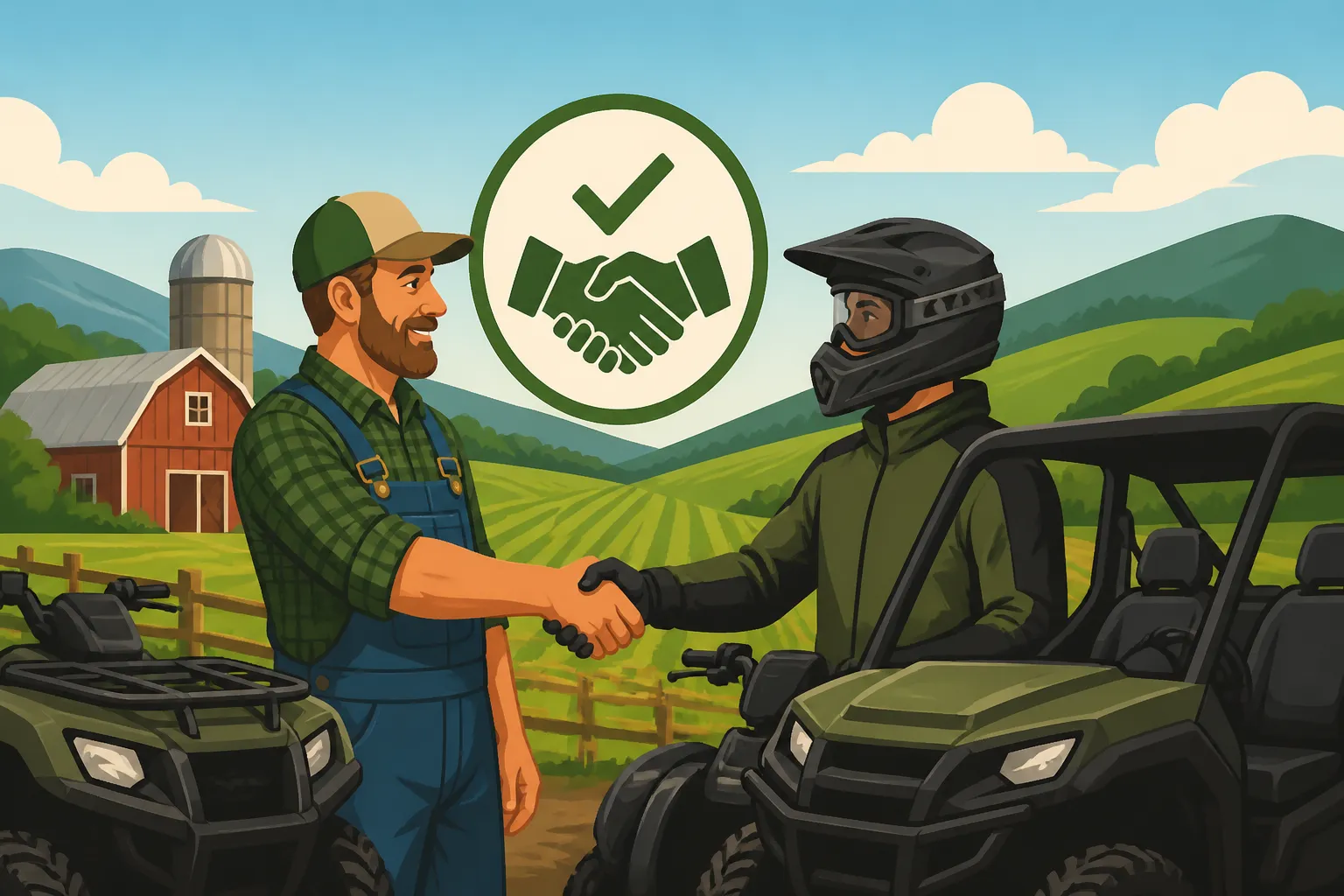
Before riding, make sure you have permission from the owner or from someone authorized to manage the property. A friendly conversation with a farm employee, neighbor, or family member may not be enough if that person does not control recreational access. If the land is leased, managed by a farm business, or jointly owned, ask who has authority to approve ATV use.
A useful agreement should make the boundaries clear. “You can ride on the farm” could mean one field, a designated woods road, or a route across the entire property. Those are very different arrangements. Confirm the route, where you may enter and exit, and whether you can ride between separated parcels. If the route crosses a neighbor’s land, that neighbor’s permission may be needed too.
Put the route and limits in writing
A written note or message can prevent misunderstandings. It does not have to be complicated, but it should be specific enough that a rider, landowner, and anyone else helping manage the farm can understand the arrangement.
Consider recording:
- The property owner’s name and the name of the person or group allowed to ride.
- The approved route, field, woods road, or other area, ideally marked on a map.
- The dates or season when riding is allowed, and any hours or days to avoid.
- Which machines may be used, and whether passengers or guests are allowed.
- Where riders may park, unload, and enter the property.
- Any restrictions on speed, noise, mud, stream crossings, or riding near livestock and buildings.
- Whether riders may use the route to connect with another parcel, a public road, or a designated trail.
- How to contact the owner if conditions change or a problem occurs.
A map can be more useful than a long description. Mark gates, buildings, livestock areas, sensitive fields, and places riders must not enter. If the route changes because of planting, harvest, logging, wet ground, or another farm activity, make sure everyone receives the update.
For additional context on permission and access, see Vermont Landowner Permission Rules and Vermont Landowner Permission Forms. A permission form can help document an agreement, but it should not be treated as a substitute for understanding the actual route and limits.
Permission can have conditions
A landowner may set reasonable conditions for access and may change or withdraw permission. A route that is open during one part of the year might be unsuitable during planting, haying, wet weather, hunting activity, or equipment movement. Do not assume that permission continues indefinitely just because you were allowed to ride last season.
Ask how the owner wants to handle temporary closures. A gate, sign, text, or phone call may be used to communicate a change. If access is unclear, stop and check rather than treating an open gate or familiar track as permission.
| Situation | What to confirm before riding |
|---|---|
| A farmer says you may ride “on the property” | Which parcels, route, dates, and access points are included |
| A farm employee gives permission | Whether that person is authorized to approve recreational riding |
| Land is leased or managed by a business | Who has authority to allow ATV or UTV access |
| A marked trail crosses farmland | Whether the route is currently authorized and what trail requirements apply |
| The route reaches a town road | Whether that road is open to ATVs and what rules apply |
| You want to bring a guest | Whether the permission includes other riders and their machines |
Farm Access Is Not the Same as Trail or Road Access
Vermont riding can involve several kinds of land and routes in one trip: private farm property, a club-managed corridor, a town road, or a state-managed area. The permission that applies in one place may not apply in the next. Plan the full route instead of assuming you can keep riding once you reach a boundary.
A landowner may allow you to ride on a farm without allowing access to a neighboring parcel or a public road. Likewise, having a machine registered or carrying a trail decal does not grant permission to ride wherever you see a track. The Vermont TAD: The Trail Access Decal Explained page can help explain how a decal relates to designated trail access; it does not replace a landowner’s approval for off-corridor riding.
Vermont’s trail network often depends on private land access. A marked corridor may cross farms or other privately owned property under a specific arrangement. Stay on the marked route and follow the instructions for that corridor. Do not treat a corridor as permission to roam around the surrounding fields or woods. Permission for one trail route is not necessarily permission to use another path across the same property.
Similarly, a farm track that connects to a road is not automatically an ATV route on that road. Before using any public road, check whether the town has designated it for ATV travel and what local conditions apply. Vermont ATV Road Rules: Towns Decide explains why road access can vary by town. Do not rely on another rider’s route, an old map, or a past season’s access as proof that a road is open now.
Riding beside your own property
Owning land next to a road or trail does not automatically give you permission to ride across someone else’s land to reach it. If your route touches another owner’s field, woods, driveway, or farm road, ask that owner for permission. The same principle applies when crossing a narrow strip of land to connect two parts of your own property.
If the machine must travel on a public road to reach your land, private-property permission does not settle whether that road use is allowed. Check the town’s posted route information and applicable operating requirements. Vermont Riding Adjacent to Your Own Property addresses this boundary issue in more detail.
Farm-use claims need care
A machine used for farm work is not automatically covered by the same rules in every setting as a machine used for recreation. The purpose of the trip, the land involved, and whether the machine is on a public route can matter. Do not assume that using an ATV to check a fence or move supplies makes recreational riding exempt from registration or other requirements.
For questions about a claimed farm-use exception, see Does a Farm-Only ATV Need Vermont Registration?. If your ride leaves the farm or uses a trail or road, confirm the requirements for that part of the trip separately. Permission from a landowner does not answer questions about registration, insurance, age requirements, safety training, or public-road access.
How to Ride Responsibly on Working Farm Land
Farm property is a workplace as well as private land. A route that looks quiet may be close to operating machinery, livestock, crops, stored materials, or people doing time-sensitive work. Responsible riding means adapting to farm conditions, not just staying on the route.
Before the first ride, ask the owner about current hazards and routines. Find out whether there are times when the property is actively used, where tractors or trucks travel, and which areas should remain closed. If the owner asks riders to avoid a field or woods road for a period, follow that instruction even if the route was previously approved.
Use these practices to reduce conflict and damage:
- Stay on the agreed route. Avoid cutting across a field to shorten the ride.
- Slow down near barns, homes, livestock, workers, vehicles, and farm equipment.
- Keep away from crops, hay fields, gardens, and newly planted or wet ground unless the owner specifically approves access.
- Do not chase, approach, or startle animals. Ask about livestock locations before riding.
- Close gates as instructed. Do not assume a gate should be left open because it was open when you arrived.
- Keep noise down near homes and animals, and avoid unnecessary revving.
- Do not create new tracks, bypass a muddy section, or ride around a closure sign.
- Carry out trash and report damage, a spill, a blocked route, or a safety issue promptly.
- Make sure every person in your group understands the boundaries before starting.
Wet ground deserves particular care. A machine can leave ruts or compact soil even when the surface looks firm. A shortcut around a muddy section can widen the damage and create more work for the farm or trail volunteers. If the approved route is too wet, ask whether to turn around or use another approved route. Do not make that decision by opening a new path.
The owner may ask riders to avoid certain areas during planting, harvest, logging, or other work. Those requests are not minor inconveniences: machinery may be moving, fields may be vulnerable to damage, or workers may need the route. If you arrive and find that conditions differ from what you expected, pause and contact the owner rather than guessing.
Check each rider and machine
Permission should cover the people who will actually ride. If you plan to bring friends, family members, or a group, tell the landowner how many machines and riders to expect. Do not assume that permission granted to one person extends to guests.
Before setting out, check that each machine is suitable for the route and in safe working order. Riders should know where they are allowed to go, how to contact the group, and what to do if someone becomes separated or a machine breaks down. A narrow woods road, soft field edge, or farm crossing may not be appropriate for every machine or rider.
Keep documentation accessible. A saved message or written permission note can help clarify the agreement if the owner is not present. It is also sensible to carry any required registration and insurance information for the machine. Requirements vary with the machine and where it is being operated, so confirm them before riding rather than relying on a general assumption about farm use.
Insurance and responsibility
Landowner permission is not a promise that the property is free of hazards, and it does not automatically settle who is responsible if someone is injured or property is damaged. Riders should review their insurance policy and ask the insurer whether the planned use is covered. Some policies may treat recreational riding, farm work, trail use, or road operation differently.
The owner and rider can discuss expectations before access begins, including how to report an incident and who to contact in an emergency. A signed release or permission form may document an arrangement, but do not assume that it removes every legal responsibility. When the situation involves a business, organized ride, paid activity, or a substantial group, the parties may need advice from an insurance or legal professional.
A Practical Permission Checklist Before You Ride
Use a short pre-ride check each time you plan to use farm land, especially if the arrangement is informal or the property’s activity changes through the season.
- Identify who controls the land. Confirm that the person giving permission is the owner or has authority to approve recreational access.
- Confirm the exact route. Use a map or walk-through if needed. Identify boundaries, gates, crossings, and no-ride areas.
- Agree on timing. Ask which dates, hours, and conditions are acceptable, and how temporary closures will be communicated.
- List the riders and machines. Confirm whether guests, passengers, or additional machines are included.
- Discuss farm operations. Ask about livestock, equipment traffic, crop areas, workers, and seasonal restrictions.
- Check the route beyond the farm. If you will use a marked trail or public road, verify that access independently. Farm permission ends at the property boundary unless the next land manager or road authority has authorized access.
- Review riding requirements. Confirm registration, insurance, safety, and other requirements that apply to your machine and route.
- Keep proof of the agreement. Save a written note, message, or map, and make sure other riders know the conditions.
- Respect changes. If the owner closes the route or asks you to leave, stop riding and follow the request.
- Report problems. Tell the owner about damage, a hazard, a spill, or an incident rather than leaving it for someone else to discover.
This process is especially useful when access is shared by a family, club, or group of neighbors. One rider’s understanding may not match another person’s. A written route and clear rules reduce the chance that someone crosses a boundary or damages a working area without realizing it.
The simplest standard is to ask before riding, stay within the agreed route, and check again when circumstances change. If you cannot confirm permission or the route is not clear, do not ride there until you have an answer. That protects the land, the farm’s work, and future access for other riders.
Disclaimer
This article is for general informational purposes only and does not constitute professional advice. Laws, prices and regulations vary by location and change over time. Consult a qualified professional for guidance on your specific situation.