Does a Farm-Only ATV Need Vermont Registration?
It's a common question among our Vermont farming community, and frankly, it can be a real head-scratcher: Does your ATV, which you use primarily for chores around the farm, actually need to be registered with the state? Many assume that if it's for work and stays mostly on private land, it's exempt, but Vermont's regulations have specific nuances that can trip up even the most seasoned Vermonter. This guide will cut through the confusion, explaining precisely when your farm-use ATV requires registration and when it might just be able to stay off the books.
Understanding Vermont's ATV Registration Requirements for Farm Use
Let's start by clarifying the baseline. Vermont's regulations for All-Terrain Vehicles (ATVs) and All-Terrain Side-by-Sides (ASVs) are primarily designed to govern their use on public lands, designated trails, and public roads. The intent is to ensure safety, fund trail maintenance, and maintain accountability. However, agricultural use often falls into a special category, but it's not a blanket exemption.
The General Rule: Registration for Off-Highway Use
In Vermont, if you plan to operate your ATV or UTV (which the state generally classifies as an ASV if it's wider or heavier) anywhere other than your own private property, you almost certainly need to register it. This includes state-designated trails, town-approved roads, or even crossing a neighbor's field if it's not part of your continuous private property. Think of registration as your machine's passport to the public sphere. It's how the state knows who you are, what machine you're operating, and that you've paid your dues to support the recreational infrastructure. This is why most riders need to understand [Vermont ATV Registration Costs and Terms] right from the start.
If your "farm-only" ATV ventures beyond your property lines for even a short distance on public land or a designated route, it needs to be registered. This can be a point of frustration for farmers who might only need to cross a short stretch of town road to get from one field to another, or to access a woodlot. The law, however, doesn't always make fine distinctions for brief excursions if those excursions are on public property.
Defining "Farm Use" in Vermont
Vermont law does offer some leeway for vehicles used strictly for agricultural purposes. The key here often revolves around the purpose of the use and the location of that use. A machine is generally considered to be in "farm use" when it's directly engaged in tasks related to the operation of a farm, such as hauling feed, checking fences, moving equipment, or tending to livestock.
However, simply owning a farm doesn't automatically make every ATV or UTV on your property a "farm-only" machine in the eyes of the law. If that same ATV is used for recreational riding on weekends, even if it stays on your property, it's not strictly farm-only. The moment it touches public land for recreation, the registration requirement kicks in. This distinction can be crucial because it's not just about the machine itself, but how and where it's being operated.
The Key Exemption: Private Land and Agricultural Tasks
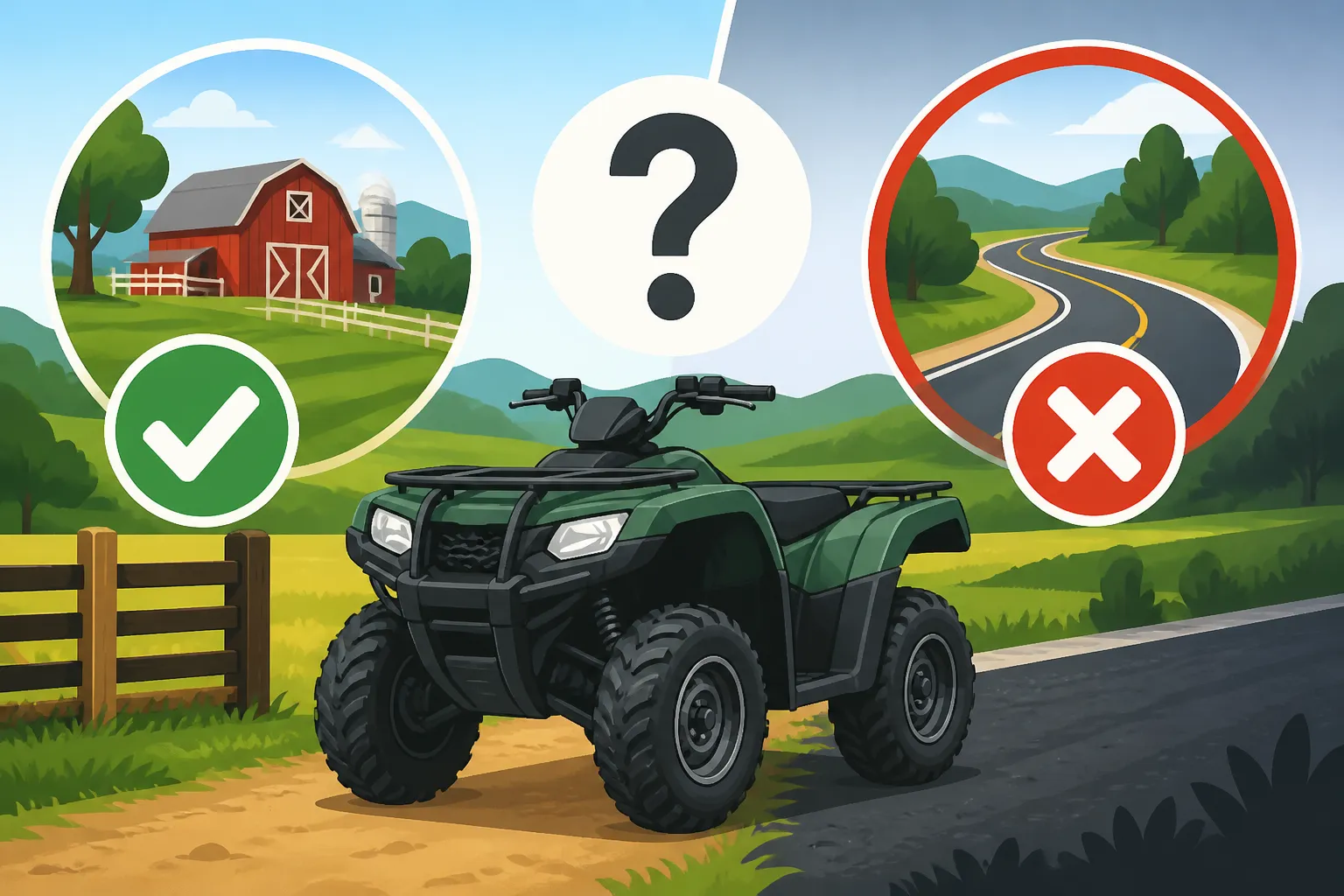
Here’s where the good news comes in for many Vermont farmers. An ATV or UTV does not need to be registered in Vermont if it is operated solely on land owned or leased by the operator, and solely for agricultural purposes. This is the core exemption that many farmers rely on.
This means if your machine lives its entire life within the boundaries of your farm, never touching a public road, trail, or even a public right-of-way, and is used exclusively for things like spreading fertilizer, rounding up cattle, or moving supplies between barns, then you are generally in the clear regarding state registration. You won't need [Registering an ATV With the Vermont DMV] for that particular machine. However, it's vital to ensure that "solely on land owned or leased" is strictly adhered to. Even crossing a small public ditch or easement that technically isn't part of your deeded property could void this exemption. It's a precise line, not a blurry one.
Navigating Public Roads and Agricultural Crossings
Now, what about those situations where your farm operations require you to briefly use public roads? This is a common dilemma for farmers whose fields are split by town roads or who need to access remote parts of their property that aren't contiguous.
Brief Road Use for Agricultural Purposes
Vermont law does provide a specific, albeit limited, exception for agricultural vehicles, which can sometimes extend to ATVs and UTVs used for farm work. If an ATV or ASV is being used for genuine agricultural purposes, you might be able to operate it on a public road for a "limited distance" to get from one part of your farm to another, or to access an adjacent farm. The key here is "limited distance" and "agricultural purpose." This isn't a free pass for joyriding on the roads. The intent must be genuinely tied to farm operations.
It's a tricky area, and enforcement can sometimes depend on the discretion of local law enforcement or game wardens. To avoid any misunderstandings, it's often wise to make these crossings as brief and direct as possible. You should also ensure your machine has all the necessary safety equipment for road travel, such as proper lighting, even if it’s just for a short hop. Remember, a machine like a side-by-side might fall under [Vermont ASV Class A Registration Explained] if it's wider or heavier, which has different implications for fees and road use permissions.
The Importance of Town Ordinances
While state law provides some general guidelines, towns in Vermont have a significant amount of autonomy when it comes to regulating ATVs and UTVs on their roads. Many towns have specific ordinances governing where and when these vehicles can be operated, and these rules can apply to farm machines just as much as recreational ones.
Before you plan to use your farm ATV on any town road, even for a brief agricultural crossing, it’s imperative to check with your local town clerk or selectboard. They can provide clarity on any specific local ordinances that might affect you. Some towns might have specific permits for agricultural road crossings, while others might prohibit them entirely. Ignoring these local rules could lead to unexpected fines. [Vermont ATV Road Rules: Towns Decide] is a critical read for any rider, especially those operating near or on public roads.
Insurance Requirements, Even for Exempt Machines
Here's a crucial point that many people overlook: even if your farm-only ATV is exempt from registration because it never leaves your private property for agricultural use, it is not exempt from potential liability. Vermont law requires that all ATVs and ASVs operated in the state be covered by liability insurance. This applies whether they are registered or not, and whether they are on public or private land.
This means if you have an accident on your farm, and someone is injured or property is damaged, your ATV must have liability insurance to cover those costs. Without it, you could be personally responsible for significant financial burdens. Don't assume that because it's "just for the farm" or "just on my land" that you're off the hook. This is where a quick chat with your insurance agent is essential to ensure your farm ATV is properly covered. You'll want to review [Vermont ATV Insurance Requirements] to understand the minimums.
What Happens If You Ride a Farm ATV Off-Farm Without Registration?
Mistakes happen, and sometimes a farm ATV ends up off private land without the proper registration. Understanding the consequences can help you make informed decisions.
Penalties and Enforcement
Operating an unregistered ATV or ASV on public land, designated trails, or public roads in Vermont, when registration is required, can lead to penalties. Law enforcement officers, including Vermont State Police and Game Wardens, have the authority to issue citations for such violations. The fines can vary, but they are certainly an unwelcome expense for any farmer.
Beyond monetary penalties, an unregistered machine could be impounded, creating additional hassle and cost to retrieve it. Enforcement isn't just about catching recreational riders; it's about ensuring all machines operating in the public sphere meet the state's requirements. This is why knowing [Vermont Penalties for Riding Unregistered] is so important. It's not just a minor slap on the wrist.
The "Better Safe Than Sorry" Approach
Given the complexities of distinguishing between strict private farm use and accidental or necessary public road use, many farmers find it simpler and less stressful to just register their ATVs. The annual registration fee, while an expense, can often be viewed as a small price to pay for peace of mind, knowing that you're fully compliant regardless of where a specific farm task might take you.
If there's any chance your ATV will leave your immediate, clearly defined private property, even for a few yards, getting it registered eliminates the guesswork and potential for fines. This is especially true if you ever plan to use your machine for anything beyond strictly agricultural tasks, even if it's just recreational riding on a VASA trail once a year. By registering, you're covered for a broader range of uses and locations, which can be invaluable.
Here's a quick comparison to help visualize the scenarios:
| Scenario | Registration Required? | Liability Insurance Required? | Additional Considerations |
|---|---|---|---|
| Strictly on your own private farm land, for agricultural use only. | No | Yes | Ensure strict adherence to "private land only." Document private ownership. |
| Briefly crossing a public road between farm fields for agricultural use. | Potentially Yes | Yes | Check local town ordinances. Minimal distance. Safety equipment for road use. Intent must be agricultural. |
| Used on VASA trails, public roads, or any public land (even if also used on farm). | Yes | Yes | Need to meet all state and local requirements. Get a VASA decal if on trails. |
| Used recreationally on your own private farm land. | No | Yes | No registration needed if it never leaves your private land. |
Best Practices for Vermont Farmers with ATVs
Even with the exemptions, there are smart ways to manage your farm ATVs to avoid legal headaches and ensure smooth operations.
Documentation and Proof of Ownership
Whether your ATV is registered or not, always keep robust documentation. This includes your bill of sale, title (if applicable, as some older machines may not have one), and any other proof of ownership. This is critical for several reasons: it protects you in case of theft, proves ownership during a sale, and is essential if you ever decide to register the machine in the future. If you bought your machine through a private sale, a clear and comprehensive bill of sale is your best friend. Services like LawDepot can provide templates for these kinds of ownership documents, ensuring all necessary details are covered. [Proof of Ownership Vermont's DMV Will Accept] outlines what you'll need.
Even if you don't need a formal title for your farm ATV (Vermont sometimes exempts older off-road vehicles from mandatory titling), having clear documentation of purchase is vital. If there's ever a question about the machine's origin, a well-drafted bill of sale, perhaps created using resources like LawDepot, can save a lot of trouble.
Considering an ASV Registration for Wider Use
If your farm ATV is a side-by-side (UTV) or a larger, wider ATV (over 50 inches wide or over 800 pounds dry weight), it likely falls under Vermont's All-Terrain Side-by-Side (ASV) classification. While the base fee is slightly higher than a standard ATV, registering it as an ASV might be a practical choice if you anticipate any public road or trail use. The ASV classification also comes with its own set of rules regarding permissible use.
Sometimes, the flexibility of a registered ASV outweighs the slight additional cost, especially if your farm operations require occasional use of diverse terrain, including town-designated roads. This is a common consideration for farmers needing to get equipment to various fields or manage larger acreages. Understanding [How the ATV and ASV Classes Change Your Fee] can help you decide.
Understanding Titles vs. Registration
It's common for people to confuse titles and registration, but they serve different purposes. A title is proof of ownership, like the deed to a house. It identifies the legal owner of the vehicle. Registration, on the other hand, is essentially permission from the state to operate the vehicle on public lands and roads.
For many older farm ATVs, especially those purchased decades ago, a formal title might never have been issued or might have been lost. Vermont law states that new ATVs and ASVs generally require a title, but there are exemptions for older models or those only used off-road. Even if your farm ATV doesn't require a title (which you can check with the DMV), if you use it off your private land, it still needs to be registered. Keep all ownership documents, even if they aren't a formal title. If you're missing key paperwork, you might need to file an [Filing an Ownership Affidavit at the Vermont DMV], which forms from services like LawDepot could help you prepare.
Disclaimer
This article is for general informational purposes only and does not constitute professional advice. Laws, prices and regulations vary by location and change over time. Consult a qualified professional for guidance on your specific situation.