Why an ATV Safety Certificate Never Expires
A Vermont ATV safety certificate is easy to confuse with a registration, trail decal or permit that must be renewed. The key difference: the certificate does not expire. Here’s what that means in practice, who may need one, how to prove you completed training, and which riding requirements remain separate.
What “Never Expires” Means for a Vermont ATV Safety Certificate
A Vermont ATV safety certificate is proof that you completed an approved safety course. Once earned, it does not have a routine renewal date. You do not need to retake the course just because a season has passed, you have not ridden for a while, or you have turned another year older.
That permanent validity is useful, but it applies to the certificate itself—not every rule connected to riding. A certificate records training. It does not give a rider permanent permission to operate any machine, on any land, at any age, or without meeting other requirements.
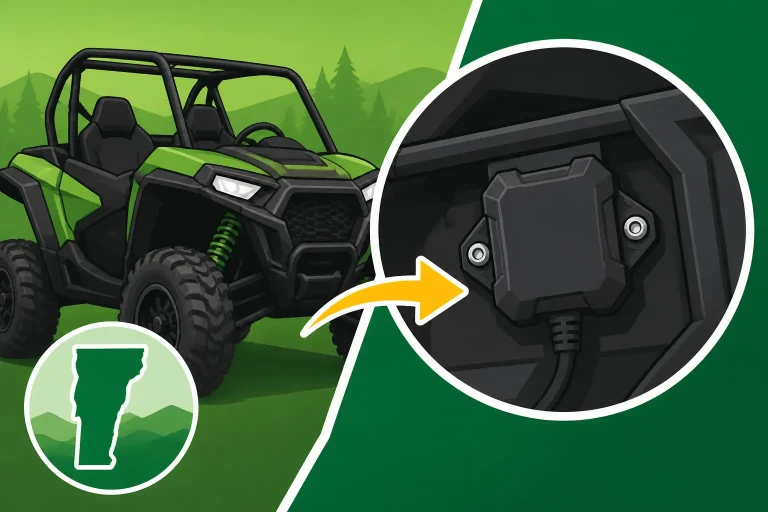
A simple way to keep the distinction straight is to think of the certificate as a record of completed training. By contrast, registration identifies the machine for legal use, and a Trail Access Decal (TAD) provides access to participating trail corridors under the applicable rules. Those other requirements may have their own validity periods or conditions. A certificate does not replace them.
| Item | What it shows or provides | Does the safety certificate replace it? |
|---|---|---|
| ATV safety certificate | Completion of an approved safety course | Not applicable |
| ATV registration | Registration of the machine | No |
| Trail Access Decal | Access to participating trail corridors when required | No |
| Permission to ride on land | Consent or legal access to that property | No |
| Age and supervision compliance | Whether a rider may operate under the circumstances | No |
So if you completed the course several years ago, you generally do not need to repeat it simply to refresh the certificate. You may still need to show proof of training, however, and the rules for the rider’s age and riding location still matter.
This is especially important for families. A parent may remember that a child took the course, but not where the certificate was saved. Or a young rider may have completed training and assume that certificate alone makes every ride legal. Keeping the document easy to retrieve helps with the first problem; understanding the separate requirements helps with the second.
For a closer look at how the course requirement applies at different ages, see Vermont Safety Course Binds at 18, Not 16. The certificate’s long-term validity does not change the age-based rules that apply to operating an ATV.
Who May Need a Certificate and When It Stays Relevant
Vermont’s safety-course requirement is tied to the rider’s age, with the certificate serving as proof of training. In general, the requirement applies to younger riders, and it does not disappear merely because the rider has gained experience. Check the current Vermont requirements for the rider’s age and circumstances before a trip, especially when a child will operate on a trail, road, or property other than family land.
The course has a minimum age, and younger riders may also face supervision requirements. These are separate questions:
- Has the rider completed the required course?
- Is the rider old enough to operate the machine in this situation?
- Does the rider need an adult supervisor?
- Is the chosen route or property open to ATV use?
- Is the machine properly registered and equipped for that use?
A safety certificate answers only the first question. It is not a general waiver of the others. For example, a rider may have completed the course and still be too young to ride without the required supervision. A certificate also does not authorize a child to ride a machine that is unsuitable for their size or ability.
The minimum age for the course and the age at which other requirements apply are not necessarily the same. If a young rider is approaching an age threshold, check the rules that apply to that specific age rather than assuming the certificate settles the matter. Vermont Safety Course Minimum Age and Vermont Supervision Rules Under 16 cover those questions in more detail.
The certificate also remains useful after a rider is no longer subject to the same age-based training requirement. It can be a lasting record of completed instruction, which may be helpful if a club, landowner, event organizer, rental provider or another jurisdiction asks about training. That does not mean every organization must accept the same certificate for every purpose. If a provider or authority has a specific training standard, confirm that your certificate meets it.
This distinction matters for visiting riders, too. A course certificate that does not expire in Vermont is not automatically proof that another state or province will accept it. Likewise, a course completed elsewhere should not be assumed to satisfy Vermont’s requirement until its recognition has been checked. Review Out-of-State Safety Courses Vermont Will Count before relying on training completed outside Vermont.
Parents and guardians can make the certificate more useful by treating it as part of the rider’s permanent records. Keep a copy with other important documents, note where the original is stored, and make sure the young rider knows that the certificate does not replace adult supervision or permission to ride. As a child grows, revisit the current rules rather than relying on what applied when the course was first completed.
The course itself is intended to support safer decisions, not just satisfy a paperwork requirement. Riders benefit from understanding how to control the machine, recognize hazards, and behave around other people and property. A certificate that remains valid does not mean the rider’s skills stay sharp without practice. Before returning to riding after a long break, review safe operating habits, check the machine and gear, and start in a controlled setting suited to the rider’s ability.
How to Keep and Show Proof of Training
A certificate that never expires is only useful when you can produce it if asked. Before the riding season, check whether you have the document, whether the rider’s name is legible, and whether the copy is clear enough to read. If the certificate is electronic, save it somewhere accessible without relying on a weak cell signal at a trailhead.
Useful options include:
- Keeping the original in a secure place at home.
- Saving a digital copy on a phone or other device.
- Printing a copy for a riding folder or family document file.
- Sharing a copy with the parent or guardian responsible for the rider.
- Recording the course provider and completion details separately in case the document is lost.
A phone copy can be convenient, but it should not be the only record if the device may be damaged, run out of battery, or lack service. A paper copy is also vulnerable to water, mud and wear, so store it in a protective sleeve or keep a clean backup at home. There is no need to carry every family document on every ride; choose a practical method that lets you produce proof when necessary without risking the only copy.
If the certificate is missing, first check the email address used during registration, the course provider’s account or records, and any files saved by a parent or guardian. A course provider may be able to explain how to retrieve or reprint proof. The process can vary, so use the provider’s current instructions rather than assuming a lost certificate requires taking the course again.
Vermont may have a way to check or retrieve training records, but availability can depend on how and when the course was completed. See Vermont Safety Certificate Lookup for information about finding a record and Printing Your Vermont Safety Certificate for help with getting a usable copy. If the rider completed a course elsewhere, contact the provider that issued the certificate and verify whether Vermont accepts that course before relying on it.
When checking a certificate, look for details that help match it to the rider. A record with a misspelled name, incomplete information or an unreadable image can create delays when someone needs to confirm it. If the name has changed, or the certificate contains an error, ask the issuing provider how to correct or document the record. Do not alter the certificate yourself.
A practical pre-ride document check can be brief:
- Confirm the rider’s training status and age-related requirements.
- Make sure proof of training can be retrieved or shown.
- Check that the machine’s registration is current for the intended use.
- Confirm whether a TAD or other access requirement applies to the route.
- Verify land access, trail status and any supervision requirements.
The last four checks are not part of the certificate, but they prevent a common mix-up: having proof of training and assuming that means everything else is in order. For guidance on keeping proof available, see Carrying Proof of Training. If you need to check the separate decal requirement, Vermont Requires Registration Plus a TAD explains why those are distinct from course completion.
What the Certificate Does Not Replace
The certificate is not a registration document, a plate, insurance proof, landowner permission, a trail pass or a general operating permit. A rider can hold a valid, permanent safety certificate and still be unable to ride a particular machine or route legally.
Registration and machine requirements
Registration applies to the machine, not the rider’s training history. It identifies the vehicle under Vermont’s registration rules and may be required for the planned use. A certificate does not register a newly purchased ATV, update an expired registration or provide proof of ownership. For the registration process, see How to Register an ATV in Vermont.
Machine requirements can also depend on what the vehicle is and where it will be used. An ATV and an ASV may fall into different classes, and a vehicle’s configuration can affect how it is treated. The rider’s certificate does not determine the machine’s classification. If you are unsure whether your machine fits the ATV or ASV rules, consult Vermont ATV Versus ASV Classes.
Trail access
A safety certificate is not a VASA trail pass. When a trail corridor requires a TAD, the rider needs to meet that requirement separately, along with any applicable registration and other access rules. The certificate cannot be used instead of the decal, and having a decal does not prove that the rider completed required training.
Trail access also depends on where the trail goes and whether it is open. Vermont’s trail network relies on landowner permission, club-maintained corridors and seasonal conditions. A certificate does not give a rider permission to cross private land or enter a closed corridor. Check current trail information and access conditions before heading out. Vermont TAD: The Trail Access Decal Explained describes the decal’s role, while Vermont Trails Run on Private Land explains why permission and closures matter.
Age, supervision and safe operation
Training is one part of a young rider’s eligibility. Age rules and supervision requirements remain separate, and they may depend on the rider’s age and the circumstances of the ride. Completing the course does not allow a child to ignore a supervision requirement or operate a machine beyond their ability.
The certificate also does not prove that the rider is currently ready for every situation. A course provides instruction, but a rider still needs to make careful choices, use appropriate protective gear and follow applicable operating rules. A familiar machine can feel different on a steep, wet or crowded route. A certificate should be treated as a foundation for safe riding, not a guarantee of skill.
Road use, insurance and local rules
A certificate does not make an ATV legal to operate on every public road. Road access can depend on state law, town decisions, posted designations, equipment, insurance and other conditions. Check the rules for the exact town and route rather than assuming that a trained rider may travel there. Can You Ride an ATV on the Road in Vermont? and Vermont ATV Road Rules by Town explain why road access needs its own check.
Insurance is another separate issue. A course certificate is not proof of liability coverage, and it does not change the terms of an insurance policy. Riders planning to use roads or organized trails should confirm which coverage applies and carry any proof required for that use. A policy can also have limits or exclusions, so do not rely on the safety certificate as evidence of insurance.
In short, the certificate answers a training question. For each ride, consider the rider, machine, location and access rules separately. This approach is more reliable than asking only whether the certificate is still valid.
If You Took a Course Elsewhere or Cannot Find Your Certificate
A certificate earned outside Vermont may be useful, but recognition is a separate question from expiration. Vermont’s acceptance can depend on the course and the proof available. Do not assume that an out-of-state card automatically meets the state’s requirement, and do not assume it is invalid just because it was issued somewhere else. Check the current acceptance rules or ask the course provider for documentation that identifies the training completed.
If the rider took a course as part of a school, club or youth program, ask who issued the certificate and whether the program retained a completion record. A participation card or a parent’s note may not contain the information needed to establish that an approved safety course was completed. Confirm what documentation is accepted before relying on an informal record.
If the certificate has been lost, avoid paying for or repeating a course until you have checked whether the original completion can be verified. Contact the issuing provider first. If that route does not work, look for available record-retrieval options and ask the relevant Vermont authority what evidence it can accept. The right solution depends on the record and course, not on an automatic expiry date.
A useful way to resolve uncertainty is to gather the facts before making a decision:
- The rider’s full name when the course was completed.
- The approximate completion date.
- The course provider or organization.
- Any email confirmation, student account or completion number.
- A photograph or partial copy of the certificate, if available.
- The rider’s current age and the kind of ride being planned.
These details can help the provider locate the right record or explain what additional steps are needed. If the certificate belongs to a child, involve the parent or guardian who may have registered the rider or received the course emails.
If no record can be recovered, ask the responsible authority or course provider whether the rider must take an approved course again or whether another form of proof is acceptable. The certificate’s non-expiring status means a valid certificate does not lapse with time; it does not guarantee that a missing or unverifiable record can be replaced without further steps.
For riders who travel across state or international borders, check requirements for both sides of the trip. Vermont’s treatment of a safety certificate does not decide what another jurisdiction requires, and a visitor’s home-state certificate does not automatically settle Vermont eligibility. Similarly, a certificate does not replace whatever registration, access decal, insurance or equipment requirements apply to a visiting machine.
Frequently Asked Questions
Does a Vermont ATV safety certificate expire?
No. The certificate does not have a routine expiration date. Keep proof of completion available, and check any separate age, supervision, registration and trail-access requirements that apply to a ride.
Do I need to take the course again when I turn 16 or 18?
Not just because you reach another birthday. The certificate itself does not expire. Age can change which operating or supervision rules apply, so check the current requirements for the rider’s age and circumstances.
Does my safety certificate replace a Vermont TAD?
No. A safety certificate proves course completion. A TAD is a separate trail-access requirement where applicable, and registration and land access are separate as well.
Will Vermont accept a safety course I completed in another state?
That depends on whether the course and its documentation meet Vermont’s requirements. Confirm acceptance before relying on an out-of-state certificate.
Disclaimer
This article is for general informational purposes only and does not constitute professional advice. Laws, prices and regulations vary by location and change over time. Consult a qualified professional for guidance on your specific situation.