Vermont Wildlife Management Area Rules
Vermont Wildlife Management Areas (WMAs) can look like open riding land on a map, but public access does not automatically include ATV or UTV use. If you are planning a ride, the key is to confirm whether a specific route is authorized—not just whether you can enter the property on foot or park nearby. Here’s how to check the rules and avoid riding where motorized travel is prohibited.
Can You Ride an ATV or UTV on a Vermont WMA?
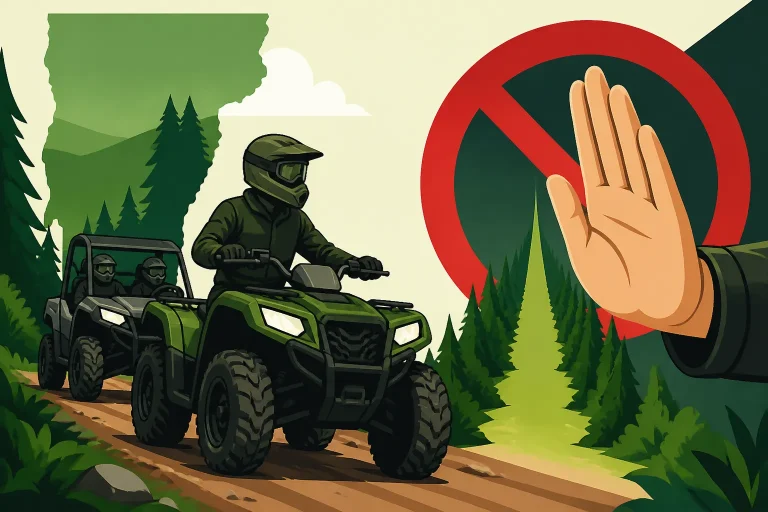
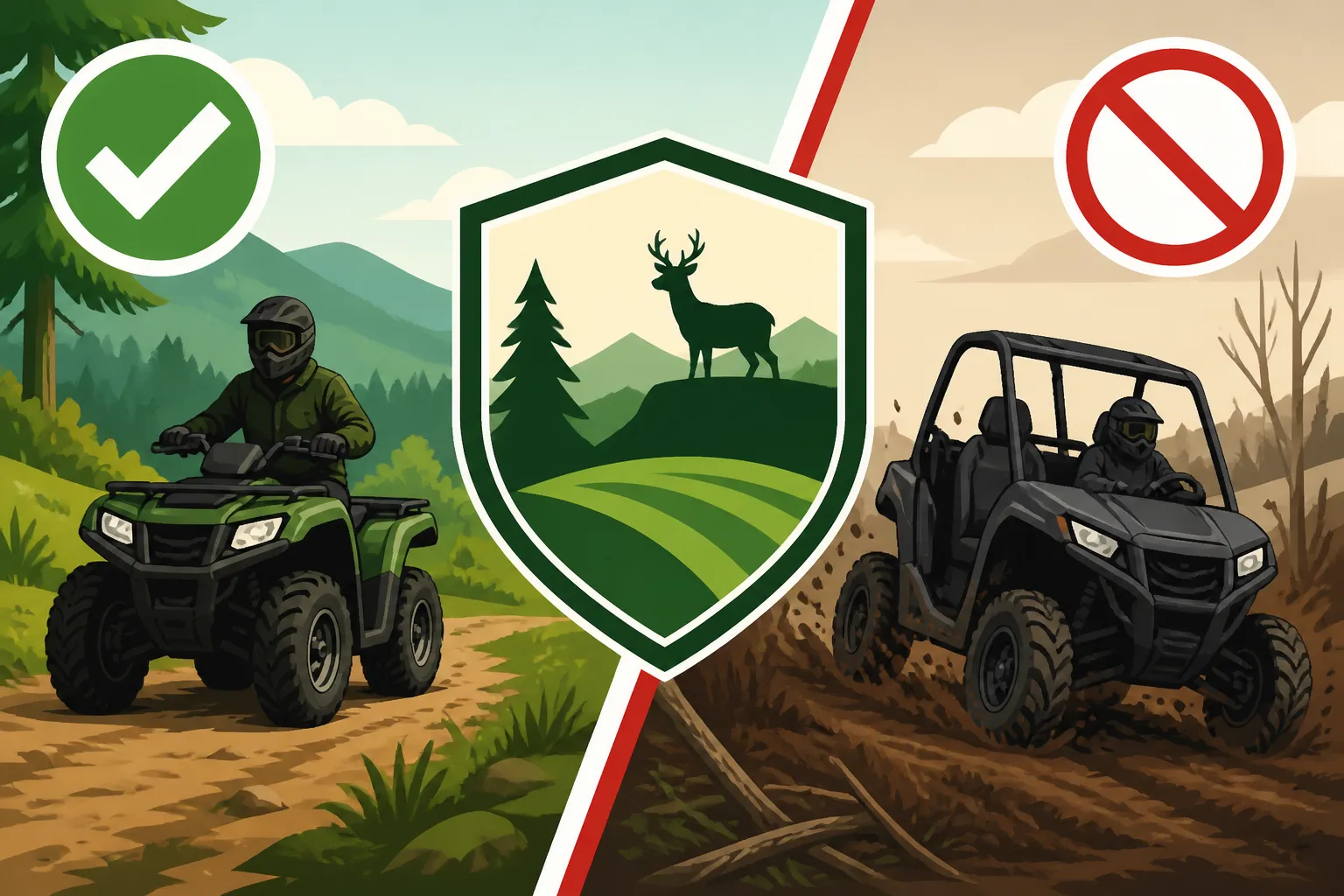
In general, do not assume an ATV or UTV may be ridden on a Vermont Wildlife Management Area. These are public lands managed for wildlife and outdoor recreation, but that does not make every road, path, or open area available to motorized vehicles. Riding is generally restricted unless a route or use is specifically authorized.
That distinction matters because WMA access can include hiking, hunting, fishing, wildlife viewing, and other nonmotorized activities while still prohibiting recreational ATV use. A gate being open, a track appearing on a phone map, or another rider’s tire marks is not proof that the route is legal.
Where a route is explicitly open to motorized travel, follow the route’s posted conditions and any applicable vehicle rules. Authorization for a road or corridor does not automatically allow you to ride onto adjoining fields, woods, wetlands, or unmarked trails. Stay on the route that is actually designated.
| What you see or know | What it tells you | What it does not tell you |
|---|---|---|
| The WMA is open to the public | Some forms of public access are allowed | That ATV or UTV riding is allowed |
| A road or trail appears on a map | A route may exist or have existed | That it is open to motorized use now |
| A gate is open | The entrance is physically passable | That recreational riding is authorized |
| You have a registration or trail access decal | You may have met certain vehicle or trail-system requirements | That you have permission to ride on a WMA |
| A road crosses or borders a WMA | There may be a legal road route | That you can leave the road and ride through the property |
Vermont’s broader state-land rules are useful context, but check the rules for the specific property and route. Vermont State Land Access Rules explains the distinction between public access and permission for particular activities. For designated state-land crossings, see Vermont State Land Crossings Designated by ANR.
How to Check a WMA Before You Ride
A few minutes of checking can prevent an unplanned turnaround—or a violation. Use current information for the exact property, not a general trail map alone.
-
Identify the WMA and its boundary. Confirm the official property name and boundary using current Vermont Fish & Wildlife information or official mapping. Online maps may show roads, tracks, or property lines without indicating whether motorized use is permitted.
-
Look for rules specific to that property. Check posted signs at entrances and along the route. If the signs, maps, or online information do not clearly authorize ATV or UTV travel, contact the managing agency before riding. Do not treat silence as permission.
-
Confirm what the designation covers. Ask whether the authorization applies to your type of machine, the entire route, and the dates you plan to ride. A route may be open only for a limited purpose or under specific conditions. Permission to use one road does not necessarily extend to another road or trail nearby.
-
Check for closures and seasonal limits. Access can change because of wildlife management, sensitive ground conditions, maintenance, or other site-specific needs. An old map, previous ride, or past permission may not reflect current conditions.
-
Plan where you will park and turn around. Use an authorized parking area and do not ride beyond it unless motorized access is clearly allowed. Avoid blocking gates, roads, access points, or equipment used by land managers.
If you are uncertain, contact the agency responsible for the WMA and describe the route you want to use. Give the property name, entrance, and road or corridor details if you have them. Ask directly whether recreational ATV or UTV riding is allowed there. A general answer about public access may not answer that specific question.
A trail map can still help with planning, but treat it as one piece of evidence rather than permission. Vermont ATV Trails: The VASA System describes the organized trail network; it should not be read as a blanket authorization to ride on every nearby public or private parcel. Vermont trails often depend on landowner permission, and a marked system route should be distinguished from an unapproved spur or shortcut. For more on that difference, see Vermont’s Trails Run on Private Land.
Registration, Decals, and Road Access Are Separate Questions
Riders sometimes assume that a registered machine or trail decal grants access to any public land. It does not. Vehicle paperwork and land-use permission answer different questions.
Registration concerns whether the machine meets applicable registration requirements. A trail access decal may be required for access to a participating trail system. Neither, by itself, gives a rider permission to operate on a WMA where motorized use is prohibited. The same is true of insurance or a safety certificate: those requirements do not open a route.
If you are riding on a VASA corridor, follow the rules for that corridor and stay within its marked route. Do not assume the corridor extends across an adjoining WMA unless the route is specifically shown and authorized there. Vermont Requires Registration Plus a TAD covers the distinction between those requirements; neither should be treated as a substitute for checking the property’s access rules.
Road access also requires care. A town road, public road, or designated ATV route that reaches the edge of a WMA does not automatically allow you to continue riding inside the property. Stay on the legally open road and do not turn onto an interior road just because it looks passable. Town access and property access can be governed by different rules. Vermont ATV Road Rules: Towns Decide is useful if your planned route includes a town road.
| Requirement or permission | What it addresses | What it does not replace |
|---|---|---|
| Vehicle registration | The machine’s registration status | Permission to ride on a particular WMA |
| Trail access decal | Access requirements for a covered trail system | Authorization to use unrelated WMA roads or trails |
| Insurance and safety requirements | Rider or machine obligations that may apply | A site-specific land-use decision |
| Town-road designation | Whether riding is permitted on a particular town road | Permission to leave that road and enter a WMA |
| WMA route authorization | Whether a specified route may be used for motorized travel | Compliance with registration, safety, or road rules |
Private property is another separate issue. Some Vermont ATV routes cross land with owner permission, and that permission can be limited or withdrawn. Do not assume that land bordering a WMA is part of the same access arrangement. [Vermont Landowner Permission Forms] and Vermont Trail Closures Landowners Request offer more context about how access can depend on permission and changing conditions.
What to Do When Access Is Unclear
If you reach a WMA entrance and cannot verify that your route is open to ATVs or UTVs, stop before entering. Do not rely on a prior visit, a friend’s recollection, tire tracks, or a digital map label. Turn around, find an authorized route, or contact the land manager for clarification.
Be especially cautious when a route passes a gate, crosses a wet area, or branches away from a marked road. A gate can be closed temporarily or left open for management work; either situation does not settle whether recreational riding is allowed. Riding around a barrier is not a safe way to interpret an access rule.
If you are already on a route and see a closure sign or a clear boundary marker, do not continue past it. Turn around without damaging the ground or widening the route. If a closure appears inconsistent with information you checked earlier, take note of the location and ask the managing agency rather than testing the restriction.
When planning a larger trip, check each property separately. A ride can move between private land, town roads, a trail corridor, and state land, with different rules applying at each section. Vermont State Forest Riding Rules may help when a route also involves state forest land, but WMA rules still need to be checked on their own.
The practical rule is straightforward: public access to a WMA is not the same as permission to ride a motor vehicle there. Ride only on a route that is specifically authorized for your machine, obey posted closures, and confirm current conditions before you unload.
Disclaimer
This article is for general informational purposes only and does not constitute professional advice. Laws, prices and regulations vary by location and change over time. Consult a qualified professional for guidance on your specific situation.