Vermont Supervisor License Requirements
Vermont’s supervision rule for young ATV riders is easy to confuse with its safety-course requirement. If a rider is under 16, the adult nearby may need more than experience: the supervisor must meet age and driver’s-license conditions. Here’s how to check eligibility, understand direct supervision, and prepare before riding.
Who May Supervise a Rider Under 16
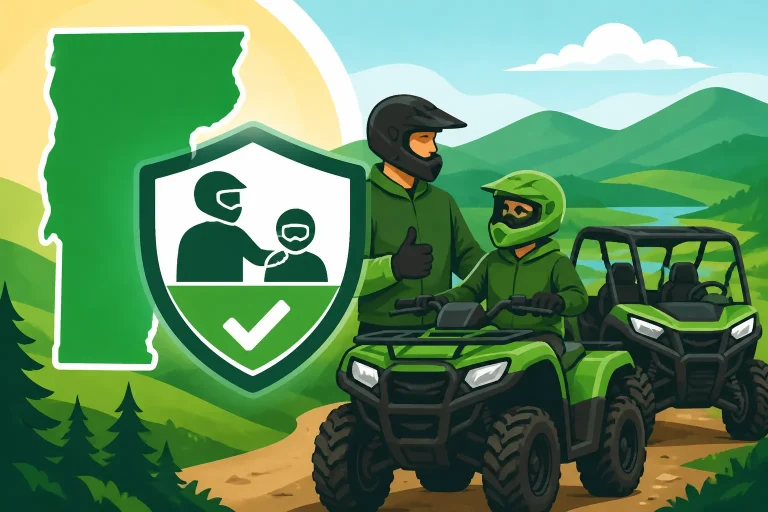
A rider under 16 must be directly supervised by someone who is at least 18 and holds a valid driver’s license. The adult does not qualify merely because they are a parent, own the ATV, or have ridden for years. Age and license status both matter.
The supervisor’s license must be valid when the ride takes place. A suspended or revoked license does not meet that requirement. If the adult’s status is uncertain, resolve that before planning a ride rather than assuming that a past license or a pending reinstatement is enough. The basic eligibility question is whether the person currently holds the required valid license.
A learner’s permit is not the same as a valid driver’s license for this purpose. If the prospective supervisor has only a permit, or has restrictions that raise questions about whether the license qualifies, confirm the rule with Vermont’s official source before relying on them. Do not treat a supervising adult’s driving experience as a substitute for the legal credential.
The rider’s relationship to the adult does not change the requirement. A parent, guardian, relative, family friend, or other adult can potentially supervise, provided the person meets the age and license conditions and can actually supervise the rider. A younger sibling or an experienced teen cannot take the place of an eligible adult simply because they know the trail.
| Supervisor question | Practical answer |
|---|---|
| How old must the supervisor be? | At least 18 |
| What license is required? | A valid driver’s license |
| Is a parent automatically eligible? | No. The parent must meet the age and license requirements |
| Can an experienced 16- or 17-year-old supervise? | No. The supervisor must be at least 18 |
| Can someone with a suspended license supervise? | Do not count on it; a suspended license is not valid |
| Does the child’s safety certificate replace supervision? | No. Course completion and supervision are separate requirements |
These are two separate checks: the young rider’s qualifications and the adult’s eligibility. A rider’s course certificate does not make an underage or unlicensed person an eligible supervisor. Likewise, an eligible supervisor does not erase any safety-course requirement that applies to the rider.
For a fuller explanation of the age rule itself, see Vermont Supervision Rules Under 16. The related overview Who Can Legally Supervise a Rider Under 16 is useful when choosing between several adults who might accompany a young rider.
What Direct Supervision Means in Practice
“Direct supervision” should not be treated as a box checked simply because an adult is somewhere on the property or has agreed to be available by phone. The supervisor needs to be present and able to oversee the young rider as the ride happens. A practical plan keeps the adult close enough to watch, communicate, and respond if the rider makes a mistake or encounters a hazard.
That changes how a family should plan a ride. An adult following in a truck on a public road, waiting at a distant trailhead, or riding far ahead may not be providing meaningful direct supervision. If the adult cannot see what the young rider is doing or respond promptly, the arrangement is too loose to rely on. When in doubt about a specific setting or what counts as direct supervision under the rule, confirm the official interpretation before riding.
The safest setup is usually straightforward:
- Choose a supervisor who is at least 18 and has a valid driver’s license.
- Keep the supervisor with the young rider throughout the ride, not just at the start.
- Choose a route and pace that let the adult maintain effective oversight.
- Agree on hand signals or other communication before setting off.
- Stop if terrain, traffic, visibility, or group spacing makes supervision difficult.
Direct supervision is not only about legal compliance. It also gives the adult a chance to help a newer rider handle turns, uneven ground, trail etiquette, and unexpected stops. A young rider may have completed a course and still lack experience with a particular machine or terrain. The adult should be close enough to notice when the rider is tiring, losing control, or becoming uncomfortable.
For a closer look at the practical meaning of the requirement, read What Direct Supervision Means. Supervision does not mean the adult should ride beyond their own ability or take on a route they cannot manage. The supervisor should choose terrain that both riders can handle and be ready to end the ride early.
Supervision is not the same as carrying a passenger
An adult riding on the same ATV is not automatically an appropriate solution. Whether a machine can carry a passenger depends on its design and the manufacturer’s seating instructions. A one-seat ATV should not be turned into a two-person vehicle to keep a child close. An adult can supervise while riding a separate machine, if the route and spacing allow effective oversight.
The same caution applies to side-by-sides and other utility terrain vehicles. A vehicle may have multiple seats, but that does not mean every passenger arrangement is appropriate for every child or ride. Use manufacturer-designated seats and follow applicable passenger and restraint rules. The adult’s supervisory role does not override equipment limits.
For a child passenger, consider the child’s ability to sit securely, reach the necessary handholds, and follow instructions. A child who cannot remain properly seated or understand the ride’s safety directions may not be ready to go, even if the vehicle has an extra seat. See Vermont ATV Rules for Passengers for the separate passenger questions.
How the License Rule Fits With Safety-Course Requirements
Vermont’s supervision rule is not the only requirement that may apply to a young rider. Riders under 18 generally have a safety-course requirement, subject to the applicable exceptions. That requirement is separate from the supervisor’s license requirement: the child may need training, and the adult may need to meet the age and license criteria.
A certificate does not substitute for a supervisor when the rider is under 16. Conversely, having an adult with a valid license nearby does not automatically satisfy the rider’s training requirement. Families should check both requirements independently before a trip.
The safety course helps riders learn practical basics such as responsible operation, hazards, and safe riding behavior. Completing it can be valuable even when a rider has practiced on private property or has ridden with family for years. Familiarity with one machine or yard does not ensure that a young person understands changing trail conditions, other trail users, or emergency decisions.
Start with Vermont ATV Safety Course Required Under 18 to understand the training requirement and its exceptions. If the rider already completed a course, make sure the certificate can be produced if requested. Vermont Safety Certificate Lookup and Carrying Proof of Training can help with checking and keeping proof accessible.
The supervisor should also understand what the child learned. A course certificate is not a guarantee that the rider can safely operate every size or type of ATV. Match the machine to the young person’s size, strength, and skill, and begin with manageable terrain. If the child is uncomfortable, tired, or unable to follow directions, stop rather than trying to complete a planned route.
A practical pre-ride check
Before leaving, confirm each item separately:
- The rider is under the supervision of an eligible adult if under 16.
- The supervisor is at least 18 and holds a valid driver’s license.
- The rider has completed any required safety course and can show proof if needed.
- The machine is appropriate for the rider and has functioning safety equipment.
- The route is open to ATV use and the group has any required access credentials.
- The adult and rider know how they will stay together and communicate.
Registration, insurance, trail access, and supervision are different issues. Having a registered machine or a trail access decal does not cancel the youth-supervision rule. Likewise, satisfying the supervision rule does not automatically authorize access to a trail or road.
For riding on the VASA trail system, check the separate access requirements before traveling. Vermont Requires Registration Plus a TAD explains why a vehicle’s registration and its trail access decal are not interchangeable. Riders should also review Vermont ATV Insurance Requirements and the rules for the specific route they plan to use.
Planning a Ride With a Young Rider
A good supervision plan begins with a realistic assessment of the young rider, the machine, and the route. The adult’s valid license is a legal threshold, not proof that the ride will be safe. Choose conditions that allow the supervisor to stay close and make decisions before a small problem becomes a larger one.
Start with the machine. A child should be able to operate the controls comfortably and manage the machine without stretching, struggling, or relying on someone else to steady it. A machine that is too powerful or too heavy can make even a familiar path challenging. Do not assume that a youth rider can handle an adult-sized ATV just because the rider has used a smaller one.
Then look at the route. A wide, familiar area with clear sightlines is easier to supervise than a narrow corridor with blind turns, steep grades, or frequent intersections. Mud, loose stones, water, poor visibility, and busy shared routes can all make it harder for an adult to keep a young rider in view and respond quickly. If the route changes or conditions worsen, be prepared to turn back.
The group should also agree on a pace. Adults sometimes ride ahead to scout a path or lag behind to help another rider, leaving the young person in the middle of a group. That can make direct supervision difficult. Keep the child close enough for the adult to observe and communicate, and avoid letting faster riders pull the group apart.
A useful plan covers more than the route:
- Set a simple pace. The child should not have to chase the adult or keep up with a faster group.
- Use frequent check-ins. Stop at safe places to confirm that the rider feels comfortable and understands the next section.
- Make signals clear. Agree on how to signal a stop, a problem, or a need to slow down.
- Limit distractions. The adult should focus on supervision rather than leading a large group while managing unrelated tasks.
- Bring appropriate safety gear. Use properly fitting helmets and other required equipment.
- Have an exit plan. Know how to return to the staging area if the child becomes tired or conditions change.
If the ride is on private land, get permission and confirm where the rider may go. If it is on a public road or designated route, local access rules may apply in addition to state requirements. Town roads are not automatically open to ATVs, and a road that is open at one time may have local conditions or seasonal restrictions. Vermont ATV Road Rules: Towns Decide provides more context on local road access.
The supervising adult should avoid dividing attention between multiple young riders who are spread out. One adult may be able to supervise a small group in a controlled setting, but a large or fast-moving group can make close oversight impractical. If the adult cannot keep every young rider within effective supervision, reduce the group size or add another eligible adult.
Visitors and out-of-state machines
Visitors should not assume that a home-state rule controls the ride in Vermont. The supervision conditions for riding in Vermont need to be checked alongside any training or machine requirements that apply to the visit. An out-of-state registration may be recognized for some purposes, but that does not necessarily settle youth supervision or trail access.
Review Vermont Reciprocity for Out-of-State Machines and Vermont Out-of-State Machines Still Need a TAD when planning a visit. Confirm current requirements before travel, especially if the young rider has training from another state or the supervisor holds a license issued elsewhere. Keep relevant documents accessible and avoid relying on an assumption that a rule from home applies unchanged.
Common Questions About Supervisor Eligibility
The most common mistake is to focus on the child’s age and overlook the adult’s status. Another is to treat “supervision” as a distant adult’s general availability. Check the supervisor’s age and license, then plan the ride so the adult can provide meaningful oversight.
If an adult has a license from another jurisdiction, do not assume that it fails simply because it was not issued by Vermont. The important question is whether the person holds a valid driver’s license that meets the rule. If the license is restricted, suspended, expired, or otherwise unusual, check with the appropriate Vermont authority before relying on it.
A supervisor generally does not need to be the young rider’s parent. The adult’s relationship to the child is not the deciding factor; eligibility and actual supervision are. Parents may still want to decide who they trust to supervise, based on the child’s experience and the route.
A rider who turns 16 may move out of the under-16 supervision category, but other requirements can still apply. The age change does not automatically eliminate a safety-course obligation that applies to riders under 18. For a specific age scenario, see Vermont ATV Rules for a 15-Year-Old and [Vermont Safety Course for a 17-Year-Old].
When the facts are not clear, the safest approach is to pause and verify. A phone call or official rule check before the ride is easier than trying to resolve a dispute after a roadside stop or incident. Keep the supervisor’s license current, make sure the rider has required training, and choose an outing where the adult can stay meaningfully involved from start to finish.
Frequently Asked Questions
Does a parent automatically qualify to supervise a rider under 16?
No. A parent must still be at least 18 and hold a valid driver’s license. The parent must also be present and able to provide direct supervision.
Can a 17-year-old supervise a younger rider?
No. The supervisor must be at least 18, so a 17-year-old does not meet the age requirement even if they have riding experience.
Can someone with a suspended license supervise?
Do not rely on a suspended license to meet the valid-license requirement. Choose an eligible adult with a current valid driver’s license or confirm the person’s status before the ride.
Does completing an ATV safety course mean a rider under 16 no longer needs supervision?
No. Training and supervision are separate requirements. A course certificate does not replace the requirement for an eligible adult to directly supervise a rider under 16.
Disclaimer
This article is for general informational purposes only and does not constitute professional advice. Laws, prices and regulations vary by location and change over time. Consult a qualified professional for guidance on your specific situation.