Crossing a Covered Bridge
There's nothing quite like the charm of Vermont's covered bridges, those historic sentinels spanning our rivers and brooks. For ATV and UTV riders, encountering one on a scenic route can be a real highlight, but it also brings unique questions and potential challenges. This guide is all about helping you understand how to respectfully and safely navigate these iconic structures, ensuring your ride is enjoyable and compliant with local regulations.
The Charm and Challenge of Vermont's Covered Bridges for ATV Riders
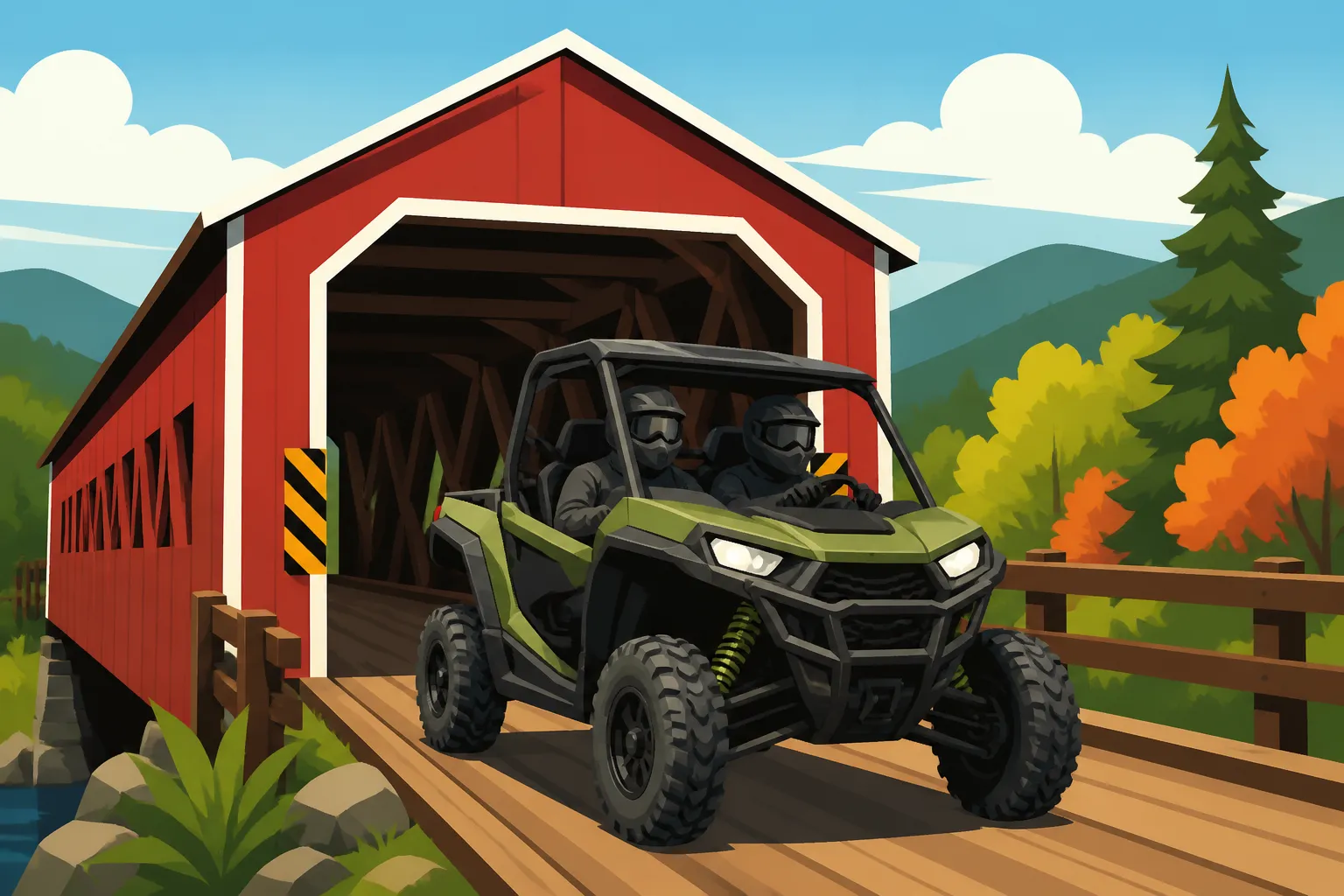
Vermont is renowned for its picturesque landscape, and nestled within that beauty are over 100 historic covered bridges. These aren't just quaint photo opportunities; they're functional pieces of history, often still in daily use, and they represent a significant part of our state's heritage. For ATV and UTV riders, stumbling upon one of these timber-framed marvels can feel like stepping back in time, adding an extra layer of adventure to any ride. However, their age and construction also present unique considerations that modern off-road machines need to contend with.
Why Covered Bridges Are So Iconic in Vermont
These "kissing bridges," as they're sometimes affectionately called, evoke a strong sense of nostalgia and connect us to a bygone era. Many were built in the 19th century, designed to protect the wooden road surface and structural timbers from the harsh New England weather. Each bridge often has its own story, its own local legend, and contributes significantly to the visual character of its town. They are living museums, testament to the ingenuity and craftsmanship of generations past. For riders exploring Vermont's backroads and designated trails, seeing the distinctive portal of a covered bridge peeking through the trees is always a welcome sight, promising a momentary escape into history. They're a favorite subject for photographers and a quiet spot for reflection, making them integral to the Vermont experience.
Their cultural significance means they're not just roads; they're cherished landmarks. Riders often seek them out for the unique experience of passing through a dimly lit, echoing wooden tunnel. The way the light filters through the cracks in the siding, the distinct scent of old timber, and the sound of your tires on the planks all contribute to a sensory experience unlike any other part of your ride. It’s this blend of history and utility that makes them so special, requiring a mindful approach from all who traverse them, especially those of us on ATVs and UTVs.
The Unique Challenges They Present to ATV and UTV Riders
While beautiful, covered bridges were certainly not designed with today's powerful and often wide ATVs and UTVs in mind. The most immediate challenge is often their narrowness. Many are single-lane, and some older bridges barely accommodate a standard passenger car, let alone a wider side-by-side or a heavily accessorized machine. This limited clearance can be a real squeeze, requiring precise control and careful attention to your machine's dimensions. Trying to push a wide UTV through a narrow bridge designed for horse-drawn buggies can lead to scrapes, damage, or even getting stuck, which is a situation no one wants to be in.
Beyond width, there are critical limitations concerning weight and height. These timber structures have specific load-bearing capacities, which are often significantly lower than modern concrete bridges. A heavier UTV, especially one loaded with passengers, gear, or substantial aftermarket components you might get from a company like SuperATV, could easily exceed these limits, potentially compromising the bridge's structural integrity. Similarly, the low overhead beams within many covered bridges can pose a serious hazard. Roll cages, roof-mounted light bars, and even taller riders in UTVs can make contact, causing damage to the machine or, more importantly, to the historic bridge itself. It's not uncommon to see scrape marks on the wooden beams from vehicles that didn't clear.
The interior of a covered bridge also presents challenges for visibility and traction. They can be quite dark, even on a sunny day, creating a sudden change in light that can momentarily impair your vision, especially if you're wearing sunglasses. The wooden decking, while charming, can be uneven, have loose boards, or become incredibly slippery when wet, muddy, or icy. This demands reduced speed and careful handling to prevent skidding or losing control. You also have to contend with blind entries and exits, making oncoming traffic a surprise. All these factors combined mean that crossing a covered bridge isn't just about driving straight through; it requires a heightened sense of awareness and respect for both the structure and other users.
Navigating the Rules: When and How You Can Cross
It's tempting to approach every covered bridge you see, especially if it appears to be part of an open road or trail. However, not all covered bridges are created equal when it comes to ATV and UTV access. Just like any other road or trail segment, specific rules and restrictions apply, and these are often determined at the local level. Understanding these guidelines, particularly the posted limits, is paramount to a safe and legal crossing. Ignoring them isn't just a risk to your machine or the bridge; it can also lead to fines and erode public trust in responsible riding.
Local Ordinances and Designated Routes
In Vermont, the decision to allow ATV and UTV access on town roads, which often include historic covered bridges, rests largely with individual towns and their selectboards. This means that access can vary dramatically from one community to the next. A bridge that's open to ATVs in one town might be strictly off-limits just a few miles down the road in another. This patchwork of regulations is why it's so important to do your homework before heading out. Our article [Vermont ATV Road Rules: Towns Decide] delves deeper into how these local decisions are made and what riders need to know.
You absolutely cannot assume that because a road leads to a covered bridge, your ATV or UTV is welcome to cross it. Always consult official trail maps, such as those provided by the Vermont ATV Sportsman's Association (VASA), or check with the local town clerk's office for specific ordinances. These resources will clearly indicate if a particular covered bridge is part of a designated ATV route. If a bridge is not on an approved route, or if a town has explicitly prohibited ATV use on that section of road, then crossing it constitutes trespassing or violating a local ordinance, even if it looks like a scenic shortcut. Our guide on [Reading Your Town's Posted Route Map] offers more insights into deciphering these crucial navigational tools.
Sometimes, towns will make specific designations for specific reasons. A selectboard might decide that while most dirt roads are open, certain historic structures, like a covered bridge, are simply too fragile or narrow to accommodate modern machines. These decisions are often made to preserve the integrity of the bridge and ensure public safety. Therefore, even if you're on a generally open ATV route, always be on the lookout for supplementary signs specifically addressing the covered bridge itself. Understanding that [Vermont Selectboards Open Roads Each Year] means these designations can change, so staying current with maps and local rules is crucial.
Understanding Posted Limits: Weight, Height, and Width
When you approach a covered bridge, whether it's on a designated route or not, your first action should be to look for any posted signs. These signs are there for a reason and are not merely suggestions; they are legally binding instructions designed to protect the bridge and everyone using it. Ignoring them is not only illegal but incredibly dangerous.
Weight Limits: These are perhaps the most critical. Many covered bridges were constructed when the heaviest traffic they'd bear was a loaded hay wagon or a Model T. A modern side-by-side, especially a four- or six-seater with passengers and gear, can weigh upwards of 2,000 pounds or more, even before modifications. If you've added heavy-duty bumpers, winches, or larger tires – perhaps from a company like SuperATV – that weight can increase significantly. Always check your machine's curb weight and factor in passengers and cargo. If the bridge has a posted limit of, say, 3 tons (6,000 pounds), and your UTV alone weighs 1,800 pounds, adding two adults (400 pounds), gear (100 pounds), and a passenger (200 pounds) quickly brings you to 2,500 pounds or more. This is why our state defines some machines as [Vermont Machines Over 2,500 Pounds], and these heavier vehicles must pay even closer attention. Exceeding the weight limit can cause serious structural damage, putting future users at risk and potentially leading to hefty repair bills or fines if you're found responsible.
Height Limits: These are just as important, especially for UTVs with roll cages, roofs, or lifted suspensions. You'll often see a sign indicating a maximum height, perhaps 8 feet, 6 inches. Before entering, take a moment to eyeball your machine against this limit. If you have a tall roll cage, a roof rack, or even an aftermarket light bar mounted high up, you could be too tall. Don't risk it. Contact with overhead timbers can damage your machine, rip off accessories, or severely damage the historic structure. This is particularly relevant for many modern UTVs, as discussed in [Vermont Machines Wider Than 72 Inches], which often come with substantial cages. A quick measurement of your machine before you leave home, especially if you've added accessories, is a smart move.
Width Limits: While less common than height or weight restrictions, some covered bridges may have width limitations due to their extremely narrow design. Even if a bridge doesn't explicitly post a width limit, the visual assessment of the opening compared to your machine's width is crucial. Many older bridges are barely wider than a modern compact car, and a wide side-by-side could easily get jammed or scrape its fenders and mirrors. If it looks too tight, it probably is. There's no shame in turning around and finding an alternate route rather than forcing your way through and risking damage to your valuable machine or the irreplaceable bridge.
Etiquette and Safety Tips for Crossing Covered Bridges
Successfully and respectfully crossing a Vermont covered bridge involves more than just knowing the rules; it requires a particular kind of riding etiquette and a strong emphasis on safety. These aren't just stretches of road; they are historical artifacts and often shared with pedestrians, cyclists, and other vehicles. Your actions inside and around these structures contribute to how ATV and UTV riders are perceived by the wider community. Being a good ambassador means prioritizing caution, courtesy, and preservation.
Pre-Crossing Checks and Approach
As you approach a covered bridge, make a conscious effort to slow down well in advance. This isn't just about safety; it's about showing respect for the structure and preparing yourself for the unique conditions within. Don't approach at trail speed. Reduce your pace significantly, giving yourself ample time to observe and react. This also minimizes dust kick-up and noise for any nearby residences, aligning with concerns often addressed in [Vermont Muffler and Noise Rules].
Your eyes should immediately scan for any posted signs. Re-emphasize looking for weight, height, and width restrictions, as well as any signs explicitly prohibiting ATV or UTV access. These signs are your primary guidance. Simultaneously, look and listen for any oncoming traffic. Many covered bridges are single-lane with blind entries, meaning you can't see vehicles approaching from the other side until they're right upon you. If another vehicle is already in the bridge or is clearly closer to entering from the other side, yield to them. Patiently wait your turn; there's no rush.
A crucial safety measure, even in broad daylight, is to turn on your headlights before entering the bridge. The interior of a covered bridge can be surprisingly dark, creating a sudden contrast that makes it difficult for you to see and for others to see you. Headlights increase your visibility to any oncoming traffic, pedestrians, or even animals that might be inside. This simple step is a core component of [Vermont Headlight and Tail Light Rules] when riding on public roads, and it's especially important here.
Crossing the Bridge Itself
Once you've made your checks and it's safe to proceed, maintain a very slow and steady speed as you enter and traverse the bridge. Avoid any sudden acceleration or braking. The wooden decking, especially if it's wet, muddy, or worn, can be slippery, and abrupt movements can cause your tires to lose traction. Smooth, controlled input is key. If you're riding a wider UTV, stay as centered as possible within the lane to maximize clearance on both sides and minimize the risk of scraping the interior timbers. Our article on [Vermont ATV Equipment Requirements] also highlights the need for properly functioning brakes, which are vital here.
Be acutely aware of your surroundings inside the bridge. Watch for uneven boards, potholes, or any debris that might have accumulated. Some older bridges might have slightly loose planks or small gaps, which can catch a tire or jolt your machine if you're not paying attention. The echoing acoustics inside a covered bridge amplify engine noise, so be mindful of your throttle. You don't want to create excessive noise that could disturb nearby residents or spook horses or pedestrians.
While many covered bridges are designed for single-vehicle passage, it's generally a good rule of thumb, especially for older or smaller bridges, to cross one machine at a time if you're in a group. This minimizes the combined weight on the structure and ensures that everyone has adequate space to navigate safely. Remember, these bridges are historical treasures, and your careful handling helps preserve them for future generations to enjoy. Always wear your helmet inside; [Vermont ATV Helmet Law for Every Rider] applies on all public access routes, including through these structures.
Post-Crossing and General Considerations
Once you've safely exited the covered bridge, don't immediately stop right at the end for photos or to regroup. Pull off to a safe spot where your machine won't obstruct traffic or pose a hazard to others. If you want to take pictures, find a safe pull-off area a short distance away where you can park without blocking the road or trail. This thoughtful practice helps maintain traffic flow and ensures everyone's safety.
Always practice "Leave No Trace" principles. These historic sites are often cherished by locals and visitors alike. Do not litter, do not deface the structure, and leave the area cleaner than you found it. Your behavior reflects on the entire ATV and UTV riding community. By demonstrating courtesy and respect, you become an ambassador for responsible riding, helping to foster positive relationships with landowners and local communities, which is vital for the long-term health of our trail system. Consider how your actions contribute to the perception of riders on [Vermont ATV Trails: The VASA System].
Finally, always be prepared for unexpected encounters. You might come across pedestrians enjoying a walk, cyclists, or even horse-drawn buggies, especially in more rural areas. Slow down, give them ample space, and pass cautiously. A friendly wave and a courteous attitude go a long way in ensuring that these beautiful covered bridges remain accessible and enjoyable for everyone. Even on [Vermont ATV Rules on a Dirt Road], showing respect for other users is paramount.
| Characteristic | Potential Challenge for ATVs/UTVs | Precautionary Measure |
|---|---|---|
| Narrow Width | Limited clearance, especially for UTVs | Check posted width limits, proceed slowly, stay centered |
| Low Height | Roll cages, roof accessories can hit beams | Check posted height limits, assess overhead clearance |
| Weight Limits | Heavy machines exceed old bridge capacity | Check posted weight limits, consider machine weight |
| Wooden Decking | Slippery when wet, uneven, loose boards | Reduce speed, avoid sudden braking/acceleration |
| Limited Visibility | Blind entry/exit, dark interior | Turn on headlights, listen for traffic, yield |
| Historical Status | Risk of damage, preservation efforts | Respect signs, ride responsibly, don't stop inside |
Disclaimer
This article is for general informational purposes only and does not constitute professional advice. Laws, prices and regulations vary by location and change over time. Consult a qualified professional for guidance on your specific situation.