Liability Limits the Law Requires
Vermont’s ATV liability rules set minimum insurance limits, but riders often need to sort out whether the rules apply to a machine sold as a UTV, what each limit covers, and what proof to keep. Here’s how to read the required amounts, check that a policy fits the machine, and avoid treating minimum coverage as a guarantee that every loss is covered.
Liability limits Vermont requires
According to the Department of Motor Vehicles, liability insurance for a registered ATV must provide at least $25,000 for one individual injured or killed, $50,000 for two or more individuals injured or killed, and $10,000 for property damage in a crash. The Department also allows evidence of $115,000 in self-insurance filed with the Commissioner in place of a bond or liability policy. These requirements are listed as of November 2026.
| Type of liability coverage | Minimum listed by the Department of Motor Vehicles | What it addresses |
|---|---|---|
| Bodily injury or death to one individual | $25,000 | Injury or death affecting one individual in a crash |
| Bodily injury or death to two or more individuals | $50,000 | Injury or death affecting two or more individuals in a crash |
| Property damage | $10,000 | Damage to property in a crash |
| Self-insurance option | $115,000 filed with the Commissioner | Evidence filed in lieu of a bond or liability policy |
These are liability coverage minimums, not a promise that an insurer will pay every expense arising from a crash. A policy’s terms, exclusions, covered operators, and covered vehicles matter. And the required limits do not determine how much a rider could ultimately be held responsible for if a loss exceeds available coverage.
The injury limits are described by the number of individuals injured or killed, while the property limit applies to property damage in a crash. Don’t assume that a policy’s short description or an insurance card explains how the insurer applies its limits in every situation. Ask the insurer to explain the policy’s applicable limits and how they would work for the way you use the machine.
For a closer look at the legal requirement, see Vermont ATV Insurance Requirements and Vermont Requires ATV Liability Insurance. The separate explanations of Vermont’s $25,000 Bodily Injury Minimum, Vermont’s $50,000 Two-Person Minimum, and Vermont’s $10,000 Property Damage Minimum can help clarify what each category means.
What the limits do and do not tell you
Liability insurance generally addresses covered claims that someone else suffered injury or property damage for which the insured rider is legally responsible. It is different from coverage for damage to your own ATV, your own injuries, theft, or roadside assistance. Whether any of those losses are covered depends on the policy you buy; the stated Vermont liability minimums do not establish that they are included.
This distinction matters when comparing a basic liability policy with broader coverage. A policy can meet a legal liability minimum without covering repairs to your own machine after a crash. Conversely, optional coverage may address other risks but still have conditions, exclusions, or deductibles. Ask the insurer to identify what the liability portion covers and what separate coverage, if any, applies to your ATV or UTV.
The minimums also should not be read as a recommended amount for every rider. A crash involving several people or costly property damage can create losses beyond the minimum limits. Consider your financial exposure, the machine’s use, and the policy options available, then discuss suitable coverage with an insurance professional. The appropriate choice depends on your circumstances; there is no single policy configuration that fits every rider.
Check whether your UTV falls under the ATV rule
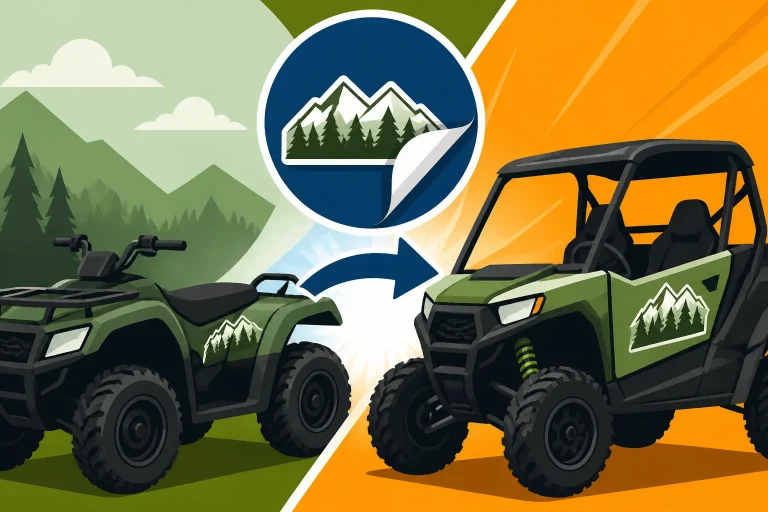
The name on a sales listing or manufacturer brochure does not necessarily settle how Vermont classifies a machine. Riders may casually use “ATV” and “UTV” as broad labels, while the state’s registration and vehicle rules rely on classifications and definitions. Before assuming a side-by-side is treated the same way as another ATV—or that it is outside the ATV requirements—confirm its classification with the Department of Motor Vehicles or your insurer.
The Department of Motor Vehicles describes an ATV as having two or more low-pressure tires at 10 psi or less and not being wider than 72 inches. Those specifications are useful clues, but they are not a substitute for checking how the specific machine is categorized for Vermont purposes. If the machine is close to a definition boundary, or its paperwork uses a different vehicle class, get a direct answer before relying on an insurance quote.
Start by matching the documents for the machine: its registration, ownership paperwork, and the identifying information the insurer uses. If a policy lists a model or vehicle category that does not match the registered machine, ask the insurer to correct or explain it. This is particularly important for a side-by-side, a modified machine, or a vehicle bought in another state. The related Vermont Registration for a Side-by-Side and Why Your Policy Must Name the Machine You Ride topics can help you identify questions to raise.
Vermont permits residents and nonresidents to register ATVs, and the Department of Motor Vehicles allows legally registered out-of-state ATVs to operate in Vermont with a valid registration. That does not mean registration reciprocity answers every insurance question. A visitor should verify that the policy applies to the machine while it is being operated in Vermont, and confirm whether the state’s required minimums are satisfied. See Vermont Reciprocity for Out-of-State Machines for the registration side of the question.
If the machine is being registered in Vermont for the first time, the Department of Motor Vehicles requires the Vermont Registration Application, form VD-119. Registration and insurance are separate matters: completing one does not establish that the other is in order. Review Vermont Registration Before Your First Ride if you are organizing the paperwork before using the machine.
Verify coverage before riding
A useful insurance check is more than glancing at a card. Confirm the policy applies to the exact vehicle, the intended operator, and the kind of riding planned. Trail use, road use, recreational use, farm work, and operation by household members or guests may be treated differently by an insurer. Do not assume a policy covers a particular use simply because the machine is insured.
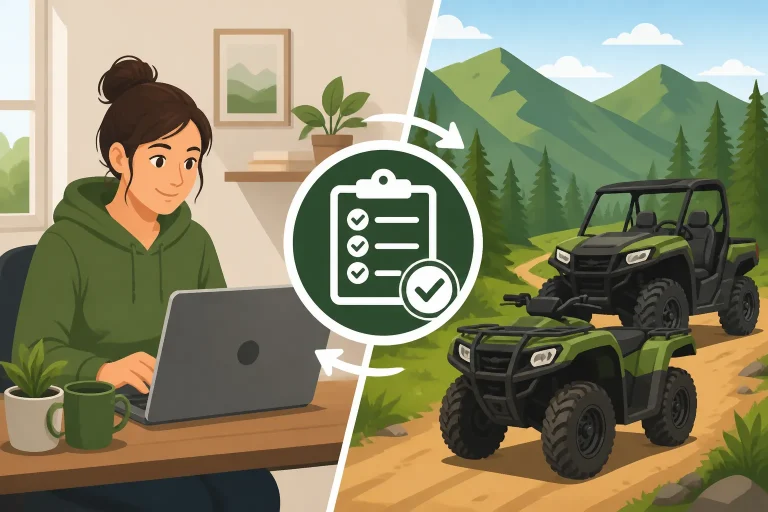
Use this checklist when arranging coverage or reviewing a renewal:
- Confirm the vehicle identification. Compare the policy’s description with the ATV or UTV’s registration and identifying details. Ask the insurer to correct any mismatch or unclear classification.
- Ask for the liability limits in writing. Have the insurer identify the bodily injury and property damage limits and confirm they meet Vermont’s requirements for a registered ATV.
- Discuss who may operate it. Clarify whether the policy covers other household members, guests, or occasional operators, and whether restrictions apply.
- Explain where and how it will be used. Be specific about trail riding, travel between riding areas, work use, or any other intended activity. Ask whether the policy excludes a type of use.
- Ask what the policy does not cover. Confirm whether damage to the machine, the rider’s own injuries, theft, or recovery costs require separate coverage.
- Keep proof accessible. Know where the insurance documents are stored and how to show them if asked. For practical considerations, see Proof of Coverage in Your Pocket.
These questions are especially worthwhile when buying a used machine, changing insurers, adding a regular operator, modifying the vehicle, or taking it across state lines. A new registration or a change in the machine’s use is a good moment to contact the insurer rather than assume the existing policy will respond in the same way.
If you are relying on self-insurance rather than a liability policy, the Department of Motor Vehicles’ stated option involves filing evidence with the Commissioner. Do not treat possession of funds or a personal promise to pay as equivalent to that filing. Confirm the process and documentation with the appropriate state office before operating on that basis. Vermont Self-Insurance at $115,000 covers that option in more detail.
Keep policy documents and insurer contact information with your registration records, but do not rely on an insurance card alone to interpret coverage. If a crash occurs, follow the applicable reporting and safety procedures and contact the insurer promptly. Preserve relevant details and documents, and avoid making assumptions about fault or coverage before the insurer has reviewed the situation.
The practical takeaway is straightforward: verify the machine’s Vermont classification, confirm the liability limits in the policy, and make sure the policy describes the vehicle and intended use accurately. Meeting the minimum is an important starting point, but understanding the policy’s scope is what helps prevent an unpleasant surprise when a claim arises.
Sources
- Department of Motor Vehicles — Registering Your All-Terrain Vehicle | Department of Motor Vehicles (checked November 3, 2026)
- Department of Motor Vehicles — Registering Your All-Terrain Vehicle | Department of Motor Vehicles (checked November 3, 2026)
- Department of Motor Vehicles — Registering Your All-Terrain Vehicle | Department of Motor Vehicles (checked November 3, 2026)
- DEPARTMENT OF MOTOR VEHICLES — VD-038-Snowmobile_Registration_Tax_Title.pdf (checked November 3, 2026)
- Department of Motor Vehicles — VN-023-ATV_Driver_Manual.pdf (checked November 3, 2026)
Disclaimer
This article is for general informational purposes only and does not constitute professional advice. Laws, prices and regulations vary by location and change over time. Consult a qualified professional for guidance on your specific situation.