What a Trail Warden Checks
A trail stop can feel uncertain if you are not sure what to show or whether a volunteer can require you to stop. On Vermont ATV trails, checks commonly focus on access, registration, rider qualifications and conduct on the marked route. Knowing what may be checked—and who is doing the checking—helps you prepare without treating every trail encounter like a roadside inspection.
Who a trail warden is and what the role may involve
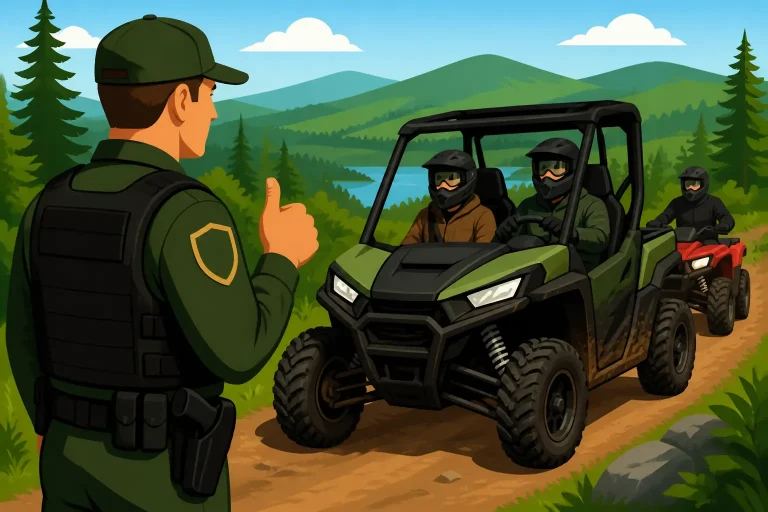
“Trail warden” can mean different things in conversation. On a Vermont club trail, the person checking riders may be a club volunteer or trail steward. That person’s role is not automatically the same as a law enforcement officer’s. Volunteers help protect access, monitor trail use and report problems; police or other authorized officers enforce applicable laws.
The distinction matters. A volunteer may ask to see a trail access decal, remind you about a gate or route restriction, or report a concern to the club or authorities. Do not assume that every volunteer has the same legal powers as an officer. If you are unsure who is speaking with you, remain calm, ask politely about their role and follow lawful instructions from an authorized officer.
Checks can happen at a trailhead, gate, intersection or along a corridor. A rider may be asked about the machine’s access decal, registration or route. A person monitoring the trail may also notice whether riders are staying on the marked corridor, closing gates properly and respecting private property. The exact interaction depends on who is checking and what has prompted the contact.
Vermont’s ATV trail network depends heavily on access across private land. Permission for a corridor does not give riders permission to roam beyond it, and a trail can be rerouted or closed when access changes. That is why a check may be about where you are riding—not just what paperwork you carry. For background on the landowner relationship, see Vermont Landowner Permission Holds the System Together.
Be courteous, pull over somewhere safe if you are asked to stop, and avoid blocking the trail. If the person is a volunteer, a calm conversation is usually the best way to clarify what they are asking. If an officer gives a lawful direction, comply and sort out any disagreement through the appropriate process afterward.
Access and documents a checker may ask about
A Vermont trail ride generally involves more than owning a machine. Registration and the Trail Access Decal, or TAD, serve different purposes: registration identifies a machine for legal operation, while the TAD provides access to participating trails. The state’s requirements can apply even when a machine is registered elsewhere. See Vermont Requires Registration Plus a TAD and Vermont Reciprocity for Out-of-State Machines.
A trail checker may look for a current decal on the machine. Make sure it is attached as directed, visible and not obscured by mud, bodywork or gear. A decal in a glove box may not help if the trail rules require it to be displayed on the machine. The current placement instructions are covered in Vermont TAD Placement on the Machine.
| What may be checked | What to have ready | Why it matters |
|---|---|---|
| Trail Access Decal | A valid decal displayed as directed | Shows that the machine has the required trail access |
| Registration | Current registration and plate or other required display | Shows the machine is registered for applicable operation |
| Insurance | Proof of required liability coverage | Confirms coverage for the machine being operated |
| Rider training | Safety certificate if the rider is subject to the requirement | Helps verify the rider has completed required training |
| Route and property access | A current map and permission where required | Keeps the ride on an open, authorized corridor |
| Ownership details | Ownership paperwork if a question arises | Helps resolve questions about the machine or its records |
Keep your registration and insurance proof accessible, rather than buried beneath cargo. Paper copies or available digital records can be useful, but a phone is not a reliable sole plan when you have no signal or battery. Follow current rules about what proof must be carried and accepted. Vermont Insurance Proof at a Trailhead explains why it is sensible to have coverage proof available.
For riders from outside Vermont, a home-state registration may be recognized under applicable reciprocity rules, but that does not automatically provide trail access. Check the current requirements for your state or province and obtain the Vermont access decal if required. The TAD and the machine’s registration should both be considered before travel, not sorted out after reaching a trailhead.
A checker may also ask questions if the plate or registration information does not appear to match the machine. Keep ownership records with your trip paperwork, especially if the machine was recently purchased, borrowed or transported by someone other than its owner. A bill of sale, title or other accepted ownership record can help explain a mismatch, though it does not replace registration or a decal. See Vermont Proof of Ownership on the Trail.
Riders under 18 should check the training rules before setting out. Vermont requires an ATV safety course for riders under 18, subject to applicable exceptions. Riders who must meet the requirement should carry proof of completion. The age, course and supervision details are discussed in Vermont ATV Safety Course Required Under 18. Do not assume that a parent’s certificate or another rider’s paperwork covers the young rider.
Machine setup, route use and rider conduct
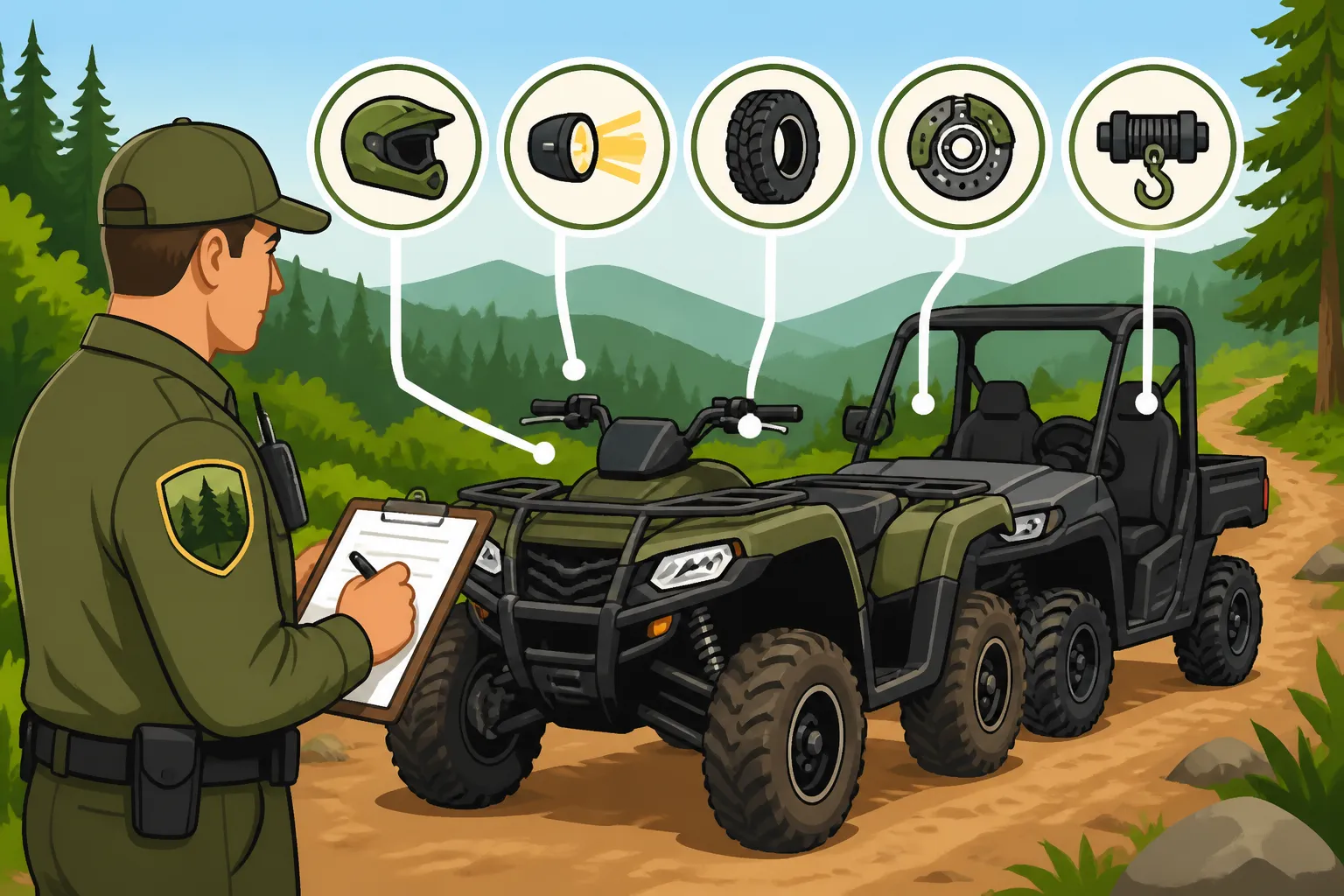
A trail encounter may involve a quick look at the machine and how it is being operated. A checker might notice a missing or unreadable plate, an obscured decal, a passenger riding in an unsuitable position or equipment that appears unsafe. A volunteer’s observation is not the same as a formal inspection, but a serious concern could be referred to law enforcement.
Before the ride, check that the registration plate and decal are secure and visible. Mud can cover identifying information surprisingly quickly, especially after a wet section. Carrying a cloth to clear the plate and decal can save time at a stop. Make sure cargo does not block the plate, lights or the rider’s view, and secure straps so they cannot drag or catch on the machine.
Your route matters as much as the machine. Stay on the signed or mapped corridor, and do not use an appealing side path unless it is clearly open to ATVs. A trail can cross working land, private roads or property where permission applies only to a specific route. Gates should be left as you found them, and a closure sign should be treated as a real boundary rather than an invitation to find another way through.
If a trail is closed, a bridge is marked with a weight limit, or a section is visibly damaged, do not try to push through. A detour across private land can jeopardize access for everyone. Check current club information before riding, since closures may change with landowner requests, weather, maintenance or trail conditions. Vermont Trail Etiquette on Private Land offers more on respecting corridor access.
Riding behavior can draw attention even when your paperwork is in order. Excessive speed, loud operation near homes, unsafe passing or riding outside the corridor can lead to complaints and a report. On a narrow trail, slow down when approaching other users, give them room and follow posted signs. If you meet a group, wait for a safe opportunity to pass rather than forcing your way through.
Passengers and young riders need particular care. The machine must be designed for the number and position of its riders, and passengers should use the intended seat and restraints if equipped. Follow applicable helmet and supervision rules, and do not treat a trail ride as a place to test whether an extra passenger can fit. A warden or officer who sees an unsafe setup may ask you to correct it or stop riding.
A useful pre-ride check takes only a few minutes:
- Confirm that the route is open and that your machine is allowed on it.
- Check the registration, displayed plate and TAD.
- Carry insurance proof and any required rider training certificate.
- Inspect tires, brakes, lights and controls, and secure all cargo.
- Review passenger, helmet and supervision requirements for everyone in the group.
- Save or carry a current trail map, including a plan for closures or dead zones.
This does not guarantee that no one will stop you, but it reduces the common reasons a ride gets interrupted. It also helps you answer questions clearly instead of searching through a vehicle or phone while standing in the trail.
How to handle a check and avoid being turned around
If someone signals you to stop, slow down and pull fully off the usable trail where it is safe. Shut the machine off if appropriate, remove your helmet only when safe, and listen before reaching for documents. A trail is a poor place for a rushed exchange: other riders may be approaching, and dust or noise can make it hard to hear.
Keep answers direct. Show the requested document if you have it, explain calmly if it is stored elsewhere, and ask what needs attention if the concern is not clear. If the issue is a decal or plate that has become covered in mud, clean it and ask whether that resolves the problem. If you do not have a required document, do not pretend otherwise; ask what the next step is and whether you need to leave the trail.
When the person is a volunteer and you disagree with their interpretation, avoid turning the exchange into an argument on the corridor. Ask which club or trail organization they represent and how to follow up. If the person is an officer, comply with lawful directions and note the details later if you intend to challenge a citation or decision.
A checker may tell you that a route is closed or that your machine cannot continue. Take that seriously. Do not go around a gate, follow another rider through a closure or continue on the assumption that a short stretch does not count. If you are turned around, use a permitted route back to a public road or trailhead. Being Turned Around at a Gate explains why a gate or closure should not be bypassed.
Before a trip, make sure each rider knows which machine they are using and where its paperwork is kept. A group leader should not assume that one person’s registration or decal covers every machine. Check each vehicle separately, including borrowed or rented machines, and confirm the current trail requirements with the relevant club or provider.
The simplest way to avoid an unpleasant surprise is to treat access as a combination of machine, rider and route. Keep registration and coverage in order, display the required decal, carry any required training proof, and stay on open corridors. If a rule or access condition is unclear, check with the trail organization or official agency before riding rather than relying on a guess at the trailhead.
Disclaimer
This article is for general informational purposes only and does not constitute professional advice. Laws, prices and regulations vary by location and change over time. Consult a qualified professional for guidance on your specific situation.