Vermont Proof of Ownership on the Trail
When someone asks for proof on a Vermont ATV trail, a bill of sale or title may not be the document that matters most. Riders need to distinguish proof of ownership from the registration and landowner permission required for riding. Here’s what to carry, how the rules work for visitors, and what to sort out before leaving home.
What Vermont Riders Need to Carry
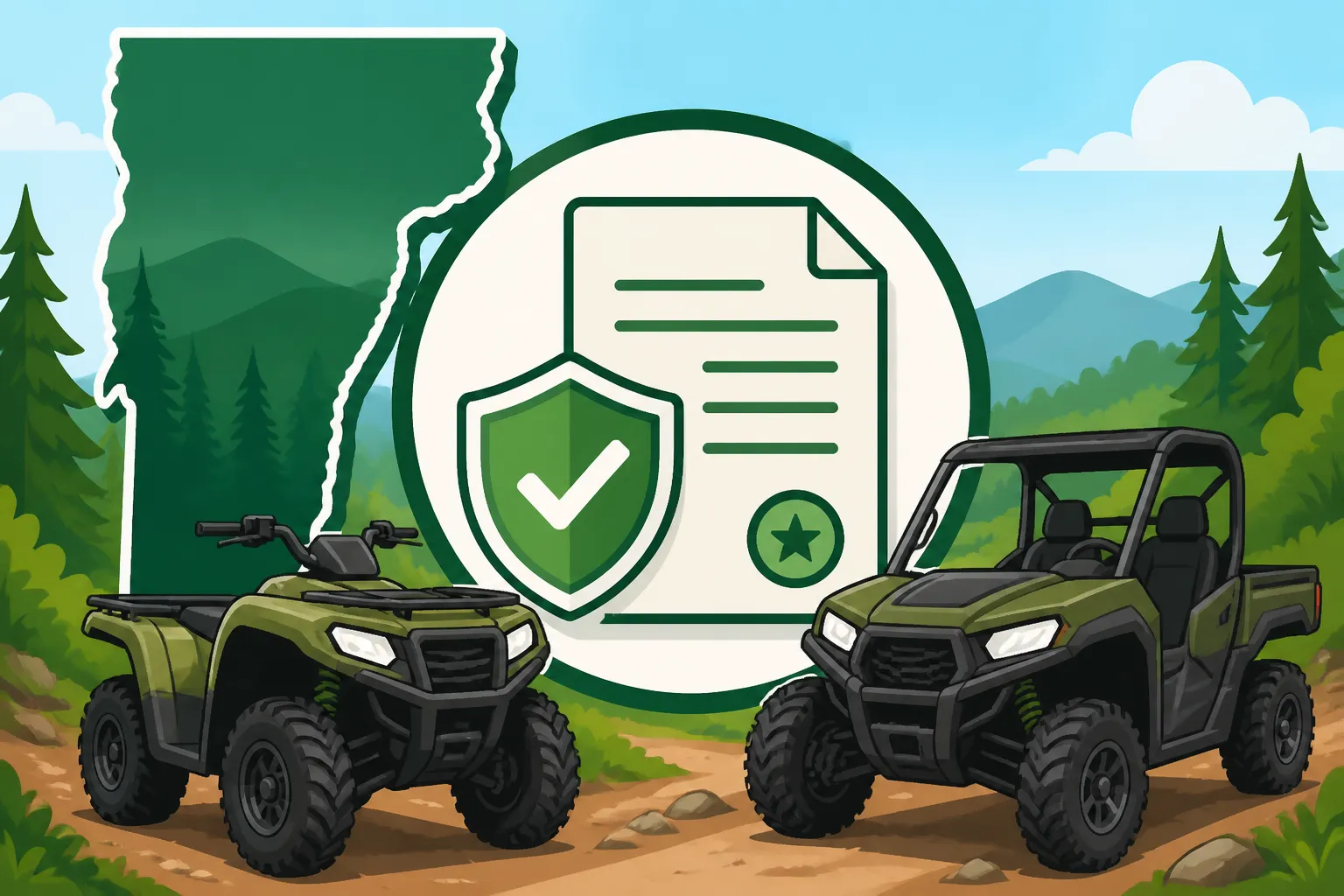
Vermont’s trail rule is about authorization to ride, not simply showing who bought the machine. According to the Vermont Department of Motor Vehicles, operators must carry a valid registration certificate and written permission from each landowner whose property they travel across, or proof of club membership that demonstrates that permission.
That means three different kinds of paperwork can come up, and they serve different purposes:
| Document | What it helps establish | What it does not replace |
|---|---|---|
| Valid registration certificate | The machine is registered for operation | Landowner permission or any required trail access |
| Written landowner permission | You are authorized to travel on that land | The machine’s valid registration |
| Club membership proof | May demonstrate landowner permission, as described by the Vermont DMV | A valid registration certificate |
| Bill of sale or other purchase record | Supports the history of the sale and ownership | Registration or permission to ride |
| Certificate of title, when applicable | A formal ownership document | Registration or permission to ride |
A purchase receipt, bill of sale, or title can be useful to keep with your records, especially if a machine has recently changed hands. But do not assume that one of those documents substitutes for the valid registration certificate or the permission required on the property you’re riding across.
The DMV says Vermont titles ATVs with some exceptions. It also says its title law for motorboats, ASVs, ATVs, and snowmobiles changed on July 1, 2024. Whether a particular machine needs a Vermont title can depend on the circumstances, including ownership and the owner’s state of residence. That title question is separate from what an operator must carry on a trail.
If you are sorting through a purchase or an incomplete paperwork file, see Proof of Ownership Vermont’s DMV Will Accept and Vermont ATV Registration Without a Bill of Sale. For the process of getting the machine registered, How to Register an ATV in Vermont is the more relevant next step.
How Ownership Records, Registration, and Permission Differ
Think of the paperwork as answering separate questions.
A title or purchase record helps document the ownership history. Registration shows that the machine is registered. Permission establishes that you may ride on the land you are crossing. A rider can have one document without having the others.
For example, a bill of sale may show that you bought a machine from a seller, but it does not by itself show that the machine is currently registered. A valid registration certificate does not, by itself, establish permission to cross a landowner’s property. And permission from a landowner does not register the machine.
That distinction matters particularly for Vermont’s trail network. The Vermont ATV Sportsman’s Association, known as VASA, is the statewide association of local ATV clubs authorized by and in partnership with the State of Vermont to develop and manage ATV trails, according to the Vermont DMV. The Vermont DMV also tells ATV users to make sure they have permission before entering someone’s property, remain on marked trails, and keep speed in check around other users.
A club membership may serve as evidence of permission under the rule described by the DMV. But do not treat membership as a universal pass to ride wherever you choose. Make sure your planned route is an authorized trail, follow its markings, and carry the proof of membership that applies to your access. For background on how the network works, see Vermont ATV Trails: The VASA System and Vermont Trail Etiquette on Private Land.
There is also a difference between trail riding and riding on state land. The Department of Forests, Parks and Recreation says ATVs may be used on state lands only on specific road crossings designated by the Agency of Natural Resources. A machine’s ownership paperwork does not open other state land to riding. Check the applicable route and access rules before setting out.
Why a title is not a trail pass
Vermont’s title rules include exceptions. According to the Vermont DMV, an ATV owned by the United States does not need a certificate of title unless it is registered in Vermont. An ATV held for sale by a manufacturer or dealer is also exempt from the title requirement. The DMV lists exceptions for nonresident owners as well, depending on whether the owner’s state requires a title and whether one has been issued or applied for.
These exceptions concern the certificate of title. They do not change the trail rule requiring valid registration and landowner permission, as applicable. If you are unsure whether your machine needs a Vermont title, use the DMV’s title information rather than relying on a seller’s verbal assurance. Vermont Title for an Off-Road Vehicle can help clarify the separate title question.
What Nonresidents Should Carry
Vermont allows legally registered out-of-state ATVs to operate in the state with a valid registration, according to the Vermont DMV. The department also says nonresident reciprocity applies to ATV and snowmobile owners.
For a visitor, the practical starting point is to bring the current registration certificate issued for the machine in your home state. Keep it accessible while riding, not packed away in a bag left at the vehicle or lodging. The fact that an out-of-state registration is recognized does not remove the need to have permission for the land you are riding across.
Visitors should also check their machine’s registration status before traveling. A bill of sale from a recent purchase is not the same thing as a valid registration. If you bought the machine out of state and have not completed registration, do not assume that proof of purchase will satisfy Vermont’s trail requirement. For the registration side of an out-of-state ride, see Vermont ATV Registration for Nonresidents and Vermont Reciprocity for Out-of-State Machines.
If a nonresident is applying for Vermont registration, the DMV says nonresidents must complete the home-state information on the application. First-time ATV registrants must complete the Vermont Registration Application, form VD-119, according to the Vermont DMV. The department also says applications must be accompanied by Vermont Sales and Use Tax, proof that it has been paid, or proof of tax paid in another state. The rules for a particular transaction can depend on its details, so check the DMV’s ATV registration information before submitting paperwork.
When the machine is an ATV or an ASV
Some riders use “ATV” loosely for different off-road machines, including utility side-by-sides. Vermont has separate vehicle categories, and the correct classification can affect the registration process. The Vermont DMV defines an ATV, in part, as having two or more low-pressure tires of 10 psi or less, being no wider than 72 inches, and having a dry weight under 2,500 pounds. The DMV’s classification rules also include other details, so these points alone may not settle how a machine is classified.
Do not guess at the classification based only on the machine’s marketing name or body style. Check the manufacturer information and the DMV’s rules for the specific vehicle. If your machine may be an ASV rather than an ATV, compare the categories in Vermont ATV Versus ASV Classes before relying on an ATV registration explanation.
A Practical Paperwork Check Before Riding
A little preparation prevents a common trailhead problem: having documents that tell part of the story but not the documents needed for the ride. Use this checklist before loading the machine.
- Confirm which machine you are taking. Check the registration against the machine, including its identifying information, and make sure you are carrying the valid certificate for that vehicle.
- Confirm the route is open and authorized. Follow the marked trail and verify access with the club or other responsible trail contact. A map or membership record does not authorize travel on land outside the permitted route.
- Carry landowner permission or applicable club proof. The Vermont DMV says operators must carry written permission from landowners whose land they travel over, or proof of club membership demonstrating such permission.
- Keep ownership records separately. A title, bill of sale, or other purchase record can help document ownership history. Keep it available, but do not rely on it in place of registration or permission.
- Make the documents usable in trail conditions. Store papers where they are protected from rain, mud, and damage but can be reached if requested. A simple waterproof document pouch, including one available through Amazon, may help keep paper records together; it does not make a copy a substitute for a required original or accepted proof.
- Check special circumstances before departure. If the machine was recently bought, inherited, brought from another state, or may need a title, confirm the registration and title steps with the DMV before riding.
For first-time Vermont registration, the Vermont DMV requires the VD-119 application. The application process and the documents needed can depend on how the machine was acquired and whether tax has already been paid. Helpful related topics include Vermont Registration for a Machine Bought Out of State and Vermont ATV Registration Processing Time.
If you want a refresher on riding rules as well as paperwork, the Vermont DMV provides the ATV Manual, form ID VN-023, and information through a Vermont State Police-approved online ATV safety course. The manual and course are separate from proof of ownership, but they can help riders prepare for operating in Vermont.
The simplest takeaway is to pack the registration certificate and the proof of permission your route requires. Bring ownership records if they help explain a recent sale or title situation, but treat them as supporting paperwork—not as a replacement for trail authorization.
Sources
- Department of Motor Vehicles — Registering Your All-Terrain Vehicle | Department of Motor Vehicles (checked November 3, 2026)
- Department of Motor Vehicles — Off-Road Vehicles | Department of Motor Vehicles (checked November 3, 2026)
- Department of Motor Vehicles — ATV Manual | Department of Motor Vehicles (checked November 3, 2026)
- Department of Motor Vehicles — Registering Your All-Terrain Vehicle | Department of Motor Vehicles (checked November 3, 2026)
- Department of Motor Vehicles — Registering Your All-Terrain Vehicle | Department of Motor Vehicles (checked November 3, 2026)
- Department of Motor Vehicles — Off-Road Vehicles | Department of Motor Vehicles (checked November 3, 2026)
- Department of Motor Vehicles — Off-Road Vehicles | Department of Motor Vehicles (checked November 3, 2026)
Disclaimer
This article is for general informational purposes only and does not constitute professional advice. Laws, prices and regulations vary by location and change over time. Consult a qualified professional for guidance on your specific situation.