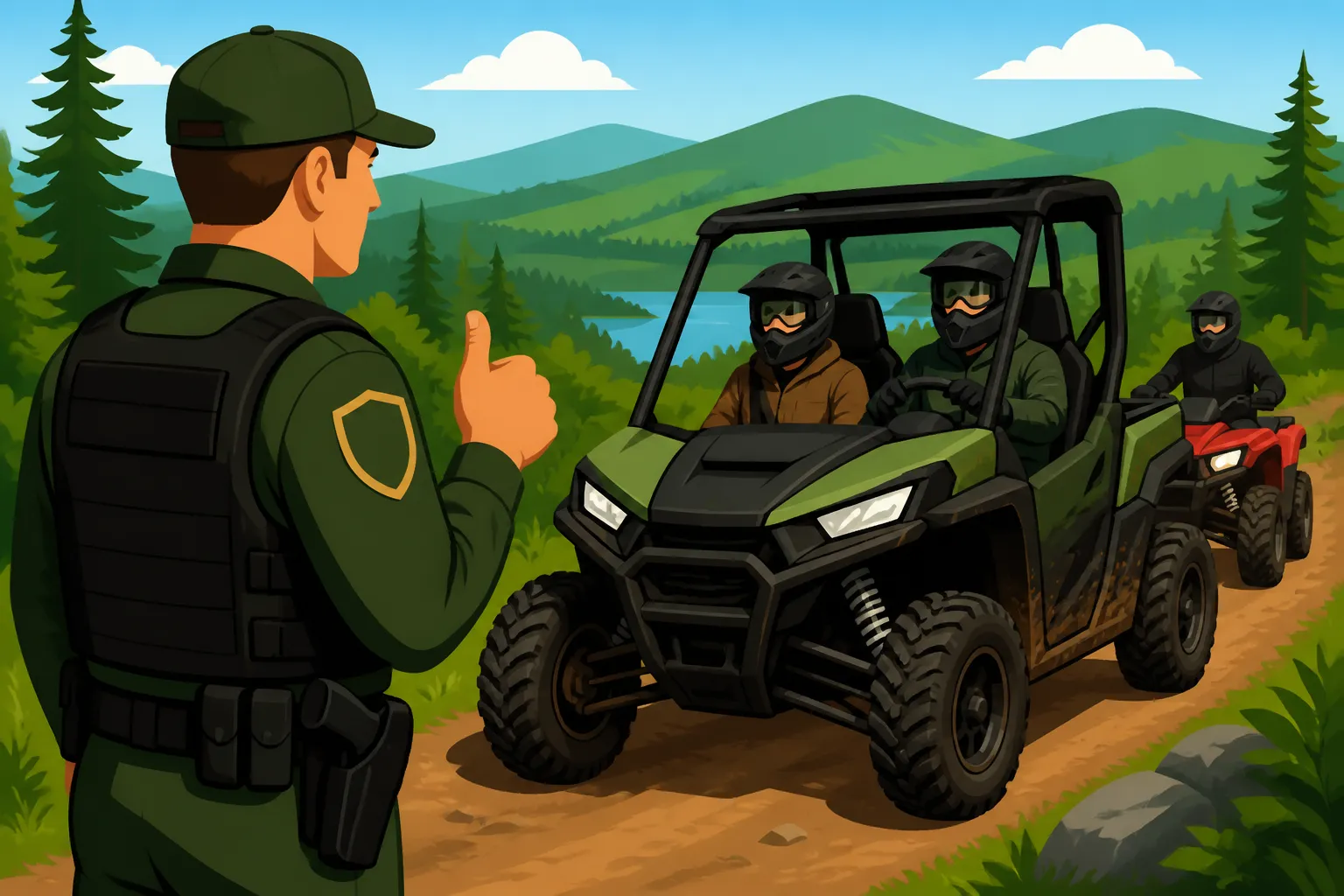
Vermont Warden Checks on the Trail
A warden stop can feel stressful when you are unsure what paperwork or equipment to show. In Vermont, the simplest way to handle a trail check is to know what may be requested, keep required documents accessible, and make sure your machine has the right registration and trail access. Here’s what to expect and how to prepare before you ride.
What a warden may check
A trail check is usually about confirming that you and your machine are allowed to be where you are, and that you are following the rules that apply to your ride. The details depend on the trail, your age, your machine and whether you are a Vermont resident or visitor.
A warden may ask to see documents or decals connected to registration, trail access, ownership, insurance or rider training. They may also check identifying information on the machine, such as its plate or vehicle identification number, and look at visible safety equipment. Not every stop involves every check.
For a closer look at common requests, see What a Warden Can Ask to See and What a Trail Warden Checks. The practical point is simple: be ready to explain who owns the machine, whether it is registered, and what gives you access to the corridor you are riding.
Registration and trail access are separate
A Vermont registration does not automatically grant access to every trail. On VASA corridors, riders generally need the required Trail Access Decal, or TAD, in addition to valid registration. A visitor’s home-state registration may be recognized for riding in Vermont, but that does not necessarily replace the Vermont trail-access requirement.
Keep the registration and decal current, and make sure the decal is displayed as directed. The decal is part of trail access, while registration identifies the machine for legal operation. For more detail, see Vermont Requires Registration Plus a TAD and Vermont Reciprocity for Out-of-State Machines.
Trail status matters too. A machine with current paperwork can still be on a closed corridor, a route that does not allow ATVs, or land where permission has been withdrawn. Stay on the marked route and obey gates and closure notices. A warden may ask where you are headed or how you accessed the trail; answer plainly and do not assume that a familiar-looking road is an open ATV route.
Rider training and age
Age-related rules may apply to younger riders, including safety-course and supervision requirements. A warden may ask a young rider about training or who is supervising them. Before a ride, check the rules that apply to the rider’s age and situation; do not rely on another state’s rules or on what was allowed on a previous trip.
The requirements can depend on the rider and where they are operating. Vermont Safety Course Required Under 18 explains the training issue in more detail. If a rider is subject to a training requirement, have the certificate or other accepted proof accessible rather than expecting a verbal explanation to settle the question.
What to carry and how to make a stop easier
A good setup lets you respond without rummaging through a backpack or leaving papers exposed to rain and mud. Keep documents together, protect them from weather, and make sure the information matches the machine and the person riding it.
Before leaving, confirm the following:
- Registration: Carry current proof for the machine, and check that the registration details match its identifying information.
- Trail access: Confirm whether the trail requires a TAD and that the decal is valid and properly displayed.
- Ownership: Keep a bill of sale, title, registration record or other useful ownership evidence available, particularly if the machine was recently bought, inherited or borrowed.
- Insurance: Carry proof of coverage and confirm that the policy applies to the machine and intended use. Vermont’s insurance rules are worth checking before riding; see Vermont Insurance Proof at a Trailhead.
- Training and supervision: If the rider’s age makes a certificate or adult supervision relevant, bring proof and make sure the required supervisor is present.
- Identification: Have identification available, and know who is responsible for the machine if you are riding one that belongs to someone else.
Paper copies are a dependable backup if a phone battery dies, a screen is difficult to read in bright light, or there is no service. If you keep a digital copy, treat it as a backup rather than assuming a digital image will be accepted in every situation. Ask the relevant agency or trail organization about acceptable proof when the format matters.
A small waterproof document pouch can keep papers together on a wet ride. If you shop for one through Amazon, choose a design that closes securely and can be stored where it will not interfere with the machine’s controls or safety equipment. Avoid carrying original ownership documents loose where mud, water or vibration could damage them.
Keep ownership information consistent
Ownership questions are more likely when the machine has recently changed hands, paperwork is incomplete, or the name on a document does not match the rider. Carry what you have and be ready to explain the situation accurately. Do not alter a document or guess at information you do not know.
If the machine is borrowed, ask the owner for the registration and any other information you may need before the ride. If you recently bought it, keep the purchase paperwork together with the registration documents. For guidance on ownership evidence, see Vermont Proof of Ownership on the Trail.
How to respond during a trail check
Stay stopped in a safe place, keep your hands visible, and follow reasonable directions. If you are riding with a group, make sure other riders stop too; continuing down the trail can create confusion and may turn a routine conversation into a more serious matter.
A calm, useful approach is:
- Stop promptly and safely. Move out of the way of other trail users when directed and secure the machine.
- Listen to the request. If you do not understand what is being requested, ask politely for clarification.
- Show the relevant documents. Hand over or display the requested proof without making sudden movements. Keep paperwork organized so you can find it quickly.
- Answer accurately. Give direct answers about the machine, its owner, your route and your riding group. If you do not know something, say so rather than inventing an answer.
- Ask what needs to be corrected. If the issue is a missing document, an unclear decal or a route restriction, ask what the concern is and what action is required.
- Follow lawful instructions. If you believe a request or decision is incorrect, avoid arguing on the trail. Make a note of the details afterward and use the appropriate process to ask questions or challenge a citation.
A warden may need to verify a machine’s identity or address a safety concern. If you are uncertain about the scope of a request, ask respectfully what is being checked. Do not obstruct the stop, conceal information or try to ride away. If you receive a citation, read it carefully and note the stated deadline and instructions. For a dispute, follow the process listed on the citation or seek qualified legal advice.
A check can also reveal a problem that is not limited to paperwork. For example, a trail may be closed, the route may not be designated for ATV use, or a rider may lack required gear or supervision. If you are directed to turn around, do so safely. Being Turned Around at a Gate covers why access can be refused even when a machine is otherwise properly registered.
Common problems to prevent before the ride
Most avoidable complications start with an assumption: that registration means trail access, that a visitor’s home registration covers every Vermont requirement, or that a machine is allowed on a route because other vehicles have used it. A few checks before departure can prevent a stop from becoming a trip-ending problem.
| Potential issue | Why it matters | What to do before riding |
|---|---|---|
| Registration is expired or does not match the machine | The warden may be unable to confirm the machine’s legal status | Check the registration and identifying information |
| TAD is missing, expired or displayed incorrectly | Registration alone may not provide access to a VASA corridor | Confirm the trail-access requirement and decal instructions |
| Visitor assumes home registration is enough | Reciprocity and trail access are separate questions | Check Vermont’s current requirements for your home jurisdiction |
| Ownership paperwork is incomplete | A recent sale or borrowed machine may raise questions | Carry available proof and contact the owner before departure |
| Insurance proof is hard to find | A rider may have coverage but be unable to show it promptly | Keep proof accessible and confirm the policy fits the planned use |
| Route status is unclear | A corridor may be closed or not open to ATVs | Check current maps, signs and local club notices |
| Young rider’s requirements are uncertain | Training and supervision rules can depend on age and circumstances | Verify the rider’s requirements and bring accepted proof |
Before a trip, check the current rules and trail information rather than relying solely on an old map or a previous season’s route. Vermont’s ATV network includes corridors that cross private land, so access depends on landowner permission and current trail designations. A route can change or close even if it appears on an older map. Respect signs, gates and requests from landowners. Vermont Trail Etiquette on Private Land explains why staying on the marked corridor matters.
Visitors should make two separate checks: whether Vermont recognizes their machine’s registration, and whether they have the access permission required for the trail they plan to ride. These are not interchangeable. If either point is unclear, contact the relevant Vermont authority or trail organization before towing the machine to a trailhead.
A brief pre-ride routine helps:
- Check registration, decal placement and dates.
- Confirm the trail is open to your machine and the route is currently designated.
- Put documents in a dry, reachable place.
- Verify insurance and any rider training or supervision requirements.
- Tell your group who is carrying the paperwork and what to do if the group is stopped.
- Leave extra time so no one feels pressured to ride through a gate or ignore a closure.
The goal is not to carry every paper you own. It is to be able to show the proof relevant to your ride, explain the situation clearly and respect the limits of trail access. When in doubt, verify the requirement before you unload. That is easier than trying to resolve a paperwork or access problem at the trailhead.
Disclaimer
This article is for general informational purposes only and does not constitute professional advice. Laws, prices and regulations vary by location and change over time. Consult a qualified professional for guidance on your specific situation.