Who Can Legally Supervise a Rider Under 16
A young rider may be capable on familiar trails but still need an adult’s help at a road crossing. In Vermont, the supervision rule supplied by the Department of Motor Vehicles applies specifically when an operator under 16 crosses a public highway. Knowing who qualifies—and what that rule does not authorize—helps families plan a safer, lawful ride.
Who may supervise a rider under 16
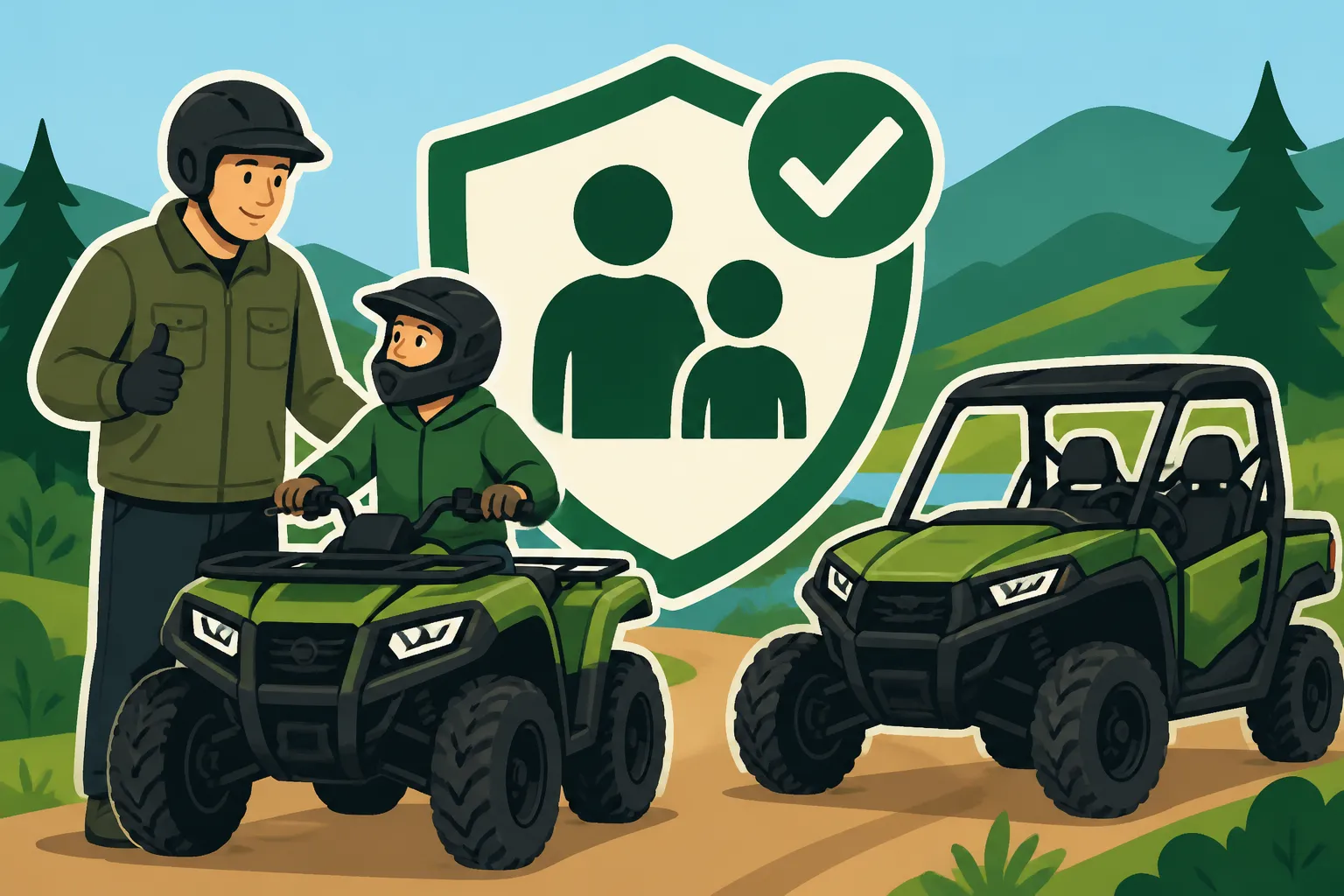
According to the Vermont Department of Motor Vehicles, an ATV operator under 16 must be supervised by someone 18 or older to cross a public highway. The rule identifies the supervisor by age: the person must be an adult who is at least 18. It does not say the supervisor must be the rider’s parent or legal guardian.
That distinction can help when planning a ride with family or friends. A parent may supervise, but the stated requirement is about the supervisor’s age, not their relationship to the young rider. If a family is unsure whether a particular arrangement meets the rule, it should confirm the current interpretation with the Department of Motor Vehicles or an appropriate local authority before riding.
The requirement is tied to crossing a public highway. It does not, by itself, establish that an adult must accompany every rider under 16 at all times or on every kind of trail. Nor does it make a public highway an ATV route. Supervision for a crossing and permission to ride on a road are separate questions. For the broader rules that may affect a young rider, see Vermont ATV Rules for a 15-Year-Old and Vermont ATV Rules for a 12-Year-Old.
The highway-crossing rule is also not a substitute for other age-related safety requirements. The Department of Motor Vehicles says children under 12 should never drive an ATV with an engine size greater than 70 cc, and youth under 16 should never drive an ATV with an engine size greater than 90 cc. An adult supervising a crossing does not make a machine suitable for a rider who falls within those limits.
What the crossing rule does—and does not—allow
A rule requiring an adult supervisor for a highway crossing should be read narrowly. It addresses the situation of an operator under 16 crossing a public highway with someone 18 or older supervising. It does not grant the ATV permission to travel along the highway, and it does not override road-access restrictions or local route rules.
Before setting out, distinguish among three things:
- A crossing: The ATV goes across a public highway.
- Travel on a road: The ATV uses the road as part of its route.
- Trail access: The ATV rides on a marked trail or other land where riding is permitted.
The rule about supervision concerns the first situation. Whether an ATV may travel on a particular road is a separate matter, and Vermont town road access can depend on local decisions. Check Can You Ride an ATV on the Road in Vermont? and Vermont ATV Road Rules by Town when planning a route that involves roads.
A legal crossing also depends on being in a place where riding is allowed in the first place. The Department of Motor Vehicles says ATV users must make sure they have permission before entering someone’s property, and users should remain on marked trails. A supervisor’s presence does not create permission to cross private land, use an unmarked route, or enter a closed area. For trail-specific responsibilities, see Vermont Trail Etiquette on Private Land.
State lands have their own limits. According to the Department of Forests, Parks and Recreation, ATVs may be used on state lands exclusively on specific road crossings designated by the Agency of Natural Resources. That restriction is separate from the age-based supervision rule. An adult supervisor cannot make an undesignated state-land crossing permissible.
| Question | Practical answer |
|---|---|
| Who must supervise an operator under 16 crossing a public highway? | Someone 18 or older, according to the Department of Motor Vehicles. |
| Must the supervisor be the rider’s parent? | The stated rule specifies the supervisor’s age, not a family relationship. |
| Does supervision allow the ATV to travel along a public highway? | No. The crossing rule does not establish road access. |
| Does supervision allow riding on private property without permission? | No. Riders still need permission to enter someone else’s property. |
| Does the same rule identify every situation in which a young rider needs supervision? | No. The stated rule concerns crossing a public highway. Check the applicable rules for other situations. |
If the route includes a road crossing, plan the route around a location where crossing is lawful and permitted. Do not treat a crossing point as an invitation to continue riding on the road. The details of an individual crossing, including whether the route is allowed there, can depend on local rules and the land involved. For additional crossing context, see Vermont ATV Crossing a State Highway and What a 12-Year-Old May Do at a Crossing.
How to plan a ride with a young operator
A little route planning can prevent a rider from reaching a highway unexpectedly. Before leaving, review the route with the young operator and identify any road crossings, trail junctions, private parcels, or restricted areas. If the route’s status is unclear, choose another route or check with the organization or authority responsible for it.
Use this practical checklist:
- Confirm the rider and machine are an appropriate match. The Department of Motor Vehicles says children under 12 should never drive an ATV with an engine size greater than 70 cc, and youth under 16 should never drive one with an engine size greater than 90 cc. Check the machine’s specifications rather than guessing from its appearance.
- Choose an allowed route. Make sure riding is permitted on the trail or property, and that any state-land road crossing is one designated for ATV use by the Agency of Natural Resources.
- Identify highway crossings in advance. If the operator is under 16, arrange for someone 18 or older to supervise the crossing, as required by the Department of Motor Vehicles.
- Keep the route within the marked trail system. The Department of Motor Vehicles advises users to remain on marked trails and to respect landowner property.
- Discuss what to do if the route is blocked or unclear. A young rider should know not to bypass a gate or leave a marked trail to find another way through. Stop and ask the supervisor to choose a lawful alternative.
The supervisor should be able to focus on the young rider and the crossing rather than trying to manage several unrelated tasks at once. Keep the group together, communicate the plan beforehand, and make sure the rider understands that a road crossing is different from riding along a road. These are sensible planning steps; they do not change the legal requirement that the supervisor be 18 or older.
The Vermont Department of Motor Vehicles points riders to a Vermont State Police-approved online ATV safety course for training and more information. The state’s ATV rules and regulations are also in the ATV Driver Manual, form VN-023. Those materials can help families review safety and operating expectations beyond the narrow highway-crossing rule. See Vermont Safety Course Minimum Age and Vermont ATV Equipment Requirements for related topics.
Common misunderstandings about adult supervision
“A parent has to be the supervisor.” The stated rule requires a supervisor who is 18 or older. It does not specify that the person must be a parent or guardian. Still, the responsible adult should understand the route and be prepared to help the rider follow the rules.
“An adult can make any road route legal.” No. The age requirement concerns supervision while crossing a public highway. It does not grant general permission to ride on that highway. Check road access separately, including town rules and posted restrictions.
“A supervisor means the rider can use any crossing.” No. Supervision does not replace the need for a permitted route. On state land, the Department of Forests, Parks and Recreation limits ATV use to specific road crossings designated by the Agency of Natural Resources. Permission is also needed before going onto someone else’s property.
“If an adult is present, the machine is suitable for any young rider.” No. The Department of Motor Vehicles separately advises that children under 12 should never drive an ATV with an engine size greater than 70 cc, and youth under 16 should never drive an ATV with an engine size greater than 90 cc. An adult’s presence does not remove those cautions.
“The crossing rule explains every supervision requirement.” It does not. The specific rule addressed here is for an operator under 16 crossing a public highway. For other questions about age, training, passengers, or road use, check the relevant rules rather than assuming the highway-crossing provision answers them all.
When there is uncertainty about a planned crossing, the safest course is not to rely on assumptions about the supervisor or the road. Confirm that the route is allowed, make sure the designated supervisor is at least 18, and choose a different route if permission or access is unclear. That approach respects the limited scope of the rule while keeping a young rider away from an avoidable roadside problem.
Sources
- Department of Motor Vehicles — Off-Road Vehicles | Department of Motor Vehicles (checked November 3, 2026)
- Department of Motor Vehicles — ATV Manual | Department of Motor Vehicles (checked November 3, 2026)
- Department of Motor Vehicles — Off-Road Vehicles | Department of Motor Vehicles (checked November 3, 2026)
- Department of Motor Vehicles — Off-Road Vehicles | Department of Motor Vehicles (checked November 3, 2026)
- Department of Motor Vehicles — VN-023-ATV_Driver_Manual.pdf (checked November 3, 2026)
Disclaimer
This article is for general informational purposes only and does not constitute professional advice. Laws, prices and regulations vary by location and change over time. Consult a qualified professional for guidance on your specific situation.