Trails Across Working Farms
A marked ATV corridor crossing a Vermont farm can feel like open countryside, but it is still a working property where livestock, equipment, gates, and seasonal fieldwork come first. This guide explains how to tell whether a route is authorized, how to ride respectfully around farm operations, and what to do when weather, animals, or a closure changes your plan.
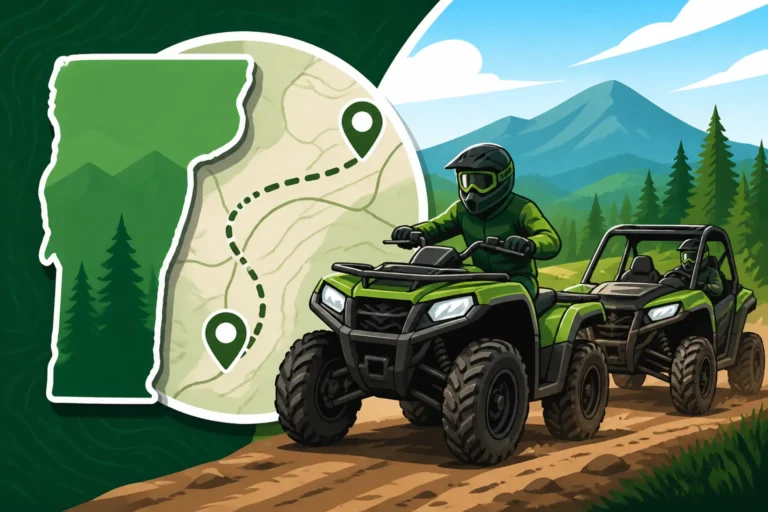
How ATV Trails Cross Vermont Farms
A marked corridor is not permission to roam
Many Vermont riding routes depend on landowner permission, including routes that cross farms and other privately owned land. That permission applies to the designated trail or corridor, not automatically to every field, farm lane, woodlot, or connecting track you can see from it. A visible tire path is not proof that it is open to riders.
Before you set out, check the route information from the club that maintains the trail and confirm that the corridor is open. The Vermont ATV Trails: The VASA System and Vermont Landowner Permission Holds the System Together explain why access depends on maintained routes and continued permission. If you use a navigation app such as onX Offroad, treat it as a planning aid rather than authorization to ride. A line on a map cannot tell you whether a landowner has temporarily closed a section.
This distinction matters most where a route passes close to farm buildings or splits into several tracks. A driveway may look like a convenient trail connection, and a tractor lane may seem to lead in the right direction, but neither should be used unless it is marked as part of the authorized route. Stay on the corridor even when a detour appears easier.
Farm work can change the route during the season
A farm is not a static backdrop. The land may be used for planting, haying, moving livestock, harvesting, repairing fences, or bringing machinery between fields. A route that is passable on one visit may be muddy, blocked, or temporarily unavailable later. A gate that is closed or a new sign posted at the trail can be a practical signal to stop and reassess—not an invitation to find another way around.
Seasonal conditions also affect the ground. A wet field edge or soft farm lane can rut under tires, and damage may make it harder for the farmer to do daily work. If a section looks saturated, freshly worked, or badly worn, avoid making it worse. Check club updates before towing to a trailhead, and be prepared to turn around if the route is closed. Vermont Trail Conditions Before You Tow is a useful companion when planning a ride around changing conditions.
Riding Responsibly Around Farm Operations
Give livestock and farm machinery room
Cattle, horses, sheep, and other animals can react unpredictably to noise or sudden movement. Slow well before reaching livestock, keep a steady course, avoid revving the engine, and leave as much space as the corridor allows. Do not stop close to an animal to take a photo, and never try to feed or touch livestock. If animals are directly on the route, stop at a safe distance and give the farmer room to manage the situation.
Farm machinery deserves the same patience. A tractor, truck, or hay wagon may be wide, slow, or difficult to maneuver, and the operator may not be able to see a rider approaching from behind. Do not squeeze between equipment and a fence, follow closely, or pass where there is limited room. Wait for a safe opportunity and follow any direction from the operator or landowner.
If a farm worker asks you to pause or leave a section, comply calmly. It may be a short-term need tied to moving animals or equipment, even if the trail appears clear at first glance. Being courteous in that moment helps protect access for future riders.
Keep gates, fences, and field edges as you found them
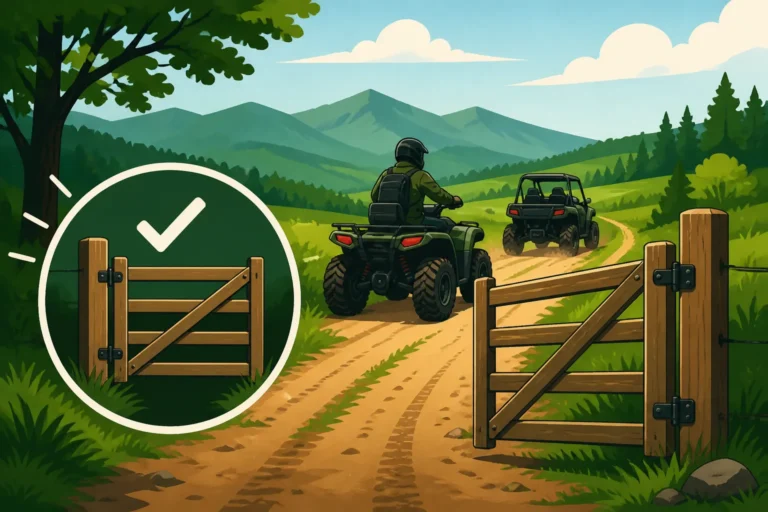
A gate is part of the farm’s everyday operation. Follow posted directions and the trail’s established gate procedure. If a gate is meant to be closed behind you, close it securely; if signs or instructions say otherwise, follow those instructions instead. Never assume that an open gate should be shut or that a closed gate should be opened. When the purpose is unclear, do not improvise—check with the trail club or landowner.
Stay on the marked corridor rather than cutting across a field to avoid a puddle, a group, or a rough patch. Repeated off-route riding can damage crops, compact soil, or create tracks that look like a new route. Do not ride around a barrier through a field or along a fence line. Gates Left As You Found Them and Staying on the Marked Corridor cover habits that help protect access and property.
| What you encounter | A considerate response | Avoid |
|---|---|---|
| Livestock near the route | Slow down, keep distance, and wait if needed | Honking, revving, or approaching animals |
| Farm machinery ahead | Leave room and wait for a safe opportunity | Passing in a narrow space or riding close behind |
| A gate with instructions | Follow the posted or established procedure | Guessing, bypassing it, or leaving it unsecured |
| Muddy or freshly worked ground | Turn back or follow an authorized alternate route | Cutting across a field or creating a bypass |
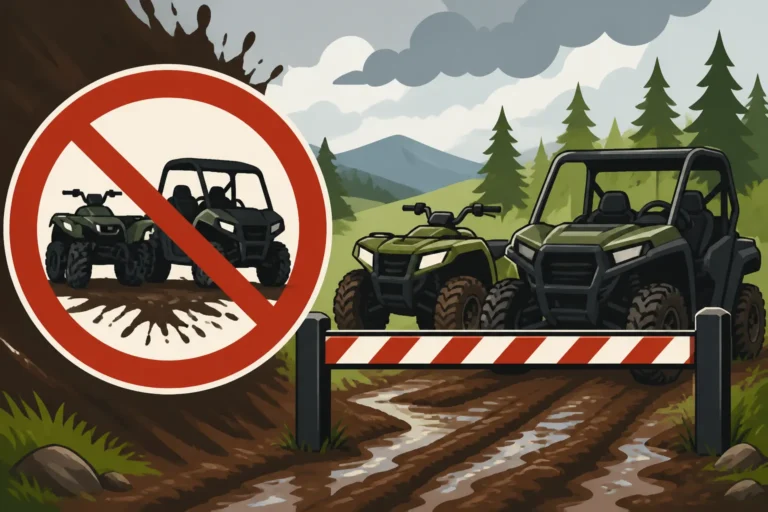
| A closure sign or blocked trail | Stop and check current club information | Going around the barrier |
| A route that appears unmarked | Confirm authorization before continuing | Treating a visible tire track as a trail |
Planning a Farm-Crossing Ride
Check the route before you leave home
Start with information from the club responsible for the corridor. Look for current trail status, route descriptions, closures, and any instructions about access. Vermont routes can involve private land and changing conditions, so an old saved track or a map screenshot may not reflect what is open today. If you are unsure about a section, ask the maintaining club before riding it.
A navigation tool can help you orient yourself, identify where your group is, and compare your position with a planned route. onX Offroad may be useful as one layer in that planning, but do not let an app override signs, gates, club notices, or a landowner’s direction. Keep an official club map or route information available as well, and make sure everyone in the group understands that only the marked, authorized corridor is part of the ride.
If a route appears to cross a farm but the trail marking is unclear, stop before entering the property. Do not follow another rider simply because they seem confident. Confirm the route through the club’s current information or choose a route you know is open.
Build in time for a change of plan
Farm work, weather, and trail conditions can change a ride after you have started. Tell your group in advance that a closure or an unsafe section means turning around, not improvising a shortcut. Carry enough fuel and supplies to retrace your route, and avoid planning a schedule so tight that the group feels pressured to push through a questionable crossing.
For longer rides, agree on a simple regrouping plan. If someone stops at a gate or waits for farm machinery, the riders behind should stop in a safe place rather than crowding the crossing. A group leader can check the route information, contact the maintaining club when appropriate, and decide whether the group should wait, turn back, or use a confirmed alternate corridor.
When a route is closed, respect the closure even if it disrupts the day. Why a Landowner Can Close a Trail Overnight explains why access can change quickly. A closure may reflect fieldwork, damage, safety concerns, or a landowner’s decision; riders do not need to know every detail to honor it.
Protecting Continued Access to Farm Trails
Leave a good impression beyond the trail itself
A considerate ride includes what happens at the trailhead and after the group passes a farm. Park only where permitted, keep noise down near homes and farm buildings, and do not block driveways, gates, or equipment access. Pack out food wrappers and other trash. If your machine has mud on it, avoid carrying clumps of soil onto roads or into parking areas where they can create a mess or hazard.
Ride at a speed that gives you time to respond to people, animals, and equipment. Keep the group together without bunching up at narrow crossings, and make sure riders behind you know when the route changes or a gate requires attention. If you see a damaged sign, downed fence, or unsafe obstacle, report it to the trail club rather than attempting a repair unless you have permission and know how to do it safely.
Private land access is built on trust. A single rider who cuts through a field or leaves a gate open can create a problem for the farmer and for the club maintaining the corridor. The Vermont Trail Etiquette on Private Land provides a broader set of practices for riding respectfully on privately owned routes.
Treat access as something to preserve
The best way to keep farm crossings available is to make your ride predictable and low-impact. Follow trail markings, obey closures, respect landowner instructions, and do not invite others onto a route that is not open to them. If a landowner or club volunteer explains a local rule, listen rather than arguing about what an app or an older map shows.
It also helps to plan with the group before departure. A brief conversation about gates, livestock, farm traffic, noise, and closures can prevent a tense moment when everyone is already on the trail. Make clear that no one should create a new track to get around mud or a blockage. If conditions make the authorized route unsuitable, turning back is the responsible choice.
onX Offroad can be part of your preparation, but the most dependable decisions come from combining navigation with current trail information and on-site signs. Use the app to help you understand your location, not to justify crossing a field or ignoring a barrier. When riders respect the farm as a workplace, they help maintain the relationships that make these corridors possible.
Disclaimer
This article is for general informational purposes only and does not constitute professional advice. Laws, prices and regulations vary by location and change over time. Consult a qualified professional for guidance on your specific situation.