Gates Left As You Found Them
A gate on a Vermont ATV trail may be controlling livestock, protecting a work area, or marking a landowner’s boundary. It can be tempting to assume an open gate should stay open, or a closed one should be left alone. This guide explains how to handle gates responsibly, what to check before continuing, and how a small decision can affect trail access for everyone.
Why gate etiquette matters on Vermont ATV trails
Gates often serve a purpose beyond the trail
Many Vermont ATV corridors cross private property. A gate may keep cattle, horses, or other animals in a pasture; restrict access to a yard or work site; or help a landowner manage vehicles moving between fields, woods, and roads. It can also mark the edge of a route where access is allowed only along a defined corridor.
That means the gate is not simply an obstacle to get past. Its position may be part of how the landowner and local club manage access. A gate left open can let livestock wander onto a road or into another field. One left closed may block an authorized trail corridor, delay another rider, or interfere with a landowner’s work.
The basic courtesy is simple: leave the gate as you found it unless a posted sign, trail steward, landowner, or other clear instruction tells you otherwise. If you are unsure what you encountered, stop and assess the situation instead of guessing. The principle behind [Gates Left As You Found Them] applies throughout shared corridors, whether you are riding a short section near a village or a longer route in the Northeast Kingdom.
Shared access depends on trust
An open trail through private land is a privilege, not a permanent guarantee. Landowners can have practical reasons to change access, and clubs often rely on relationships with those owners to maintain a usable trail network. A gate left swinging in the wind, a damaged latch, or a machine driven around a barrier can make a landowner less comfortable with continued access.
One rider’s decision can affect more than one trip. If an owner finds livestock outside a pasture or equipment exposed to unauthorized traffic, they may ask a club to reroute or close a corridor. That can affect local riders, visiting families, volunteers, and nearby businesses that depend on responsible trail access.
This is why following signs and respecting barriers is part of trail etiquette, not just a matter of convenience. The broader context is covered in [Vermont Landowner Permission Holds the System Together] and [Vermont Trail Closures Landowners Request]. A gate is often the most visible reminder that a corridor crosses someone else’s property.
What to do when you reach a gate
Use the gate’s original position as your guide
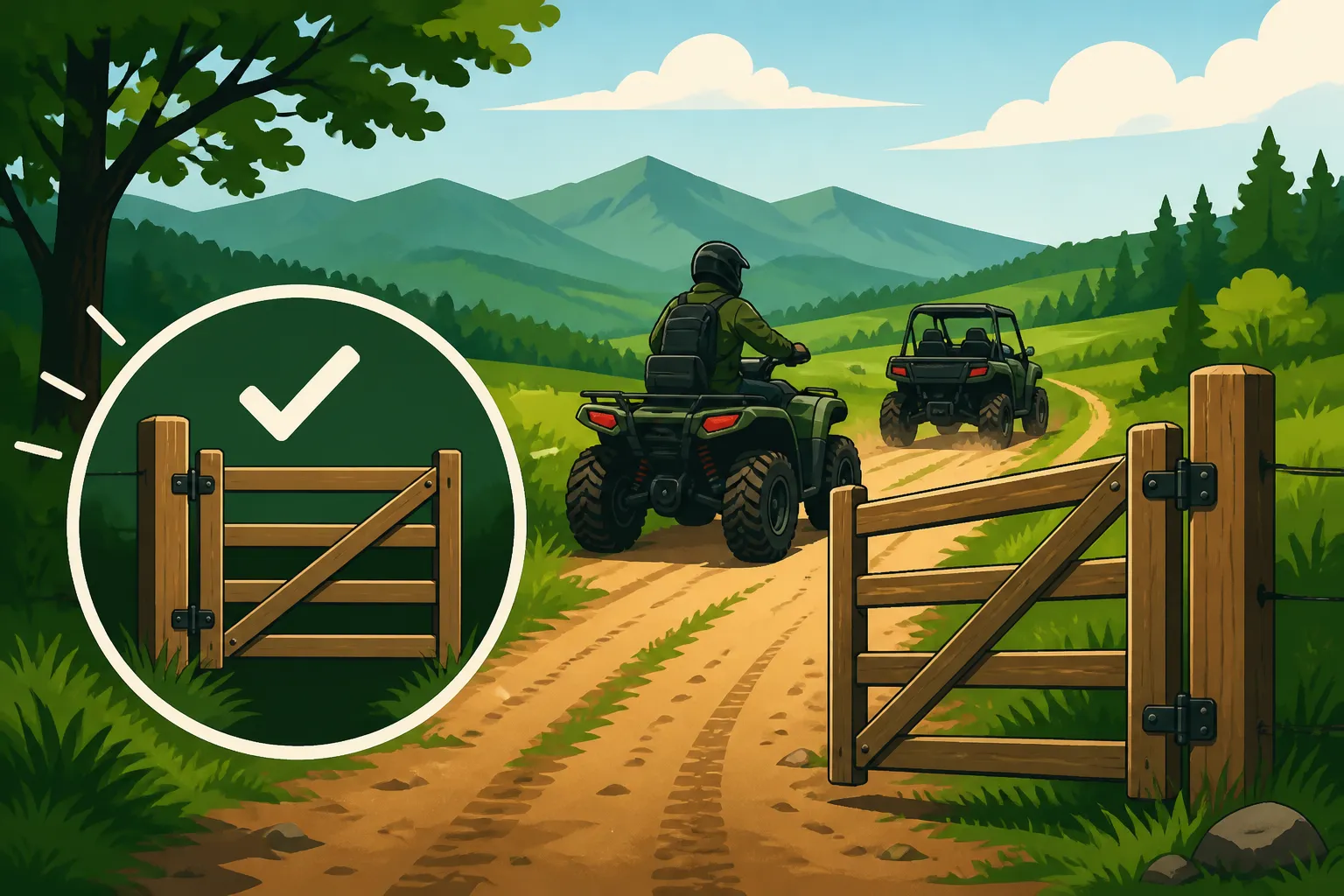
Before touching the gate, pause long enough to see how it is secured and whether there are signs, tracks, or other clues. If it is closed and latched, open it only if the marked route clearly continues through it and riders are permitted to pass. Go through carefully, then close and secure it in the same manner. Do not leave it resting against a post or hanging open because that seems faster.
If the gate is open, do not automatically close it. It may have been left open intentionally for the landowner, a farm vehicle, or a planned trail passage. Leaving it as you found it is the safest general approach when there are no additional directions. Avoid changing the gate’s position simply because you think it would be better closed or more convenient for the next rider.
| What you find | Sensible response |
|---|---|
| Closed and latched, with the marked route continuing through | Open only as needed, pass through, and close and latch it as found |
| Open, with no sign or instruction to close it | Leave it open as found |
| A sign gives a specific instruction | Follow the posted instruction |
| Gate is damaged or cannot be secured | Do not force it; notify the local club or trail contact |
| Access is unclear or the route appears closed | Stop and verify before proceeding |
| Animals are near the opening | Move slowly, avoid startling them, and make sure the gate is secured as directed |
A gate can be heavy, awkward, or under tension. Keep hands clear of hinges and latches, and make sure every rider in your group understands who is handling it. If a passenger or younger rider is helping, do not let them stand where the gate could swing or where a machine might roll toward them.
Make the crossing calmly and safely
Approach at a controlled speed and stop before the gate rather than braking sharply at the last moment. Give the rider behind you enough room to stop, and avoid crowding the person opening or closing it. If you are riding in a group, pass through one machine at a time so the gate is not left unattended while several riders move through.
Keep the ATV or side-by-side on the established trail surface. Do not widen the opening by riding around a post, cutting across a field, or forcing a machine through brush. Those shortcuts can damage property and create the impression that riders are willing to ignore the corridor boundary. Staying on the signed route is part of [Staying on the Marked Corridor] and [Vermont Trail Etiquette on Private Land].
Once through, check the latch before moving on if you were responsible for closing the gate. A gate that looks shut may not be secured. At the same time, do not spend time adjusting a gate beyond what is needed to return it to its original position. The goal is to preserve the landowner’s setup, not redesign it.
When the situation is unclear
Signs and closures take priority over assumptions
A gate’s position does not always tell the full story. There may be a temporary closure, seasonal restriction, farm operation, washout, or other condition that makes continuing unsafe or unauthorized. Look for signs on both sides of the gate and check the club’s current route information before setting out. A map can help you understand where a corridor is supposed to go, but it does not override a closure notice or permission change.
For trip planning, use the local club’s trail information and maps rather than relying on an old saved route alone. Tools such as onX Offroad can help riders review a route and orient themselves, but confirm that the corridor is currently open through the relevant club or trail source. The same habit matters when using a downloaded map or phone app: a line on a screen is not proof that access remains available.
If you arrive at a locked gate, a clear “closed” sign, or a barrier that blocks the route, do not climb over it or ride around it. Turn back and report the issue to the appropriate club contact if the closure is unexpected or the signage is confusing. [Why a Landowner Can Close a Trail Overnight] explains why access can change even when riders have used a route before.
Report damage without making it worse
If a gate is broken, its latch is missing, or it is lying across the trail, do not try to repair it unless you have the landowner’s permission and the right equipment. A well-meant fix can damage a hinge, leave a gate unsecured, or create a safety hazard for someone approaching from the other direction.
Take note of the location and describe what you see. If it is safe and appropriate, a photo can help a club volunteer identify the problem, but do not photograph people or private areas unnecessarily. Contact the local club or the trail organization responsible for the corridor, and provide a concise report: the trail or nearby landmark, the gate’s condition, and whether the route is passable.
Do not post a speculative claim that a route is permanently closed or blame a landowner for a temporary barrier. Information can be incomplete, and public arguments can strain relationships that clubs work hard to maintain. If you use onX Offroad or another navigation app, a location pin or clear landmark description can make a report easier to understand, but share it directly with the appropriate trail contact rather than treating a map note as official notice.
Build gate etiquette into every ride
Prepare your group before you leave
A quick conversation before the ride can prevent confusion at the first barrier. Tell everyone to slow down at gates, watch for posted directions, and avoid riding around a closed gate. Decide who will handle the gate when possible, especially if the group includes children, new riders, or passengers who may not know the routine.
Before departing, review the route and check for closures or changes with the local club. For a larger group, identify who is leading and who is riding at the back so no one gets separated while a gate is being opened. A leader can wait until the last machine is through and confirm that the gate has been returned to its original position.
Trail etiquette also includes leaving the corridor clean and avoiding unnecessary noise near homes, farms, and work areas. A careful approach at one gate is part of a larger pattern of respectful riding. For more on shared routes and access, see [Vermont Club Volunteer Work Days] and [Vermont Landowner Permission Forms].
Treat every gate as someone’s property, not a trail feature
The most useful rule is also the easiest to remember: observe, follow instructions, and leave the gate as you found it. Do not assume that an open gate is an invitation to leave it open, or that a closed gate is an invitation to change it. When signage or conditions make access uncertain, stop and verify rather than taking a chance.
That small pause protects livestock, property, and the trust that keeps corridors open. It also makes the ride smoother for the next person, who should find the trail in the same condition you did. Vermont’s trail system depends on riders making these considerate choices again and again, including when nobody is watching.
Disclaimer
This article is for general informational purposes only and does not constitute professional advice. Laws, prices and regulations vary by location and change over time. Consult a qualified professional for guidance on your specific situation.