Why a Landowner Can Close a Trail Overnight
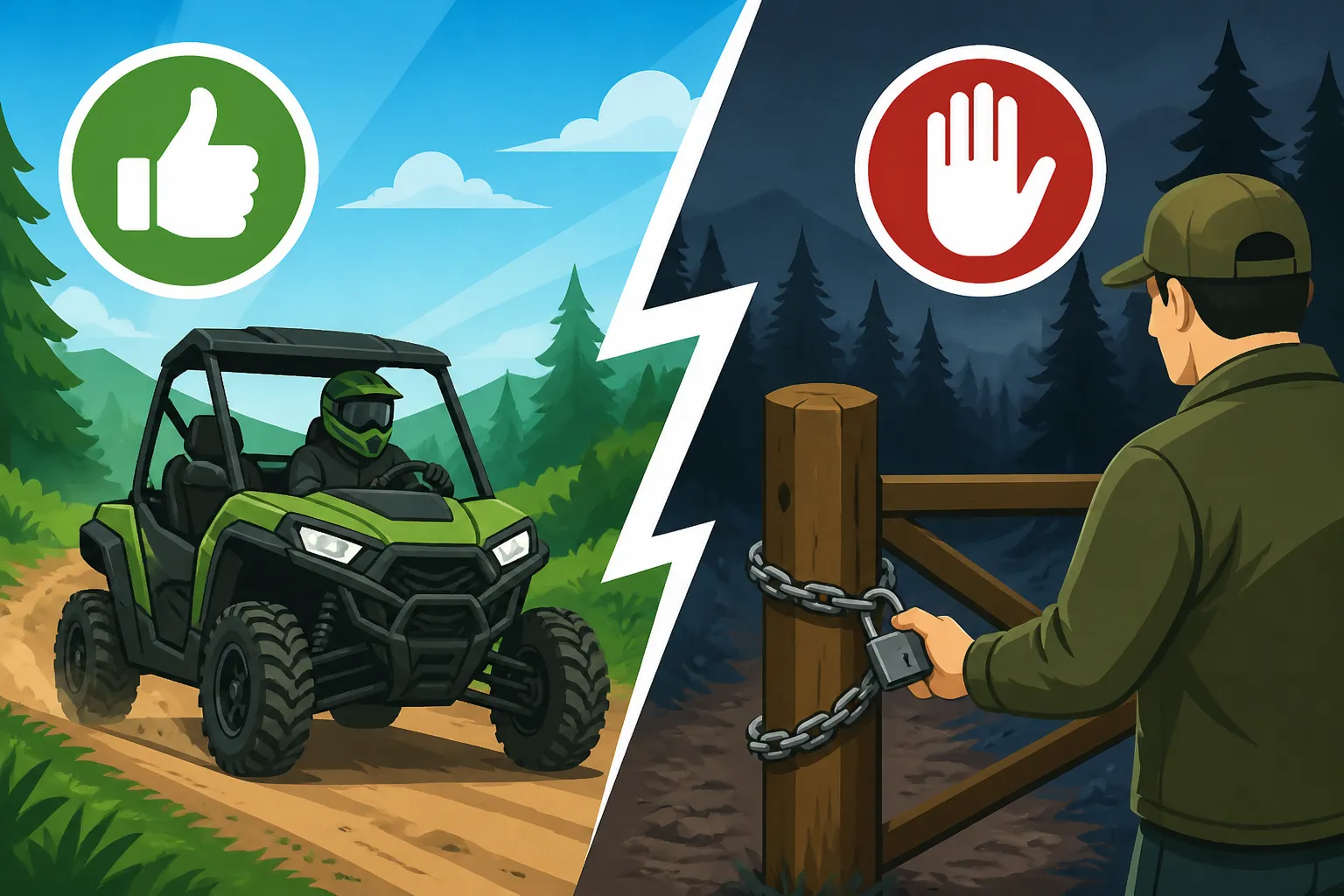
A Vermont ATV trail that was open yesterday may be closed today, leaving riders with a trailer, a planned route, and no clear explanation. That change can feel abrupt, especially when a corridor appears on a map or has been rideable for years. Here’s why a landowner may close a trail overnight, what to do when it happens, and how to plan without treating access as guaranteed.
Why Vermont ATV trails can close with little notice
Much of the trail network depends on private permission
A marked route can look permanent on a map while crossing land that remains privately owned. In Vermont, many ATV corridors rely on landowners allowing a club or trail organization to use a defined route across their property. That permission makes riding possible, but it does not turn the land into public property or necessarily create an indefinite right to use it.
This arrangement is especially important in the Northeast Kingdom, where corridors may cross timberland, farms, and other private parcels between towns. A landowner can decide that access no longer works for them and ask for it to stop. A local club or trail organization may then close the corridor, remove or cover signs, and work on a reroute if one is available. For a closer look at how this network functions, see [Vermont's Trails Run on Private Land] and [Vermont Landowner Permission Holds the System Together].
The practical point is easy to miss: a trail’s existence on a map does not mean riders have a permanent entitlement to cross every property along it. Even if you have ridden a segment for years, current permission matters. If that permission is withdrawn, continuing past a closure sign or gate can turn a frustrating detour into a trespass problem.
A trail closure is not always the same as a road closure
Vermont riders may use several kinds of routes: club-maintained trails, corridors over private land, and town roads that have been designated for ATV use. Those routes can have different decision-makers and different rules. A landowner’s choice to end access across their parcel can affect a private trail corridor, while a town-road designation is generally a municipal decision.
That distinction matters when you’re trying to understand what has closed. A landowner may close a trail crossing their property, but that does not automatically mean an entire town road network has been shut. Conversely, a road that was open to ATVs in a previous season may no longer be designated. Check the specific route and the authority responsible for it rather than assuming one closure notice applies to every nearby segment. The guide [Vermont ATV Road Rules: Towns Decide] explains why road access can vary from town to town.
When you’re unsure whether a route is a private trail, a town road, or a connection between the two, pause and confirm before continuing. A map line by itself may not tell you who controls access or whether the designation is current.
“Overnight” may describe when riders notice, not when the decision was made
A closure can feel as though it happened overnight because riders often learn about it at the trailhead or when they encounter a gate. The underlying issue may have been building for weeks: repeated problems with noise, rutting, litter, unauthorized riding, or disagreements over where the route runs. Or a landowner may make a decision quickly after a sudden event, such as property damage or a change in plans for the land.
Clubs may need time to notify riders, update route information, and remove or revise signs. In a connected network, one property owner’s decision can also affect a longer corridor: the trail may have used that parcel to link two otherwise separate sections. A closure can therefore disrupt more than the short stretch shown beside a gate.
That doesn’t make a sudden closure arbitrary from the rider’s perspective. It means the landowner and trail organization may be dealing with circumstances riders cannot see from the corridor. For perspective on the broader relationship, [Why a Landowner Withdraws Permission] looks at common reasons access can end.
What may prompt a landowner to close access
Property use can change
Private land is not a fixed recreation space. An owner may need to harvest timber, move equipment, repair a road, manage a farm, build or maintain a structure, or use the property for another purpose that conflicts with ATV traffic. A route that worked during one period may no longer fit the way the property is being used.
In a working forest, for example, a machine or truck may need to travel along a corridor where riders previously passed. On farmland, seasonal work can make a route unsuitable or unsafe. Sometimes a closure is temporary while work is underway; sometimes the owner decides the trail should not return. Riders may not receive a detailed explanation, and they should not assume that a temporary-looking barrier can be bypassed.
If a closure notice gives a reason or time period, follow it as written. If it doesn’t, treat the route as closed unless the responsible club or authority confirms otherwise. Never decide on your own that a gate is only meant for vehicles larger than an ATV.
Damage, noise, and repeated rule-breaking can wear down goodwill
The trail network depends on more than a signed agreement. It also depends on riders behaving in ways that make continued access acceptable to the people whose land they cross. A single incident can cause a problem, but repeated smaller ones may also add up: leaving a gate open, riding off the marked corridor, speeding near homes, making excessive noise, or leaving trash.
Wet conditions can intensify the impact. A route that is manageable when firm may rut badly after rain or during mud season. Riders who go around a wet section can widen the trail or damage vegetation, leaving more work for a club and greater concern for the owner. If a landowner sees recurring damage or disregard for boundaries, closing access may feel like the clearest way to protect the property.
Etiquette is not just about being courteous to another rider. It is part of preserving access. [Vermont Trail Etiquette on Private Land] and [Gates Left As You Found Them] cover the small choices that can help prevent avoidable conflict.
Safety and liability concerns may change an owner’s comfort level
A property owner may become concerned about a crossing, a damaged bridge, an unstable slope, a new hazard, or the way people are using the trail. A route can be closed while a club or owner assesses the situation, even if riders have not heard about an accident. The absence of a visible hazard to one rider doesn’t establish that the corridor is safe for everyone.
Changes in traffic can matter, too. If riders begin using a route in a way that was not expected, or the corridor becomes harder to manage, the owner may reconsider allowing access. A landowner might also prefer to close a segment rather than leave an uncertain crossing open while repairs or decisions are pending.
Riders should not treat a closure as an invitation to investigate the problem on foot or by machine. Stay on the public or permitted route, give workers and property owners room, and seek updates through the trail organization or town rather than confronting someone at the gate.
How a closure affects your ride and route plan
One closed parcel can break a longer connection
A corridor network works like a chain: a short segment can connect a trailhead, a town, or two larger areas. If that link closes, a route that once seemed continuous may no longer be rideable from end to end. In areas around Island Pond, Newport, or elsewhere in the Northeast Kingdom, the practical impact can be a longer detour, a changed ride plan, or no legal connection at all.
Don’t assume you can simply ride around the closure on a nearby logging road or through an adjacent parcel. An alternate track may be private, unmarked, closed, or unsuitable for ATVs. Riding around a barrier can also create a new access problem for the owner whose land you enter.
Before setting out, identify your planned route’s likely pinch points: bridges, crossings, narrow connections, and segments that link separate corridors. If a key link is closed, change the plan rather than trying to improvise around it. [Vermont Trail Closures Landowners Request] and [Vermont Trails Connected by Town Roads] can help explain how a closure may affect connectivity.
Maps and older information may not reflect a new closure
Printed maps, saved routes, social media posts, and GPS tracks can remain in circulation after access changes. A track recorded on a previous ride only shows where someone traveled at that time; it does not prove that the route is currently open. Even a line displayed by a mapping app should be treated as a navigation aid, not permission to cross private property.
Digital tools such as onX Offroad can help you review route options and understand the surrounding terrain before leaving home. But no app can replace checking current trail status and respecting a closure sign. Use onX Offroad as one part of trip planning, then confirm access with the relevant club or official trail information before you ride.
A sensible habit is to compare more than one source when a route is important to your plan. Look for recent club announcements, current trail-status notices, and signs at the trailhead. If sources disagree, choose the cautious option and avoid the uncertain segment until you can confirm it is open.
A closure may be local rather than statewide
A closed trail does not necessarily mean that all Vermont ATV riding is suspended, or that every route in a town has changed. The restriction may apply to one property, one segment, or a temporary area affected by work or conditions. At the same time, a local closure can have consequences beyond the property boundary if it removes a vital connection.
Ask what route is affected and what alternatives are officially available. Avoid turning a local announcement into a broad claim that a whole region is open or closed. If you’re riding near a town-road connection, check the town’s posted route information as well as trail-club updates. [Vermont Towns That Never Opened a Road] is a useful reminder that riding access can differ significantly even between nearby communities.
For a group ride, pass along the precise closure information rather than a vague message like “the trails are closed.” That helps other riders avoid both unnecessary cancellations and accidental entry onto a closed segment.
What to do when you encounter a closed trail
Stop and follow the sign or barrier
If you reach a gate, closure notice, or clearly marked boundary, stop before entering the restricted area. Don’t ride around the gate, squeeze beside a barrier, or follow tire tracks through a closed section. Another machine’s tracks do not demonstrate that access is allowed.
Take a moment to read the notice from a safe location. It may identify a temporary closure, a closed segment, or the organization to contact for an update. If you’re riding with others, tell the group to stop as well; it’s easy for a rider farther back to follow the lead machine past a sign they never saw.
If the closure blocks your planned route, turn around or use an alternate route that is clearly open and authorized. Do not cross private land to reach a road or trail just because it looks like the shortest way out. When conditions or the layout make a safe retreat unclear, contact the relevant trail organization or local authority for guidance.
Verify the status through the responsible organization
Look for information from the club that maintains the corridor, the organization responsible for the trail network, or the town if the route involves a designated road. A local announcement may clarify whether the closure is temporary, whether a reroute is planned, or which nearby segments remain open. If you can’t find an update, don’t assume silence means the route has reopened.
A club’s role may include managing signs, responding to landowner requests, and communicating route changes. It may not be able to share private details about why an owner withdrew permission. A concise, respectful question is more useful than demanding a personal explanation from the landowner.
When you contact someone, include the route or trail name if you know it, the nearest trailhead or landmark, and what the sign says. Avoid posting identifying details about an owner or property online. That keeps the conversation focused on access and avoids escalating a situation that may already be sensitive.
Don’t create a second problem while looking for a detour
A common temptation is to ride along the edge of the trail, follow a faint track, or cross a field to regain the route. That can expand the closure’s impact by bringing machines onto land that was never part of the authorized corridor. It can also make the owner less willing to support a future reroute.
If you need to change your route, return to a place where you can choose a confirmed option. Use onX Offroad to orient yourself and compare the terrain, but verify that any alternate corridor is open before entering it. Remember that a mapped road or trail can still be private or restricted.
For more on identifying the route and keeping to its authorized line, see [Staying on the Marked Corridor] and [Reading a VASA Club Trail Map]. When in doubt, take the longer confirmed route or end the ride early rather than treating an unknown track as an acceptable shortcut.
How riders can help keep access open
Ride as a guest, not as if the trail were public property
Even if a trail is familiar, behave as though you are a guest on someone else’s land. Stay on the marked corridor, keep gates as you found them, avoid unnecessary noise near homes, and leave no trash. If a landowner or worker asks you to stop, be calm and follow instructions rather than arguing at the property boundary.
Make sure every person in your group understands the route and the rules before you leave. A rider who wanders off the corridor can create a problem for the whole group and may contribute to a broader loss of access. A quick briefing at the trailhead is often worthwhile: stay together, obey closure signs, and don’t improvise a detour.
These habits matter especially on group rides, where riders at the back may not hear a warning given at the front. Assign someone to watch for signs and confirm that the group stays on the marked route. Respect for the corridor is part of being able to ride it again.
Support the organizations maintaining the network
Trail organizations often coordinate with landowners, manage signs, maintain corridors, and respond when access changes. Riders can help by reporting a downed sign, damaged crossing, or confusing closure notice through the appropriate channel. Share factual details, such as the location and what you observed, without speculating about the owner’s motives.
Volunteering, joining a local club, or supporting trail work can also strengthen the relationships that make the network possible. It won’t guarantee that any particular parcel remains open, but it helps the people doing the work respond to problems and communicate with riders. [Vermont ATV Clubs and What They Maintain] offers more context on the role clubs can play.
When access is lost, avoid blaming or naming an owner in public posts. A private landowner’s decision is theirs to make; respectful communication leaves more room for a constructive conversation about a different route or future access.
Make a flexible plan before you tow
Build extra time into the day and know where you can turn around. Before towing from Burlington, Montpelier, or farther away toward the Northeast Kingdom, check the trail information available for your intended area and identify a backup ride that does not depend on the same closed connection. If your group has limited fuel or daylight, a closure can turn a small detour into a much larger problem.
Keep a phone charged, save relevant information for offline use where possible, and let someone know your general plan. A phone app can help you understand where you are, but don’t rely on cellular service in remote areas. onX Offroad may be useful for planning and orientation; confirm that the trail itself is open through current local information.
Most of all, treat access as something to verify, not something to assume. That mindset makes an unexpected closure easier to handle and helps prevent a disappointing ride from becoming a trespass or property-damage issue.
Disclaimer
This article is for general informational purposes only and does not constitute professional advice. Laws, prices and regulations vary by location and change over time. Consult a qualified professional for guidance on your specific situation.