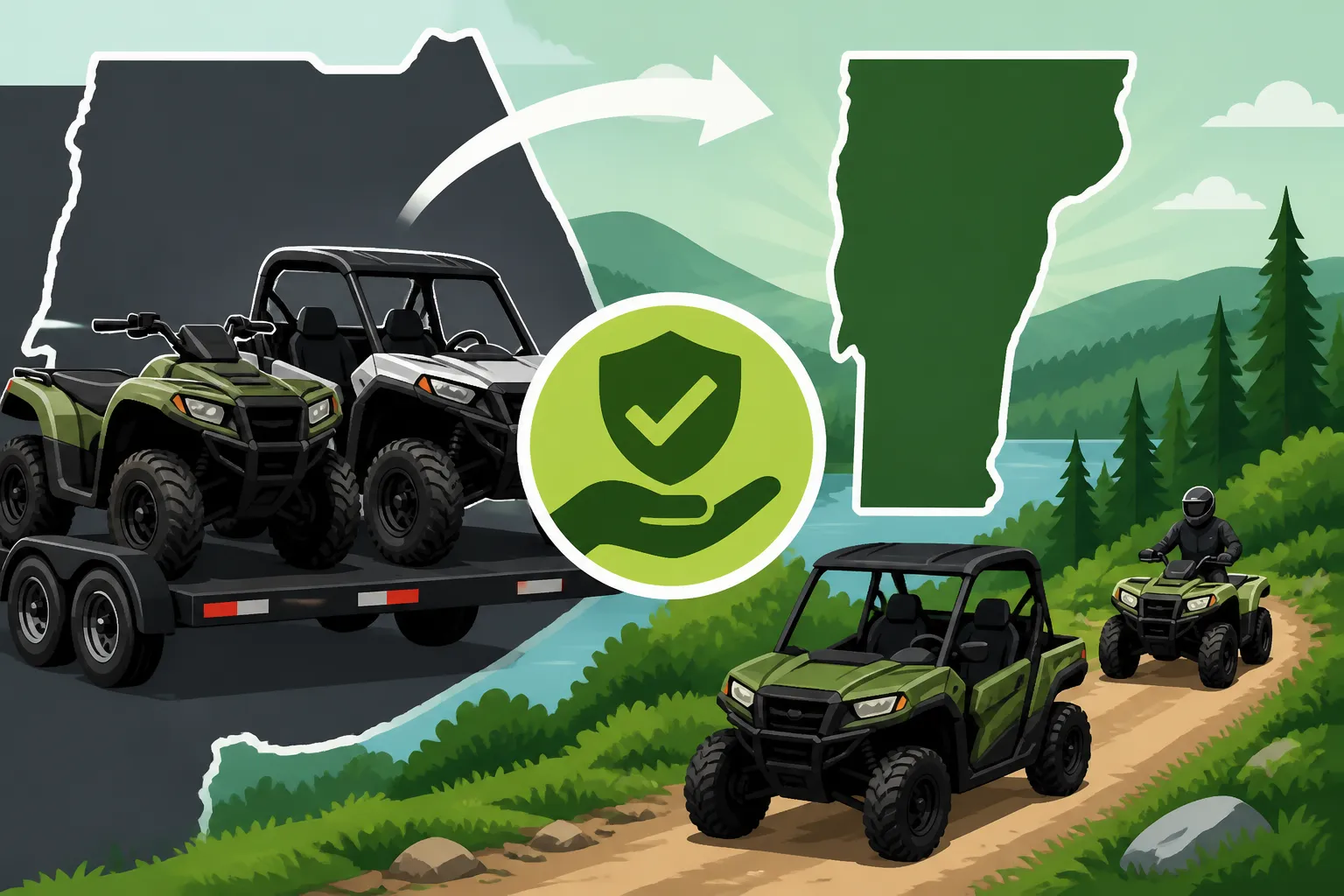
Vermont TAD at $125 for Out-of-State Machines
Vermont TAD at $125 for Out-of-State Machines
Bringing an ATV or side-by-side into Vermont does not automatically give you access to its VASA trail network. In addition to valid registration, an out-of-state machine generally needs a Vermont Trail Access Decal, or TAD. Here’s what the $125 visitor decal covers, how to get one, and what to check before you tow north.
What the $125 Vermont TAD Is For
A Vermont Trail Access Decal is permission to use participating Vermont ATV trails, not a substitute for registering your machine. For an out-of-state machine, the listed TAD cost is $125. A lower rate may apply when you buy a decal for an additional machine in the same transaction; check the current official purchase information before ordering, since fees and terms can change.
The decal supports access to the trail network and the clubs that help maintain it. Vermont riding corridors often depend on permission from private landowners, club work, signs, bridges and other infrastructure. A TAD helps fund the organized trail-access system, but it does not give you permission to ride anywhere you can physically reach.
Think of your paperwork as two separate pieces:
- Registration: Shows that the machine is registered where required. A qualifying out-of-state registration may be recognized in Vermont under reciprocity rules.
- TAD: Provides access to participating Vermont trails for the decal period.
You may also have separate responsibilities involving insurance, safety training, equipment and local rules. A decal does not override any of them. For the distinction between the sticker and the machine’s plate, see Vermont Requires Registration Plus a TAD and The Plate and the TAD Vermont Trails Require.
Who usually needs the visitor decal
If you are visiting Vermont with a machine registered outside the state and intend to ride on VASA-connected trails, plan on arranging a TAD for that machine. It is best not to assume that an out-of-state plate, a registration card, a club membership from home or a prior season’s decal will cover this season’s trail access.
Registration reciprocity and trail access are related but separate issues. Reciprocity may mean Vermont recognizes the machine’s home-state or home-province registration for applicable purposes. It does not automatically give the machine access to the VASA trail network. Visitors commonly need both valid registration and the Vermont decal.
For details about whether a particular home registration is recognized, review Vermont Reciprocity for Out-of-State Machines. If you are crossing from a nearby jurisdiction, the more specific guides to Vermont Recognizes Quebec Registrations, Vermont Recognizes New Hampshire Registrations, Vermont Recognizes Maine Registrations or Vermont Reciprocity With New York can help you identify the right question to check.
What the fee does not mean
Paying $125 does not turn every forest road, private driveway or public road into an ATV route. A TAD is not a general permission slip for statewide riding. It also does not replace a town’s decision to open a road, landowner permission, a required trail permit or a machine’s legal registration.
Trail access is limited to the routes and areas covered by the system and open at the time you ride. A corridor can close because a landowner withdraws permission, conditions make it unsafe, a bridge or culvert needs repair, or a club reroutes the trail. Always check current route information before setting out.
How to Buy a TAD Before Your Trip
Buying ahead is usually the least stressful option, especially if you are planning a group trip or traveling during a busy riding period. The exact ordering process can change, so use the official Vermont or VASA-linked sales channel and read the current instructions rather than relying on an old checkout page or a screenshot from another rider.
A practical sequence looks like this:
- Confirm the machine is eligible to ride. Check that its registration is current and that the registration is valid for the places where you plan to ride. If you are unsure about reciprocity, resolve that before ordering the trail decal.
- Check the current TAD instructions. Confirm the visitor category, current fee, required machine details and whether the decal can be ordered online or obtained through another approved seller.
- Buy one decal for each machine that will use the trails. Do not assume that a decal on one ATV covers a second ATV in your trailer. If you are purchasing for more than one machine, check whether a second-machine rate applies and how the order has to be placed to qualify.
- Allow time for delivery or pickup. Do not leave this until the morning you plan to unload at a trailhead. Confirm how the decal is provided and when you can expect to receive it.
- Apply it as directed. Follow the placement instructions and choose a clean, visible, durable spot on the machine. A decal that is tucked away, obscured by mud or peeling off may be difficult to verify.
- Carry the supporting documents. Keep the machine’s registration and required proof of insurance accessible. If the decal or purchase confirmation is not physically attached or visible, retain any additional proof the current instructions tell you to carry.
The guide How to Buy a Vermont TAD is useful if you want a step-by-step look at the buying process. If you already have a decal and need to understand its validity dates, see [Vermont TAD Expiration Date].
One decal per machine is the safe assumption
If you are hauling two machines, plan paperwork for both. This is a common point of confusion for families and groups: the person who places the order may think of it as buying trail access for a trip, while the decal is associated with a machine. A single decal should not be treated as a pass that can move from one ATV to another during the day.
Before placing a multi-machine order, make a simple list of the machines, their registration jurisdictions and the names of the people responsible for them. Then verify whether the current system offers a reduced price for another machine and whether it requires a particular order sequence. The title [Vermont TAD for a Second Machine] covers that separate issue.
Do not plan on peeling a decal off one machine and transferring it to another. Decals are intended to be displayed on the machine they were issued for, and moving one can damage it or leave you without a usable decal. For replacement or transfer questions, check [Vermont TAD Replacement If Lost] and Transferring a Decal to a New Machine before you ride.
Don’t rely on a marketplace listing
A TAD is an access credential, not ordinary riding equipment. Do not assume that a listing on a general shopping marketplace, including Amazon, is an official way to buy one. Use an authorized source and make sure the decal you receive is valid for the current period and for the correct machine category.
Amazon can be useful for trip supplies such as a document pouch, a basic tire-pressure gauge or gloves, but those purchases do not replace the official decal process. If you shop there for accessories, check that the item actually fits your machine and that any safety gear meets the applicable requirements. For the sticker itself, follow the official sales instructions.
Registration, Reciprocity and Other Requirements
The visitor TAD addresses trail access. Your machine still needs to meet registration and other applicable requirements. Start with the registration rules for the jurisdiction where the ATV or UTV is registered, then confirm that Vermont recognizes that registration for your situation. A machine that is not properly registered does not become legal to ride on Vermont trails just because its owner has bought a decal.
A useful way to prepare is to separate what you need into three groups:
| Item | What it is for | What to check before traveling |
|---|---|---|
| Home-state or home-province registration | Establishes the machine’s registration status | Confirm it is current and accepted for your planned Vermont use |
| Vermont TAD | Provides access to the covered trail system | Confirm the correct visitor decal, fee, season and placement |
| Other required documents or equipment | May include insurance proof, safety-course proof or required equipment | Check the rules that apply to the rider, machine and route |
For a broader explanation of what visitors should bring, see Registering at Home Before You Visit. If you are also deciding whether you need a Vermont registration rather than relying on your home registration, review Vermont Visitors Registering at Home First and the specific reciprocity guidance for your jurisdiction.
Insurance and safety training still matter
A trail decal does not replace insurance. Check the requirements for your machine and the coverage in your policy, especially if you have not previously ridden in Vermont. A policy may have exclusions, and the fact that a machine is insured for ordinary use does not necessarily answer every question about trail riding. Keep proof available in the form required by the applicable rules. See Vermont ATV Insurance Requirements and Vermont Insurance Proof at a Trailhead for more on that part of the preparation.
Training rules can depend on the rider’s age and circumstances. If a younger rider is coming along, look up the age-specific requirements in advance, rather than assuming that a certificate accepted at home will automatically settle every Vermont requirement. The safety course information in Vermont ATV Safety Course Required Under 18 and Out-of-State Safety Courses Vermont Will Count can help you make a checklist.
Visitors should also be ready for ordinary trail checks. An official may ask to see registration, proof of insurance, a decal or evidence of training when applicable. Keep these items together in a waterproof pouch, and make sure the documents refer to the machine you are riding. A phone photo can be useful backup, but do not assume it replaces a document the rules require you to carry.
The decal does not open public roads
VASA trails and town roads are not the same thing. Some corridors may use connecting roads or designated sections, but that does not mean you can ride any public road between two trailheads. Road access can depend on local decisions, posted signs, town ordinances, season and the route’s current designation.
Before riding a road section, verify that it is open to ATVs and that your machine and rider meet the conditions for using it. The guide Vermont ATV Road Rules: Towns Decide explains why the rules can change from town to town. For a specific road or crossing, check local signs and current maps, not just a general trail map.
Using the TAD Correctly on Vermont Trails
The simplest way to avoid a preventable problem is to treat the TAD as one part of a larger ride plan. Put it on the correct machine, keep registration and insurance documents accessible, and make sure your route is currently open. If you are riding with friends, confirm that each machine has what it needs; one rider’s paperwork does not automatically cover the whole group.
Check the route before you tow
Vermont’s trail access network depends on cooperating landowners and local clubs. Routes can change, and a trail shown on an older map may be rerouted or closed. A legal decal does not guarantee that the trail you rode last season is open today.
Before leaving home:
- Check current trail and closure information for the region you plan to ride.
- Confirm the relevant club’s access requirements and any local restrictions.
- Look for notices about weather damage, washed-out culverts, bridge limits or seasonal conditions.
- Make sure your route does not depend on crossing private land outside an authorized corridor.
- Save or download the information you will need before entering areas with limited cell service.
For map-use basics, see Reading a VASA Club Trail Map and Vermont ATV Trail Map Downloads. If you are riding near the Northeast Kingdom or another remote area, plan for gaps in phone coverage; a route saved on your phone may be more useful than relying on live data.
Keep the decal readable and attached
Mud, brush and repeated washing can make a decal hard to read or loosen its edges. Clean the intended surface before application and follow the placement directions that come with the decal. Avoid sticking it over a textured, curved or removable panel unless the official instructions allow that placement.
After a ride, check that it is still attached and legible. A small piece of clear protective material may seem like an easy fix, but do not cover required information or alter the decal in a way that conflicts with the instructions. If you need accessories for keeping documents dry or protecting exposed gear, Amazon may be a convenient place to compare options, but verify the dimensions and materials before buying. A local powersports shop can also help you choose gear suited to your machine and riding conditions.
If a decal gets damaged or comes off, do not improvise by moving a decal from another machine. Follow the replacement process and ask the issuing organization what proof you need while the replacement is being handled. The relevant guide is [Vermont TAD Replacement If Lost].
Respect closures and property boundaries
A TAD is not permission to bypass a gate, ride around a closure sign or leave a marked corridor because a nearby route looks convenient. A closed section may protect land, prevent damage or allow maintenance. Riding around a closure can harm the trail and put future access at risk.
Follow these habits:
- Stay on the signed, authorized route.
- Leave gates as you found them.
- Do not ride into fields, driveways or side roads unless they are clearly part of the permitted route.
- Slow down near homes, farms and other trail users.
- Stop and turn around if a route is closed or its status is unclear.
These practices matter particularly on private land, where the trail network depends on landowner cooperation. Vermont Landowner Permission Holds the System Together explains why access can be fragile, while Vermont Trail Etiquette on Private Land covers day-to-day behavior that helps protect it.
Carry practical backup supplies
A TAD and a map get you onto the right system, but they will not solve a flat tire, dead phone or sudden change in weather. For a day ride, pack the basics for your machine and the conditions: water, a first-aid kit, a tool kit, a tow strap, a charged phone and a way to navigate if service drops out.
Amazon may be a practical source for routine items such as a compact first-aid kit or dry pouch, but compare product specifications rather than choosing solely by a listing photo. For machine-specific parts, such as a belt or tire repair supplies, check the owner’s manual or ask a mechanic what is compatible. A spare that does not fit your machine adds weight without helping when something breaks.
Common Visitor Questions
Does the $125 TAD include Vermont registration?
No. The TAD is for trail access; it does not register the machine. Visitors should have valid registration from their home jurisdiction if that registration is accepted for the planned use, or complete whatever registration process applies to them. Confirm both questions independently before traveling.
Does buying a TAD make every Vermont trail available?
No. It covers access to the trails included in the applicable system while they are open. It does not authorize riding on closed trails, unmarked land, private property outside an authorized corridor or town roads that are not open to ATVs. Local conditions and current closures still matter.
Does one TAD cover a trailer load of machines?
Do not assume so. Plan on a separate decal for each machine that will ride, and check current instructions for any additional-machine rate. A decal should be associated with the machine for which it was issued, not passed among several vehicles.
Can I buy the decal after I arrive?
That depends on current sales options and availability. It is safer to check the official purchase process before departure and order early enough to receive the decal or arrange an approved pickup. Do not assume a nearby shop sells them or that a seller has stock.
What if my home registration is valid but my plate is hard to read?
A valid registration document does not make an obscured or improperly displayed plate easy to verify. Clean the plate, mount it as required where it is visible, and check your home jurisdiction’s rules as well as Vermont’s applicable requirements. See Vermont Plate Visibility on the Road for practical visibility concerns.
What if I only plan to ride on private land?
A TAD is associated with access to the covered trail system; it is not a general requirement for every machine activity on private property. But that does not mean every private-land ride is automatically exempt from registration, safety or other rules. The landowner’s permission and the exact location and use matter. If your plan includes connecting to a club trail or crossing an authorized corridor, the TAD and trail rules may apply.
Before You Head North
For an out-of-state machine, the $125 Vermont TAD is one piece of a lawful trail ride, not the whole checklist. Confirm current fee and purchase instructions, arrange a decal for every machine, verify your registration and insurance, and check the trail status shortly before you leave. Once you arrive, stay on open marked corridors and follow the local rules. That preparation protects your trip and helps keep Vermont’s trail access available.
Disclaimer
This article is for general informational purposes only and does not constitute professional advice. Laws, prices and regulations vary by location and change over time. Consult a qualified professional for guidance on your specific situation.