Vermont Supervision Rules Under 16
A young rider’s age can change what is allowed on a Vermont ATV or UTV ride, and “an adult is nearby” may not be enough. This guide explains the supervision and training rules to check before heading out, how they differ from trail-access requirements, and what parents and visiting riders should confirm for their particular machine and route.
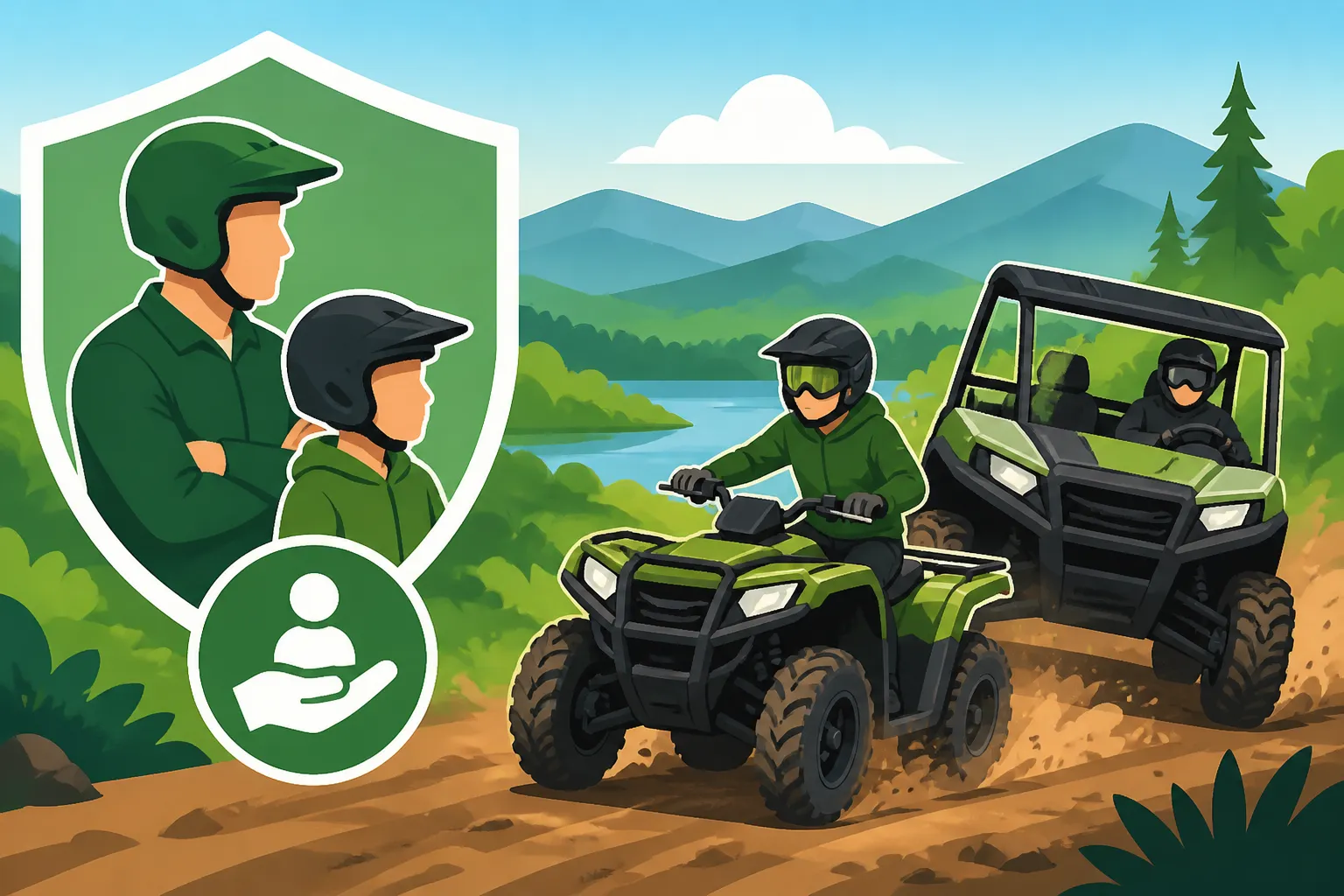
The basic rule: riders under 16 need adult supervision
In Vermont, a person under 16 generally needs direct adult supervision when operating an ATV. That requirement is separate from safety-course rules, registration, insurance, and trail access. Meeting one requirement does not replace the others: a trained young rider may still need an adult supervising, and an adult riding alongside does not necessarily satisfy the training requirement.
The practical point is to plan for the adult to be actively responsible for the young rider throughout the ride. Do not assume it is enough for an adult to be somewhere else on the trail, waiting at the next intersection, or reachable by phone. Vermont’s supervision requirement is about oversight while the minor is operating, not simply having an adult in the group.
For a closer look at the age rule itself, see Vermont Riders Under 16 Need an Adult. The details that matter most on the day are the rider’s age, the adult’s eligibility, how closely the adult can supervise, and where the machine will be operated.
What “under 16” means in practice
The supervision rule applies to riders who have not yet turned 16. A rider’s birthday does not change the rule until the rider actually reaches that age. If a trip includes a rider who is nearly 16, plan according to the rider’s age on the day of the ride, rather than assuming the restriction will end during the season.
Turning 16 does not automatically mean every other requirement ends. A 16- or 17-year-old may still be subject to Vermont’s youth safety-course requirement. Course rules and supervision rules are related, but they are not interchangeable. Vermont Safety Course Binds at 18, Not 16 explains that distinction.
The adult must be eligible to supervise
Do not assume every adult passenger or family member qualifies. Vermont’s requirements for the supervising adult matter, including the applicable age and licensing conditions. Check Vermont Supervisor License Requirements before relying on a particular person to supervise.
A sensible planning standard is to choose an adult who is legally eligible, understands the route, can keep track of the young rider, and is able to respond quickly if the rider has trouble. If you are uncertain whether someone qualifies, confirm before the ride rather than trying to settle it at a trailhead or roadside stop.
Supervision is not the same as riding together
Riding in the same group is helpful, but it does not automatically establish adequate supervision. An adult who is far ahead, far behind, out of sight, or separated by a junction may not be in a position to oversee a young rider effectively. The safest arrangement is one in which the adult can see what the rider is doing, communicate clearly, and intervene or stop the ride when needed.
For more detail on what this means in practical terms, see What Direct Supervision Means. Treat supervision as an active responsibility, not a box checked by putting an adult’s name on the ride plan.
Supervision, training, and eligibility are separate checks
One of the most common planning mistakes is to treat a safety certificate as permission to ride without an adult. A course can teach a young operator important skills and help meet Vermont’s training requirement, but it does not erase a separate age-based supervision rule.
Vermont’s youth training requirement is important for ATV riders under 18. Before a young person operates, check Vermont ATV Safety Course Required Under 18 and confirm that the rider has completed a course Vermont recognizes. The course’s minimum age is another separate issue; see Vermont’s Minimum Course Age of 12.
| Check | What it answers | What it does not replace |
|---|---|---|
| Rider’s age | Whether age-based supervision or training rules apply | Registration, insurance, or trail access |
| Safety course | Whether the rider has completed required training | Adult supervision for a rider under 16 |
| Adult eligibility | Whether the accompanying adult can legally supervise | The rider’s course requirement |
| Registration | Whether the machine is properly registered for its use | Trail access or local route permission |
| Trail Access Decal | Whether the machine has the required access for the applicable trail system | Registration, training, or supervision |
| Route permission | Whether the route is open to the machine and rider | Any statewide operator requirement |
Keep the age rule and course rule distinct
Think of the two requirements as separate gates. A rider under 16 may need both an accepted safety certificate and an eligible adult supervising. A rider who is 16 or 17 may no longer be subject to the under-16 supervision rule, but may still need to satisfy the course requirement. The exact situation depends on the rider’s age and the kind of machine and riding involved.
A certificate is also not a general license to ride every machine in every location. It does not authorize riding on a closed trail, waive town restrictions, or make an otherwise unsuitable machine safe for a child. Parents should consider the youth rider’s ability, the machine’s size and controls, and the difficulty of the route in addition to the legal minimums.
Check what happens when a young rider turns 16
A birthday can change one part of the legal picture without changing the rest. Before the rider’s first outing after turning 16, check What Changes for a Rider Who Turns 16. Confirm training, registration, insurance, trail access, and route rules independently rather than assuming the age change resolves everything.
This is particularly important when a family’s plans involve public roads or town-designated routes. A young operator may face additional limits there, and a route that is open to ATVs does not necessarily mean every rider may operate on it without other conditions.
Choose the adult and riding arrangement before leaving
A good supervision plan is more specific than “Mom is coming” or “there will be adults in the group.” Choose the responsible adult in advance, check that the person qualifies, and decide how the group will stay together. The plan should work on narrow trails, at intersections, and if a machine needs to stop.
Put the adult in a position to supervise
When possible, have the supervising adult ride close enough to monitor the young operator and respond promptly. If the adult is on another machine, plan the group order so the young rider is not left between distant riders or out of view around turns. If the adult is riding as a passenger, make sure the machine is designed and equipped for that arrangement and that passenger rules are met.
A large group can make supervision harder. Riders spread out, stop at different places, or take different branches. Keep the group small enough that the adult can account for the young rider, and agree on a clear stop-and-regroup procedure before starting.
Match the route and machine to the rider
Legal eligibility is only the starting point. Consider whether the young operator can comfortably reach the controls, steer and brake, understand the terrain, and manage the machine’s weight and power. A youth who is technically able to operate a machine may still be unprepared for a steep, rocky, wet, or unfamiliar route.
ATV and UTV categories can differ, so do not assume a rule or machine limit works identically for every vehicle. Check the machine’s legal classification and the relevant use rules. Vermont ATV Versus ASV Classes can help clarify why classification matters. Regardless of classification, the adult should make a practical judgment about whether the machine and route are appropriate for the young rider.
For a UTV, also think about seating and passenger arrangements. A child should ride only in a seat intended for a passenger, with the required restraint used as designed. A supervising adult should not assume that carrying a child as a passenger is equivalent to supervising that child as the operator. For passenger considerations, see Vermont ATV Rules for Passengers.
Agree on simple rules before the engine starts
Young riders do better when expectations are clear and short. Before the ride, agree on rules such as:
- Stay where the supervising adult can keep track of you.
- Stop at every junction and wait for the group.
- Do not pass the adult unless told to do so.
- Stop if you cannot see the adult or are unsure which way to go.
- Do not ride around a closed gate, barrier, or posted restriction.
- Tell the adult immediately if the machine feels wrong or you are tired.
These are practical safeguards, not substitutes for legal requirements. They also help adults identify when the ride should end. Fatigue, poor visibility, changing trail conditions, or a young rider becoming overwhelmed are good reasons to turn around.
Private property and special circumstances need careful checking
Families sometimes assume a private-property ride is exempt from all rules. That is too broad. Requirements can differ depending on the rule, the land, who owns or controls it, and the activity taking place. A possible exception to one requirement does not automatically waive supervision, safety, equipment, or other legal obligations.
Do not treat “private land” as a blanket exemption
A family-owned field or woods may raise different questions from a public road or organized trail, but the phrase “it’s our land” is not enough to settle them. Confirm which specific rules apply to the exact property and activity. If a course exception is relevant, do not assume it also removes the need for adult oversight. Riding on Land Your Parents Own and Vermont Course Exception on Family Land address the kinds of distinctions families should check.
Landowner permission is also not the same thing as legal access to an established trail network. Permission to use one parcel does not authorize crossing neighboring property, entering state land, or continuing onto a road or trail that has separate restrictions.
A course or instructor exception may be narrow
Some training situations may involve an instructor or a specific course setting. Do not assume that a young rider’s ordinary recreational outing qualifies as supervised instruction. If someone is claiming an exception, identify the exact rule it applies to and confirm the conditions before riding.
Keep records of course completion and any relevant permission or instruction arrangement. Documentation may not answer every question during a stop, but having it available can help explain the circumstances. For broader certificate questions, see Which Safety Certificates Vermont State Police Accept.
Private-land rules do not erase basic safety duties
Even where a particular access or training requirement does not apply, adults should still set conservative limits. Keep young operators away from unfamiliar terrain, steep slopes, water crossings, roads, and other hazards unless the rider is ready and the activity is allowed. Do not let an older child supervise a younger child in place of an adult required by law.
If a property ride connects to a public route, stop and check the rules before entering it. A route may have age, equipment, insurance, or local restrictions that do not apply in the same way to a closed private parcel.
Visiting riders must plan for Vermont’s rules too
A child’s home-state certificate or a machine’s home-state registration does not automatically settle every Vermont requirement. Visiting families should check Vermont’s rules before traveling, including the operator’s age, adult supervision, training, machine paperwork, insurance, and access for the intended route.
Reciprocity does not mean every rule is waived
Vermont may recognize certain out-of-state registrations or credentials for specific purposes, but reciprocity is not a blanket exemption from Vermont’s operating rules. Start with Vermont Reciprocity for Out-of-State Machines and confirm whether the rider’s training certificate is accepted under Vermont requirements. For certificates earned elsewhere, see Out-of-State Safety Courses Vermont Will Count.
Do not assume that an out-of-state adult’s presence is enough either. Confirm that the supervising adult meets Vermont’s conditions. If you cannot verify eligibility before leaving home, contact the appropriate Vermont office or trail organization before the trip.
Trail access has its own requirements
Many Vermont riding routes use a trail-access system separate from vehicle registration. A visiting machine may need the required access decal even if it is properly registered at home. Review Vermont Requires Registration Plus a TAD and Vermont TAD for a Visitor’s Machine before choosing a trail.
The supervision rule still applies to the young rider. A decal does not make an under-16 rider eligible to operate without a supervising adult, and an adult supervising a child does not replace the decal or registration requirements. Check all of the following before loading the machine:
- The young rider meets Vermont’s age and training requirements.
- The supervising adult meets Vermont’s eligibility requirements.
- The machine’s registration and insurance are in order.
- The required trail access is in place for the planned route.
- The route is open to that machine and appropriate for the rider’s ability.
Carry useful proof
Have the young rider’s course information, machine registration, insurance proof, and access documentation available in the manner required for the activity. A trail warden or officer may ask for documents or other proof, so avoid leaving everything at the lodging or in a tow vehicle that is far from the ride. See What a Trail Warden Checks for a broader overview.
For children, it can also help to keep emergency contact information with the adult supervising them. A phone may not have service everywhere, so agree on a plan for separation or a disabled machine before entering a remote area.
Build a safety plan that supports supervision
Legal compliance does not guarantee a safe ride. Young riders may have less experience judging speed, traction, visibility, and how quickly trail conditions change. A simple, repeatable safety routine helps the supervising adult stay focused on the rider rather than trying to solve preventable problems along the way.
Check protective gear and fit
A helmet must meet Vermont’s applicable requirements and fit the rider correctly. A helmet that is too large, damaged, or poorly fastened is not a useful safety measure. Review Vermont ATV Helmet Law for Every Rider and check that the helmet remains secure when the rider moves their head. Eye protection, gloves, sturdy footwear, and clothing suitable for the weather also matter.
If you shop on Amazon for gear, verify the exact product’s safety information, fit options, and return policy rather than relying on a listing title or a generic claim. For helmets in particular, confirm that the specific model meets the applicable standard and fits the rider; a child’s helmet should not be bought with extra room to “grow into.” A local dealer may be better for checking fit in person.
The same caution applies to gloves and eye protection ordered online. A product photo cannot tell you whether it interferes with grip, vision, or helmet fit. Try gear before the ride, and replace damaged safety equipment instead of treating a low price as a reason to keep using it.
Inspect the machine together
Before starting, check that the controls work, tires look sound, brakes respond, lights are functional where needed, and the machine has no obvious leaks or loose parts. Make sure the young rider knows how to stop, shift or change direction as appropriate, and shut the machine down. The adult should not rely on the child’s confidence as proof that the machine is safe or that its controls are familiar.
If you need replacement safety equipment or basic ride supplies, Amazon can be one place to compare options, but check product compatibility and the manufacturer’s instructions. Avoid aftermarket changes that could affect fit, visibility, or safe operation. A new part or accessory should be installed and tested before the ride, not improvised at the trailhead.
Reassess as conditions change
A route that feels manageable at the start may become harder when it gets wet, crowded, or dark. The adult should be prepared to shorten the ride, take an easier route, or stop altogether. If the young rider is tired, upset, or struggling to keep pace, continuing just to finish the planned loop is poor judgment.
If you are considering gear through Amazon, use it as a shopping option—not as a substitute for checking whether an item is appropriate for the machine, rider, and legal requirements. For something safety-critical, confirm the model and fit, and ask a knowledgeable dealer or qualified professional when the specifications are unclear. The best equipment is the gear the child can wear correctly and the adult has checked before departure.
A practical checklist for parents and trip leaders
Before a ride, work through the checklist below. It is deliberately broader than the supervision rule because a compliant plan can still fail if access, paperwork, or basic preparation is missing.
Before the trip
- Confirm the rider’s age on the ride date.
- Check the applicable supervision rule and choose an eligible adult.
- Confirm that the rider has completed a safety course Vermont recognizes, if required.
- Make sure the adult understands that supervision is active, not just being present in the group.
- Choose a machine the rider can operate safely and a route suited to the rider’s experience.
- Check registration, insurance, and trail-access requirements.
- Confirm the route is open and permitted for the machine.
- Review passenger arrangements if a child will ride in a UTV or other machine.
- Pack properly fitting protective gear and any required proof.
- Agree on a plan for stops, separation, fatigue, and emergencies.
For help with the course requirement and the age thresholds involved, review Vermont ATV Safety Course Required Under 18 alongside Vermont’s Minimum Course Age of 12. For a rider approaching the age cutoff, also review What Changes for a Rider Who Turns 16.
At the start of the ride
Ask the young rider to explain the basic plan back to the adult: where the group is going, who to follow, where to stop, and what to do if separated. Check that the helmet is fastened, eye protection is usable, and the rider can operate the controls without stretching or losing balance. Let the rider practice in an appropriate safe area if the machine or terrain is unfamiliar.
Then make a final call about conditions. If the adult cannot keep the young operator in view or respond quickly, change the group arrangement or choose another route. The plan should be realistic for the actual terrain, not just adequate on paper.
When in doubt
If you are unsure whether a person qualifies to supervise, whether a certificate is accepted, or whether an exception applies, verify the specific issue before riding. Ask the appropriate state agency or trail organization and describe the actual circumstances: the rider’s age, machine type, location, and planned route. A general answer about “kids on ATVs” may not cover a particular UTV, private-property situation, or trail system.
The safest approach is straightforward: confirm the rules, bring an eligible adult, keep supervision close, and choose a ride the young operator can handle. That gives the child room to learn without confusing a training certificate, an adult’s presence, or trail access with permission to ignore the rest of Vermont’s requirements.
Disclaimer
This article is for general informational purposes only and does not constitute professional advice. Laws, prices and regulations vary by location and change over time. Consult a qualified professional for guidance on your specific situation.