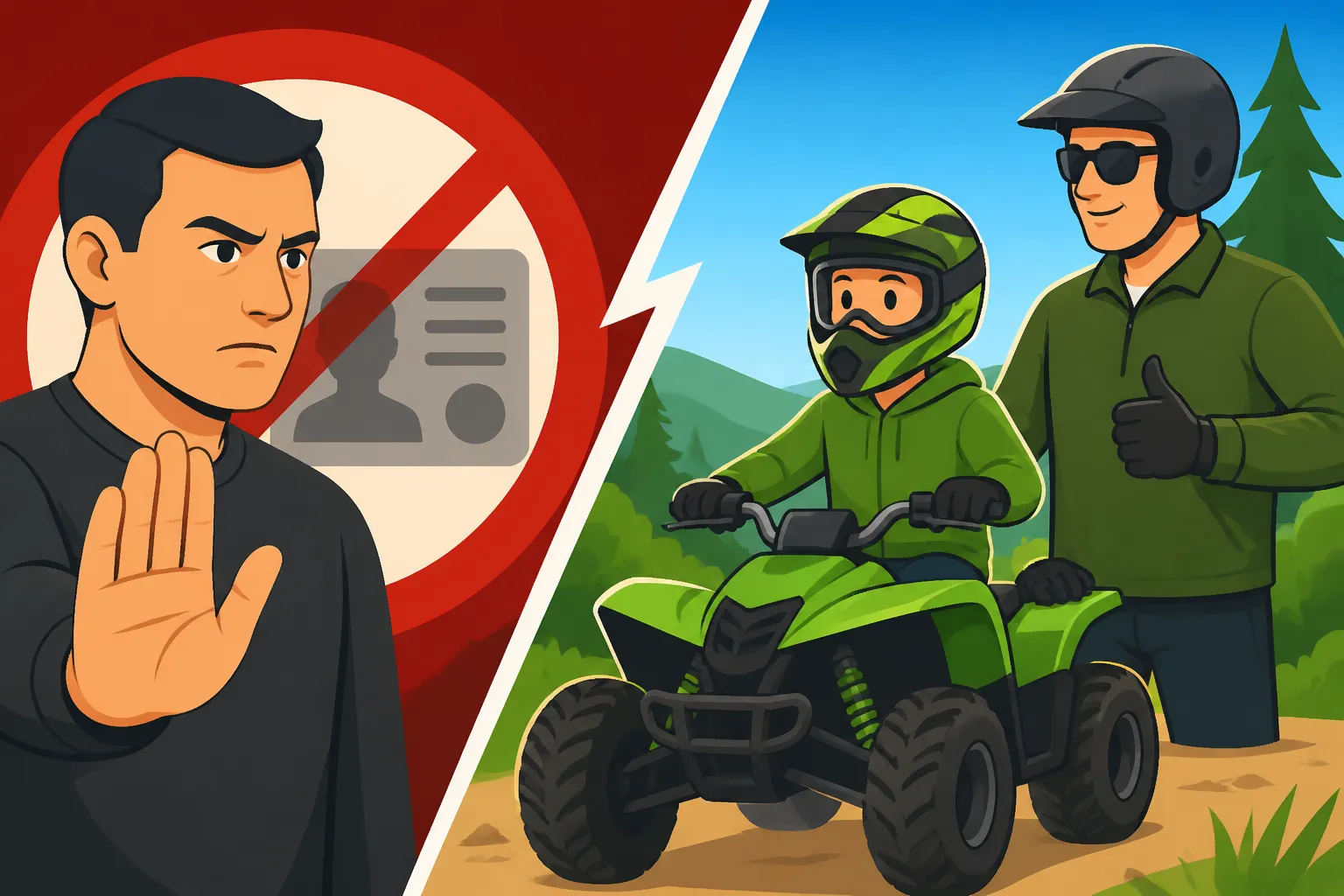
Can a Suspended Driver Supervise a Young Rider?
Can a Suspended Driver Supervise a Young Rider?
A suspended license can create a problem beyond driving a car: it may also disqualify an adult from supervising a young ATV or UTV rider in Vermont. The key issue is whether the supervising adult meets the state’s eligibility requirements—not whether the adult is a parent or has years of riding experience. Here’s how to assess the situation and what to confirm before a ride.
The short answer: an active suspension may make an adult ineligible
Vermont’s supervision rules for young ATV riders include an age requirement and a driver’s-license requirement for the supervising adult. The adult generally needs to be at least 18 and hold a valid driver’s license. If that person’s license is currently suspended, it may not qualify as valid for this purpose.
That means a parent, guardian, relative, or family friend should not assume they can supervise a rider under 16 while their driving privilege is suspended. Being the child’s parent does not necessarily replace the license requirement. Nor does experience operating an ATV or UTV.
The practical answer is to treat an active suspension as disqualifying unless the appropriate Vermont authority confirms that the person’s particular status qualifies. The young rider should not head out on the assumption that an adult who cannot legally drive on a suspended license can still satisfy the supervision rule.
| Adult’s situation | Practical approach |
|---|---|
| At least 18 with an active, valid driver’s license | May meet the basic adult eligibility requirement; check the other rules too |
| Driver’s license currently suspended | Do not count on this adult as the required supervisor |
| Driver’s license revoked or otherwise invalid | Treat the adult as ineligible unless an authority confirms otherwise |
| License restricted or subject to special conditions | Ask whether the specific restriction affects eligibility before the ride |
| Adult has no current license card but the license may still be valid | Confirm the license status; a missing card and a suspended privilege are not the same issue |
| Adult is a parent or guardian but has a suspended license | Relationship alone should not be treated as an exception |
A suspension is about the person’s legal driving status, not simply whether a physical license card is in their wallet. If the card is lost but the driving privilege remains valid, that is a different problem from a suspension. Conversely, holding an unexpired card does not necessarily mean the person’s privilege is currently valid.
For the background rules, see Vermont Supervisor License Requirements and Vermont Supervision Rules Under 16. The important takeaway is simple: check the actual license status, not just the card or the adult’s relationship to the child.
What Vermont’s supervision rule means in practice
A qualified supervisor is not just an adult who is present somewhere at the trailhead, at home, or on the property. The rule is meant to put an eligible adult in a position to oversee the young rider while the rider operates. The adult should be able to see what is happening, communicate with the young rider, and respond if a safety issue arises.
The precise legal meaning of “direct supervision” depends on the applicable rule and circumstances. For a practical explanation of the concept, see What Direct Supervision Means. At minimum, do not treat supervision as a phone call, a ride scheduled with another group, or an adult waiting at a distant parking area while the young rider takes off alone.
A few practical points help avoid misunderstandings:
- The supervisor should be present for the riding activity. An adult who drops off a young rider and leaves is not providing meaningful supervision.
- The adult should be able to keep track of the rider. A supervisor who cannot see or reliably contact the young rider may not be able to intervene when needed.
- The adult should be capable of responding. A person who is impaired, distracted, or otherwise unable to oversee the ride is not providing safe supervision.
- The adult must meet the legal qualifications. Close proximity does not solve an eligibility problem, such as an active driver’s-license suspension.
- The adult’s permission is not the same as legal qualification. A parent can approve a ride, but that does not automatically waive a statutory supervisor requirement.
Supervision also does not make every location or route lawful. Registration, trail-access requirements, landowner permission, route rules, and equipment requirements may still apply. A young rider can have an eligible adult beside them and still be riding somewhere they are not allowed to ride.
If the young person is under 16, review Who Can Legally Supervise a Rider Under 16 alongside the rule for the particular vehicle and riding situation. ATV and other off-road vehicle classifications can have distinct requirements, so do not rely on a rule you remember from a different machine or activity.
What to do if the intended supervisor’s license is suspended
If the only available adult has an active suspension, the safest course is to arrange a different qualified supervisor or postpone the ride. Do not assume that a suspension for an unrelated driving matter is irrelevant. Unless the rule or an official interpretation provides otherwise, a person whose license is suspended should not be treated as having the valid license needed to qualify.
Before making plans, identify exactly what the license status is. People sometimes use “suspended” loosely to describe different situations: a lost card, an expired credential, an administrative hold, a restriction, an out-of-state suspension, or a formal suspension of driving privileges. These are not necessarily interchangeable. The relevant question is whether the person has a current, valid driver’s license that meets Vermont’s requirement for supervising a young rider.
Use this process:
- Check the adult’s official license status. Do not rely only on the date printed on a card or on what the adult remembers receiving.
- Read the suspension notice or other official communication. It may explain when the suspension began, whether it is still in effect, and what conditions must be met before driving privileges are restored.
- Ask the right authority about the ATV supervision question. A general answer about whether the person may drive a car may not answer whether they qualify as a supervisor for an off-road ride.
- Give the authority the relevant details. Explain the rider’s age, the adult’s license jurisdiction and status, the type of machine, and where the ride is planned.
- Wait for a clear answer before relying on an exception. If the answer is uncertain, choose an adult whose eligibility is clear.
The Vermont DMV may be able to clarify the adult’s license status and restoration conditions. Questions about how an ATV rule applies can also involve the relevant law-enforcement or state authority. A local club or landowner may explain trail access conditions, but should not be treated as the final source for an individual’s driver’s-license status.
If the license is eligible for reinstatement, do not assume that paying a fee, completing a requirement, or mailing paperwork immediately restores the privilege. Confirm that the suspension has actually ended and that the license is valid before relying on that adult as a supervisor. The same caution applies to a restricted license: find out whether its conditions affect the person’s eligibility for this separate role.
This is a useful point to separate two questions that can get mixed together:
- May the adult legally drive? That depends on the status of the adult’s driving privilege and any restrictions.
- May the adult legally supervise the young rider? That depends on the ATV supervision rule, including its qualifications for the adult.
One answer should not be assumed to settle the other. An adult might be physically able to accompany a child but not meet the legal qualification. An adult might also have a valid driver’s license but still be unable to provide adequate supervision under the circumstances.
The young rider has separate requirements
An eligible supervisor does not automatically satisfy the young rider’s other obligations. Age, safety training, vehicle type, registration, trail access, land permission, and operating location can all matter. Treat supervision as one part of a pre-ride check, not as a substitute for the rest.
Check training and age rules
Vermont has safety-training requirements that may apply to young operators. The details depend on the rider’s age and the situation, so check the current rule rather than assuming a child is exempt because an adult is present. See Vermont ATV Safety Course Required Under 18 and Vermont’s Minimum Course Age of 12 for related information.
A course certificate and adult supervision serve different purposes. A certificate shows that the rider completed the required training where applicable; it does not make an otherwise ineligible adult a qualified supervisor. Likewise, a qualified supervisor does not replace training the young rider is required to complete.
Some rules may have limited exceptions for particular circumstances, such as riding on certain family land or under an instructor’s supervision. Do not extend an exception beyond the conditions it actually covers. For example, an exception tied to a specific location may not apply to a public trail, a road route, or land owned by someone else. If an exception appears relevant, confirm its scope before relying on it.
Confirm the machine’s classification
Owners often use “ATV” as a general term for off-road machines, including side-by-sides. Vermont’s legal classifications can be more specific. A utility vehicle or other machine may not fall under the same category as a conventional ATV, and requirements can depend on how the machine is classified.
Check the machine’s documentation and the applicable Vermont rules rather than assuming that a requirement for one type of vehicle automatically applies to another. The young rider’s age, the machine’s design, and the place of operation may all be relevant. If the classification is unclear, ask before the ride.
Check where the ride will take place
Permission to ride on private land is not the same as permission to use a trail system or a town route. Trail access may involve registration, a trail access decal, club rules, landowner permission, and seasonal closures. Town-road access is a separate issue and depends on local designations and requirements.
Before setting out, confirm:
- The machine is properly registered where required.
- Any required trail-access credential is current and attached as instructed.
- The route is open to that type of machine.
- The landowner or trail operator permits the ride.
- The young rider is allowed to operate in the planned location.
- The adult can remain close enough to supervise throughout the route.
A valid plate or decal does not cure a supervision problem. And an adult who is qualified to supervise does not create permission to ride on a closed trail or private property without authorization.
Choosing a safe plan when the adult is not eligible
When a license suspension affects the planned supervision arrangement, the solution is usually straightforward: use another adult who clearly meets the requirements, or wait until the intended supervisor’s status is restored and confirmed. Avoid improvising with a distant adult, an informal handoff, or an assumption that a family relationship creates an exception.
A practical plan might look like this:
- Choose a backup supervisor early. Verify that the adult meets the age and valid-license requirements before travel or unloading the machine.
- Confirm the young rider’s own eligibility. Check age, training, machine classification, and any applicable restrictions.
- Pick a lawful route and location. Confirm access with the landowner, club, town, or trail operator as appropriate.
- Agree on how supervision will work. Discuss pace, stopping points, communication, visibility, and what happens if the group becomes separated.
- Carry the required documents and proof. Bring the items required for the machine and ride, and make sure the supervising adult can access them.
- Cancel or change the plan if a requirement is uncertain. A ride is not worth risking an unlawful trip or putting a young operator in a situation without qualified oversight.
A backup adult should be more than technically eligible. They should be familiar with the machine, the young rider’s ability, and the route. They also need to be willing and able to intervene. An adult who has a valid license but is operating another vehicle far ahead, cannot see the child, or is not prepared to respond may satisfy one qualification while failing to provide effective supervision.
If arranging a qualified adult is difficult, consider a lower-risk alternative: delay the ride, choose a controlled setting where the applicable rules allow the activity, or have the young rider complete required training before going out. Do not assume a private yard or family property is automatically exempt from every rule. The location and conditions of any exception matter.
For additional detail on how training requirements interact with age, see Vermont Safety Course Binds at 18, Not 16. That distinction can be easy to misunderstand: a rider’s training status and the adult’s eligibility are separate checks, and both need to be addressed where the rules require them.
Frequently Asked Questions
Can a parent with a suspended license supervise their child?
Do not assume so. A parent’s relationship to the child does not necessarily replace Vermont’s requirement that the supervising adult hold a valid driver’s license. If the suspension is active, use a different adult unless the appropriate authority confirms that the parent qualifies.
Does it matter why the license was suspended?
The reason may matter to the adult’s license status or any restrictions, but it should not be treated as an automatic exception to the supervision requirement. Confirm whether the person currently holds a valid license that qualifies under the rule.
What if the adult has a restricted or conditional license?
Do not guess. Ask the Vermont authority responsible for the relevant rule whether that specific license status qualifies. Restrictions can have conditions, and an answer about ordinary driving may not resolve the separate supervision question.
Can an adult without a suspended license supervise if they are not the child’s parent?
A parent is not necessarily the only person who can supervise. The adult must meet the applicable qualifications and provide the required supervision. Check Who Can Legally Supervise a Rider Under 16 for the related eligibility question.
Disclaimer
This article is for general informational purposes only and does not constitute professional advice. Laws, prices and regulations vary by location and change over time. Consult a qualified professional for guidance on your specific situation.