Vermont Group Size Limits on Club Trails
A large ATV or UTV group can be harder to manage than it looks on a map: riders spread out, trail conditions change, and a corridor may cross private land. Vermont riders should not assume one group-size limit applies everywhere. The practical answer is to check the rules for the specific club trail, then plan a group small and coordinated enough to follow them.
Is there one group-size limit for Vermont club trails?
There is not a safe universal number to rely on for every club trail in Vermont. A corridor may be maintained by a local club, pass over private property, or connect with other routes. The club’s current guidance, landowner conditions, and any event rules can all affect how a group may use it.
That distinction matters. A statewide riding requirement and a trail-specific restriction are not the same thing. Even if you cannot find a general maximum for ordinary group rides, that does not mean every corridor welcomes any number of machines arriving together. A club or landowner may set conditions for access, and an organized ride may have its own operating plan.
VASA’s trail network depends on permission to cross private land. Permission can be limited or withdrawn, and the people maintaining a corridor may need to protect the route, nearby property, and other users. For context on how that system works, see Vermont ATV Trails: The VASA System and Vermont Landowner Permission Holds the System Together.
Before planning around a particular number of machines, check the current trail information from the club responsible for that corridor. Look for posted group guidance, event notices, access conditions, and closures. If the information is unclear, ask the club directly rather than treating silence as permission for a large group.
| What may affect a group’s access | What to check |
|---|---|
| Club trail guidance | Whether the maintaining club sets a group limit or asks riders to split up |
| Private land access | Any landowner conditions, gates, signs, or temporary restrictions |
| Organized event | Registration requirements, assigned start times, and event-specific instructions |
| Trail conditions | Whether mud, damage, or a closure makes group travel unsuitable |
| Other trail users | Narrow sections, shared corridors, and places where passing is difficult |
A route shown on a map is not necessarily an invitation to bring a large convoy at any time. Maps help with navigation, but a trail’s current access conditions can change. Check the local club’s information before travel, especially when organizing a group from out of town. Finding the VASA Club That Maintains Your Local Trail can help you identify whom to contact.
Why group size matters on a shared corridor
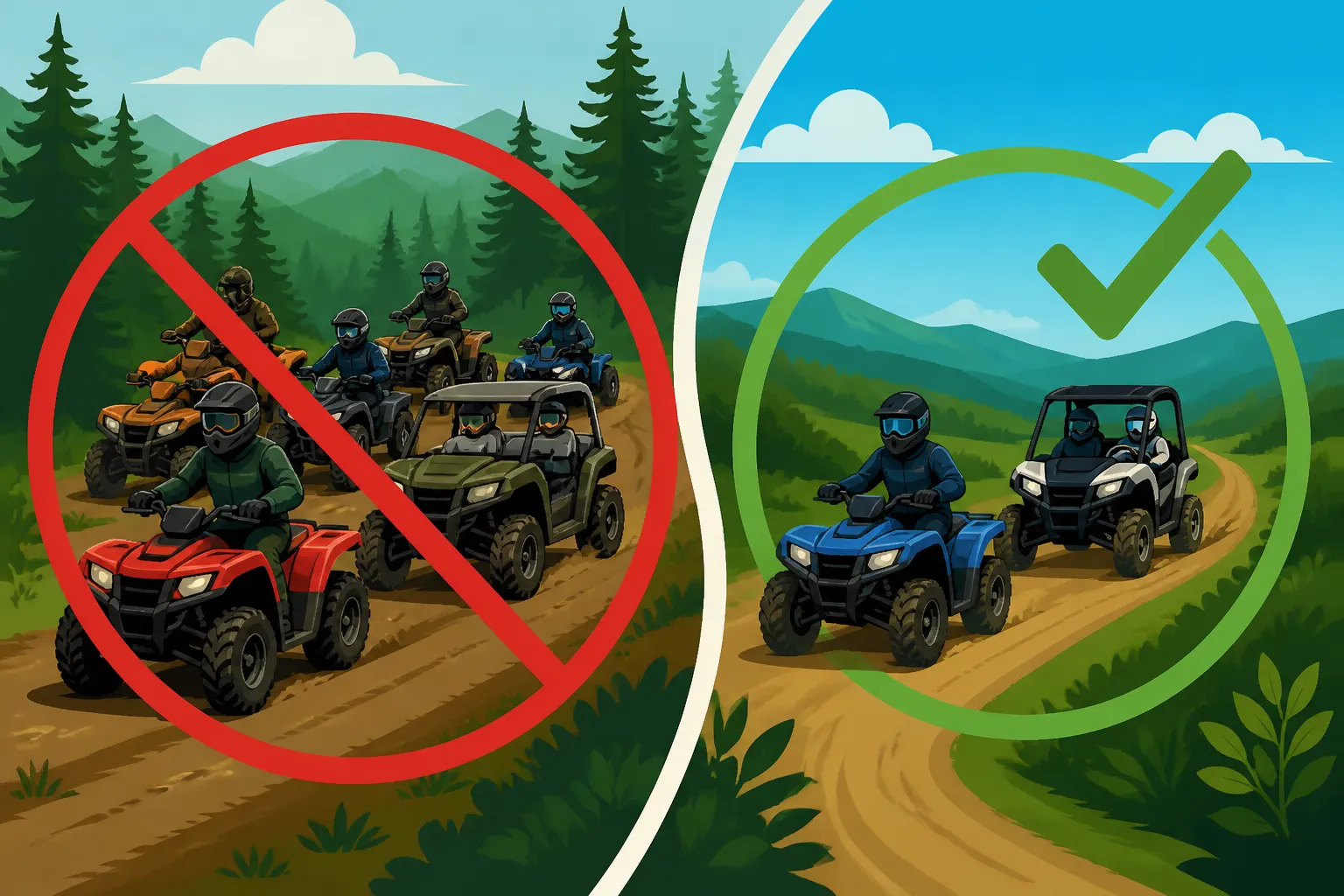
A bigger group affects more than the pace of the ride. It can take longer to clear a narrow section, increase the chance of riders losing contact, and make it harder to respond to a stalled or damaged machine. On a corridor that crosses private land, a long line of vehicles can also create more noise and disturbance near homes, farms, or working land.
Large groups can be particularly awkward where riders meet in both directions. A single machine may be able to find a safe place to yield, while a long group can leave its last riders waiting around a blind corner or blocking a passing area. On a narrow trail, riders who stop unpredictably may create a hazard for the people behind them.
Group size is only one part of the problem. A well-organized group with clear communication can travel more responsibly than a smaller group that spreads out, ignores signs, or blocks access. But as the number of machines grows, coordination takes more effort. The group needs to know who is leading, who is sweeping at the back, where to stop, and what to do if riders become separated.
A route can also change character along the way. A wide section may lead to a tight corridor, a bridge with a posted weight limit, or a wet area that cannot handle repeated traffic without damage. A group that is manageable on one section might need to slow down or break into smaller units on another. Vermont Trail Etiquette on Private Land covers the habits that help keep access open, while Bridge Weight Limits on a Club Trail explains why a bridge can be a limiting point even when the rest of the route appears suitable.
Do not treat a large group as a single vehicle for planning purposes. Each machine needs a safe way to travel, stop, turn around if needed, and respond to a changing trail. If a corridor is too narrow for the full group to gather without blocking it, arrange a meeting point elsewhere.
How to plan a group ride responsibly
Good planning starts before anyone unloads. Pick a route that fits the least experienced rider and the least capable machine in the group, not just the most confident rider’s preferred pace. Confirm that the route is open, identify the maintaining club, and ask about any group-size guidance or special conditions.
Use this process:
- Confirm trail access. Check the local club’s current information and ask whether it has a limit, recommendation, or special procedure for larger groups. Review Vermont Trail Conditions Before You Tow before setting out.
- Check access requirements. Make sure each machine and rider has the required credentials for the ride. Vermont club-trail access can involve registration and a Trail Access Decal; do not assume a permit or decal held by one rider covers the rest of the group. See Vermont Requires Registration Plus a TAD for the access distinction.
- Choose a route that matches the group. Consider experience, machine width, fuel range, weather, and the condition of the trail. Avoid making the day’s plan depend on a narrow or fragile section that could become difficult to pass.
- Set a lead and a sweep. The lead rider manages turns and pace; the sweep stays with the last rider. Agree on what to do if someone stops, has a breakdown, or misses a turn.
- Agree on regrouping points. Stop in places where the full group can get off the traveled corridor. Do not let riders wait across a gate, bridge, intersection, or private driveway.
- Split the group if needed. If the club recommends smaller groups, follow its instructions. If no size is specified but the group is difficult to manage, travel in separate units with enough space between them to avoid crowding.
- Keep the ride flexible. Turn around or choose another route if conditions are poor, a corridor is closed, or the group cannot pass without damaging the trail.
A split group should not become a rolling convoy with no gap between units. Leave enough space to reduce congestion and avoid making every rider wait at the same bottleneck. At the same time, the units should remain coordinated: agree on the route, regrouping points, and a way to contact each other. Cell service can be unreliable in some areas, so do not make a phone signal the only plan. Cell Dead Zones in the Kingdom and Carrying a Radio on a Long Ride offer useful preparation for rides where communication may be limited.
For an organized event, check with the organizer before advertising a group size or inviting additional riders. Events may have registration, staging, or start procedures that do not apply to an informal outing. A large gathering can also require coordination with the club and landowners beyond the requirements for a few friends riding together. See Organized Rides and Their Permits for event-specific considerations.
What to do when the rules are unclear
If club information does not give a clear answer, contact the organization that maintains the trail and ask a direct question: “Does this corridor have a maximum group size, or do you want larger groups divided into smaller units?” Include the route, approximate number of machines, date, and whether the ride is informal or organized. A concrete request is easier to answer than a general question about all Vermont trails.
Do not rely only on another rider’s recollection or an old social media post. A group policy may apply to a particular event, section, season, or landowner rather than to the whole network. Likewise, a club’s recommendation for a small group does not necessarily establish a statewide legal limit. Confirm the source and scope of any rule before building plans around it.
At the trailhead, pay attention to posted notices and gates. If a sign gives a group instruction, treat it as part of the access conditions. If the group arrives and the route is crowded, wet, or visibly vulnerable, wait, divide into smaller units, or choose another route. A planned ride is not a reason to push through an unsuitable section.
For a large gathering, ask whether the club wants advance notice, a different staging location, or separate start times. That is especially helpful if machines may queue near a home, farm entrance, or trail junction. Clubs understand the local corridor and can often flag pinch points or access concerns that are not obvious from a map. Vermont ATV Clubs and What They Maintain and Who to Call About Vermont Trail Conditions are useful starting points.
The best rule of thumb is straightforward: follow the current instructions for the specific corridor, and keep the group small or divided enough to travel without blocking, damaging, or disturbing the trail. If nobody can confirm that a large group is welcome, do not assume it is.
Disclaimer
This article is for general informational purposes only and does not constitute professional advice. Laws, prices and regulations vary by location and change over time. Consult a qualified professional for guidance on your specific situation.