Registration Mistakes Vermont Clerks See
There’s nothing quite like the excitement of getting a new ATV or UTV, whether it’s fresh off the dealer lot or a gem you found in a private sale. But that excitement can quickly turn into frustration if you trek all the way to a Vermont Department of Motor Vehicles (DMV) office, paperwork in hand, only to be told you've missed a critical step or filled something out incorrectly. It’s a common scenario, and it delays your ability to hit those beautiful Vermont trails. This guide will walk you through the most frequent registration mistakes Vermont DMV clerks see, helping you navigate the process smoothly and get your machine registered without a hitch.
The Importance of Getting Your ATV/UTV Registration Right the First Time
You've got a new machine, visions of autumn leaves and mud-splattering adventures dancing in your head. The last thing you want is to be stuck in bureaucratic limbo because a form wasn't perfect. Getting your registration paperwork right the first time isn't just about avoiding a second trip to the DMV; it's about avoiding unnecessary stress, potential delays in riding season, and sometimes even fees for corrected documents. Vermont's DMV clerks are incredibly helpful, but their hands are tied by strict rules regarding proper documentation. They see the same issues come through their doors day after day, and by understanding these common errors, you can bypass them entirely.
Why Small Errors Lead to Big Headaches
It might seem like a minor detail – a missing initial, an incorrect date, or a transposed number – but in the world of official vehicle registration, these small errors can completely derail your application. Imagine you've driven an hour to the Montpelier DMV office, waited your turn, and finally gotten to the counter, only to be told your bill of sale from a private seller is missing the seller's full address. Now you're faced with the choice: drive all the way back home to get the missing information, try to contact the seller on the spot, or simply give up for the day. Each scenario costs you time, fuel, and peace of mind. These aren't personal rejections; they're simply adherence to the letter of the law to ensure proper ownership and tax collection.
Preventing Delays in Your Riding Season
Vermont's riding season, particularly for ATVs and UTVs, can feel precious and fleeting. You want to make the most of every sunny weekend or crisp fall day. Delays in registration mean lost riding time, and nobody wants that. If your registration is held up, you can't legally ride on designated VASA trails or town roads where ATV access is permitted. [Does Vermont Require a Horn on an ATV?] or [Vermont ATV Helmet Law for Every Rider] might be on your mind, but none of that matters if your machine isn't even registered. Understanding the paperwork requirements beforehand is your best defense against these frustrations, ensuring your machine is ready to roll when you are.
Common Paperwork Pitfalls Vermont DMV Clerks Encounter
When it comes to the actual forms and documents, there's a myriad of small mistakes that add up. These are the details that often lead to a polite but firm "I'm sorry, we can't process this today" from a Vermont DMV clerk. Being meticulous here can save you a world of trouble.
Incomplete or Illegible Forms
One of the most straightforward yet common issues is simply not filling out every required field on the registration application. It’s easy to skip a line if you're unsure or think it doesn't apply, but clerks are trained to look for completeness.
- Missing Information: For example, Form VD-119, the Application for Motorboat, ATV, or Snowmobile Registration and Title, requires specific details about the applicant, the machine, and its previous registration if applicable. Leaving sections blank, especially contact information or previous registration numbers, is a red flag. Clerks need to see all applicable boxes filled in, even if it’s with "N/A" where appropriate.
- Hard-to-Read Writing: While many applications are now typed, handwritten forms still exist. If your handwriting is notoriously difficult to decipher, take your time and print clearly. An illegible VIN (Vehicle Identification Number) or date can cause significant delays because the clerk cannot verify the information against other documents. Imagine a clerk trying to determine if that's a 'B' or an '8' in your VIN – it's a detail that can halt the entire process.
- Incorrect Signatures or Dates: This might sound obvious, but people often forget to sign where required, or they date the form incorrectly (e.g., dating it for the future, or a date that contradicts other paperwork). All signatures must match the identity of the applicant, and dates need to align with the purchase and application timeline. Sometimes, a joint owner forgets to sign, necessitating both parties to return.
VIN Errors and Misidentification
The Vehicle Identification Number (VIN) is your ATV's unique fingerprint. Any discrepancy here can lead to an immediate rejection of your registration.
- Transposed or Incorrect VINs: It's incredibly easy to accidentally transpose numbers or letters when copying a VIN from the machine to the paperwork, or from a bill of sale to the registration form. Always double-check, triple-check, and then ask someone else to verify the VIN you've written down against the actual VIN stamped on the machine itself. The VIN on your bill of sale, title (if applicable), and registration application must be an exact match. Clerks will compare these meticulously.
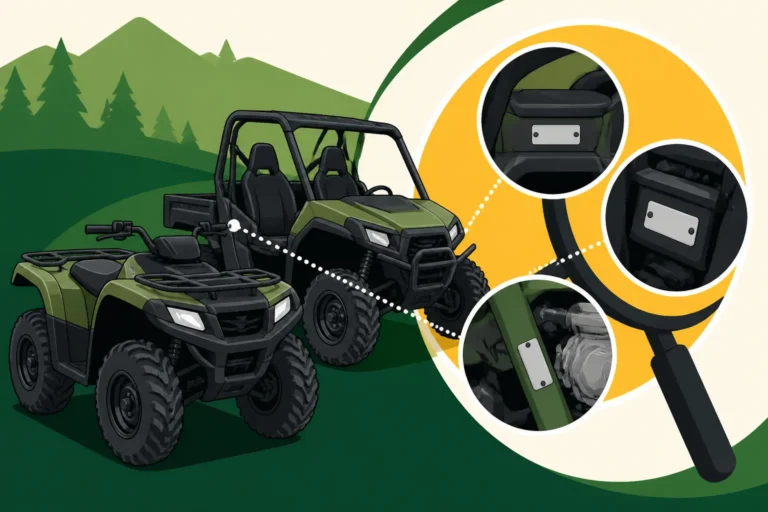
- Obscured or Unreadable VIN: Sometimes, the VIN plate or sticker on the ATV itself might be dirty, rusted, painted over, or damaged, making it impossible to read. While this isn't strictly a paperwork error, it becomes one if the clerk cannot verify the VIN you've provided. Make sure your machine's VIN is clean, legible, and accessible for inspection if required. If it's truly unreadable, you'll have a much larger problem to solve, potentially requiring a VIN verification by law enforcement.
Mismatched Information Across Documents
This is where many people get tripped up. You might have all the right documents, but if the information doesn't perfectly align, clerks can't proceed.
- Name Discrepancies: Your name on the registration application must exactly match your name on your driver's license or other proof of identity. If you've recently changed your name, ensure all your documents reflect this, or be prepared to show legal proof of name change. The same goes for the seller's name on a bill of sale matching their ID if they're a private party, or the dealership's official name.
- Address Inconsistencies: Your current Vermont residential address needs to be consistent across all documents and match your [Vermont Registration and Proof of Address]. If your driver's license shows an old address, you'll need to update it or provide supplementary proof of your current residency, such as a utility bill or lease agreement.
- Purchase Date Conflicts: The date of purchase on your bill of sale, title transfer, or manufacturer's certificate of origin (MCO) must be clear and consistent. If the dates are unclear or contradict each other, it can raise questions about the true date of ownership transfer, which affects things like [Vermont Purchase and Use Tax on an ATV].
Ownership and Title Troubles
Establishing clear ownership is paramount for any vehicle registration. Vermont DMV clerks pay close attention to how you prove you are the rightful owner of the ATV or UTV. Any ambiguity here is almost certain to result in a rejected application.
Missing or Inadequate Proof of Ownership
This is perhaps the most common reason for a rejected registration. Without solid proof that you own the machine, the DMV simply cannot register it in your name.
- Insufficient Bill of Sale: For private sales, a properly executed bill of sale is crucial. Many people make the mistake of providing a simple handwritten note that lacks essential information. A Vermont-accepted bill of sale needs to include the full names and addresses of both buyer and seller, the date of sale, the purchase price, a clear description of the ATV (make, model, year, and especially the VIN), and signatures of both parties. Clerks often see bills of sale missing the VIN, the seller's address, or the purchaser's signature. Using a template, perhaps from a service like LawDepot, can help ensure you don't miss any critical fields, even for a casual private transaction. Remember, clarity prevents questions.
- Lost or Missing Manufacturer's Certificate of Origin (MCO): If you're buying a brand new ATV or UTV, the dealership should provide you with the MCO, sometimes called an MSO (Manufacturer's Statement of Origin). This document serves as the "birth certificate" for the machine. If this is lost or not provided, you cannot register a new machine. It's the primary proof that the vehicle has never been registered before. [An MCO at the Vermont DMV Counter] is a must-have for new machines.
- Problems with Previous Titles: If the ATV is an older model (usually 15 years or older in Vermont, but check current rules as this can change) it might not require a title, but for newer machines, a properly assigned title from the previous owner is essential. Clerks frequently see titles that haven't been signed off by the previous owner, or where the assignment of title section is incomplete. If a title is lost, the previous owner must obtain a duplicate title before they can transfer ownership to you. Trying to register a machine with a title that has a lienholder not properly released, or an owner's signature that doesn't match, will lead to immediate rejection. [Vermont Title Application Steps] outlines what's needed.
Issues with Affidavits of Ownership
Sometimes, life throws a curveball, and you might not have a perfect paper trail. Vermont's DMV does allow for an affidavit of ownership in certain circumstances, but these are scrutinized very carefully.
- Incorrect Use of Affidavit: An affidavit of ownership is not a catch-all solution for simply "lost paperwork." It's typically used in very specific situations, like registering an inherited machine where a formal bill of sale wasn't generated [Vermont Registration for an Inherited ATV], or for older machines where previous records are truly nonexistent and a title was never issued. Clerks often see people attempting to use an affidavit when a proper bill of sale or MCO should have been obtained.
- Insufficient Supporting Documentation: Even with an affidavit, you usually need to provide supporting evidence. This could include old registration cards, insurance policies, or even a sworn statement from a third party confirming your ownership. Without sufficient supplementary proof, the affidavit alone might not be enough to satisfy the DMV's requirements. Clerks need to be confident that you genuinely own the machine and aren't trying to register a stolen vehicle.
Mistakes with Lien Releases
If you financed your ATV or UTV, the lender (lienholder) will hold the title or have their lien noted on the title. When you pay off the loan, the lien must be formally released.
- Unreleased Liens: A very common mistake is attempting to register a machine that still has an active lien recorded against it, but without proper documentation of that lien being satisfied. Clerks will check for any outstanding liens, and if one is found, you cannot register the vehicle in your name unless you are the original lienholder or have a clear release. [Releasing a Lien on a Title] is a crucial step if you've paid off your machine. You'll need an official lien release document from the bank or financial institution that held the lien.
- Incorrect Lien Release Documentation: Sometimes, people present a letter from their bank, but it's not the official lien release form or it lacks specific details like the VIN. The DMV requires clear, unequivocal proof that the lien has been satisfied and that the secured party no longer has an interest in the vehicle.
Avoiding Tax Tangles
Vermont, like most states, collects sales tax – or in this case, a "purchase and use tax" – on ATV and UTV transactions. Many registration applications get held up because the tax aspect is misunderstood or mishandled.
Miscalculation of Purchase and Use Tax
This is a frequent point of confusion, especially for private sales.
- Incorrect Tax Rate: The purchase and use tax rate is a set percentage of the purchase price, but customers sometimes apply an outdated rate or simply guess. The DMV clerk will calculate this for you, but if your own calculation is significantly off, it can indicate a misunderstanding of the process. Always check the current Vermont Purchase and Use Tax rate before you go.
- Undervaluation of the Machine: While tempting, trying to list a significantly lower purchase price on a bill of sale to reduce tax can backfire. If the price seems unreasonably low compared to the machine's market value, the DMV has the right to assess the tax based on the fair market value, not your stated price. This can lead to delays as they investigate or reassess the value. Be honest about the actual transaction price.
- Forgetting About Trade-In Credits: If you traded in an old ATV or UTV as part of your new purchase, you might be eligible for a tax credit on the trade-in value, reducing the taxable amount of your new machine. However, this needs to be clearly documented on the bill of sale from a dealer or in a separate, formal document. If it's not explicitly stated, the clerk might not apply the credit. [Vermont Tax Credit for a Trade-In] can save you money, but only if documented correctly.
Incorrectly Claiming Tax Exemptions
Vermont offers specific exemptions from purchase and use tax, but they have strict criteria. Clerks often see people trying to claim an exemption they don't qualify for, or without the proper documentation.
- Gift Transfers Between Non-Family Members: While you can be exempt from tax if an ATV is a bona fide gift between immediate family members, trying to claim a gift exemption for a machine given by a friend or a distant relative is usually not allowed without a specific, approved exception. [Vermont Tax Exemption for a Gift] only applies under very specific conditions, usually involving close familial relationships. You'll need an affidavit of gift or other documentation proving the relationship and the nature of the transaction.
- Already Paid Tax Out of State: If you purchased an ATV out of state and paid sales tax there, Vermont often provides a credit for that tax, so you don't pay it twice. However, you must provide proof of the tax paid to the other state. A sales receipt clearly showing the sales tax itemized and paid is necessary. Without this, Vermont will charge its full purchase and use tax. Clerks frequently see out-of-state purchases without adequate proof of prior tax payment. [Vermont Tax on an Out-of-State Purchase] explains this in more detail.
Final Checks and What to Do If You've Made a Mistake
Before you even leave your driveway for the DMV, give your entire packet of documents one last, thorough review. Think of the DMV clerk as a highly detail-oriented editor looking for any inconsistencies or omissions.
Your Personal Pre-DMV Checklist
Creating your own checklist is a simple yet effective way to catch those easy-to-miss mistakes.
- Gather All Originals: Always bring original documents, not just photocopies, unless specifically told a copy is acceptable. This includes your bill of sale, MCO, previous title, and proof of identification. The clerk needs to see the real deal.
- Verify All Key Data Points: Go through each document and compare the VIN, names, addresses, and dates. Do they match perfectly across every single piece of paper? Even a middle initial difference can raise a flag.
- Ensure All Signatures Are Present: Are there signatures from all necessary parties (buyer, seller, lienholder if applicable) on all required documents? Are they dated correctly? This includes your own signature on the application form.
- Confirm Proof of Residency: Make sure you have valid [Vermont Registration and Proof of Address] documents if your license doesn't reflect your current residency. A utility bill, a lease agreement, or a bank statement might suffice.
- Double-Check Payment Method: While not a paperwork error, make sure you have an accepted form of payment for the registration fee and any applicable taxes. Check the DMV's website for accepted payment methods before you go. [Vermont ATV Registration Cost] and [Vermont ASV Registration Cost Compared] will help you estimate the funds needed.
| Document Type | Common Mistakes | What the Clerk Needs to See |
|---|---|---|
| Registration Form | Incomplete fields, illegible handwriting, missing signature, incorrect dates. | All applicable fields filled legibly, signed, correctly dated, matching applicant's ID. |
| Bill of Sale | Missing VIN, vague machine description, no addresses for buyer/seller, missing signatures, altered info. | Full buyer/seller info (names, addresses), clear VIN, make, model, year, sale price, date, both signatures. |
| Title (Previous) | Not signed by seller, lien not released, incorrect name assignment, lost. | Properly assigned by previous owner, all liens released, no alterations, matching machine details. If lost, a [Vermont Duplicate Title Cost] from previous owner is needed. |
| MCO (New Machines) | Lost, damaged, not provided by dealer. | The original Manufacturer's Certificate of Origin, free of alterations. |
| Proof of Identity | Expired ID, non-matching address. | Valid, current government-issued photo ID (e.g., driver's license), with current address or proof of residency. |
| Tax Exemption Proof | Claiming exemption without valid documentation, vague "gift" claims. | Specific documentation for valid exemptions (e.g., family relationship for a gift, out-of-state tax receipt). |
What to Do If You Realize You've Made a Mistake
Don't panic! It happens to the best of us. If you realize you've made a mistake before you get to the DMV, take the time to correct it.
- Contact the Other Party: If it's an error on a bill of sale or title from a private seller, try to reach out to them to get a corrected or new document, or to add missing information. It’s much easier to do this before you involve the DMV. Services like LawDepot can assist in generating legally sound documents that minimize such errors from the outset.
- Re-fill Forms: If you've made errors on the registration application itself, simply print a new one and fill it out again carefully.
- Seek Advice: If you're truly unsure about a specific requirement, you can always check the Vermont DMV website or call their customer service line for clarification before making the trip. This can save you a wasted journey.
- Be Prepared for a Second Visit: If you get to the counter and a mistake is found, simply accept it gracefully. The clerks are doing their job. Ask exactly what needs to be corrected or obtained, and then make a plan for your next visit. Sometimes, the issue is minor enough that you can step aside, make a quick call, and return to the line. For more complex issues, you might need to leave and gather new documentation. [Registering an ATV by Mail Versus in Person] might seem easier to avoid the initial trip, but if there's an error, it often means mail delays too.
By being diligent and understanding these common pitfalls, you can ensure your ATV or UTV registration process in Vermont is as smooth as possible, getting you onto the trails and enjoying the Green Mountain State in no time.
Disclaimer
This article is for general informational purposes only and does not constitute professional advice. Laws, prices and regulations vary by location and change over time. Consult a qualified professional for guidance on your specific situation.