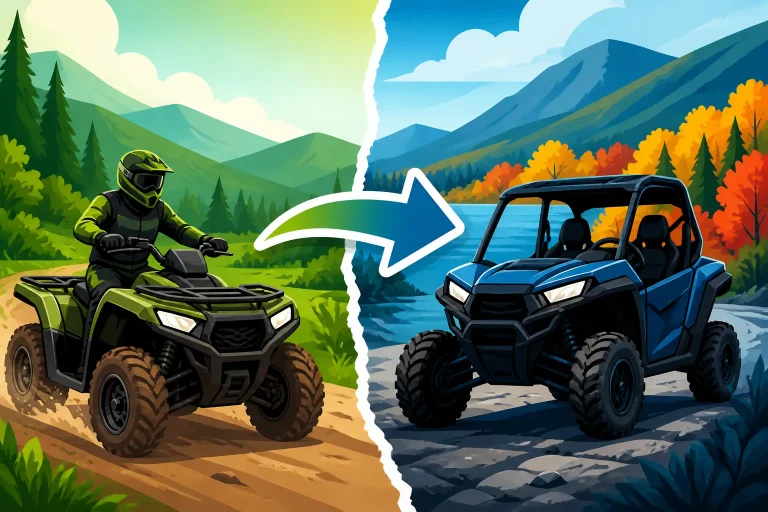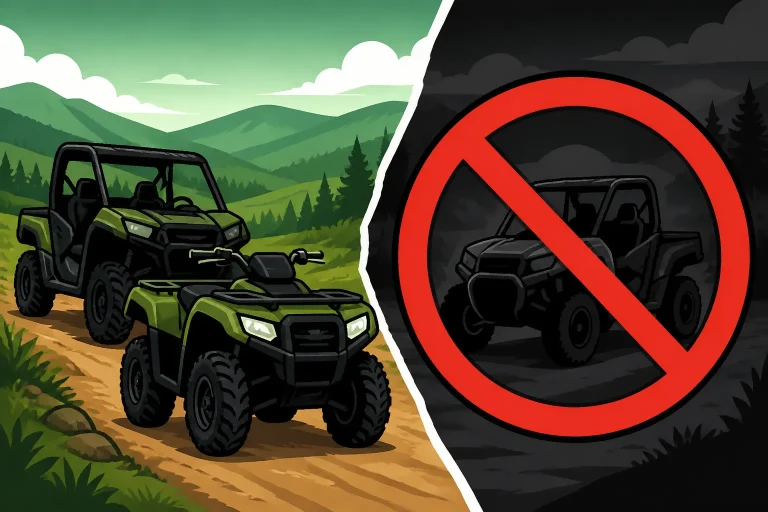
Quimby Country and Its Vermont ATV Guests
Quimby Country can make a quiet Northeast Kingdom base for a Vermont trip, but an ATV stay takes more planning than simply arriving at a lodge and heading out. Rental machines and riding routes may be across the New Hampshire border, so guests should confirm where pickup happens, how they will reach it, and what riding access is actually included.
What Quimby Country guests should know about ATV rentals
The key planning detail is that lodging and riding may be separate parts of the trip. Do not assume that a room or cabin reservation includes an ATV, a guided ride, transportation to a rental counter, or permission to ride from the property. Confirm each part directly before you book.
Quimby Country is in Averill, in Vermont’s Northeast Kingdom. Rental options for guests may be based in New Hampshire rather than at the place they are staying. Pittsburg is one possible rental hub to investigate; the drive from Averill is often described as roughly 45 minutes, but actual travel time depends on your starting point, route, weather, and road conditions. Verify the pickup location and current directions with the rental operator.
That border crossing matters for more than the drive. You need to know where the machine will be used, whether the rental company permits travel across state lines, and what access arrangements apply to the riding area. A machine picked up in New Hampshire does not automatically have permission to ride on Vermont trails, and lodging in Vermont does not itself provide trail access.
Before committing to a stay or rental, ask Quimby Country what it can arrange for guests and ask the rental operator what it provides. A referral is not the same as a reservation, transportation service, guide booking, or trail pass. Ask which business takes payment, who handles cancellations, and who is responsible for explaining riding rules.
A useful starting point is Vermont ATV Rentals: Why They Are Scarce for the broader rental landscape. For a closer look at options across the border, see Bear Rock Adventures in Pittsburg. Treat any operator or listing as a lead to verify, not as proof that a machine or riding date is available.
Separate the four parts of the outing
An ATV day based from Quimby Country can involve four separate arrangements:
- Lodging: Your room or cabin, arrival details, parking, and any property-specific rules.
- Rental: The machine, rental time, driver eligibility, required documents, deposit, and insurance arrangements.
- Transportation: How your group and any gear get from the lodging to the rental pickup point and back.
- Riding access: Where the rental company permits you to ride, which trails or routes are open, and what permits or decals are required.
Some businesses may help coordinate more than one part, but get the details in writing. A lodging host may be able to suggest a rental contact without controlling the rental company’s fleet or policies. Similarly, a rental business may provide a machine and orientation without arranging your lodging or guaranteeing that a particular trail is open.
| Planning question | Why it matters | What to confirm |
|---|---|---|
| Where is the rental pickup? | The counter may be in another state and require a separate drive. | Exact address, check-in time, and parking |
| Where can the machine be ridden? | State lines and property boundaries do not define trail permission. | Approved riding area, route, and access requirements |
| Is transportation included? | A machine may not be delivered to the lodging. | Whether you need your own vehicle and trailer |
| What is included in the booking? | Helmet, fuel, guide, trail access, and insurance vary. | Itemized inclusions and any separate purchases |
| What happens in bad weather? | Rain can affect safe riding and trail conditions. | Cancellation, rescheduling, and refund terms |
| Who handles each issue? | Lodging and rental providers are different businesses. | Contact for booking, machine, and accommodation questions |
Choosing a rental, a tour, or a different outing
Not every guest needs the same kind of ride. A self-guided rental can suit a group that is comfortable following instructions, navigating a permitted route, and managing the machine without a guide. A guided ride may be a better fit for first-timers, visitors unfamiliar with local terrain, or groups that want someone else to lead route decisions. Some guests may find that a non-riding day is the better choice if transportation, weather, age, or access requirements do not line up.
Self-guided rental
With a self-guided rental, you control the pace within the rental period and follow the operator’s approved riding directions. You will generally need to arrive on time, complete an orientation, understand the machine’s controls, and follow limits on where it may go. The operator should explain whether the rental is intended for a specific trail system, a private property route, or another permitted area.
The convenience is flexibility. The trade-off is that your group must pay close attention to navigation, trail conditions, fuel planning, and return time. Ask whether you receive a map, a phone-based route, or verbal directions, and what to do if you lose the route or encounter a closure. Do not assume a map downloaded before the trip reflects a same-day reroute.
Guided ride
A guided ride usually reduces the navigation burden, but it does not remove the need to confirm the details. Ask how long the ride lasts, what the quoted duration includes, how many machines are involved, and whether the guide leads from a separate machine or rides with the group. Confirm the group’s minimum age, passenger arrangement, pace, and any experience expectations.
A guide’s route is still subject to land access and current conditions. Ask whether the ride is on a trail network, private land, or a designated route, and whether the operator handles any required access fees. If you are searching through a booking platform such as Viator, check who actually operates the ride, where it starts, and how cancellations are handled. The platform’s listing and the local operator’s rules may not answer the same questions.
A machine for the whole group or more than one
The number of seats is not the only question when choosing a machine. Consider the size and comfort of every passenger, the operator’s age rules, the machine’s capacity, and the route’s terrain. A multi-seat side-by-side can simplify a family outing, but a single machine may not be suitable for every group or every trail. Never assume that a child can ride on a particular machine just because a seat appears available.
Ask the rental business to recommend a machine only after you describe who will ride, their ages and approximate sizes, and their experience. Then confirm the manufacturer’s seating configuration and the rental company’s passenger policy. The operator’s stated weight or passenger limits are not suggestions to stretch.
For a full comparison of choices and what affects the bill, see [Vermont ATV Rental Cost]. If your group specifically wants a side-by-side, Vermont Side-by-Side Rental Options can help you frame questions about seating and machine type.
When renting may not be the right fit
A rental may be impractical if you cannot get to the pickup point, the dates are unavailable, your group does not meet the operator’s requirements, or the riding area is closed. It may also be a poor match if someone in the group is uncomfortable with noise, uneven ground, or a long day outdoors.
Avoid booking lodging on the assumption that an ATV will be available at the last minute. If the ride is central to the trip, secure a confirmed rental before treating it as part of the itinerary. If the rental cannot be confirmed, plan an alternative rather than relying on an unverified listing or an informal suggestion.
Booking from Averill and managing the drive
The drive between lodging and pickup is part of the outing, not a minor detail to solve after arrival. If your group is traveling from Averill toward a rental location in Pittsburg, factor in check-in, orientation, gear fitting, loading, and the return trip. A rental’s advertised ride duration may not include any of those steps.
Call or message the operator before booking and ask for the exact pickup address. Confirm whether the address is the place where you collect the machine, a meeting point, or a trailhead. Ask where your personal vehicle can be parked and whether a trailer is needed or allowed. Some rental arrangements begin at a counter; others may use a designated riding area. Do not infer one setup from another company’s listing.
Plan transportation for people and equipment
First find out whether the rental company provides the machine at the riding location or expects you to transport it. If you must tow, your vehicle needs to be suitable for the trailer and machine, and you need to be comfortable loading, securing, and unloading the equipment. If you are not towing, confirm that the rental operator’s arrangement allows you to ride from the pickup point. Never ride an ATV on public roads just to avoid arranging transport.
The transportation plan should account for the full group. A driver may need to stay sober and available, and someone may need to remain with the vehicle if the group’s arrangement involves separate transport. If children or passengers are joining, ask the operator whether they can wait safely at the pickup location and whether the rental start time leaves room for orientation.
If you are considering a machine rental near another town, the list of questions in Vermont Rentals Near Island Pond can help you compare the convenience of different bases. For people considering a stay farther north, [Quimby Country in Averill] provides a related starting point for understanding the lodging location, but check directly for current services and arrangements.
Build in a realistic schedule
A simple schedule can prevent a rushed start:
- Set a pickup arrival time that leaves room for paperwork and orientation.
- Allow for the drive from Averill and any planned stop before the counter.
- Confirm when the rental clock begins and when the machine must be returned.
- Leave a buffer for fuel, trail conditions, and the trip back.
- Decide in advance what the group will do if the pickup is delayed or the ride is shortened.
Ask whether late arrival reduces ride time or causes the booking to be forfeited. Get the policy from the operator, not from a general assumption about rental businesses. Also ask whether you may return early and what happens if a mechanical problem interrupts the ride. Keep the operator’s phone number available while you are out.
Verify the route before travel
Use current directions from the lodging and rental provider, and confirm that the route is practical for your vehicle. Rural roads can be narrow, steep, or affected by weather. Do not rely on a phone map alone for a last-minute change, particularly if cell service is limited. If the rental operator provides specific arrival instructions, follow those rather than navigating to a similarly named business or a general trailhead.
Riding access, permits, and rules
The most important distinction is between renting a machine and having permission to ride it. Paying for a rental does not automatically buy access to every trail, road, forest, or parcel in the region. The permitted riding area depends on the operator’s arrangement, landowner permissions, trail status, and applicable rules.
Before you book, ask the operator to identify the riding area in plain terms. Is the ride confined to private property? Does it use a managed trail network? Does the route cross a public road? Are you expected to stay on a marked corridor? Ask which access charges, decals, or permits are included and which are your responsibility. If the answer is vague, get clarification before paying.
Vermont’s trail system involves access permissions and club-managed corridors, while New Hampshire has its own rules and trail arrangements. A Vermont lodging reservation does not transfer Vermont access rights to a rental machine based in New Hampshire. Likewise, a New Hampshire rental company’s permission to use a machine on its approved routes does not necessarily cover riding in Vermont. Check state-specific requirements with the rental operator and the relevant trail or access organization.
For an overview of Vermont’s access system, see Vermont ATV Trails: The VASA System. Visitors who are bringing their own machine rather than renting should also review Vermont Reciprocity for Out-of-State Machines. Reciprocity is not the same thing as permission to ride any particular trail.
Ask what documentation to carry
Before leaving the pickup point, ask what documents you must keep with you. Depending on the riding arrangement, that may include rental paperwork, proof of coverage, identification, or access documentation. Know whether the rental operator keeps a record electronically or expects the rider to carry a paper copy. If a warden or other authorized person checks the machine, you should know how to show the documents the operator says are required.
For trail access in Vermont, a Trail Access Decal may be relevant for machines using the VASA network. Rental businesses may explain whether their machine already has the necessary access arrangement or whether the rider must do something separately. Do not buy a second access product or assume one is included without asking. The details for a visitor using a rental can differ from those for an owner riding their own machine; see Vermont TAD for a Rented Machine.
Understand the boundaries
Stay on the route the operator identifies. Do not use a road, trail, field, or forest simply because it appears passable or because another vehicle has driven there. Landowner permission can be limited or withdrawn, and a trail may close because of mud, damage, maintenance, or other conditions.
Ask how to recognize a closure and what to do if a gate is shut or a marked trail ends. Do not go around a gate or create a new track. If the route is unclear, stop in a safe place and contact the rental operator. A few minutes spent checking is preferable to trespassing, getting stuck, or damaging a trail.
Ask about insurance and responsibility
Rental agreements can describe coverage, exclusions, deductibles, damage responsibility, and other terms. Read the agreement before signing, and ask for a direct explanation if a term is unclear. Do not treat a waiver as insurance or assume your personal vehicle policy covers a rented ATV. Coverage depends on the relevant policies and rental contract.
Ask whether you are responsible for damage caused by rollover, impact, water, mud, or riding outside an approved area. Find out what to do after a collision or mechanical issue and whether the business expects you to call before moving the machine. Keep the rental operator’s emergency contact information with the group. For a general list of questions about coverage, see Vermont Rental Insurance and Deposits.
Preparing your group for the ride
A group that arrives prepared has more time to focus on the ride and less time trying to solve basic problems at the counter. Share the plan before departure: pickup location, start time, return time, riding area, machine assignment, and who is responsible for the driving.
Confirm driver and passenger eligibility
Rental companies set their own requirements for who may operate a machine, who may ride as a passenger, and what identification or license is required. Ask for the rules for every driver and passenger in your party before reserving. A person who can legally drive a car is not automatically eligible under a rental company’s terms, and a passenger’s age or size may affect which machine is suitable.
Vermont law and New Hampshire rules are not interchangeable. If the rental ride takes place in New Hampshire, check the rules that apply there as well as the operator’s contract. If any part of the itinerary enters Vermont, ask how Vermont requirements apply. Do not rely on a general statement that “kids can ride” or “a license is not needed.” Get the exact conditions from the operator and the relevant official source.
For youth riding rules in Vermont, see Vermont Supervision Rules Under 16. The rental company may impose stricter age or supervision requirements than the law, and those contract rules still matter for using its machine.
Dress for weather and terrain
Wear clothing suited to a day outdoors rather than a short drive from the lodge. Long sleeves, long pants, sturdy footwear, eye protection, and weather-appropriate layers help reduce exposure to branches, dust, insects, and changing temperatures. Bring rain protection even if the forecast looks favorable, and consider how quickly conditions can change in a rural or mountainous area.
Ask what the rental provides. Helmets may be included, but fit and availability should be confirmed for every rider. Eye protection may be required or expected, and a standard pair of sunglasses may not offer the same protection as appropriate riding eyewear. If the company supplies helmets, ask whether you may bring your own and whether it must meet a particular standard.
Pack water and a small amount of food if the ride length and operator’s rules allow it. Keep phones protected from dust and moisture, but do not let navigation or photography distract the driver. Leave bulky items at the lodging or in the vehicle unless the rental company says the machine has secure storage.
Set expectations for a mixed-experience group
The least experienced rider should be part of the machine and route decision. Ask the operator whether the route is suitable for beginners, how difficult the terrain is, and whether the guide can adjust the pace. A description such as “easy” can mean different things to different businesses, so ask about specific features: narrow sections, steep grades, rough ground, water crossings, or extended periods of riding.
If the group includes people who have never operated a machine, tell the operator in advance. An orientation is not a substitute for practice if someone is uncomfortable with the controls. Do not pressure a hesitant rider to participate. They may be happier joining the outing as a passenger if permitted, staying at the lodging, or choosing a different activity.
Before starting, agree on simple group practices: keep a safe following distance, stop only where the operator says it is safe, and do not leave the group to explore. If a guide is leading, follow the guide’s instructions and do not pass without permission. On a self-guided ride, decide how the group will communicate if someone needs to stop.
Weather, trail conditions, and backup plans
A confirmed reservation does not guarantee that every route will be suitable on the day of your ride. Rain, recent storms, maintenance, soft ground, and other local conditions can affect safety and access. The rental business or trail manager may close a route or change the approved riding area. That decision can be inconvenient, but riding around a closure can damage land and put the group at risk.
Ask the operator how it makes weather decisions and when it will notify you. Confirm whether a change means a different route, a shorter ride, rescheduling, or cancellation. These terms vary by provider; read the booking conditions rather than assuming that rain automatically qualifies for a refund. Vermont Rental Cancellation Terms offers useful questions to ask before booking.
Make a plan for a delayed or canceled ride
Build an alternative into the trip, especially if your stay is short. That could be a non-riding day, a shorter local outing, or simply more time at the lodging. Do not plan the rest of the trip around a rental that is still only an inquiry or a waitlist request.
If the operator cancels, ask whether the booking can be rescheduled to another available time. If a machine becomes unavailable, clarify whether the business offers a substitute and whether it has the same seating or riding capabilities. If the group cannot accept a substitute, ask what choices the contract provides. Keep lodging and rental cancellation terms separate because different businesses may have different policies.
Check conditions close to departure
Check in with the rental operator shortly before travel, even if the reservation is confirmed. Verify that the pickup location has not changed, the machine is ready, and the route remains open. Check the weather for both the lodging area and the riding area; the two may not have identical conditions.
If you are driving to a pickup in another state, allow extra time for poor visibility or slow travel. Avoid arriving with a trailer or large vehicle without confirming where it can be parked. If a road or access route is closed, do not improvise an alternative trail. Contact the operator and follow its directions.
Be ready to stop
The group should be prepared to turn back or end the ride if conditions change or a rider is uncomfortable. A route that was manageable at the start may feel different after rain, fatigue, or a minor mechanical issue. Tell the operator promptly about a problem rather than trying an unauthorized repair or continuing on a damaged machine.
When returning, follow the business’s instructions for fuel, cleaning, parking, and inspection. Report damage or a malfunction honestly and promptly. Take a moment to check that personal items are not left in storage compartments, and ask for a receipt or return confirmation if the company provides one.
A practical booking checklist for Quimby Country guests
The safest approach is to confirm the lodging, rental, and access details independently, then connect them into one itinerary. Use this checklist while comparing options.
Before booking lodging
- Ask whether Quimby Country currently helps guests arrange ATV rentals or transportation.
- Confirm whether the property has parking suitable for your vehicle and any trailer.
- Ask about property rules for parking, unloading, washing, or storing a machine.
- Check whether a rental pickup location is within a practical drive of the lodging.
- Avoid assuming that a local referral includes a machine reservation or trail access.
Before paying for a rental
- Get the business name, exact pickup address, and contact information.
- Confirm the date, check-in time, rental duration, and return deadline.
- Ask which riding area the machine is approved for.
- Confirm whether transportation, a guide, fuel, helmets, and access charges are included.
- Check eligibility rules for every driver and passenger.
- Ask about machine seating, capacity, and limits for children or smaller riders.
- Read the contract, insurance terms, deposit conditions, and damage policy.
- Get the weather cancellation and mechanical breakdown procedures in writing.
- Confirm whether the machine may cross the state line and where it may be ridden.
- Ask whether the operator provides a map, route instructions, or an on-ride contact.
Before leaving the lodging
- Reconfirm the pickup location and route.
- Check current weather and any notices from the rental operator.
- Bring identification, required clothing, and any documents the operator specifies.
- Make sure the group understands the return time and approved route.
- Keep the rental contact number accessible.
- Leave enough time for the drive, parking, check-in, orientation, and return journey.
Guests who can verify those details before arrival are much less likely to spend valuable vacation time chasing a machine, solving a transport problem, or discovering that the ride they imagined is not the ride they booked. Quimby Country can be a useful base for a Vermont stay, but the practical ATV plan depends on the rental operator, the pickup location, and the riding access confirmed for your dates.
Frequently Asked Questions
Can I rent an ATV directly at Quimby Country?
Do not assume that you can. Ask Quimby Country directly whether it currently offers rentals or only provides information about nearby options. Confirm any rental separately with the business that supplies the machine.
How far is Pittsburg from Quimby Country?
Pittsburg is a New Hampshire rental hub guests may investigate, and the drive from Averill is often described as roughly 45 minutes. Verify the route, pickup address, and travel time for your specific trip.
Does a New Hampshire rental automatically include Vermont trail access?
No. A rental agreement and trail access are separate matters. Ask the operator where the machine may be used and what permits, decals, or permissions apply to that riding area.
Should I book a guided ride or a self-guided rental?
Choose based on your group’s experience, comfort with navigation, and preferred pace. A guided ride can reduce route-planning work, while a self-guided rental gives more independence but requires careful attention to the approved route and return time.
What should I confirm before paying?
Confirm the exact pickup point, ride location, machine and seating, eligibility rules, inclusions, transportation plan, coverage terms, and cancellation procedure. Get important details from the rental operator in writing.
Disclaimer
This article is for general informational purposes only and does not constitute professional advice. Laws, prices and regulations vary by location and change over time. Consult a qualified professional for guidance on your specific situation.