Vermont Recognizes Maine Registrations
Vermont Recognizes Maine Registrations
A Maine ATV registration can help you avoid registering the same machine again just to visit Vermont, but it does not automatically grant access to every Vermont trail or road. The key is to separate vehicle registration from trail access, insurance, and local riding rules. Here’s what Maine riders should check before loading up and crossing the border.
What Vermont’s Recognition of Maine Registration Means
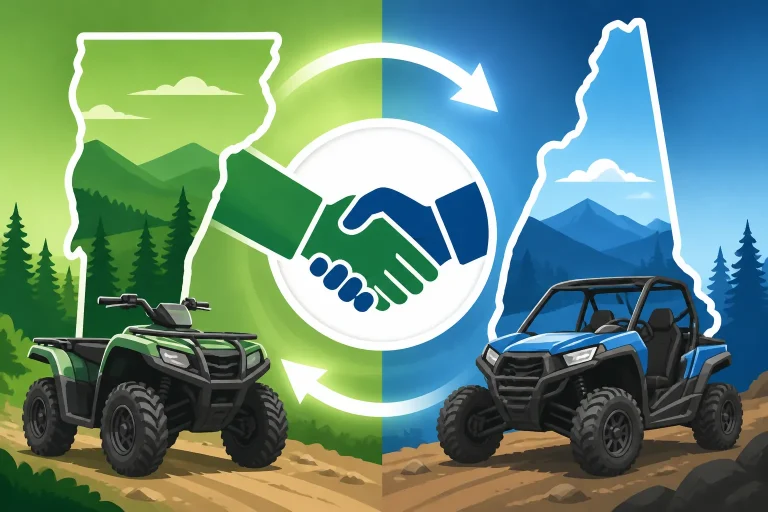
Vermont recognizes valid Maine ATV registrations for visitors. In practical terms, a Maine-registered machine generally does not need a second Vermont registration solely because you are bringing it into Vermont for a ride. You should still carry proof that the Maine registration is current and belongs to the machine you are operating.
That recognition is about registration. It is not a blanket permit to ride wherever you choose, and it does not replace other requirements that may apply to your machine, your age, or the place you intend to ride. A visiting rider still has to comply with Vermont’s trail-access rules, applicable insurance requirements, safety rules, and local restrictions.
It helps to treat the requirements as separate layers:
- Maine registration identifies the machine as registered in its home state.
- Vermont trail access may require a separate Trail Access Decal, or TAD, for riding on participating trails.
- Insurance and safety rules apply according to the riding situation and Vermont law.
- Road and property access depends on posted routes, town decisions, and landowner permission.
A current Maine registration answers one question: whether Vermont recognizes your machine’s home-state registration. It does not answer whether a particular trail is open, whether you have the required trail decal, or whether a town road is legally available to ATVs.
If you are comparing requirements for visitors from different states, see Vermont Reciprocity for Out-of-State Machines. For the broader registration question, Vermont ATV Registration for Nonresidents explains why a visitor’s home-state paperwork and Vermont registration are not interchangeable in every situation.
Keep the registration valid and available
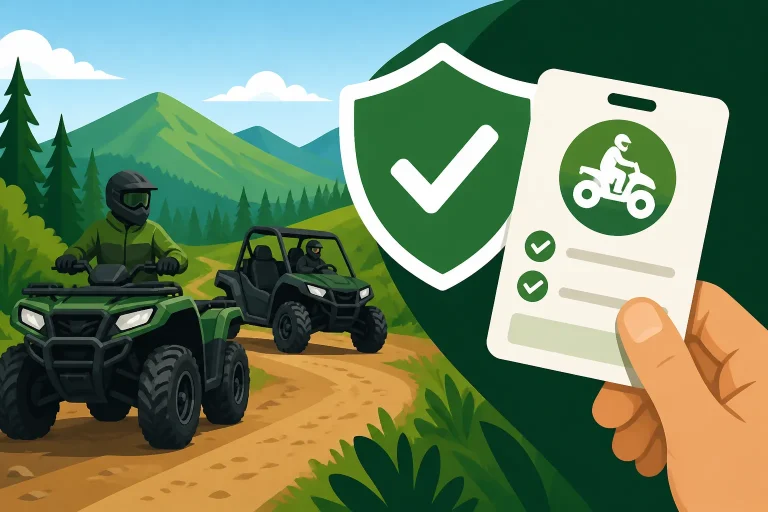
Before leaving Maine, check the registration’s expiration date and confirm that the identifying information matches your machine. Carry the registration document with you rather than relying on a photograph you may not be able to access if your phone battery dies or service is unavailable.
Make sure the machine’s identifying number is legible and consistent with its paperwork. If you recently bought the ATV or UTV, check that the registration and ownership documents have been properly updated. A registration issued to a previous owner may not settle questions about who is entitled to operate or transport the machine.
A useful pre-trip check is to confirm:
- The Maine registration is current.
- The machine’s make, model, and identifying number match the paperwork.
- The person bringing the machine has access to the registration document.
- Any ownership or transfer documents are available if the registration was recently changed.
- The machine meets the operating requirements for the kind of riding planned.
This is especially important when the machine is borrowed, recently purchased, or transported by someone other than its registered owner. A valid registration does not remove the need to resolve ownership or permission issues.
Recognition is not a substitute for every Vermont requirement
Visitors sometimes hear that Vermont recognizes an out-of-state registration and assume they are ready to ride. That is only part of the answer. A registration does not function as a Vermont trail pass, and it does not override rules attached to a particular corridor, town road, public property, or private parcel.
The reverse is also true: buying a Vermont trail decal does not register your ATV in Maine or replace your Maine registration. Keep each document for the purpose it serves.
If you need to check the difference between registration and the trail decal, Vermont Requires Registration Plus a TAD lays out the two-part access picture. For the decal’s role specifically, see Vermont TAD: The Trail Access Decal Explained.
Maine Registration Does Not Automatically Provide Vermont Trail Access
The most important distinction for a Maine rider is between having a registered machine and having permission to use a Vermont trail. Vermont’s organized ATV trail system is tied to trail-access requirements, club corridors, and landowner permission. A valid Maine registration alone does not generally replace the required Vermont TAD for access to participating trails.
A TAD is a separate trail-access credential. It supports access to the trail system covered by the decal and associated club arrangements. It is not a replacement for the machine’s registration, and it does not authorize riding on every road, trail, or parcel in the state.
For a visitor bringing a Maine-registered ATV or UTV, the planning sequence is generally:
- Confirm the Maine registration is current.
- Identify the specific Vermont trail area you intend to ride.
- Check the current trail-access requirements for that area.
- Obtain the appropriate TAD if it is required for the planned trail use.
- Confirm the route is open and that your machine is permitted on it.
- Carry the registration, decal, and other required documents while riding.
The proper decal category can depend on whether the machine is registered in Vermont or another state. A Maine registration does not make the machine a Vermont-registered vehicle. Check the visitor requirements before buying a decal, and confirm current terms with the relevant provider. [Vermont TAD for a Visitor’s Machine] covers the visitor category, while Vermont Out-of-State Machines Still Need a TAD focuses on the difference between out-of-state registration and Vermont trail access.
A decal does not open every road
A trail decal should not be read as statewide permission to ride on roads. Vermont road access is local and route-specific. Some towns may designate certain roads for ATV use, while others do not. Restrictions can include route limits, hours, seasons, equipment conditions, or other local rules.
Before riding on a road, verify that the specific route is open to ATVs and that you are following the rules that apply there. Do not assume that a road is open because it connects two trail sections, appears on an informal map, or has been used by riders in the past. Official signs and current local information matter.
The same caution applies to private land. A marked corridor or a route used by a club does not mean riders may leave it to explore nearby woods, fields, or driveways. Stay on the authorized route, follow posted instructions, and respect gates and closures. Vermont’s trail network depends on landowner permission, which can be withdrawn.
For help understanding the role of the decal and the club network, Vermont’s Trails Run on Private Land explains why access can depend on landowner agreements. To learn more about what the decal covers, see Vermont TADs Cover VASA and Club Dues.
Check that the trail is open before you travel
Access may change because of weather, trail conditions, landowner requests, maintenance, or seasonal closures. A route that was open on an earlier visit may not be open on the day you arrive. A valid Maine registration and current decal cannot make a closed corridor legal to ride.
Check with the club responsible for the area or another current official trail-information channel before hauling your machine. Ask about:
- Whether the corridor is open to ATVs and UTVs
- Whether the trail has a seasonal or weather-related closure
- Any machine-width or weight restrictions
- Whether the planned route crosses a road that requires separate authorization
- Where riders may park or stage a trailer
- Whether the route has a particular check-in or decal-display requirement
If your plans depend on a long connection between trail areas, confirm each segment rather than assuming one open section guarantees access to the next.
Documents, Equipment, and Rules to Check Before Riding
A smooth border trip starts with paperwork, but it should not end there. Bring the documents that show the machine is registered, confirm the applicable trail access, and be prepared to demonstrate that you meet the rules for the ride.
Documents to carry
A sensible document set for a Maine rider may include:
- Current Maine ATV registration
- Proof of ownership or purchase paperwork if relevant
- The required Vermont trail decal, when applicable
- Proof of insurance if required for the planned riding
- A safety certificate or other training proof if required for the rider
- Written permission or authorization if riding on private land outside an established corridor
Keep documents protected from mud and water, but accessible. If a warden or other authorized officer checks your machine, you should be able to produce the relevant documents without having to return to your truck or trailer.
Do not rely on a decal as proof of registration, or registration as proof of trail access. Each document covers a different part of the trip. It is also wise to check the machine’s plate and decal placement requirements before departure, since a document that is valid but not displayed as required may still create avoidable problems.
Insurance and liability
Registration recognition does not automatically establish that your insurance meets Vermont requirements. Review your policy before riding and confirm that it covers the machine and the type of use planned. Some policies may distinguish between public roads, private property, organized trail systems, or other uses.
Carry proof of coverage where required, and make sure the policy identifies the machine correctly. If you are borrowing an ATV or UTV, do not assume the owner’s policy covers every rider or every kind of use. Ask the owner or insurer directly.
Vermont has specific insurance rules for ATV operation in certain settings. The details can depend on where and how the machine is operated, so verify the current requirements before riding. Vermont ATV Insurance Requirements provides more on the coverage question, and Vermont Insurance Proof at a Trailhead addresses what riders may need to show while out on the trails.
Insurance is not just a box to tick for enforcement. A collision can involve another rider, a vehicle, a landowner’s property, or a trail structure. Understanding your coverage before riding is much easier than trying to work it out after an incident.
Rider age, training, and supervision
Vermont’s age and safety requirements may apply to visiting riders as well as residents. If a child or teenager will ride, check the current rules for training, supervision, and the kind of machine they may operate. Do not assume that Maine’s rules alone determine what is allowed once the ride is in Vermont.
For riders under 18, check whether an accepted safety course or certificate is required for the planned riding. Vermont’s rules also include age-related supervision requirements for younger riders. The person supervising may need to meet specific age or qualification conditions, and supervision can mean more than simply being somewhere on the same trail.
Before departure, confirm:
- Whether the rider’s age triggers a training requirement
- Whether the rider must be directly supervised
- Who may legally supervise
- Whether the machine is appropriate for the rider under the relevant rules
- Whether passengers are allowed on that machine and are properly seated
The requirements can differ from the habits or rules riders are used to at home. See Vermont Supervision Rules Under 16 and Vermont Safety Course Required Under 18 for related details.
Equipment and machine fit
A Maine registration does not exempt the machine from Vermont equipment rules. Check that the ATV or UTV is suitable for the trails and routes you plan to use, and that required safety equipment is installed and working.
At a minimum, inspect the machine before the trip:
- Check brakes, steering, tires, and lights.
- Confirm that the exhaust system and other required equipment are in good condition.
- Secure any loose cargo.
- Make sure the license plate and trail decal are mounted where required and remain visible.
- Check the owner’s manual for passenger limits and load capacity.
- Confirm that the machine’s width and weight are acceptable for the trail or route.
A machine that fits on one trail may not fit another. Narrow bridges, gates, culverts, and posted restrictions can limit access. If you are bringing a side-by-side, verify that the planned corridor allows its dimensions rather than assuming all ATV trails accommodate every UTV.
For more on riding a side-by-side in Vermont, Vermont Registration for a Side-by-Side covers machine-specific registration considerations. For use on town routes, review Vermont ATV Road Rules: Towns Decide.
Planning a Vermont Ride From Maine
A little advance checking can prevent a long drive that ends at a closed gate or a trailhead where the machine is not properly equipped. Build the trip around a confirmed route and the requirements for that route, not around the general idea that Vermont recognizes Maine registrations.
Start with the exact destination
Choose the town, club area, trailhead, or lodging location you plan to use. Then check the current trail map and access information for that area. Vermont’s ATV trails are not a single state-owned network that every registered machine can enter. Many corridors depend on private property and local club arrangements.
If you are staying near a trail area, ask the lodging provider which access points are open and whether guests need to arrange a decal before arrival. Do not treat a lodging package, parking arrangement, or informal trail description as proof that the machine has legal access to every connected route.
When a route crosses a town road, verify the road designation separately. Some roads may be open only for a specific purpose or during certain conditions. A designated route in one town does not establish access in a neighboring town.
Plan for changes and closures
Weather and trail conditions can change quickly, particularly on soft or wet ground. Riding a closed trail can damage the corridor and jeopardize access for everyone. If a club closes a section, use the official reroute if one is provided; do not improvise a detour across private property.
Keep a backup plan that does not depend on riding an unconfirmed route. If a section is closed, be prepared to turn around or use a legal alternative. Respect gates, signs, and barriers even if the route looks passable.
Before loading the trailer, check:
- Trail and club notices for the intended area
- Town information for any road segments
- Weather and recent conditions
- Parking and trailer staging arrangements
- Fuel availability and the machine’s practical range
- Whether the group has enough communication and recovery equipment
Cell service may be limited in some riding areas. A downloaded map or paper map can be useful, but neither overrides a closure or an official sign. Share the route with someone who is not riding, and agree on a meeting point if the group becomes separated.
Be careful about cross-border assumptions
Maine and Vermont have their own registration and operating rules. Recognition of Maine registration is useful, but it does not mean every Maine trail permission, permit, or local authorization carries over across the border. Likewise, a Maine safety course or insurance policy should be checked against Vermont’s current requirements rather than assumed to satisfy them automatically.
If you have a machine registered in Maine but plan to ride in Vermont repeatedly, it may be worth reviewing the full process for nonresidents and the current decal options before each season. A visitor who brings more than one machine should confirm whether each machine requires its own documentation or decal. Do not assume that one person’s registration or one machine’s decal covers the whole group.
If a machine is newly purchased or has paperwork in transition, resolve that before travel. Bring proof of ownership and check that the Maine registration is properly associated with the machine. For visitors who are unsure whether their home paperwork will be accepted, Vermont Visitors Registering at Home First explains the value of getting the home-state paperwork in order before a trip.
Common Misunderstandings for Maine Riders
“Vermont recognizes my registration, so I do not need anything else”
Recognition addresses registration, not trail access. If a Vermont TAD is required for the trails you intend to ride, you still need to meet that requirement. You also need to follow applicable insurance, age, equipment, and local rules.
“The decal lets me ride on any Vermont road”
A trail decal does not grant general road access. Road use depends on the specific town and route. Check for current designations and posted restrictions before riding on pavement.
“The trail map shows the route, so it must be open”
Maps help with navigation, but trail conditions and access can change. Check for current closures and follow signs on the ground. A mapped route is not permission to bypass a closed section or cross land outside the authorized corridor.
“My policy covers the machine, so it must cover this ride”
Coverage varies. Confirm that the policy covers the machine, the rider, and the type of use planned in Vermont. Ask the insurer rather than relying on a general description of the policy.
“One decal or registration covers everyone in my group”
Documents are usually tied to a machine, a person, or a particular type of access. Check the requirements for each machine and rider. A group leader’s paperwork does not automatically satisfy every other rider’s obligations.
Frequently Asked Questions
Does Vermont recognize a current Maine ATV registration?
Yes. Vermont recognizes valid Maine registrations for visiting ATVs. Carry the current registration and confirm that it matches the machine. Recognition does not replace separate trail-access or operating requirements.
Do Maine-registered ATVs need a Vermont TAD?
A Maine registration does not itself provide access to Vermont’s participating trail system. Visitors should check the current TAD requirement for the trails they plan to ride and obtain the appropriate decal when required.
Does a Vermont TAD allow road riding?
No. A TAD is for trail access covered by the relevant program; it is not general permission to ride on roads. Road access depends on the town, route designation, signs, and local restrictions.
Should I carry proof of insurance?
Carry proof if required for the kind of operation planned, and confirm that your policy covers the machine and use in Vermont. Do not assume that registration recognition confirms insurance compliance.
Do Vermont rules apply to Maine riders?
Yes. Visitors must follow the applicable Vermont rules while riding in Vermont, including requirements for trail access, equipment, road use, and rider age or supervision.
Disclaimer
This article is for general informational purposes only and does not constitute professional advice. Laws, prices and regulations vary by location and change over time. Consult a qualified professional for guidance on your specific situation.