Vermont ATV Tours and Guided Options
Finding an ATV or side-by-side tour in Vermont can take more work than picking a scenic route: guided outings are not available everywhere, and trail access, vehicle choice, and included equipment vary. The key is to confirm what kind of ride you are booking and what the operator handles. Here’s how to compare options, prepare, and avoid surprises on ride day.
What a guided ATV tour in Vermont may include
A guided ride is more than a machine rental with someone riding ahead. Depending on the operator and location, it may include a vehicle, a route briefing, basic operating instructions, a guide, required safety gear, and permission to ride on a particular property or corridor. Those details are not universal, so check each one before you reserve.
Some outings take place on private property or a managed riding area. Others may use permitted trails or connected routes. A guided ride might stay within a small area for practice and sightseeing, while a longer outing may travel a broader route. The advertised duration can include check-in, orientation, and gear fitting, not just time moving on the machine.
A guided tour may be a good fit if you are new to riding, unfamiliar with Vermont, or looking for a set plan rather than choosing trails and navigating independently. It can also help groups with mixed experience levels: a guide can set a manageable pace, explain turns and obstacles, and make clear where riders should stop or regroup.
But “guided” does not automatically mean every cost or logistical detail is covered. Ask whether the booking includes:
- The ATV or side-by-side, and whether the vehicle is shared or assigned to one rider or group
- A guide for the full ride or only an orientation
- Required helmets and any other safety equipment
- Fuel, trail access, and any required decals or permits
- Insurance, a damage waiver, or other protection
- A passenger seat, if your group needs one
- A route suitable for your experience and comfort level
- Time for instruction, breaks, and questions
For a broader look at why the available options can be limited, see Vermont ATV Rentals: Why They Are Scarce. A guided experience may be easier to arrange than an independent rental in some areas, but it still depends on local operators, land access, season, and the vehicle fleet available.
Tour formats and vehicle choices
Vermont riding experiences are not all the same. Before comparing operators, decide what sort of outing you want. A short introduction on private land is different from a guided route on a trail network, and a two-seat side-by-side calls for a different plan than an ATV that each rider operates alone.
| Ride format | What it may suit | What to confirm |
|---|---|---|
| Guided beginner ride | First-time riders who want instruction and a slower introduction | How much instruction is included, whether practice time comes before the route, and what terrain to expect |
| Scenic guided ride | Riders who want a planned outing with a guide and stops | Ride time, pace, terrain, viewing stops, and whether the route changes with conditions |
| Private-property experience | Groups seeking a contained area or an operator-controlled route | Whether the outing stays on the property, how the route is managed, and whether the listed duration includes check-in |
| Trail-based guided ride | Riders seeking a longer route or a trail-network experience | Which trails are used, what access documents apply, and whether the route is open on the booking date |
| Side-by-side outing | Couples, families, or groups who prefer to ride together in one vehicle | Seat count, passenger rules, driver requirements, and weight limits |
| Private or custom group ride | Groups wanting a set pace or a specific type of outing | Minimum group size, route flexibility, guide availability, and cancellation terms |
ATV or side-by-side
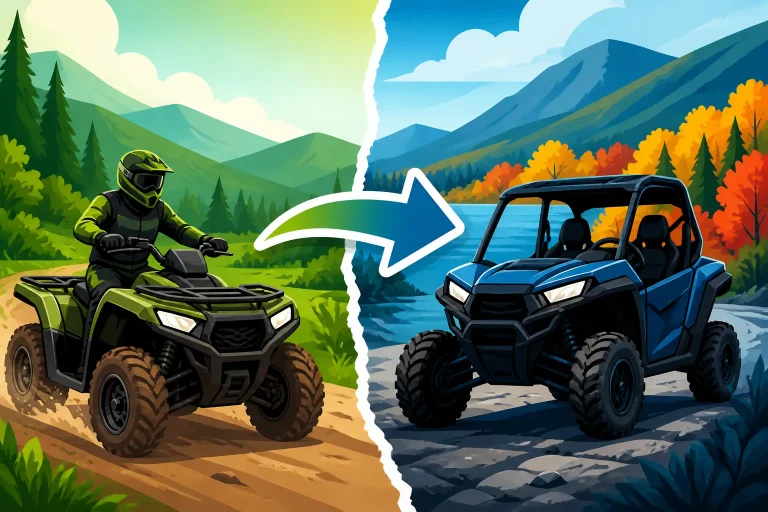
An ATV is generally ridden by one person at a time. It calls for active control, balance, and attention to the terrain. If everyone in the group wants to ride individually, confirm that each person will have a machine and meets the operator’s requirements.
A side-by-side, often called a UTV, has a seated driving position and a steering wheel. It may be a better fit for people who do not want to operate an ATV, for passengers who want to ride together, or for a family group that needs multiple seats. Do not assume that a vehicle advertised as a side-by-side has enough seats for everyone: ask for the exact seating arrangement and whether the guide rides in a separate machine.
Consider the trip, not just the passenger count. A larger vehicle may feel more comfortable to some riders but can be wider and heavier than an ATV. That can affect which routes are suitable. Ask the operator to match the vehicle to the route, passengers, and riders’ experience.
Shared, private, and group rides
A shared tour can be a practical way to join a scheduled outing, but the pace and stops may be set for the whole group. Ask how many machines or participants may be on the ride and whether the operator pairs unrelated bookings together.
A private booking gives your party more control over pace and conversation, though it may have different availability or booking conditions. If someone in the group is nervous, inexperienced, or has mobility needs, explain that before reserving. The operator can tell you whether the route and vehicle can accommodate them; do not rely on a general description such as “beginner friendly.”
For groups, establish who is riding, who is a passenger, and who might need a separate vehicle before paying. Operators may have limits based on vehicle capacity, age, height, weight, or route conditions. Those limits are specific to the operator and machine, so ask directly rather than estimating from a listing photo.
Where Vermont tours take place and why access matters
The location of a tour determines more than the view. It affects the terrain, the type of permission needed, how far you travel to the starting point, and whether a route can be used on your chosen day.
Some rides take place on private land under an arrangement with the landowner. Others may use a permitted trail network or connect with roads that have been opened to ATV use. Vermont’s trail network includes corridors on private land, and access depends on permission and current trail conditions. A route shown in a listing or map is not proof that it is open to the public or available to a tour on a particular date.
If a tour is described as a VASA trail ride, ask which access rules apply and what the operator provides. The Vermont ATV Trails: The VASA System overview explains why trail access is tied to a managed system rather than being a general invitation to ride any visible track. The required Vermont TAD: The Trail Access Decal Explained is a separate point to verify. Ask whether the operator handles the decal or other access requirements for its machines and whether that arrangement covers every participant.
This distinction matters because a rental, a guided tour, and permission to ride are different things. A machine can be available while the route you expected is closed or unavailable. Likewise, a tour operator may use a private route that does not require the same visitor arrangements as a trail-network ride. Get the exact ride area and access plan before booking.
Ask for the actual start point
“Near” a town or region can still mean a significant drive from where you are staying. Ask for the meeting location, parking instructions, and whether the group starts riding from that spot or is transported to a separate location. Check how early you must arrive and what happens if you are delayed.
If your booking mentions trails, ask whether the advertised route is a fixed itinerary or a general description. Operators may change the route because of weather, landowner requests, maintenance, or trail conditions. A reputable operator should be able to explain what kinds of changes are possible and whether the outing can still proceed if the planned route is unavailable.
Do not assume roads are part of the tour
Some ATV routes may connect with roads, but road access is not automatic across Vermont. Towns make decisions about which roads, if any, are open to ATVs, and local rules can affect where and when a machine may travel. A tour that uses a private property route is not the same as a ride that includes public-road sections.
If a tour claims to use town roads, ask which town or route is involved and how the operator handles local requirements. The general background in Vermont ATV Road Rules: Towns Decide can help explain why a route that is permitted in one place may not be allowed in another.
Out-of-state visitors should also ask whether they need to arrive with home-state registration or other documents. Vermont recognizes certain out-of-state registrations under reciprocity rules, but visitors should confirm that their particular machine and trip qualify. See Vermont Reciprocity for Out-of-State Machines and ask the operator what proof it expects at check-in. A tour provider’s instructions for its own fleet may differ from the requirements for someone arriving on a personal machine.
How to choose the right operator and outing
A good listing gives you enough information to decide whether the ride fits your group. If the description is vague, treat that as a reason to ask questions—not as a reason to assume that the details are standard.
Start with the type of ride. Are you looking for instruction, scenery, a longer trail experience, or simply the chance to try a machine? Then compare the practical parts: vehicle, group size, route, pace, included gear, and cancellation policy. A tour that is inexpensive to book may not include items another operator bundles, so compare the full arrangements rather than the headline description.
Check the operator’s suitability
Before reserving, ask:
- What exact vehicle will we use, and how many seats does it have?
- Is the guide with the group throughout the ride?
- How much time is spent on the route compared with check-in and instruction?
- What terrain and difficulty should we expect?
- Are first-time riders accepted, and is instruction provided?
- What are the minimum age, driver’s license, and passenger requirements?
- Are there height, weight, or other machine-specific limits?
- What safety equipment is supplied, and what should we bring?
- Is trail or property access included, and who handles any required decal?
- What happens if weather, trail conditions, or a closure affects the ride?
The answer to “beginner-friendly” should be more specific than a yes or no. Ask whether the route has steep slopes, narrow sections, mud, water crossings, rocks, or other features that can be challenging. Also ask what happens if a participant is uncomfortable or unable to continue. A guide may be able to adjust the pace, but route changes and return arrangements depend on the operator.
Compare listings with care
A booking marketplace can make it easier to find and compare activities, but the listing is not a substitute for confirming details with the operator. Viator may be one place travelers encounter activity listings; availability, descriptions, and booking conditions can vary. Read the full terms and verify key points directly, especially if the activity is described in broad terms or the booking is close to the ride date.
Polaris Adventures may also be relevant when you are looking for a brand-associated riding or rental experience. Its name alone does not establish that a specific Vermont tour is available, guided, or appropriate for your group. Confirm the actual local operator, location, route, vehicle, and terms attached to the outing you are considering.
No marketplace or brand name guarantees that a particular route is open or that every feature is included. Be sure the business you are booking with can answer questions about check-in, access, vehicles, insurance, and weather changes.
Read the cancellation and damage terms
Outdoor rides are affected by weather and trail conditions. Before paying, find out whether the operator cancels, reschedules, or modifies a tour when conditions are unsuitable. Ask who makes that decision and how the operator contacts customers. A forecast of rain does not necessarily mean a ride is canceled, but heavy rain or trail damage may affect the route or whether it is responsible to ride.
Damage policies deserve careful attention. Ask what financial responsibility you accept if a machine is damaged, whether a damage waiver is optional, and what it does and does not cover. A waiver is not necessarily insurance, and the name of a policy or add-on does not tell you its exclusions. The details in Vermont Rental Insurance and Deposits are useful questions to raise when comparing rental-based outings.
Booking, costs, and what to bring
The price of a tour depends on how it is sold. An operator may charge by machine, rider, seat, or length of outing. A private booking may be priced differently from a shared ride, and a larger side-by-side may have a different rate from a single ATV. Since costs and terms vary, check the operator for current figures and compare what is included before you book.
A useful comparison looks beyond the total:
| Booking detail | Why it matters |
|---|---|
| Price unit | Clarifies whether you pay per person, vehicle, seat, or group |
| Ride duration | Shows whether the stated time includes orientation and check-in |
| Included access | Helps identify whether trail or property access is covered |
| Fuel and equipment | Avoids surprises about fuel, helmets, or other gear |
| Insurance or damage terms | Explains what may be your responsibility if a machine is damaged |
| Deposit and payment conditions | Helps you understand what is charged or held at booking |
| Cancellation and weather policy | Shows what happens if plans or conditions change |
| Passenger arrangements | Confirms that everyone has a legal and suitable seat |
Some providers may require a payment card, deposit, or damage authorization. The amount and process vary, so check the operator’s terms. Ask whether the cardholder must be the driver, whether the deposit is charged or held, and when any hold is released. Do not assume that a marketplace booking changes the operator’s own damage or check-in rules.
Reserve for the whole group
When booking for multiple people, provide accurate ages, rider experience, and passenger plans. Operators may not be able to change a vehicle assignment at the last minute if the group size or age information was incorrect. If you are booking a side-by-side, confirm the vehicle’s actual seating capacity and whether each seat is appropriate for the passengers in your party.
If a child is coming along, ask about both the operator’s minimum age and Vermont requirements. These are not necessarily the same question. A tour business may set stricter rules than the law, and a route may not be suitable for a child even where participation could otherwise be allowed. For riders under 18, review Vermont ATV Safety Course Required Under 18 and ask the operator what certificate or supervision it requires.
For driver eligibility, check whether a valid driver’s license is required for a side-by-side or other machine. Tour operators can set their own requirements, and rules may vary by vehicle and location. The questions collected in Vermont ATV Rental Age and License Rules are a useful starting point, but the provider’s current policy is the final check for its booking.
Dress for riding, not just the forecast
Wear clothing that covers your legs and arms and can handle dust, mud, and brush. Closed-toe footwear with a secure fit is a sensible choice. Bring layers if the day may start cool or conditions could change. Eye protection is important, especially on dusty routes or behind another machine. If an operator supplies a helmet, ask whether it has different sizes and whether you can bring your own approved helmet.
Do not plan to ride in clothing you are unwilling to get dirty. Mud, rain, and spray are normal possibilities on an outdoor route. A spare layer and a bag for wet clothing can make the drive back more comfortable. Ask before bringing loose items, bags, or personal equipment, since storage space may be limited.
Pack the items the operator requests, along with any personal medication you may need. A phone can be useful before and after the ride, but do not assume you will have reliable service on the route or that you can safely use it while riding. Keep valuables secure and follow instructions about cameras, mounting equipment, or stopping for photographs.
Safety, rules, and riding etiquette
A guided outing still requires each participant to make safe decisions. The guide can explain the route and give instructions, but riders must follow those instructions, control their machine, and tell the guide if they are uncomfortable. Never ride faster than your ability or follow another machine into a section you cannot handle.
Before moving, pay attention to the orientation. Learn how the controls work, how to stop, where to look for the guide, and what signals the group will use. Ask questions before the ride begins. If you do not understand how to use a control or are unsure about a maneuver, say so rather than trying to catch up without instruction.
Follow the guide’s spacing and passing instructions. Keep a safe distance from the machine ahead, particularly where visibility is limited or the trail is slippery. Stop only where the guide says it is safe to stop. Do not overtake the guide or leave the route to take a photograph or find a shortcut.
Respect landowners and other trail users
A large part of Vermont riding depends on permission to cross private land. Stay on the marked or instructed route, close gates if you are told to, and do not leave litter. Avoid revving near homes or stopping in a way that blocks access. A route can be withdrawn or changed, so courtesy is not just good manners; it helps preserve access for future rides.
Be ready to share corridors with other users. Slow down when approaching people, animals, or a narrow section. Follow the guide’s directions on when to pass and how to give others room. Do not assume that a trail belongs exclusively to your tour group.
For more on these expectations, see Vermont Trail Etiquette on Private Land. If your ride uses a trail network, the operator should explain the route and any local rules that matter. Your responsibility is to ride only where the guide directs and to avoid creating new tracks or widening muddy sections.
Be honest about comfort and ability
A route described as easy can feel very different to someone who has never operated a machine. If steep terrain, loose ground, mud, or water crossings make you uneasy, tell the operator before you reserve and repeat that concern during the briefing. Ask whether you can choose a less challenging route, ride as a passenger in an appropriate vehicle, or stop if you decide not to continue.
Do not let group pressure determine your pace. A tour should not require a rider to take an obstacle they are not prepared to handle. If a machine feels difficult to control, stop in a safe place and get the guide’s attention. Never attempt to recover a stuck or damaged machine unless the guide has explained what to do.
Alcohol or impairing substances do not belong before or during a ride. Fatigue, dehydration, and discomfort can also affect judgment. Speak up if you need a break, and follow the operator’s instructions if the guide decides conditions are no longer safe.
Planning your Vermont ride from arrival to return
A smooth outing starts before you reach the meeting point. Confirm the booking, check the operator’s messages, and review the location and arrival time. Build in extra travel time, particularly if the route is unfamiliar or the meeting point is away from your lodging. Ask where to park and whether trailers or larger vehicles can use the lot.
Before leaving home or your lodging, check that everyone has the documents and equipment the operator requested. Review the weather, but use the operator’s update as the source for whether the outing is proceeding. If you have a question about a route closure, call the business rather than assuming that a map or old review reflects current conditions.
A practical sequence is:
- Confirm the date, start time, meeting location, and expected return time.
- Verify the vehicle assignment, rider and passenger details, and age requirements.
- Ask what access, registration, training, or identification documents apply.
- Review the equipment list, cancellation terms, and damage policy.
- Arrive early enough for check-in and instruction.
- Tell the guide about your experience level or any concern before setting out.
- Follow the route and return instructions, and check the machine in with staff afterward.
For riders bringing their own machine rather than using a tour provider’s vehicle, the planning changes. You may need to arrange registration, trail access, insurance, and safety documentation yourself. Do not assume the tour operator’s access arrangements extend to a personal ATV or UTV. The details in Vermont ATV Trails: The VASA System and Vermont Reciprocity for Out-of-State Machines can help you identify what to verify for your situation.
Set expectations for the day
A tour is an outdoor activity, not a guaranteed sightseeing itinerary. The guide may choose a different route because of rain, mud, a damaged section, or another access issue. A scenic ride may include limited stopping time, while a beginner outing may spend more time on instruction than covering distance. Ask what the experience is designed to provide so that your expectations match the booking.
Do not compare tour lengths by clock time alone. One operator’s stated duration may include orientation and gear fitting, while another may describe time on the route. Ask how much time participants should expect to spend riding and whether the group can take breaks.
If the outing is part of a larger trip, leave space in your schedule after the return time. Check-in, changing, cleaning up, and travel back to your lodging can take longer than expected. Avoid making a tight connection or booking another activity immediately afterward.
If you are deciding between a tour and a rental
Choose a guided tour when you want a planned route, support from a guide, and help understanding the local riding setup. Choose a rental when you are comfortable managing the route and access arrangements yourself and the provider offers a suitable vehicle and permitted riding area. In Vermont, independent access should not be treated as automatic: verify where you may ride and what documents or decals apply.
A tour can reduce the work of route planning, but it does not remove the need to check vehicle fit, rules, weather, and safety terms. A rental may give you more flexibility, but it can leave more decisions to you. For people who are new to off-road riding, a guided introduction is often the clearer starting point—provided the operator gives a proper briefing and the route matches the group’s ability.
Frequently Asked Questions
Are guided ATV tours widely available throughout Vermont?
Availability varies by area, season, and operator. Do not assume there is a tour near every town or trail network. Search for the specific region you plan to visit, then confirm the actual start point, route, and dates directly with the provider.
Does a guided tour include trail access?
It may, but the term “guided tour” does not guarantee that trail access, a decal, or every permit is included. Ask which land or trail system the outing uses and what the operator handles for its vehicles and participants.
Can beginners take a Vermont ATV tour?
Some outings are designed for first-time riders, but difficulty and instruction vary. Ask what the orientation covers, what terrain the route includes, and whether the operator can offer a slower or less challenging ride.
Can children join a guided ATV or UTV ride?
That depends on the child’s age, the vehicle, the operator’s policy, and applicable requirements. Ask about minimum ages, passenger seating, supervision, and any required safety certificate before booking. Do not assume a child can ride as a passenger simply because a vehicle has an extra seat.
What should I do if the weather turns bad?
Follow the operator’s instructions and cancellation policy. Ask before booking how it handles rain, trail closures, or unsafe conditions, and make sure the business has a way to contact you with changes.
Disclaimer
This article is for general informational purposes only and does not constitute professional advice. Laws, prices and regulations vary by location and change over time. Consult a qualified professional for guidance on your specific situation.