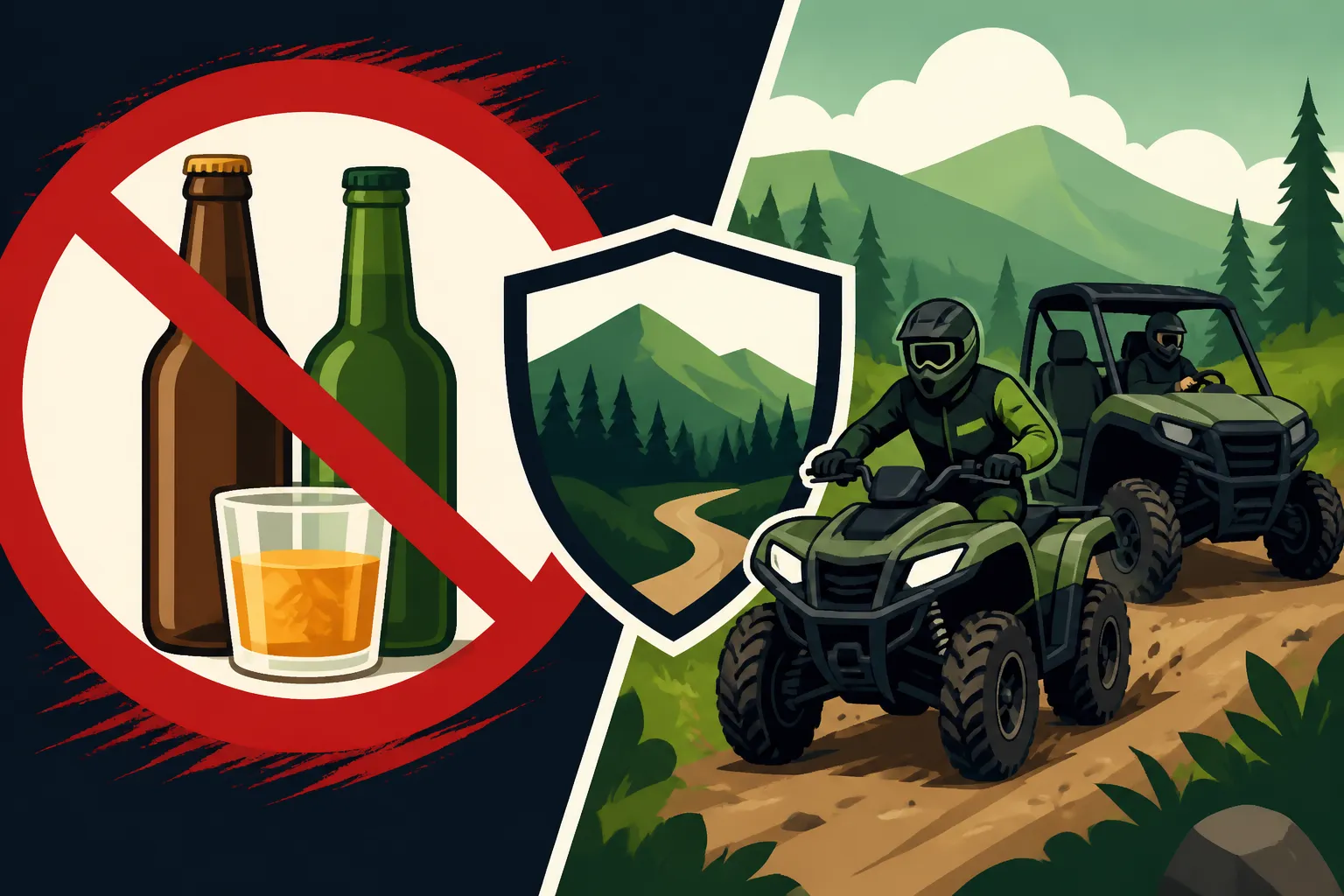
Alcohol and Why Clubs Enforce It
Alcohol and ATV or UTV riding do not mix, but the rules can seem unclear when a ride follows private land and club-maintained corridors. In Vermont, impairment creates a serious safety and legal risk, while individual clubs may set stricter conditions for trail access and events. Knowing the difference helps riders avoid a dangerous trip, a turn-around at a gate, or trouble for the club.
The difference between Vermont law and club rules
The basic rule is straightforward: do not operate an ATV or UTV after drinking. Vermont’s impaired-driving laws can apply to ATV operation, and being on a trail rather than a public road is not a sound reason to assume the law does not apply. The details can depend on the circumstances, so riders with a specific legal question should check Vermont DUI Law and ATVs.
Club rules are a separate layer. A club may prohibit alcohol use at a ride, on a trail, at a staging area, or anywhere covered by its event rules. It may also require a rider to leave if an organizer or trail representative believes the rider is impaired. Those conditions can be stricter than the minimum rules that apply statewide.
That distinction matters because a club trail is not simply a public recreation area. Vermont’s ATV network relies heavily on permission from private landowners and on the clubs that maintain and sign corridors. A club can set conditions for using the routes it manages, and a landowner can withdraw permission. A rule against alcohol may therefore protect the club’s access arrangement as well as riders.
The phrase “alcohol on the trail” can mean several different things:
| Situation | What to consider |
|---|---|
| Operating after drinking | Do not ride. Impairment can make operation unsafe and may trigger legal consequences. |
| Carrying alcohol while riding | Check the applicable club, event, and landowner rules. Do not assume it is allowed. |
| Drinking at a staging area or club event | Follow the event organizer’s instructions; an event may prohibit alcohol even when no machine is being operated. |
| A passenger has been drinking | A passenger can affect the driver’s balance, judgment, and ability to respond. A club may also apply its conduct rules to passengers. |
| A rider appears impaired | Stop the ride, prevent further operation, and follow the club’s safety process. |
A rule against drinking while riding is not necessarily the same as a statewide ban on possessing alcohol everywhere. The exact rule may vary by club, property, and event. Read the conditions for the route you plan to use, and ask the club or organizer if the wording is unclear. The article Vermont Alcohol Rules on Club Trails covers that club-level issue in more detail.
Why clubs take alcohol seriously
An ATV or UTV requires attention, coordination, and sound judgment. Riders need to choose a safe line, control speed, avoid obstacles, judge slopes, and react to other people using a narrow corridor. Alcohol can affect those abilities before a rider feels noticeably drunk. A rider who believes they are “fine” may still be slower to spot a hazard or make a safe decision.
The risks are not limited to the person who has been drinking. Club trails may pass through working land, use bridges and culverts, or share space with other riders and property users. A mistake can injure a passenger or another trail user, damage a machine or trail feature, or create a conflict with a landowner. A serious incident can also make a landowner less willing to let a club keep a corridor open.
That is why club enforcement can feel strict. A club may be trying to prevent a foreseeable problem before it becomes a crash or a loss of access. A landowner who grants permission is trusting riders to use the property responsibly. Clubs have a strong reason to take reports of impairment seriously and to apply event and trail conditions consistently.
Alcohol can complicate a group ride in practical ways, too. Riders may become separated, take an incorrect turn, or respond poorly when the group needs to stop. A person who has been drinking may underestimate how difficult a muddy section or steep descent is. If a machine becomes stuck or breaks down, the group needs clear communication and careful decisions to manage the situation.
UTVs do not remove these concerns. A larger machine may feel more stable than a quad, but it still needs a capable operator. Passengers, added weight, and a side-by-side’s size can make tight trails, turns, and uneven ground more demanding. A seat belt, roll-over protection, or enclosed cab does not make impaired operation safe.
Access depends on responsible conduct
Vermont trail access involves more than arriving with a machine and a registration plate. Riders generally need to follow the access conditions that apply to the trail system they use. For VASA corridors, that includes the applicable Trail Access Decal requirements; see Vermont TAD: The Trail Access Decal Explained. Visitors should check the rules that apply to their own machines and trip rather than assuming that an out-of-state registration alone covers trail access. Vermont TAD for a Visitor’s Machine explains that visitor-specific question.
An access decal or membership is not permission to ignore a club’s safety requirements. A valid decal does not guarantee that every route is open, and it does not override a landowner’s conditions. A club may close a corridor or refuse access when conduct creates a safety concern.
Alcohol policies can also apply beyond the moment a machine is moving. An event organizer may prohibit alcohol at a gathering, staging area, or organized ride. If the event conditions say no alcohol, follow those conditions instead of trying to interpret a narrow exception. When riding on private land, respect the property rules as well as the marked route; Vermont Trail Etiquette on Private Land offers useful context.
How clubs may enforce a no-alcohol rule
Enforcement can be different from one club or event to another. The process may be written in club rules, included in an event waiver, posted at a trailhead, or explained by an organizer before a ride. Some clubs may rely on volunteers to observe conduct and report concerns; others may have a designated event lead or trail representative.
A rider may be asked to stop, leave the corridor, or arrange a sober driver to take them and their machine back. An organizer may refuse participation or remove someone from an event. The club’s options depend on its rules, the property arrangement, and the situation. Do not assume that every club follows the same procedure or that a warning is guaranteed.
A trail representative who asks someone to stop is usually trying to prevent the situation from escalating. Arguing, continuing along the trail, or asking another rider to conceal what happened can put the group and club in a worse position. Cooperate with reasonable safety instructions. If there is a disagreement about a club decision, address it later through the club rather than continuing to ride in a potentially unsafe condition.
A warden or other enforcement officer may also check for compliance with relevant laws and trail conditions. A roadside or trail stop can involve questions about the machine, its registration, or trail access. What a Trail Warden Checks explains the kinds of requirements a rider may need to be ready to show. Keep in mind that a club volunteer’s role is not necessarily the same as a law enforcement officer’s role, and a club rule is not automatically a criminal statute.
If someone appears impaired, the safest response is to prevent them from operating. Do not get on the machine with them, and do not let them drive a group vehicle or trailer if they are not safe to do so. If there is an immediate danger or a crash, contact emergency services. Otherwise, arrange a sober ride and deal with the machine once everyone is safe.
For a group ride, decide in advance how the group will handle a rider who has been drinking. Make sure the plan does not depend on that person’s judgment at the time. A responsible group can pause, keep other riders clear of the machine, and ask a sober person to coordinate transport. Avoid creating a confrontation in the middle of a narrow or hazardous trail; move to a safe place if possible.
Plan a ride that keeps alcohol out of the operation
The simplest plan is to separate drinking from riding entirely. If there is an after-ride gathering, finish operating, park the machines, and make sure no one plans to ride again afterward. A break does not automatically make someone safe to operate; impairment can last longer than a rider expects. If there is any doubt, leave the machine parked and arrange another way home.
Before heading out, confirm the route’s current access conditions and any event-specific rules. Clubs may update closures or requirements, and a route that was open on a previous visit may not be available now. Check the relevant club information, follow posted signs, and ask the organizer about alcohol rules before the ride begins.
A few practical steps make the policy easier to follow:
- Tell the group the plan before departure. Agree that anyone who drinks will not operate a machine afterward.
- Name a sober ride lead. This person can handle directions, group decisions, and transport if plans change.
- Read the event rules. Look for conditions on alcohol, passengers, staging areas, and conduct.
- Keep alcohol separate from riding equipment. Do not bring it onto a route if the club or property rules prohibit it.
- Stop when a rider seems impaired. Do not rely on the rider to decide whether they are fit to continue.
- Arrange transport before it is needed. Know who can drive people and machines back safely.
- Follow the club’s instructions. Ask questions later if you disagree with a decision.
Insurance is another reason not to treat impairment as a minor rule issue. A policy’s coverage and exclusions depend on its terms, and coverage should never be assumed after an incident involving alcohol. Riders should review their own policy and understand the requirements that apply to their machine; Vermont ATV Insurance Requirements is a useful starting point.
Visitors should take the same care as local riders. Reciprocity or recognition of an out-of-state registration does not necessarily exempt a visitor from Vermont laws, club access conditions, or event rules. If you are riding from another state or country, confirm the requirements for your machine and route before departure. For example, Vermont Rules for a Visiting Quebec Rider addresses the need to understand Vermont conditions when arriving from Quebec.
The practical takeaway is simple: do not drink and operate, and do not assume a club’s alcohol policy is identical to statewide law. Check the rules for the route and event, respect the landowner’s conditions, and make a sober plan for getting everyone and every machine home. That approach protects riders, passengers, trail access, and the clubs that keep corridors available.
Disclaimer
This article is for general informational purposes only and does not constitute professional advice. Laws, prices and regulations vary by location and change over time. Consult a qualified professional for guidance on your specific situation.