Vermont Rules for a Visiting Quebec Rider
Bonjour, fellow rider! Planning to bring your quad or side-by-side down from Quebec to explore the gorgeous green mountains and vast trail networks of Vermont? That's an absolutely fantastic idea! There's nothing quite like the experience of riding through Vermont's diverse landscapes, from the rolling farmlands to the dense forests. However, before you load up your machine and head south, it's crucial to understand that Vermont has its own set of rules and regulations for ATVs and UTVs, and they can differ significantly from what you're used to in la belle province. This guide is here to walk you through everything a visiting Quebec rider needs to know to ensure your adventure is smooth, legal, and stress-free, helping you avoid any unwelcome surprises or fines.
Understanding Vermont's ATV and UTV Definitions for Visitors
One of the first things that can cause confusion for Quebec riders heading to Vermont is the way each jurisdiction defines off-road machines. What you call a "VTT" (Véhicule Tout-Terrain) or "côté-à-côté" in Quebec might have a slightly different classification in Vermont, and those distinctions are super important for registration and trail access.
What Vermont Calls an "ATV" and "ASV"
In Vermont, we primarily categorize off-road vehicles into two main groups for registration purposes: All-Terrain Vehicles (ATVs) and All-Terrain Side-by-Side Vehicles (ASVs). An ATV, in Vermont's eyes, is generally a motorized, off-highway vehicle designed to travel on four or more low-pressure tires, having a seat designed to be straddled by the operator and handlebars for steering. Think of your traditional quad.
Where it gets interesting for many Quebec side-by-side owners is with the ASV definition. Vermont has specific width and weight limits that dictate whether your machine falls into the standard ATV class or the ASV (Class A) category, which has different registration costs. The current statutory definition generally covers machines that are 72 inches or less in width and weigh 2,500 pounds or less. If your machine is wider or heavier, it might not fit the conventional ATV/ASV definition and could face different rules entirely, though many modern side-by-sides from brands like SuperATV, known for their wider stances and robust builds, still fall within these parameters. It's really important to measure your machine before you come down so you know where you stand. For a deep dive into these specifics, you'll want to review [Vermont's 72-Inch, 2,500-Pound ATV Definition].
Differences from Quebec's Definitions
Quebec's definitions for ATVs and side-by-sides, as regulated by the FCMQ (Fédération des clubs de motoneigistes du Québec), are well-established for riders in Quebec. While both provinces are talking about off-road vehicles, the nuances in size, weight, and even tire requirements can vary. For example, Quebec might have specific regulations around passenger capacity that align with manufacturer design, but Vermont's focus tends to be more on the physical dimensions and weight for classification.
It's not uncommon for a Quebec-registered machine to perfectly fit Vermont's ATV or ASV criteria, but it's never a guarantee. The critical takeaway here is that you can't assume your Quebec registration or classification automatically translates directly into Vermont's system for riding access. Always double-check your machine's dimensions against Vermont's legal definitions to ensure you’re in compliance.
The Importance of Classification for Your Ride
Why does all this talk about definitions matter? Because it directly impacts how you register your machine for use in Vermont and, subsequently, which trails and roads you can legally access. A machine that falls into the ASV (Class A) category, for instance, has a different registration fee than a standard ATV. If your machine happens to exceed the 72-inch width or 2,500-pound weight limit, it may not be considered a recreational ATV under Vermont law at all, which could severely limit where you can ride. This classification is the foundation for everything else, from registration to insurance requirements, so getting it right from the start saves a lot of headaches later on.
Registration and Trail Access for Quebec Riders
This is where many visiting riders from Quebec have the most questions. You've got your machine registered and plated in Quebec, so do you really need to do anything else to ride in Vermont? The short answer is yes, you almost certainly do, especially if you plan to hit the trails.
Do Quebec Machines Need Vermont Registration?
Here's the good news: Vermont does have reciprocity agreements with Quebec when it comes to ATV registration. This means that if your ATV or ASV is legally registered and plated in Quebec, you typically do not need to obtain a separate Vermont registration plate for recreational trail riding. This is a huge convenience and avoids the hassle and cost of a second full registration process. You can find more specific details on this reciprocity arrangement by checking out [Vermont Reciprocity With Quebec].
However, there's a crucial distinction. While your Quebec registration plate is recognized for identifying your machine, it doesn't automatically grant you access to Vermont's extensive trail system. That's where the Vermont Trail Access Decal comes in.
The Vermont Trail Access Decal (TAD)
Even with your valid Quebec registration, if you intend to ride on Vermont's VASA (Vermont All-Terrain Vehicle Sportsman's Association) trail system, which comprises the vast majority of legal ATV and UTV trails in the state, you must purchase a Vermont Trail Access Decal, or TAD. Think of the TAD as your "ticket" to the trails. It's a sticker that shows you've paid your dues to support the maintenance and development of Vermont's trail network. The TAD includes your VASA membership and club dues, which are essential because VASA and its member clubs, not the state, maintain almost all of Vermont’s recreational ATV trails, primarily on private land with landowner permission.
Here’s what you need to know about the TAD for visitors:
- Cost: The cost for a visitor's TAD is different from a Vermont resident's. It's a bit higher because you're not contributing to the Vermont registration fees. You'll want to check current prices directly on the VASA website, but expect it to be a separate, non-insignificant expense. For up-to-date figures and a clearer picture, look for [Vermont TAD Prices for Visitors].
- Expiration: All TADs, regardless of when they are purchased during the year, expire on December 31st of the year they are issued. So, if you buy one in October, it will still only be valid until the end of that calendar year. Plan your purchase accordingly.
- Placement: The decal must be affixed to your machine in a clearly visible location, usually on the front fender or windshield. Wardens and club volunteers will be looking for this, and riding without one is a surefire way to get turned around or fined.
- Where to Buy: You can typically purchase a TAD online through the VASA website, or sometimes from local ATV dealers or shops in Vermont. It's always a good idea to buy it in advance of your trip to avoid delays.
So, while your Quebec plate gets you recognition, the TAD gets you access. Always make sure you have both your valid Quebec plate and your Vermont TAD prominently displayed. [Carrying Both Plate and Decal] is non-negotiable for riding the trails.
Required Documents for Trail Riding
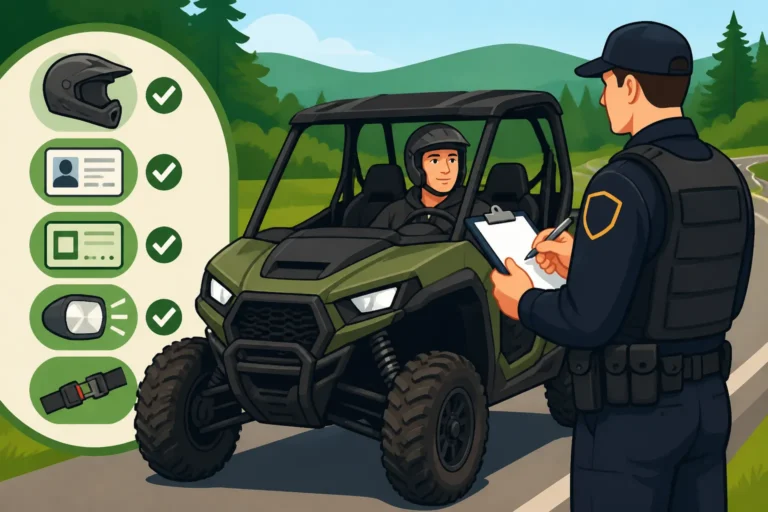
When you're out on the trails in Vermont, a warden or local law enforcement officer might stop you. It's important to have all your paperwork in order. For a Quebec rider, this generally includes:
- Proof of Quebec Registration: Your valid Quebec ATV or ASV registration card.
- Vermont Trail Access Decal (TAD): Proof of purchase, or better yet, have it already affixed to your machine.
- Proof of Insurance: Your Quebec insurance policy, ensuring it provides adequate liability coverage in Vermont. We'll delve into this more below. [Vermont Registration and Insurance Proof] is vital.
- Safety Certificate (if applicable): If you or any other riders in your group are under the age of 18, Vermont requires completion of an ATV safety course. While Vermont does recognize some out-of-state safety certificates, it's best to verify if your Quebec safety course is reciprocally recognized or if an online Vermont-approved course is necessary for younger riders.
Having these documents readily available, perhaps in a waterproof pouch on your machine or in your riding gear, will make any interaction with authorities quick and smooth.
Road Rules and Operating Regulations for Visiting Riders
Riding in Vermont isn't just about the trails; it also involves navigating designated town roads, crossing highways, and adhering to general safety regulations. These rules apply equally to visiting Quebec riders as they do to Vermont residents.
Helmet and Safety Gear Requirements
Vermont takes rider safety very seriously. Unlike some jurisdictions where helmet laws might only apply to younger riders, in Vermont, it's universal. Every single person, regardless of age, operating or riding as a passenger on an ATV or ASV in Vermont must wear a safety helmet. This helmet must meet federal motor vehicle safety standards (FMVSS) or ASTM standards. This means no novelty helmets; you need certified protection. Make sure your helmet fits properly and is securely fastened. This is one rule that wardens are especially strict about enforcing. For more details on this, see [Vermont ATV Helmet Law for Every Rider].
Beyond helmets, it's highly recommended to wear appropriate riding gear, including eye protection, long pants, a long-sleeved shirt, gloves, and sturdy boots. While not all of this is legally mandated, it's smart riding practice to protect yourself from branches, debris, and potential falls.
Insurance Mandates
Just like in Quebec, Vermont requires that all ATVs and ASVs operated in the state carry liability insurance. This is non-negotiable, whether you're a resident or a visitor. Your Quebec insurance policy might extend coverage to your machine while riding in Vermont, but you absolutely must verify this with your insurance provider before your trip. Don't assume. Some policies have geographical limits or specific exclusions for out-of-province off-road use.
Vermont's minimum liability coverage requirements are specific: $25,000 for bodily injury to one person, $50,000 for bodily injury to two or more persons, and $10,000 for property damage. If your Quebec policy doesn't meet these minimums or doesn't cover out-of-province recreational use, you may need to purchase supplemental insurance. Carrying proof of this insurance with you at all times is also a requirement. [Vermont ATV Insurance Requirements] lays out these details clearly. Think of it as another layer of protection, not just for you, but for others on the trails or roads.
Permitted Roads and Speed Limits
While Vermont has an extensive trail system, you'll often find that these trails are connected by designated town roads. This is a unique aspect of riding in Vermont, but it comes with strict rules. You cannot simply ride your ATV or ASV on any public road in Vermont. Instead, towns must specifically vote to open certain roads for ATV/ASV use. These are typically dirt roads or less-trafficked paved roads, and they will usually be marked with signs indicating they are open to ATVs.
When riding on these designated town roads, you are expected to follow all standard traffic laws, including posted speed limits. Even if a road is open to ATVs, don't assume you can fly down it. Speed limits will vary, and often, there might be a specific ATV speed limit set by the town, such as 25 mph in villages or residential areas. Always be on the lookout for signage. Some towns, like Brighton or Newport City, have specific ordinances you'll want to be aware of. For a broader understanding, refer to [Vermont ATV Road Rules by Town].
Remember, riding off the designated trail system or on unposted roads can lead to trespassing charges or fines, so stick to the routes you know are open. Using an app like SuperATV's navigation tools or checking VASA's official maps can help ensure you stay on legal paths.
Crossing State Highways
There will be instances where an ATV trail or a designated town road requires you to cross a state highway. This is allowed under specific conditions but requires extreme caution and adherence to rules. You typically must come to a complete stop, yield to all traffic, and cross the highway directly and safely, perpendicular to the road. You cannot ride along a state highway. The idea is to minimize your time on the busy pavement. Special rules apply to younger riders at crossings; for instance, a 12-year-old on an ATV must be directly supervised by an adult at least 18 years old when crossing a public highway. More on this can be found at [Vermont ATV Crossing a State Highway].
Key Differences and What to Expect at the Border
Crossing an international border to ride is an exciting prospect, but it also means navigating customs and understanding that even small cultural or procedural differences can have an impact on your trip.
Customs and Border Crossing
When you bring your ATV or ASV across the U.S.-Canada border into Vermont, you are temporarily importing a vehicle. While typically straightforward for recreational use, you must declare the machine to U.S. Customs and Border Protection (CBP). Have your Quebec registration documents handy. You usually won't need specific import paperwork for a recreational visit, but being transparent and cooperative with the border agents is key. They'll want to confirm ownership and purpose of your visit. For detailed information on this, check [Customs Paperwork for a Machine].
It’s also wise to ensure your machine is reasonably clean before crossing. Mud and foreign biological material on tires or undercarriages can sometimes be an issue for agricultural inspectors, though this is more common for commercial vehicles. A quick wash before you leave Quebec is a good habit.
Trail System Differences
The VASA trail system in Vermont operates differently from Quebec's FCMQ system. While Quebec has its extensive network, Vermont's VASA trails are predominantly on private land, secured through the goodwill and generosity of thousands of individual landowners. This means respect for private property is paramount. Staying on marked trails, respecting landowner requests (like leaving gates as you found them), and understanding that [Vermont Trails Run on Private Land] are crucial for the continued existence of the trail system.
You'll find that Vermont's trail system, especially in the Northeast Kingdom around towns like Island Pond or Newport, offers a fantastic variety of terrain, from gravel logging roads to winding forest paths. Some trails even utilize old rail beds. You might also encounter sections where trails briefly cross small pieces of state land, but these are specifically designated and marked. For information on such crossings, refer to [Vermont State Land Crossings Designated by ANR].
Enforcement and Penalties
Vermont's ATV and UTV rules are enforced by various authorities, including Vermont State Police, county sheriffs, local police departments, and state Fish & Wildlife wardens. These officers are knowledgeable about ATV laws and are often present on the trails or connecting roads. They conduct checks for registration, TADs, helmets, and insurance.
If you are found riding unregistered (without recognized reciprocity), without a valid TAD on VASA trails, without a helmet, or without required insurance, you can face fines. Penalties for riding unregistered can be significant, so don't risk it. [Vermont Penalties for Riding Unregistered] outlines the potential consequences. It's always better to be fully compliant than to face a ticket or have your riding trip cut short.
Language and Local Ordinances
While Vermont is an English-speaking state, don't hesitate to ask questions if you're unsure about signage or local rules. Most locals involved in the ATV community are friendly and happy to help. Keep in mind that beyond state laws, individual towns can have their own specific ordinances regarding ATV use on town roads. These might include curfews, noise restrictions, or specific routes. Always pay attention to local signage, especially when entering or passing through a village.
By understanding these nuances and preparing accordingly, your trip from Quebec to ride the beautiful trails of Vermont will be an unforgettable experience. Enjoy the ride, be safe, and respect the land!
Here’s a quick summary of key differences for Quebec riders:
| Feature | Quebec (FCMQ System) | Vermont (VASA System) |
|---|---|---|
| Registration | Required, issued by SAAQ. | Quebec plate recognized via reciprocity. |
| Trail Access Decal | Required (FCMQ trail permit). | Required: Vermont Trail Access Decal (TAD) for VASA trails. |
| Helmet Law | Required for all riders. | Required for all riders (FMVSS/ASTM certified). |
| Insurance | Required liability coverage. | Required liability coverage ($25k/$50k/$10k minimum). Verify out-of-state coverage. |
| Road Access | Designated roads/trails, often by municipalities. | Designated town roads only, voted open by selectboards. Marked. |
| Trail Ownership | Mix of public and private land. | Primarily private land, maintained by VASA clubs with landowner permission. |
| Youth Safety Course | Required under 16, typically. | Required under 18. Reciprocity for some out-of-state courses. |
| Primary Enforcement | Provincial police, local police, conservation officers. | State Police, Wardens, Sheriffs, Local Police. |
| Border Crossing | N/A (domestic). | Declare machine to U.S. Customs. Have registration handy. |
Disclaimer
This article is for general informational purposes only and does not constitute professional advice. Laws, prices and regulations vary by location and change over time. Consult a qualified professional for guidance on your specific situation.