Insurance Required Before You Ride
Getting an ATV or UTV ready for Vermont means more than checking its registration and trail access. Liability insurance is required for registered ATVs, and having a policy is not enough if it does not cover the machine and the way you plan to use it. Here’s how to check the minimums, review your coverage and prepare before riding.
Vermont’s liability insurance minimums
According to the Vermont Department of Motor Vehicles (DMV), registered ATVs must carry liability insurance at the minimum levels shown below. The requirements listed here are as of November 2026.
| Coverage category | Minimum liability coverage |
|---|---|
| One individual injured or killed in a crash | $25,000 |
| Two or more individuals injured or killed in a crash | $50,000 |
| Property damage in any one crash | $10,000 |
These are liability limits, not a promise that every loss will be paid. Liability coverage generally concerns covered claims for injury or property damage for which an insured rider is responsible. The policy’s terms, exclusions and limits determine what the insurer will pay. Damage to your own ATV, your own medical expenses or damage arising from a specific type of use may be handled differently or not covered by liability insurance at all.
The DMV also allows evidence of self-insurance in place of a bond or liability policy. According to the DMV, the owner must file evidence of self-insurance in the amount of $115,000 with the Commissioner. This is not the same as simply deciding to pay for any crash personally; it involves a formal filing. If you are considering this route, confirm the requirements with the DMV before riding.
For a closer look at the legal coverage rule, see Vermont ATV Insurance Requirements. If you already have insurance, compare the policy limits with the table rather than assuming that any active policy meets Vermont’s minimums.
Check that your policy covers the machine and its use
A policy that mentions an ATV or off-road vehicle may still leave important questions unanswered. Before you ride, check that the policy identifies the machine correctly and applies to the activities you expect to do. A machine’s everyday label, such as “side-by-side” or “UTV,” does not by itself confirm how Vermont classifies it or what a particular insurance policy covers.
The DMV describes an ATV as having two or more low-pressure tires at 10 psi or less, a width no greater than 72 inches and a dry weight under 2,500 pounds. If you are unsure whether your machine falls within that definition, verify its classification with the DMV and your insurer. Registration classification and insurance coverage are related questions, but one does not automatically settle the other.
Confirm the policy details
Review the insurance documents, or contact the insurer and ask direct questions. Be ready to provide the machine’s make, model and identification details. Then confirm:
- The policy covers the specific machine you plan to operate.
- The liability limits meet Vermont’s minimums.
- The policy applies to off-road or trail use, not only another type of operation.
- Any restrictions on riders, passengers, locations or activities are clear.
- The coverage dates include the period when you plan to ride.
- You know what proof of insurance the insurer provides and how to access it.
Pay particular attention to exclusions. For example, ask whether the policy excludes certain trails, organized events, racing or commercial use if any of those situations could apply to your ride. These are questions to put to your insurer, not assumptions about what every policy excludes. The wording can vary, and the insurer is the right source for an answer about your contract.
A policy may also distinguish between liability coverage and coverage for damage to the insured machine. If you want protection for repair or replacement costs after a crash, ask about that separately. Do not treat the state’s liability minimums as evidence that your own machine is insured against damage.
The machine should be named accurately on the policy. Why Your Policy Must Name the Machine You Ride explains why this detail matters, while When Your Insurance Policy Excludes Trail Riding can help you think through use-related limitations. If the policy is in someone else’s name, ask the insurer whether you are covered when operating the machine and whether the policy’s terms allow the planned use.
Visiting Vermont with an out-of-state machine
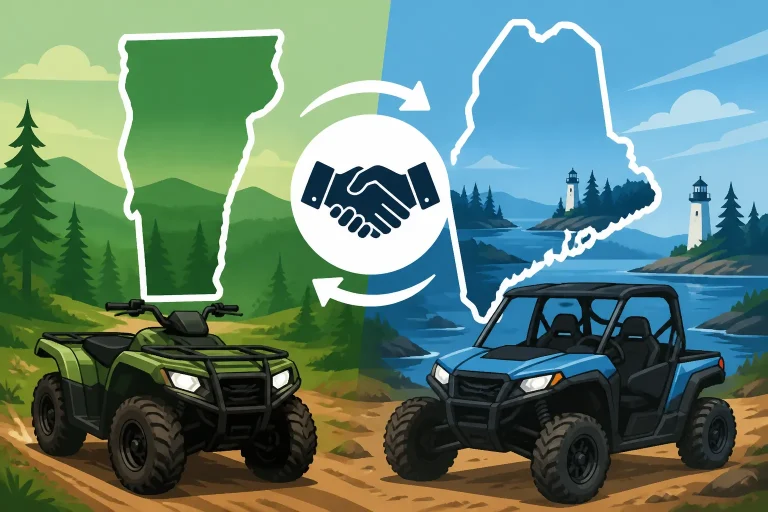
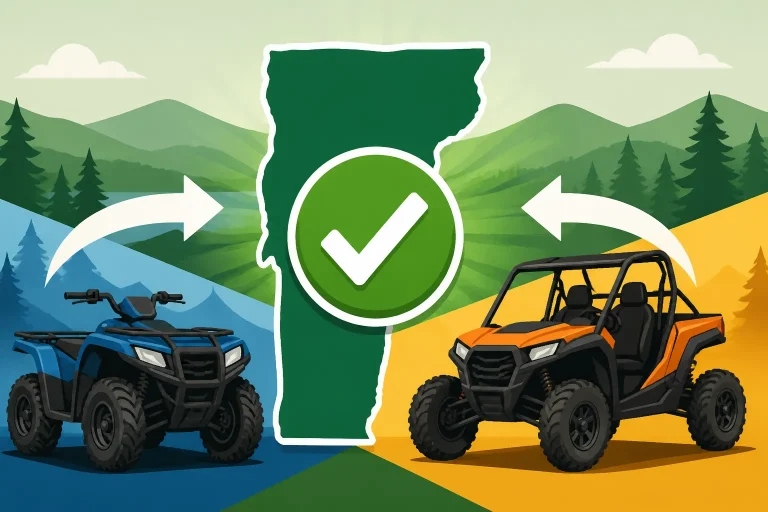
Vermont allows legally registered out-of-state ATVs to operate in the state with a valid registration, according to the DMV. That reciprocity addresses registration. It should not be treated as proof that your home-state insurance automatically meets Vermont’s insurance requirements or covers every Vermont ride.
Before traveling, ask your insurer whether your policy applies to the machine while it is being operated in Vermont and whether its limits meet the state’s stated minimums. If your policy card does not show the limits or does not clearly identify the machine, request documentation that does. Keep the insurer’s explanation with your other ride documents.
For the registration side of a visit, see Vermont Reciprocity for Out-of-State Machines. Keep the questions separate: valid registration is one check, insurance is another, and access to a particular trail or property is a further check.
That last distinction matters in Vermont. The DMV says ATV users must make sure they have permission before entering someone’s property. The Vermont ATV Sportsman’s Association (VASA) is the statewide association of local ATV clubs authorized by and in partnership with the State of Vermont to develop and manage ATV trails. Even with valid registration and insurance, do not assume that you may ride wherever a route appears on a map or wherever a machine can physically travel. Stay on marked trails and confirm access with the relevant club or landowner.
State land has its own limits: according to the Department of Forests, Parks and Recreation, ATVs may be used on state lands exclusively on specific road crossings designated by the Agency of Natural Resources. That restriction is separate from insurance. Having insurance does not create permission to ride on land or a route that is not open to your machine.
A practical pre-ride insurance check
Make insurance part of the same preparation routine as checking the machine, registration and route. A few simple checks can help prevent a coverage question from turning into a problem at the trailhead or after a crash.
- Confirm the machine’s classification. If you are unsure whether the machine is an ATV under Vermont’s definition, check with the DMV. This is especially useful when the manufacturer or seller uses a different everyday label.
- Read the liability limits. Compare the policy with Vermont’s minimums, and check that the relevant coverage is active for the ride.
- Ask about exclusions. Confirm that off-road use and the specific kind of riding you plan to do are covered under the policy.
- Carry accessible proof. Keep the insurance card or other insurer-issued proof with your registration documents. A waterproof document pouch can help protect paper copies; a small pouch from Amazon is one possible option, but follow your insurer’s instructions about acceptable proof.
- Check access separately. Verify registration reciprocity where relevant, trail status and landowner permission. Insurance does not replace any of these checks.
- Review the plan with other riders. Make sure anyone who may operate the machine understands who is covered and what the policy excludes.
If you want a more detailed checklist for showing coverage, see Proof of Coverage in Your Pocket. For related questions about what may be checked during a stop, What a Warden Can Ask to See covers the documents and details riders should be prepared to discuss.
If there is a crash
Keep your insurer’s contact information available and follow its instructions for reporting an incident. Record the relevant details while they are fresh, and do not assume that an insurance claim replaces any required report to Vermont authorities.
According to the DMV, a crash report must be sent to the Commissioner of Motor Vehicles within 72 hours after a crash involving injury, death or property damage. The DMV also says an enforcement officer must be notified immediately if property damage in a crash exceeds $100. These are separate reporting requirements from contacting your insurer. For more on the reporting process, see Vermont ATV Accident Reporting.
The practical takeaway is straightforward: confirm that the machine is correctly identified, the policy covers the way you will use it, the limits meet Vermont’s minimums and proof is easy to reach. For a visitor, verify insurance independently from registration reciprocity. Then check route permission and trail access before setting out.
Sources
- Department of Motor Vehicles — Registering Your All-Terrain Vehicle | Department of Motor Vehicles (checked November 3, 2026)
- Department of Forests, Parks and Recreation — All Terrain Vehicles | Department of Forests, Parks and Recreation (checked November 3, 2026)
- Department of Motor Vehicles — Registering Your All-Terrain Vehicle | Department of Motor Vehicles (checked November 3, 2026)
- Department of Motor Vehicles — Registering Your All-Terrain Vehicle | Department of Motor Vehicles (checked November 3, 2026)
- DEPARTMENT OF MOTOR VEHICLES — VD-038-Snowmobile_Registration_Tax_Title.pdf (checked November 3, 2026)
- Department of Motor Vehicles — VN-023-ATV_Driver_Manual.pdf (checked November 3, 2026)
Disclaimer
This article is for general informational purposes only and does not constitute professional advice. Laws, prices and regulations vary by location and change over time. Consult a qualified professional for guidance on your specific situation.