Do VASA Trails Ask for a Spark Arrester?
If you’re getting an ATV or UTV ready for a VASA ride, you may be wondering whether its exhaust needs a spark arrester before you can enter a trail. The practical answer is to check the rules for the specific route: requirements can depend on the landowner, managing club, or land agency, and an acceptable muffler is not necessarily the same thing as a spark arrester.
Is a Spark Arrester Required on Every VASA Trail?
Do not assume that one spark-arrester rule applies to every corridor in Vermont’s VASA trail system. Routes cross different properties and may be maintained by different clubs. The conditions for access can therefore vary by location, landowner agreement, and any rules that apply to a particular section.
A club or property owner may ask riders to use an approved spark-arresting exhaust system, especially where the route crosses land with specific fire-prevention conditions. A trail or road managed by a public agency may also have requirements separate from a club’s general guidance. Conversely, a machine that meets one route’s requirements may not automatically meet the conditions for another.
The safest approach is to check before you travel:
- Identify the club or trail section you plan to ride. A statewide map or local club information can help you find the right contact.
- Ask whether a spark arrester is required on that route, and whether there is a particular approval or marking the club expects.
- If the route crosses agency-managed land, check that agency’s current rules as well.
- Confirm that your exhaust system is in working order and that the machine meets applicable noise and equipment requirements.
A VASA Trail Access Decal is not proof that your machine satisfies every equipment condition on every corridor. The decal addresses trail access, while equipment conditions may come from the specific route or property. For the access basics, see Vermont Requires Registration Plus a TAD and Vermont State Land Access Rules.
| Situation | What to check |
|---|---|
| A route maintained by a local club | Ask the club about its current equipment and landowner conditions |
| A route crossing public or agency-managed land | Check the managing agency’s current requirements |
| A dry or high-fire-risk period | Look for temporary restrictions, closures, or added conditions |
| A machine with a modified exhaust | Confirm both spark-arrester status and noise compliance |
| A route with unclear rules | Contact the club before loading or riding |
The distinction matters because permission to use a corridor does not necessarily mean every machine configuration is acceptable there. If you cannot confirm the rule, do not treat silence on a map or sign as permission to ignore a landowner’s or agency’s conditions.
What a Spark Arrester Does—and What It Does Not Do
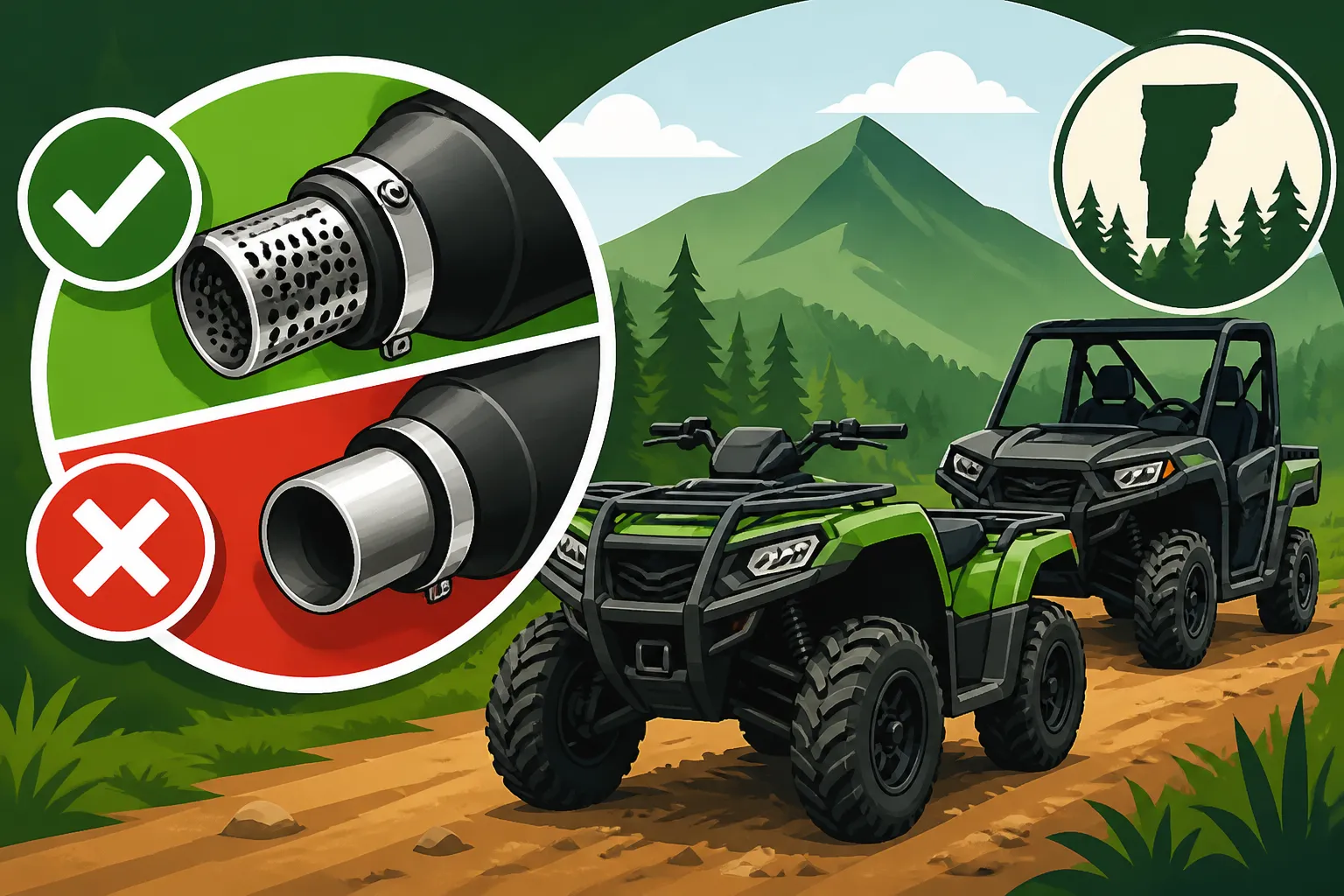
A spark arrester is a device in an exhaust system designed to reduce the chance that hot particles or sparks will leave the exhaust and ignite dry vegetation. Depending on the design, it may use a screen or another internal arrangement to trap or cool particles. It is not simply a cap, a quiet muffler, or a decorative exhaust part.
A muffler reduces exhaust noise. Some exhaust systems include a spark arrester as part of the assembly, but the two functions are different. A quiet machine is not automatically equipped with a spark arrester, and a spark arrester does not automatically make an exhaust quiet enough for a route’s noise rules. Check both issues separately. Vermont Sound Limits on the Trail explains why noise compliance is a separate concern.
The term “spark arrester” also does not identify one universal part that fits every ATV or UTV. Compatibility depends on the machine and exhaust system. A replacement screen or insert needs to be intended for that specific setup and installed as directed by the manufacturer. A screen that looks similar may not fit correctly or meet the standard a club or agency requires.
When verifying a system, look for:
- The machine and exhaust manufacturer’s documentation.
- A part number or product description that identifies the component as a spark arrester.
- Any approval mark, label, or documentation required by the route manager.
- Installation instructions and maintenance guidance for your exact exhaust.
Do not rely only on a seller’s broad statement that a part is “off-road legal” or “trail ready.” Those phrases may not answer whether it is accepted on the corridor you intend to ride. If a club has a specific requirement, ask what documentation or marking it recognizes before buying a part.
How to Check Your Machine Before a Ride
A quick check before departure can prevent a frustrating turn-around at a trail entrance. It can also help you spot a loose, damaged, or clogged exhaust component before it affects the machine.
Start with the route rather than the part. Find the club or manager responsible for the trail section, then ask a clear question: “Does this route require a spark arrester, and what type of identification or approval do you accept?” If your ride includes several club areas, check each one. A single answer from one club should not be treated as a guarantee for the entire ride.
Next, check the machine’s exhaust information. Use the owner’s manual, manufacturer’s parts information, or documentation for the installed exhaust. If the system has been modified, confirm that the component is still present and correctly installed. A previous owner’s assurance or the fact that a machine passed a different inspection may not establish what is fitted now.
Inspect the assembly when the machine is cool. Look for loose fasteners, damage, missing parts, heavy deposits, or a screen that appears blocked. Follow the manufacturer’s maintenance instructions; do not remove or alter an exhaust component to make the machine louder or to improve flow without confirming the result still meets the route’s requirements. If you are unsure what part is installed, a dealer or qualified repair shop can identify it.
If you need a replacement, match it to the machine’s make, model, year, and exhaust configuration. A retailer such as Amazon may list compatible parts, but verify fitment and documentation against the manufacturer’s information and the trail manager’s stated requirements. A listing alone does not establish that a part meets a particular club’s or agency’s standard.
Keep any useful paperwork with your riding documents. A product description, manufacturer’s instructions, or proof of the installed part can make it easier to answer questions, though the route manager decides what evidence it accepts. For other equipment checks that may matter on a ride, see Vermont ATV Equipment Requirements and Vermont Warden Checks on the Trail.
Fire Risk, Noise, and Responsible Trail Use
A spark arrester is one part of reducing fire risk, not a guarantee that a ride is safe under all conditions. Dry grass, leaves, brush, and roadside debris can catch fire from several sources, including hot machine components. Conditions can change quickly after dry weather, and land managers may impose temporary limits or close routes. Check local conditions before towing to the trailhead, and respect posted closures. Vermont Trail Conditions Before You Tow can help you plan that check.
If a route manager asks riders to avoid a section or follow an additional fire precaution, treat that as a condition of access. VASA corridors rely on permission to cross private property, and careless riding can put that access at risk. Stay on the marked route, keep away from dry vegetation where directed, and do not ride around a gate or closure. The principles in Vermont Trail Etiquette on Private Land apply even when a route is part of a larger riding network.
Noise deserves separate attention. An exhaust can have a spark-arresting component and still be too loud for a particular corridor or community. A damaged or modified muffler may create complaints and put future access in jeopardy. Keep the exhaust system maintained and use a machine that complies with applicable noise rules; do not assume that passing a spark-arrester check settles every equipment question.
Before each outing, make a short route-and-machine check:
- Confirm the trail section is open and identify the club or manager.
- Ask about spark-arrester requirements if they are not clearly stated.
- Check for temporary fire restrictions or other posted conditions.
- Verify the exhaust component is installed, secure, and maintained.
- Keep noise and other equipment requirements in mind separately.
- Carry the access documents and machine information you may need.
The useful takeaway is simple: a spark arrester may be required on a particular VASA corridor, but do not assume the answer is identical across the whole system. Check the exact route, confirm what the responsible club or agency accepts, and make sure the exhaust system is maintained before you ride.
Disclaimer
This article is for general informational purposes only and does not constitute professional advice. Laws, prices and regulations vary by location and change over time. Consult a qualified professional for guidance on your specific situation.