Vermont Registration and Insurance Proof
Riding an ATV or UTV in Vermont offers unparalleled access to some of the most stunning landscapes and a vibrant trail community. But before you even think about hitting those scenic VASA trails or designated town roads, you absolutely must ensure your machine is properly registered and insured. Many riders get caught off guard, facing fines and trail closures simply because they didn't have the correct paperwork or proof on hand. This guide will walk you through exactly what Vermont requires for both ATV registration and insurance, ensuring you're fully prepared and protected every time you ride.
Why Proof of Insurance and Registration is Non-Negotiable in Vermont
Let's be honest, nobody enjoys dealing with paperwork, especially when all you want to do is fire up your machine and explore the Green Mountain State. But when it comes to ATVs and UTVs in Vermont, having valid proof of registration and insurance isn't just a suggestion—it's the law. Ignoring these requirements can lead to some serious headaches, from hefty fines to having your ride cut short by a warden. It’s not about being a killjoy; it's about protecting yourself, other riders, and the continued access to the trails we all love.
Think about it this way: Vermont's extensive network of trails, often running across private land, exists because landowners trust riders to be responsible. That trust is built on adherence to rules, and chief among those rules are registration and insurance. Wardens and law enforcement officers regularly patrol these areas, and they have every right to ask for your documentation. If you can't produce it, you're not only risking a ticket but also jeopardizing the goodwill that keeps these trails open. An unregistered or uninsured machine is seen as a liability, pure and simple.
Furthermore, registration isn't just a formality; it links your machine to you, the owner, which is crucial in case of theft, accidents, or other incidents. It’s part of a broader system designed to keep everyone safe and accountable. Likewise, insurance provides a critical safety net. Accidents happen, even to the most experienced riders, and without proper liability coverage, you could find yourself in a financially devastating situation. Vermont takes these requirements seriously, not to make your life harder, but to ensure that everyone who participates in this fantastic outdoor activity does so responsibly.
Understanding Vermont's ATV Insurance Requirements
Navigating insurance can feel like wading through a bog sometimes, but for your ATV or UTV in Vermont, it's pretty straightforward: you absolutely need liability coverage. This isn't just a suggestion; it's mandated by law for any machine operating on public trails or designated town roads. The purpose of this insurance is primarily to protect others in case you're at fault in an accident, covering bodily injury and property damage.
The Minimum Coverage You Need
Vermont law specifies clear minimum liability limits that every ATV and UTV rider must meet. These are typically structured as split limits: a certain amount for bodily injury to one person, a higher amount for bodily injury to two or more people, and a separate amount for property damage. For instance, the common minimums are $25,000 for bodily injury to one person, $50,000 for bodily injury to two or more people, and $10,000 for property damage in a single accident. It might seem like a lot of numbers, but it’s the basic coverage that kicks in if you accidentally cause harm or damage to someone else's property. [Vermont's $25,000 Bodily Injury Minimum] and [Vermont's $50,000 Two-Person Minimum] are critical figures to remember.
These are just the minimums, however. Many seasoned riders, myself included, often opt for higher coverage limits. Why? Because accidents, especially those involving medical expenses or extensive property damage, can quickly exceed these minimums. Imagine a scenario where you accidentally collide with another rider, resulting in significant injuries and a damaged machine. If your insurance only covers the minimums, you could be on the hook for the difference out of your own pocket. It's always a good idea to discuss your options with an insurance agent who understands powersports vehicles to ensure you have adequate protection.
What Counts as Proof of Insurance
When you're out on the trails, a warden might stop you and ask to see your proof of insurance. This isn't a trick question; you need to have readily accessible documentation. This usually means carrying an insurance card or a copy of your policy that clearly shows:
- The name of the insurance company.
- Your policy number.
- The effective dates of coverage.
- A clear identification of your ATV or UTV (usually by VIN or description).
- The liability limits that meet or exceed Vermont's minimums.
Many riders simply keep a physical card in a waterproof pouch on their machine, or a digital copy easily accessible on their phone. Just make sure your phone is charged and readable in all conditions! It's also important to verify that your specific policy covers trail riding, as some general policies might have exclusions for off-road use. Always [Carrying Vermont Insurance Proof on the Machine] is a good habit.
There's also the option of self-insurance, which is typically for entities with significant financial resources, such as large businesses or rental fleets. This involves filing an application and demonstrating substantial financial capability (like [Vermont Self-Insurance at $115,000]) to the Commissioner of Motor Vehicles, proving you can cover potential liabilities yourself. For the vast majority of individual riders, a standard insurance policy is the route you'll take.
How to Prove Your ATV is Registered in Vermont
Just like insurance, proving your ATV or UTV is registered is a mandatory part of riding legally in Vermont. This involves two main components: the physical license plate and your registration certificate. Both serve distinct purposes but work together to confirm your machine is legally allowed on the trails and roads.
The Physical Plate and Its Placement
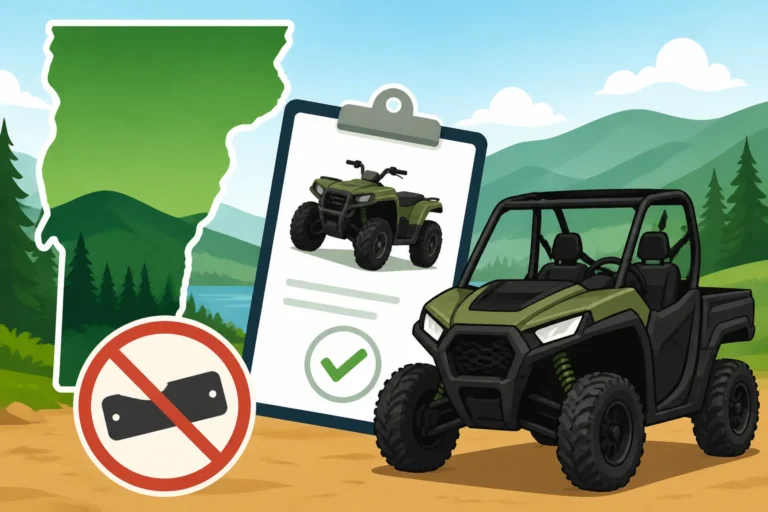
Every registered ATV or UTV in Vermont must display a valid license plate. This isn't just for show; it's a critical identifier for law enforcement and emergency services. The plate is mailed to you after your registration is processed and must be affixed to the rear of your machine. [Vermont Plate Mounted on the Rear] is the standard requirement. It needs to be securely mounted, clearly visible, and kept clean so that the numbers and letters are legible at all times.
You might think, "Who cares if it's a little muddy?" But a dirty or obscured plate can lead to being stopped by a warden, even if your registration is perfectly valid. The rule is about visibility and identification. If your plate falls off or becomes damaged, you'll need to apply for a replacement, which typically involves a small fee. This ensures your machine remains identifiable and compliant. If you bought your machine out of state, don't assume its existing plate is sufficient; you'll still need a Vermont-issued one.
Your Registration Certificate
Beyond the physical plate, you'll also receive a registration certificate. This document is essentially your proof of ownership and registration details. It lists:
- Your name and address.
- The year, make, model, and Vehicle Identification Number (VIN) of your machine.
- The expiration date of your registration.
- Any lienholder information, if applicable.
It is crucial to carry this certificate, or a clear copy, with you whenever you're riding. A physical copy in a waterproof bag is always a good idea, but many riders also keep a digital copy on their phone. When a warden asks, "Can I see your registration?" this is the document they're looking for, in addition to checking your plate. [What a Warden Can Ask to See] includes both of these critical pieces of information.
Losing your registration certificate isn't the end of the world, but it does require action. You'll need to contact the Vermont Department of Motor Vehicles (DMV) to request a duplicate. Having a clear copy saved on your phone or email can be a lifesaver in such situations, allowing you to ride legally while you await the official replacement. For more on the initial process, check out [How to Register an ATV in Vermont].
Essential Documents to Keep Handy and Common Pitfalls
Staying compliant with Vermont's ATV and UTV laws is all about preparation. Knowing which documents to have on hand, and understanding common mistakes, can save you a lot of hassle and ensure your riding adventures are smooth sailing.
Your ATV/UTV Documentation Checklist
To make things easy, here’s a quick checklist of what you should always have with you or readily accessible when riding in Vermont:
| Document Type | Purpose | Where to Keep It |
|---|---|---|
| Registration Certificate | Proof your machine is legally registered | On the machine (waterproof pouch), or phone |
| Insurance Card/Policy | Proof of required liability coverage | On the machine (waterproof pouch), or phone |
| Safety Course Certificate | Required for riders under 18 (or those born after a specific date) | On the machine (waterproof pouch), or phone |
| Trail Access Decal (TAD) | Required for VASA trails (physical sticker) | Affixed to the machine, clearly visible |
| Valid Driver's License | Proof of age and identity, even if not for driving the ATV itself | Your wallet |
Always keep these documents current. An expired registration or insurance policy is as good as having none at all. Make it a habit to check the expiration dates a month or so before they're due. [Vermont Registration Paperwork Checklist] can give you an even more comprehensive overview of all the documents needed for initial registration.
Dealing with Unique Situations and Missing Documents
Sometimes, you might find yourself in a situation where a document is missing or informal, especially after a private sale or inheriting a machine. For instance, if you bought a machine from a private seller and the bill of sale was a quick handshake and scribbled note, you might need something more formal for the DMV. In such cases, online legal document services like LawDepot can be incredibly useful. They provide templates for drafting official bills of sale, ownership affidavits, or other legally binding documents that the DMV will accept, saving you from potential registration roadblocks. [Writing a Bill of Sale the Vermont DMV Accepts] is crucial for private sales.
Another common pitfall involves assuming reciprocity. While Vermont does recognize registrations from some neighboring states like New Hampshire and Quebec for certain purposes, you still need a Vermont Trail Access Decal (TAD) to ride the VASA trail system, regardless of where your machine is registered. This is a common point of confusion for visitors.
Finally, always double-check the placement and condition of your physical plate and TAD. A plate covered in mud or a TAD peeling off can still lead to a stop. Take the extra minute to clean it off before a ride, and if your TAD is looking rough, secure a replacement. For specifics on how much a replacement plate or TAD might cost, you'll want to check with the Vermont DMV or VASA directly.
Disclaimer
This article is for general informational purposes only and does not constitute professional advice. Laws, prices and regulations vary by location and change over time. Consult a qualified professional for guidance on your specific situation.