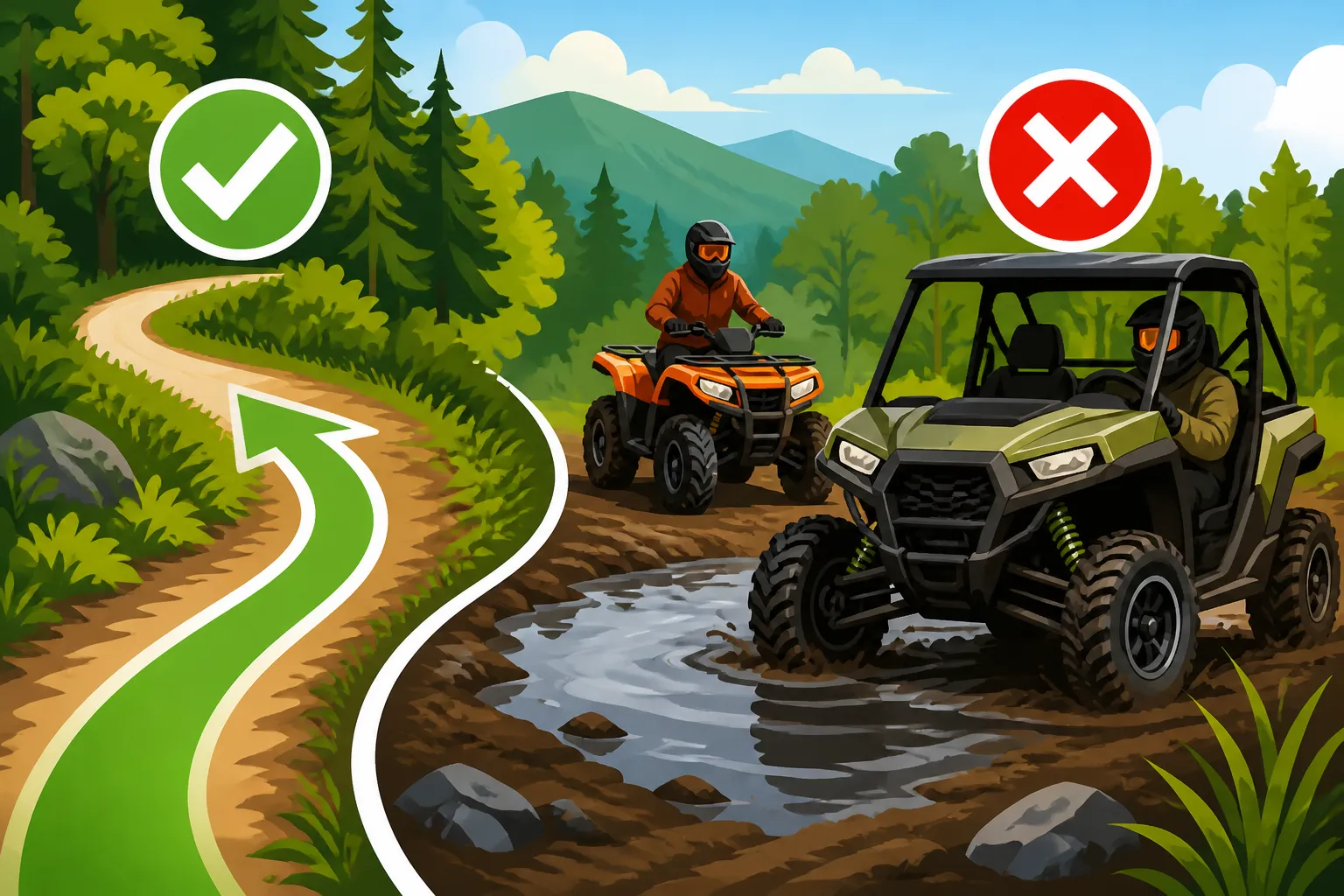
Riding Around a Wet Section
A muddy patch on a Vermont ATV or UTV trail can look like a small inconvenience, especially when firm ground seems only a few feet away. But riding around it can widen the trail, damage land, or send you somewhere you are not permitted to go. This guide explains how to assess a wet section, protect the trail, and decide when to turn back.
How to assess a wet section before you ride through
Stop and read the trail
When you reach standing water, deep mud, or a visibly soft stretch, stop before entering it. Look for trail markers, signs, a gate, or evidence that the corridor has been closed or rerouted. A wet trail is not automatically closed, but neither is it an invitation to find your own way around. Follow posted directions and the route shown by the club responsible for that corridor.
Take a moment to assess what is actually in front of you. Is the wet area shallow and firm enough to cross without spinning tires, or is the surface soft, rutted, or hiding a drop-off? Is there flowing water, an exposed culvert, or a bank that could give way? A puddle can conceal a rut deep enough to stop a machine or damage its underside.
If you are riding with a group, pause where you will not block the corridor. Agree on what you see before anyone moves. The first rider should not enter simply because another machine has already made tracks; those tracks may lead into deeper mud, and following them can make the damage worse.
Decide whether the route is passable
There is no single visual test that makes every wet section safe. Soil, recent rain, machine weight, tire setup, and trail design all matter. A short patch of damp gravel is very different from a water-filled rut on a steep slope. Be especially cautious where you cannot see the bottom, where water is moving, or where a tire could slide sideways into a ditch or soft shoulder.
Use the trail’s condition as the deciding factor, not the pressure to keep up with the group. If a machine would need aggressive throttle, repeated attempts, or a high-speed run to get through, that is a strong sign to stop and reconsider. Spinning tires can dig holes quickly, and one rider’s struggle can leave a much rougher obstacle for everyone who follows.
| What you notice | Safer response |
|---|---|
| Damp but firm surface with a clear marked route | Proceed slowly if the trail is open and your machine can pass without spinning or leaving the corridor |
| Deep ruts, soft edges, or water hiding the trail surface | Stop and assess from a safe place; do not guess at the depth |
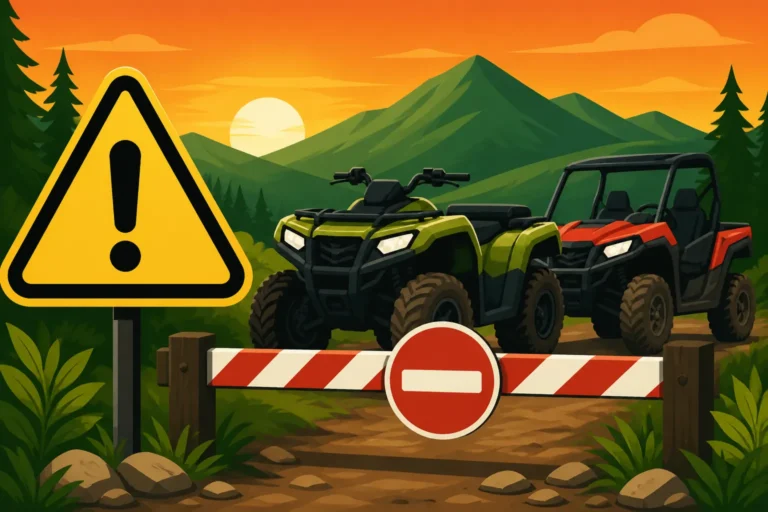
| A gate, closure sign, or marked detour | Follow the direction provided; do not go around the barrier |
| A tempting strip of dry ground beside the trail | Stay on the marked corridor unless an official reroute directs you elsewhere |
| A washed-out crossing or exposed culvert | Turn back if the route is unsafe; report the problem to the maintaining club |
For a wider picture of conditions, check Vermont Trail Conditions Before You Tow before setting out, and look for local club updates during wet weather. A route that was passable last weekend may be soft or closed after rain. The same caution applies in spring, when thawing ground can be vulnerable even if the weather feels mild. See Vermont Mud Season Closures for why seasonal restrictions matter.
Why you should not make your own bypass
A small detour can become a new trail
The easiest-looking option is often a strip of grass, woods, or higher ground beside the mud. But riding off the marked corridor can crush vegetation, disturb soil, and start a new track that other riders may copy. The next machine widens it; repeated traffic can turn a brief detour into a lasting scar across the land.
A bypass can also be misleading. Dry ground may slope toward a ditch, stream, private yard, or another part of the property that is not open to riding. In Vermont, many riding corridors depend on permission from private landowners. Staying on the designated route is part of respecting that permission, not just a way to avoid getting stuck. Vermont Trail Etiquette on Private Land covers the habits that help keep access open.
Even a detour that seems harmless to one rider can create a problem for a landowner or trail club. It may cross a sensitive area, damage drainage, or lead riders toward a home or field. If you cannot tell whether a side track is authorized, treat it as off-limits unless signs or the maintaining club say otherwise.
Follow markings and official reroutes
A club may route riders around a wet or damaged section, but that does not mean any visible tire track is an approved detour. Look for official arrows, signs, or other markings that clearly direct riders. If the markings are unclear, stop and check the map or contact the local club rather than improvising. Vermont Trail Signs and What They Mean can help you understand why signs and markers deserve close attention.
When using a digital map, treat it as a planning aid, not permission to leave the corridor. onX Offroad can help you review your route before a ride, but confirm trail access and closures with the relevant club or official notices. Map lines do not necessarily show a temporary closure, a newly placed barrier, or a landowner’s request to reroute traffic.
onX Offroad may also help your group keep track of its planned route, but it should not be used to justify riding around a closure or through an unmarked property. If the map and the trail signs do not appear to agree, do not assume the less restrictive option is correct. Pause, follow posted directions, and verify the route before continuing.
A landowner can request that access be changed, and conditions can shift quickly after a storm or damage. Why a Landowner Can Close a Trail Overnight explains why a route that was open on a previous visit may not remain available. Respecting a new closure protects the relationship that allows riders to use the corridor at all.
How to handle a wet section safely
Use a calm, deliberate approach
If the corridor is open and the wet section appears passable, make a plan before moving. Identify the marked line, check for other riders, and give the machine ahead enough room. Keep your speed low and steady. Sudden acceleration, sharp turns, and unnecessary wheelspin can make the surface less stable for you and more damaged for the riders behind you.
Choose a line only within the established trail. Do not edge toward a bank or cross vegetation to avoid a rut. If the trail has multiple established tracks, use the one that appears to be part of the marked corridor and is appropriate for your machine. Avoid guessing about water depth, especially if the bottom is hidden or the current is moving.
For a UTV, remember that its width and weight can make a narrow soft section more challenging than it looks. A tire close to the edge may slip into a ditch, and a heavy machine can deepen ruts quickly. For an ATV, keep your body position balanced and avoid abrupt steering inputs. If the machine begins to bog down, stop applying more throttle; spinning harder can dig it in.
Turn around when the risk is too high
Turning back is the right call when you cannot see a safe path, the crossing appears damaged, or the machine cannot pass without force. It is also sensible when a rider in the group is uncomfortable or when conditions have worsened since you reached the trail. No route is worth risking a rollover, a damaged machine, or a rescue in an isolated area.
Before reversing direction, make sure your group can turn around without leaving the corridor or blocking a blind approach. If there is no safe place to turn, move carefully to an appropriate wider area within the authorized route. Keep riders together, and make sure no one is left behind while the group checks its options.
If you encounter an obvious washout or a culvert that looks damaged, do not try to test it with a machine. Water can undermine the ground around a crossing, making the surface unstable even when it appears solid. Culverts Washed Out After Rain explains why these features deserve extra caution. If a storm has damaged multiple parts of the route, Vermont Trail Closures After a Storm offers useful context for treating closures and reports seriously.
What to do after you encounter a problem
Report damage or unclear access
Once you are in a safe spot, note the location as clearly as you can. A nearby sign, trail marker, junction, or landmark is often more useful than a vague description such as “somewhere after the woods.” If you use onX Offroad to record your planned route or identify where you are, share that information as a location aid—not as evidence that the corridor is open.
Contact the club that maintains the trail, using its preferred method for reporting conditions. Keep the report factual: describe what you saw, whether the trail was passable, and whether there was visible damage or a sign you could not interpret. Avoid moving barriers, adding your own markers, or attempting repairs unless the club has asked you to help.
A clear, timely report can help clubs assess whether a section needs attention or a temporary closure. It also helps other riders avoid arriving unprepared. If you see a gate or official closure notice, leave it as you found it and do not share advice that encourages riders to bypass it. Staying on the Marked Corridor is the simplest principle to keep in mind when the route becomes uncertain.
Prepare before your next ride
Before leaving home, check the route and any available club updates, especially after heavy rain or during spring thaw. Carry a map you can use without cell service, and make sure everyone in your group knows the plan if a trail is closed or impassable. A little preparation is easier than trying to decide what to do while standing beside a deep, muddy rut.
Set expectations with your group before the ride: nobody has to push through a questionable crossing to keep the day moving. Agree that you will turn back rather than create a bypass, and decide who will contact the club if conditions are unclear. This matters on long rides, where riders may be tired and reluctant to abandon a planned loop.
Most importantly, think of wet sections as a shared responsibility. Staying on the authorized corridor, avoiding wheelspin, respecting closures, and reporting damage help protect the trail and the access behind it. If the ground is too soft or the crossing looks unsafe, turning around is not a failed ride. It is a sensible choice that leaves the route—and the land—better for the next visit.
Disclaimer
This article is for general informational purposes only and does not constitute professional advice. Laws, prices and regulations vary by location and change over time. Consult a qualified professional for guidance on your specific situation.