Island Pond ATV Riding in Vermont
Island Pond is a popular base for exploring Vermont’s Northeast Kingdom, but finding a route that is open, permitted, and suitable for your machine takes more than picking a line on a map. This guide explains how the local trail system works, what to check before you unload, and how to ride responsibly around Island Pond and nearby communities.
What to know about ATV riding around Island Pond
Island Pond is a village in the town of Brighton, in Essex County. Its Northeast Kingdom setting makes it a natural starting point for a day on the trails, but access is not the same as having permission to ride wherever a track appears on a map. Vermont’s riding network depends on marked corridors, landowner permission, club maintenance, and access requirements.
Before planning a route, separate three questions: Is the route open? Are you allowed to use it? Does your machine and paperwork meet the rules for that route? Answering all three can prevent a frustrating trip to a closed gate—or a much more serious problem with a landowner or enforcement officer.
Island Pond as a riding base
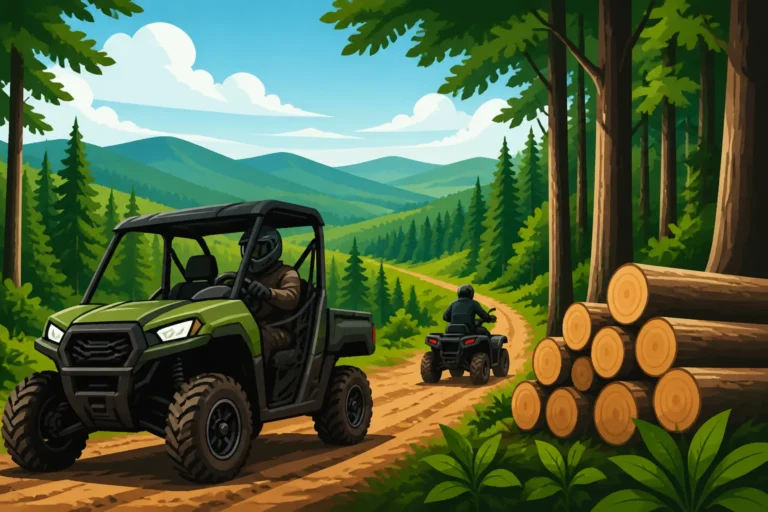
Island Pond can work well as a staging point for riders staying in the Northeast Kingdom, especially if you have arranged lodging, trail access, and a permitted place to park or unload. The area’s wooded landscape, small communities, and rural roads make for a very different trip from a large, purpose-built off-road park. The experience depends on an interconnected system of corridors, not a single fenced property with unrestricted riding.
That distinction matters when you plan a ride. Your route may use trails crossing private land, club-maintained sections, or designated connections. A trail that appears close to the village may not be open from your chosen starting point, and not every road or forest track is an ATV route. Check the information provided by the local club and confirm the status of each segment before heading out.
Island Pond is also a community, not just a trailhead. Be mindful of residents, pedestrians, vehicles, and other people using shared spaces. Ride quietly near homes, keep machines on signed routes, and do not assume that a convenient-looking lane or driveway is part of the trail network.
For broader regional context, see Northeast Kingdom ATV Riding in Vermont and Vermont Riding From Island Pond. These topics can help you think beyond one route and plan around the wider riding area.
A club-based network rather than open access
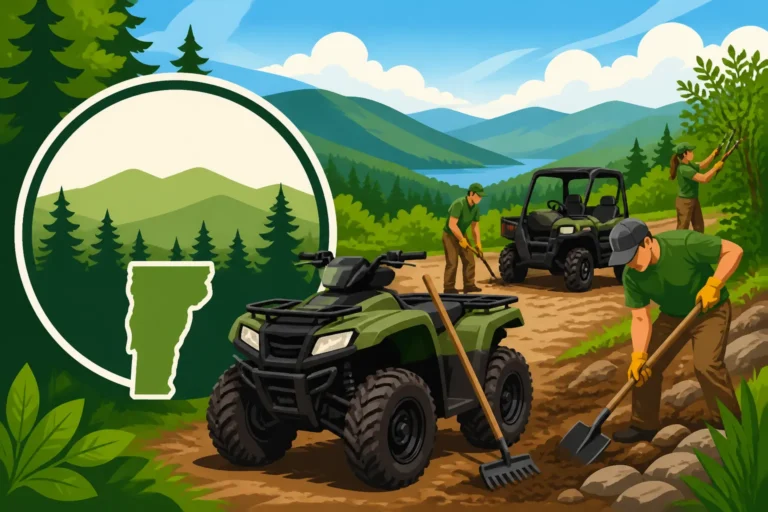
Vermont’s ATV corridors rely heavily on agreements with private landowners. Local clubs help maintain and sign routes, while landowners make access possible by allowing a corridor to cross their property. That arrangement is valuable, but it also means access can change. A route shown in old trip notes may have been rerouted, temporarily closed, or withdrawn after conditions or landowner preferences changed.
Stay on the marked corridor even when an alternate track looks easier. Cutting around a wet section, going around a gate, or following another machine off route can damage the land and put continued access at risk. If a gate is closed or a sign indicates a closure, turn around rather than treating it as an invitation to find another way through.
This is why a current local map and recent club information are more useful than a random line displayed in a general mapping app. A navigation tool can help you understand where you are, but it cannot grant permission to ride a route or guarantee that the route is open. For more on how the system works, read Vermont's Trails Run on Private Land and Finding the VASA Club That Maintains Your Local Trail.
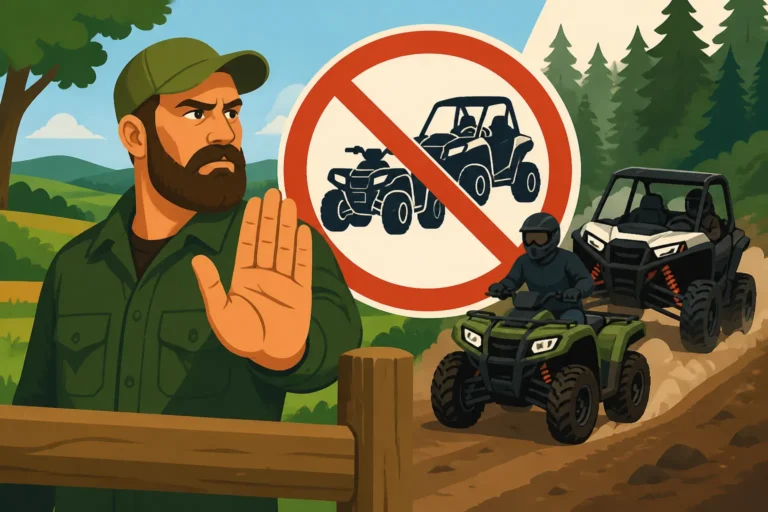
Island Pond is not a free-roaming riding area
It is easy to picture a remote corner of Vermont as open country where a rider can explore any unpaved track. That assumption is risky. A logging road, farm road, woods lane, or path beside a trail is not automatically open to ATVs. The route must be authorized for your use, and signs, gates, and current closures should guide your decisions.
The same caution applies to nearby public land. Vermont state land is generally not a place to assume ATV riding is allowed. A designated crossing or authorized corridor is different from permission to ride around a forest, park, or wildlife area. Check the relevant land-management information before making a route that touches public property.
When in doubt, ask the local club or the relevant land manager before riding. A quick clarification can save a long detour and help preserve relationships with landowners. For additional context, see Vermont State Land Is Mostly Closed to ATVs and Vermont Landowner Permission Holds the System Together.
How to prepare before riding
A good Island Pond ride begins before the trailer leaves home. Confirm your machine is eligible for the route, your paperwork is in order, and the trail access requirements are satisfied. Then check conditions and make a route plan that includes a sensible turnaround point.
This preparation is especially important for visitors. An out-of-state registration, a trail access decal, insurance proof, and a safety certificate are not interchangeable documents. Each may answer a different question about your right to ride.
Registration and trail access are different
Registration identifies the machine for applicable legal purposes. A trail access decal, often called a TAD, is associated with access to the Vermont ATV trail system. Having one does not automatically resolve every other requirement, and a registration plate alone should not be treated as permission to ride club trails.
Visitors should check what is required for their particular machine and home jurisdiction before traveling. Vermont recognizes certain out-of-state registrations for riding purposes, but riders still need to confirm the applicable trail access and operating requirements. Do not rely on a friend’s decal or assume that a decal can be moved between machines.
A useful pre-trip check is to keep the machine’s registration information, insurance proof, trail access information, and any required safety documentation together. Store digital copies as a backup, but carry and display documents in the way the rules require. For related details, see Vermont Requires Registration Plus a TAD, Vermont Out-of-State Machines Still Need a TAD, and Vermont Reciprocity for Out-of-State Machines.
Safety training and supervision
Age-related rules can affect who may ride and who must supervise. Vermont has safety-certificate requirements for some younger riders, along with supervision rules that depend on the rider’s age and circumstances. Families should confirm the specific requirement before putting a child on a machine, rather than relying on a rule of thumb from another state.
Plan the ride around the least experienced person in the group. A young rider or beginner may need a shorter route, more frequent breaks, and a machine that is appropriate for their size and ability. Never treat an adult’s presence somewhere in the group as a substitute for direct supervision where the rules require it.
A family trip can go smoothly when the group agrees on expectations before starting: who rides where, what signals mean stop, how to respond if someone falls behind, and when to turn back. Review Vermont ATV Safety Course Required Under 18 and Vermont Supervision Rules Under 16 before bringing younger riders.
Insurance and proof you may need to show
Make sure your insurance covers the machine and the kind of riding you intend to do. A policy that covers a vehicle on a road may not provide the protection you expect for off-road use. Read the policy language, ask the insurer about exclusions, and keep the required proof with the machine.
Insurance requirements and trail access requirements are separate from each other. A decal does not replace insurance, and proof of insurance does not replace a decal or registration. Carry the documents you are required to have and make sure the information corresponds to the machine you are actually riding.
Before leaving, check that your contact and policy details are easy to find if a group member needs to help after a breakdown or collision. More information is available in Vermont ATV Insurance Requirements and Carrying Vermont Insurance Proof on the Machine.
Planning a route from Island Pond
A strong route plan balances riding time, fuel, terrain, weather, and the experience of the group. Do not plan only by distance. A short corridor can take longer than expected when the surface is rough, muddy, busy, or affected by recent weather.
Use information that is specific to the route and date of your ride. A map can show a corridor, but the local club’s current conditions and closure notices help you understand whether the corridor is usable now.
Start with current club information
Look for current trail maps, club notices, and access updates before you set out. Local clubs know the corridors they maintain and may share information about closures, reroutes, seasonal openings, or work on a trail. If you cannot determine whether a route is open, ask before riding rather than testing the gate.
A printed map can be helpful if a phone loses service or power. A phone map can make it easier to identify your location and follow a planned route. Some riders use a navigation app such as onX Offroad as a supplementary reference, but it should not replace official trail information or permission from the club and landowners.
Download or save the information you will need before leaving an area with reliable service. In remote parts of the Northeast Kingdom, cell coverage may be limited. Mark your intended route, meeting points, and exit options while you still have a connection. For practical map-reading advice, see Vermont ATV Trail Map Downloads, Reading a VASA Club Trail Map, and Paper Maps Versus a Phone App.
Build a realistic itinerary
Estimate the day around the group’s pace, not the fastest rider’s pace. A party with a mix of experienced riders and first-timers will need time for stops, regrouping, navigation, and minor adjustments. Avoid stringing together so many segments that a small delay turns into a late return.
Choose a clear turnaround time and tell someone who is not riding where you expect to be. If the group has multiple machines, agree on a lead rider and a sweep rider. The lead should avoid pulling away at every junction, while the sweep checks that no one has been left behind.
Plan for a route to change. A closed section, washed-out culvert, mechanical problem, or weather shift may require you to retrace your path. Keep enough fuel and daylight in reserve for a return trip, and do not start an unfamiliar long route late in the day.
Check maps against conditions on the ground
Navigation apps and GPS devices are useful for orientation, but displayed tracks can be incomplete or out of date. A line on a screen may represent a road, a trail from an old data set, or a route that is not open to your machine. Treat signs, gates, and current club instructions as the authority for where you may ride.
If your phone has offline maps, test them before you leave home. A saved map is only useful if it covers the area, loads without a connection, and has enough battery behind it. Carry a backup power source, but do not let a device distract you while operating the machine.
When local information and a digital map appear to disagree, stop in a safe place and resolve the uncertainty. Do not ride ahead just to see where a track goes. An app such as onX Offroad may help you keep track of your position, but it cannot confirm landowner permission or override a closure sign.
Seasons, weather, and trail conditions
Trail conditions in the Northeast Kingdom can change quickly. A route that felt firm in one stretch may become slick or deeply rutted around the next bend, and a corridor that was passable after a dry spell may be a poor choice after heavy rain.
Seasonal access is not necessarily uniform across all trails. Individual clubs and landowners may set opening and closing conditions, and local restrictions can apply. Check before every trip rather than assuming the season is open everywhere.
Mud season and wet ground
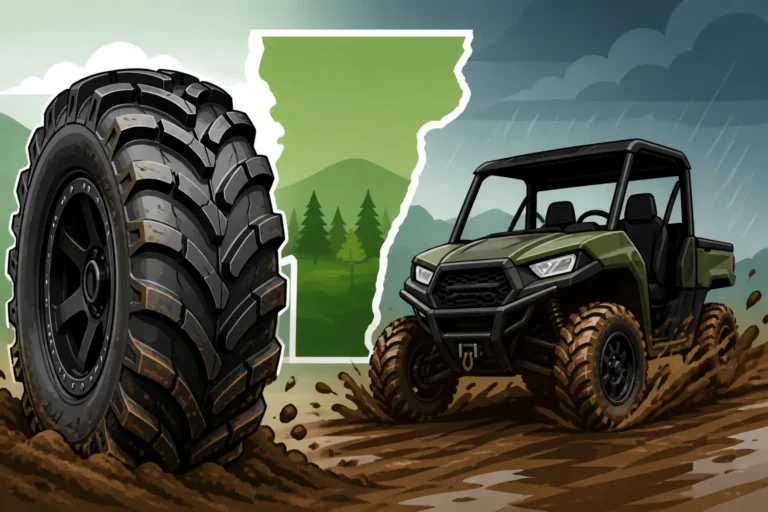
Wet soil is especially vulnerable to rutting. If tires are spinning, the machine is digging in, or the track is beginning to break down, stop and reassess. Continuing through a muddy section can turn a manageable patch into a long-lasting rut that harms the route and makes it harder for others to pass.
Do not create a new track to avoid a wet spot. Riding around the corridor can damage vegetation and private property, and may take you somewhere you do not have permission to be. If the marked route is too wet to ride responsibly, turn around or choose another confirmed-open route.
A “challenge” that involves forcing a heavy machine through deep mud is not always worth the recovery risk. Before heading out, ask the club whether conditions are suitable for your machine and skill level. Read Vermont Mud Season Closures and Rutting and Why Clubs Close Trails for more on why closures matter.
Rain, wind, and changing conditions
Rain can reduce traction, conceal holes, and make slopes or rocky sections harder to manage. It can also create runoff and damage trail surfaces. If a storm is forecast or conditions are deteriorating, shorten the route or postpone the ride rather than trying to complete the original plan at any cost.
After heavy rain, check for club updates before starting. Culverts and bridges may be affected, and a crossing that was manageable earlier may no longer be safe. Never enter moving water or ride through a flooded section when you cannot see the surface and understand what lies beneath it.
Wind and changing temperatures can affect comfort and visibility, especially on a long day outdoors. Pack layers and rain protection, and make sure each rider has water and basic supplies. For condition-specific planning, see Vermont Trail Conditions Before You Tow and Vermont Trail Closures After a Storm.
Seasonal closures and local differences
Do not assume all Northeast Kingdom trails open and close on the same dates. The operating schedule can depend on the local club, landowner agreements, weather, maintenance, and other conditions. A neighboring corridor may have a different status from the one you plan to ride.
Seasonal access can also differ between club trails and town roads. A town may open a route under its own rules, while nearby club trails follow a separate schedule. Confirm both parts of your route if you expect to use a town connection.
When planning a trip around foliage, summer weekends, or a particular event, verify access close to your departure date. Earlier trip reports are useful for general orientation, but should not be treated as confirmation that a route remains open. See Vermont Trail Season Dates by Club and Vermont Riding Season From May to October.
Riding responsibly around Island Pond
Responsible riding protects both the group and the access that makes the trip possible. A good day is not just one without a mechanical problem; it is also one where riders respect private land, other trail users, and the people who live nearby.
The safest approach is to ride predictably, follow posted rules, and avoid turning an uncertain situation into a bigger one. If you are unsure whether a route or maneuver is allowed, stop and check.
Follow signs, gates, and marked corridors
Stay on the signed route and pay attention at junctions. If trail markers are missing or confusing, do not guess your way onto a private road. Stop somewhere safe, consult your map, and contact the club if you need help identifying the corridor.
A closed gate means the route beyond it is not available to you at that moment. Do not go around it, lift it, or follow another machine through. Gates and signs may protect land, manage access, or indicate a closure that is not obvious from the trail surface.
Leave gates as you found them, and do not remove, alter, or cover signs. These small choices matter because landowners and volunteers see how riders behave. More guidance is in Staying on the Marked Corridor, Gates Left As You Found Them, and Why a Landowner Can Close a Trail Overnight.
Share the trail and ride with care
Expect to encounter other trail users and adjust your speed to the conditions. Slow down near people, homes, animals, road crossings, and places where visibility is limited. On a narrow corridor, allow room for others and avoid accelerating aggressively when passing.
Stay alert for horses, hikers, cyclists, work vehicles, and farm equipment where routes connect with shared roads or trails. Follow posted signs and local rules about yielding. If you meet a horse, reduce noise and wait for direction from the rider rather than assuming the animal will move aside.
Keep the group together without crowding. Leave space between machines so riders have time to respond to a sudden stop, and regroup in a safe spot rather than blocking a narrow corridor. See Vermont Trail Etiquette on Private Land and Meeting Horses on a Shared Vermont Corridor.
Reduce noise and protect nearby residents
Rural routes often pass close to homes, farms, or village streets. A machine that seems loud to the rider can be disruptive to someone indoors, especially when several machines pass together. Keep exhaust systems in good repair and ride quietly near residences.
Avoid revving engines while stopped near homes, gathering in a way that blocks local access, or treating a village street as part of an off-road playground. Follow all posted town rules and remember that road access is determined locally. A route that is open in one town may not be open in the next.
If you stop for a break, choose an appropriate location and keep the group’s noise and footprint low. Take litter with you, and do not use private property as a convenient parking or picnic area without permission. For more context, read Riding Quietly Past Houses and Vermont ATV Road Rules: Towns Decide.
Machines, gear, and group readiness
The best machine for an Island Pond ride is one that is suitable for the route, mechanically sound, and operated by someone who can handle it. A large side-by-side may be comfortable for some riders, but machine width, trail conditions, and posted limitations can affect where it can go.
Before departure, check the machine, pack for a delay, and make sure every rider understands the route plan. A little preparation can prevent a minor issue from turning into a difficult recovery.
Check the machine before unloading
Inspect tires, brakes, steering, lights, fuel, and any safety equipment required for your machine and route. Look for loose parts or visible damage that could become a problem on rough terrain. If the machine has been stored since the previous season, take time to check it before relying on it for a full day.
Carry the tools and basic repair supplies appropriate for your machine and the ride. A spare belt may be useful for some side-by-sides, while other machines may call for different parts or tools. Know what you can reasonably repair trailside and when it is safer to stop and call for help.
Make sure your registration and other required information are associated with the correct machine. A paperwork folder for one vehicle will not help if you accidentally bring the other machine. For related preparation, see Vermont ATV Equipment Requirements and Vermont Proof of Ownership on the Trail.
Pack for a long day in the Northeast Kingdom
Bring water, food, basic first aid supplies, weather-appropriate clothing, and a way to contact someone if the plan changes. Pack for the possibility of a longer return than expected. A warm layer and rain protection can make a big difference when the weather changes or a group has to wait for a repair.
Do not count on continuous cell service. Tell a person who is not riding the route and expected return time, and agree on what they should do if you are overdue. If the group uses radios, check them before departure and establish simple communication rules.
Keep supplies secured so they cannot fall off or interfere with controls. Make sure helmets and protective gear fit correctly and are appropriate for the ride. For additional packing ideas, see Packing for a Full Day Out, First Aid Worth Carrying, and Cell Dead Zones in the Kingdom.
Choose a route that matches your group
A route that is manageable for one experienced rider may be too demanding for a family group, a first-time rider, or a machine with limited clearance. Be honest about skill, comfort, and mechanical ability when choosing the day’s plan. A shorter, easier outing can be more enjoyable than a long route that leaves someone anxious or exhausted.
For groups with different abilities, agree beforehand that anyone can ask to slow down or turn back. Avoid pressure to keep up, especially on unfamiliar terrain. The lead rider should pause at junctions and confirm that the group is together before continuing.
If you are new to the area, consider a conservative first ride and build up only after you understand the terrain, signage, and local riding rhythm. Review Best Vermont ATV Trails for Beginners and Vermont Group Ride Planning when deciding how to organize the day.
Staying, staging, and making the trip work
A trip to Island Pond involves more than the ride itself. You need a legal place to park and unload, lodging that works for your group, and a plan for fuel, food, and machine care. Do not assume a motel, campground, or local business provides trail access or permits ATV parking unless you have confirmed it.
Planning these details early is particularly helpful during busy travel periods. It gives you time to verify access, arrange a suitable trailer setup, and avoid improvising at the roadside.
Confirm parking and unloading arrangements
Ask your lodging provider or host whether trailers and machines can be parked on the property, and whether there is a suitable place to unload. Confirm any conditions in advance, including where equipment may be stored and whether washing a muddy machine is permitted.
Never unload on a private lot, roadside shoulder, or business property without permission. A convenient pull-off may not be a designated staging area, and leaving a trailer in the wrong place can create hazards or block local access. If you need a public staging location, verify that it is approved for your use and available during your visit.
Consider the practical details: room to turn a truck and trailer, a surface firm enough to support the load, and a safe route from the staging point to an authorized corridor. For ideas on planning accommodation around a ride, see Vermont ATV Camping With Trail Access and Vermont Lodging That Welcomes Machines.
Plan fuel, food, and machine care
Check where you can obtain fuel along your planned route, and do not assume a business will be open when you arrive. Start with enough fuel for the ride and a reasonable reserve for detours or a slower pace. The same approach applies to food and water: carry what the group needs instead of relying entirely on services along the way.
Mud and dust can build up on a machine during a ride. If you want to wash it afterward, confirm that your lodging or another location allows it. Avoid washing debris into waterways, storm drains, or areas where it can affect other people’s property.
Respect business hours and local rules when stopping in or near town. Park only where permitted, keep access clear, and make sure the group does not overwhelm a small business or neighborhood. Related planning topics include Vermont Riding Areas With Fuel Nearby and Vermont Riding Areas With Wash Stations.
Have a backup plan for breakdowns
A breakdown can turn into a long wait if the group has no way to contact help or move a machine. Before leaving, discuss what the group will do if a vehicle becomes disabled, a rider is injured, or the route is blocked. Make sure everyone knows the meeting point and who has the essential information.
Carry recovery equipment appropriate to the machine and know how to use it safely. Do not attempt a recovery that puts people in the path of a moving machine or places a strap under dangerous tension. If the situation is beyond the group’s ability, stay in a safe location and seek assistance.
A conservative itinerary, a charged device, offline navigation, and a person at home who knows your plan are simple safeguards. For more trip-preparation ideas, see Tow Straps on a Muddy Loop and Vermont Trail Closures After a Storm.
A practical pre-ride checklist
Use this checklist before leaving for Island Pond. It is not a substitute for checking the specific rules, club guidance, and route conditions that apply to your trip, but it can help catch common oversights.
| Before the ride | What to confirm |
|---|---|
| Route | The corridor is currently open and suitable for your group |
| Permission | The route is authorized, marked, and not behind a closure |
| Registration | Each machine has the required registration information |
| Trail access | Each machine has the applicable access decal or authorization |
| Insurance | Coverage applies to the machine and intended riding |
| Riders | Age-related training, supervision, and equipment rules are understood |
| Machine | Tires, brakes, steering, lights, fuel, and safety equipment are checked |
| Navigation | Current club information is saved, with an offline backup |
| Supplies | Water, food, clothing, first aid, tools, and communications are packed |
| Staging | Parking, unloading, and lodging arrangements are confirmed |
| Return plan | Someone knows the intended route and expected return time |
The day before
Check the current trail and weather information, then make a route that has a reasonable backup option. Review the requirements for each machine and rider, including any details that apply to visitors or younger riders.
Confirm parking, unloading, lodging, and fuel plans. If you are unsure whether a corridor is open or an accommodation permits machine storage, contact the relevant club or business directly rather than relying on an old trip report.
At the trailhead
Before moving, make sure every rider understands the route, group order, meeting points, and turnaround time. Confirm that registration and access details are in order and that no machine has a mechanical issue that should have been caught before unloading.
Check signs at the starting point and follow any posted instructions. If conditions look unsafe or the route status is unclear, choose a different confirmed-open option or postpone the ride.
During and after the ride
Stay on the marked corridor, close gates as directed, and adapt to conditions. If you encounter a closure, do not bypass it. If the group has to turn back, treat that as a successful decision to protect people, machines, and the trail.
Afterward, remove your litter, report a significant hazard or damaged sign to the appropriate club, and clean the machine where permitted. Leaving the area in good condition helps maintain the relationships that make riding around Island Pond possible.
Disclaimer
This article is for general informational purposes only and does not constitute professional advice. Laws, prices and regulations vary by location and change over time. Consult a qualified professional for guidance on your specific situation.