Class A and What It Covers
Navigating Vermont's powersports vehicle classifications can feel like deciphering a secret code, especially when you encounter terms like "Class A ASV" and wonder how it impacts your ride, your wallet, and your access to those incredible trails. This guide is here to untangle the specifics of Vermont's "Class A" ASV designation, helping you understand what it covers, why it matters, and how it affects everything from registration to hitting the dirt.
Unpacking Vermont's ATV and ASV Classifications
Vermont, much like other states, has specific definitions for off-road vehicles that dictate how they can be registered, where they can be ridden, and what fees apply. It’s not just about calling everything a "quad" or a "side-by-side"; there's a nuanced system in place, and understanding it is key to being a responsible and legal rider here in the Green Mountain State. The primary distinction the Vermont Department of Motor Vehicles (DMV) makes is between All-Terrain Vehicles (ATVs) and All-Terrain Side-by-Side Vehicles (ASVs). While both are designed for off-road use, their characteristics lead to different classifications and, ultimately, different rules.
The confusion often arises because many riders use the terms interchangeably in casual conversation. However, the DMV sees distinct differences, particularly when it comes to size, seating capacity, and how the vehicle is steered. These distinctions aren't arbitrary; they're in place to help manage safety, enforce regulations, and ensure that vehicles are appropriately suited for the specific terrains and routes they might encounter, whether on designated trails or limited public roads. Getting this classification right from the start saves you headaches, fines, and potential trail access issues down the line.
What Exactly Qualifies as a "Class A" ASV in Vermont?
So, let's talk about "Class A." In Vermont, "Class A" specifically refers to a particular type of All-Terrain Side-by-Side Vehicle (ASV). These aren't your typical sit-astride quads. Instead, Class A ASVs are distinct machines characterized by several key features. They typically have a steering wheel, foot pedals for acceleration and braking, and most importantly, side-by-side seating, resembling a small off-road car rather than a motorcycle. This configuration often allows for multiple passengers, which is a major differentiator from traditional ATVs.
To be precise, a "Class A" ASV in Vermont, as of current regulations, is generally defined by its dimensions. These machines can be up to 72 inches in width and weigh up to 2,500 pounds dry weight. This [Vermont's 72-Inch, 2,500-Pound ATV Definition] is critical, as anything exceeding these limits might fall into a different, perhaps even unregistered, category for trail riding purposes. Think of popular models like many modern Polaris RZRs, Can-Am Commanders, or Yamaha Wolverines; these often fit neatly into the Class A ASV definition. They're built for adventure, often with robust suspension and capable engines, designed to tackle serious terrain while offering a more social riding experience than a single-rider ATV. The "Class A" designation essentially puts these larger, often multi-passenger machines into their own category, recognizing their unique operational characteristics and potential impact on trails and public roads.
Why the "Class A" Designation Matters for Your Ride
Understanding the "Class A" designation isn't just about technicalities; it has very real implications for how you use your machine in Vermont. First and foremost, it affects your registration. ASVs, including those classified as Class A, typically have a different fee structure than traditional ATVs. You’ll find that [Vermont ASV Registration at $108 a Year] is a common figure for a one-year registration, and a two-year option is also available at a slightly discounted rate per year. This is generally higher than the fees for standard ATVs, reflecting the different class. When you go to register, the DMV will ask for your vehicle's specific details, and understanding that yours is a Class A ASV will help ensure you're processed correctly.
Beyond registration fees, the Class A designation can also influence where you can ride. While Vermont has an extensive network of ATV trails managed by VASA (Vermont All-Terrain Vehicle Sportsmen's Association) and its member clubs, some trails or sections might have width restrictions. A wider Class A ASV might find certain tighter trails inaccessible, even if they're open to narrower ATVs. It's crucial to always check trail maps and local club regulations before heading out, especially with a wider machine. Furthermore, when it comes to road access, while many Vermont towns have opened specific roads to ATVs and ASVs under [Vermont ATV Road Rules: Towns Decide], the larger size of a Class A ASV might present different challenges or local restrictions compared to a smaller quad. For instance, some village streets or older, narrow dirt roads might simply not be practical or even legal for wider machines. Being aware of your vehicle's classification helps you anticipate and navigate these rules effectively.
The Nuts and Bolts of Registering a Class A ASV in Vermont
Registering your Class A ASV in Vermont is a mandatory step before you can legally hit the trails or designated public roads. It's not a complicated process, but it does require attention to detail and the right paperwork. Whether you bought your machine from a dealer or a private seller, the process largely involves providing proof of ownership, filling out the necessary forms, and paying the applicable fees and taxes. Ignoring this step can lead to significant penalties, including fines for riding an unregistered machine, which can quickly put a damper on your outdoor adventures. The DMV needs to confirm who you are, what machine you own, and that all financial obligations, like sales tax, have been met before issuing you a plate and registration.
While some parts of the process might seem bureaucratic, remember that proper registration contributes to rider safety, helps fund trail maintenance, and allows law enforcement to track ownership in case of theft or accident. It’s all part of the larger system that supports responsible powersports recreation in Vermont. Knowing what to expect and having your ducks in a row will make your visit to the DMV (or your mail-in application) smooth and efficient.
Required Documentation for Your Class A ASV Registration
When you head to the Vermont DMV to register your Class A ASV, or if you're mailing in your application, you'll need a specific set of documents to prove ownership and residency. The absolute cornerstone of your application is valid proof of ownership. For a brand-new ASV purchased from a dealer, this will typically be the Manufacturer's Certificate of Origin (MCO) or the Certificate of Origin (COO), along with a bill of sale. If you're buying a used machine through a private sale, a clear, dated [Writing a Bill of Sale the Vermont DMV Accepts] is essential, signed by both buyer and seller, detailing the vehicle's make, model, year, and Vehicle Identification Number (VIN). This bill of sale often needs to be notarized, especially if there's no title involved, to prevent disputes. Having a properly drafted bill of sale is crucial for the DMV to accept your ownership claim; resources like LawDepot can be invaluable for generating official-looking and legally sound documents that meet these requirements.
Beyond ownership, you’ll need proof of identity and Vermont residency. A valid Vermont driver's license or state ID card usually suffices. If you’re a new resident, you might need to provide additional documents, such as utility bills or a lease agreement, to establish your Vermont address. Don't forget the application form itself – usually Form VD-119, or some variant, which will ask for all the pertinent details about you and your ASV. Sometimes, especially with older machines or unusual circumstances, you might need to file an [Filing an Ownership Affidavit at the Vermont DMV] if traditional ownership documents are unavailable. Always check the DMV website or call ahead to confirm the most current and specific requirements for your situation, as rules can sometimes change or have nuanced exceptions.
Understanding the Costs: Registration and Purchase and Use Tax
Beyond gathering your documents, you'll need to be prepared for the financial aspect of registering your Class A ASV. As mentioned, ASVs often carry a different registration fee than ATVs. For a one-year registration for a Class A ASV, you're typically looking at a fee that's a bit higher than the standard ATV rate, often around $108. If you want to simplify things and save a tiny bit over two separate one-year registrations, a [Vermont ASV Two-Year Registration at $211] is usually an option. These fees primarily go towards the administration of the registration system and, in part, towards supporting the powersports infrastructure in the state.
Then there's the Purchase and Use Tax. This is Vermont’s equivalent of a sales tax applied to vehicles. When you register your ASV for the first time in Vermont, whether it was bought new or used, you will generally be assessed this tax unless you qualify for an exemption. The [Vermont Purchase and Use Tax Rate] applies to the purchase price of the machine. It’s important to understand that this tax is usually paid at the time of registration at the DMV, not necessarily at the point of sale, especially for private transactions. If you bought your ASV out of state and paid sales tax there, you might be eligible for a credit against Vermont’s tax, but you’ll need to provide proof of that payment. Similarly, certain transfers, such as [Vermont Tax Exemption for a Gift] between immediate family members, might be exempt. Always keep good records of your purchase price and any taxes paid. If you’re unsure about calculating the tax or proving an exemption, the DMV staff can guide you. Many people find using templates from services like LawDepot for gift affidavits or specific bills of sale helps clearly document the transaction details required for tax purposes.
Riding Your Class A ASV: Rules, Regulations, and Trail Access
Once your Class A ASV is properly registered and ready to roll, the next step is understanding where and how you can legally and safely operate it in Vermont. It’s not a free-for-all; Vermont has a comprehensive set of rules designed to protect riders, landowners, and the environment. These rules encompass everything from general trail etiquette to specific equipment requirements and limitations on public road use. Your Class A ASV, with its unique size and seating, often comes with its own set of considerations that can differ slightly from those for a traditional ATV. The key is to be informed and proactive, ensuring your adventures are enjoyable and free from legal headaches.
The VASA trail system, which relies heavily on the generosity of private landowners, is the lifeblood of ATV and ASV riding in Vermont. Respecting the rules, including those specific to your machine type, is paramount to maintaining this precious access. Every rider plays a role in preserving this privilege, and that starts with knowing the regulations.
Navigating Vermont's Trail System with a Class A ASV
Vermont's incredible network of ATV trails, primarily maintained by VASA and its affiliated clubs, offers unparalleled opportunities for exploration. However, accessing these trails with your Class A ASV requires a few important steps and considerations. First, your registered ASV absolutely needs a [Vermont TAD: The Trail Access Decal Explained]. This decal is crucial; it acts as your "pass" to ride on the VASA trail system and includes your club dues, which directly support trail maintenance. Without it, even with a valid registration, you cannot legally ride on VASA trails.
The second, and perhaps most critical, consideration for Class A ASVs is their size. While many VASA trails are designed to accommodate these wider machines, some older, narrower sections or specific landowner agreements might have width restrictions. It is absolutely essential to consult the latest VASA trail maps and individual club maps (often available online or at local businesses) before you head out. These maps will typically indicate any restrictions, ensuring you don’t end up on a trail too narrow for your machine, which could cause damage or even lead to trespassing if you have to turn around off the marked path. Remember, these trails crisscross private land, and respecting landowner rules, including width limits, is non-negotiable for preserving access. Some clubs might even have specific routes designated for wider side-by-sides versus traditional ATVs, so always do your homework!
Road Rules and Public Access for Class A ASVs
Riding your Class A ASV on public roads in Vermont isn't a blanket permission across the state; it's a carefully regulated privilege determined at the local level. The general rule is that [Vermont ATV Road Rules: Towns Decide] whether to open specific roads within their jurisdiction to ATVs and ASVs. This means you absolutely must research the local ordinances for any town you plan to ride through or in. What's open in one town, like Brighton with its specific ordinance, might be strictly closed in another. These town ordinances often specify things like speed limits, hours of operation (curfews), and specific routes that are permitted.
When riding on designated public roads, your Class A ASV must also meet certain equipment requirements. This includes having working headlights and tail lights (especially for riding after dusk or before dawn), functioning brakes, and often mirrors to help with visibility in traffic. While not always mandated for off-road use, features like a horn or turn signals can be highly advisable for enhanced safety on public routes. Moreover, [Vermont Requires ATV Liability Insurance] for any machine operating on public roads or trails. Your policy must meet the state’s minimum liability limits. It's wise to carry proof of this insurance with you, as law enforcement or wardens may ask to see it during a stop. Always remember that when you're on a public road, you're sharing it with other vehicles, so operating defensively and adhering to all traffic laws is paramount, just as it would be in a car.
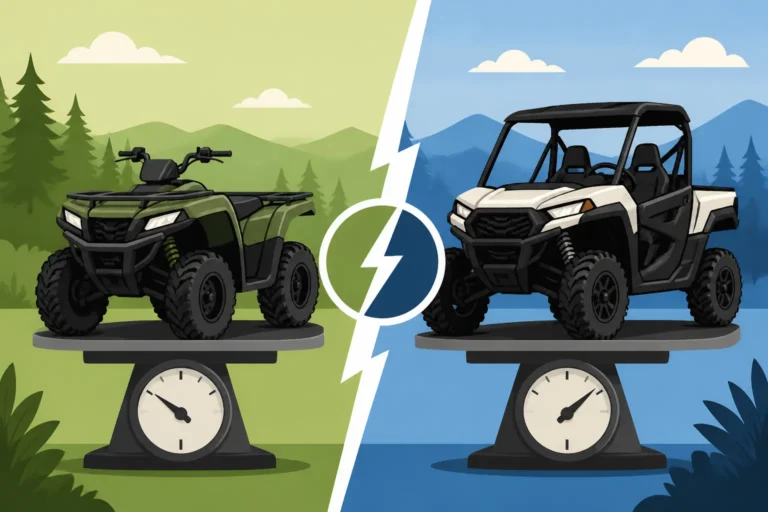
| Feature | Traditional ATV (e.g., Quad) | Class A ASV (e.g., Side-by-Side) |
|---|---|---|
| Steering | Handlebars | Steering wheel |
| Seating | Straddle-seat (often one, sometimes two) | Bucket or bench seats (two or more) |
| Control | Thumb throttle, foot brake/shifter | Foot pedals (gas/brake), steering wheel |
| Max Width | Up to 50 inches (generally) | Up to 72 inches (Class A specific) |
| Max Dry Weight | Up to 1,000-1,200 lbs (generally) | Up to 2,500 lbs (Class A specific) |
| Registration Fee | Often lower annual fee (e.g., $45) | Higher annual fee (e.g., $108 for Class A) |
| Trail Access | Generally wide access | May be limited on narrower trails; check maps carefully |
| Road Rules | Subject to town ordinances | Subject to town ordinances; wider footprint |
| Safety Gear | Helmet always required | Helmet required (for all), seatbelts mandatory |
Disclaimer
This article is for general informational purposes only and does not constitute professional advice. Laws, prices and regulations vary by location and change over time. Consult a qualified professional for guidance on your specific situation.