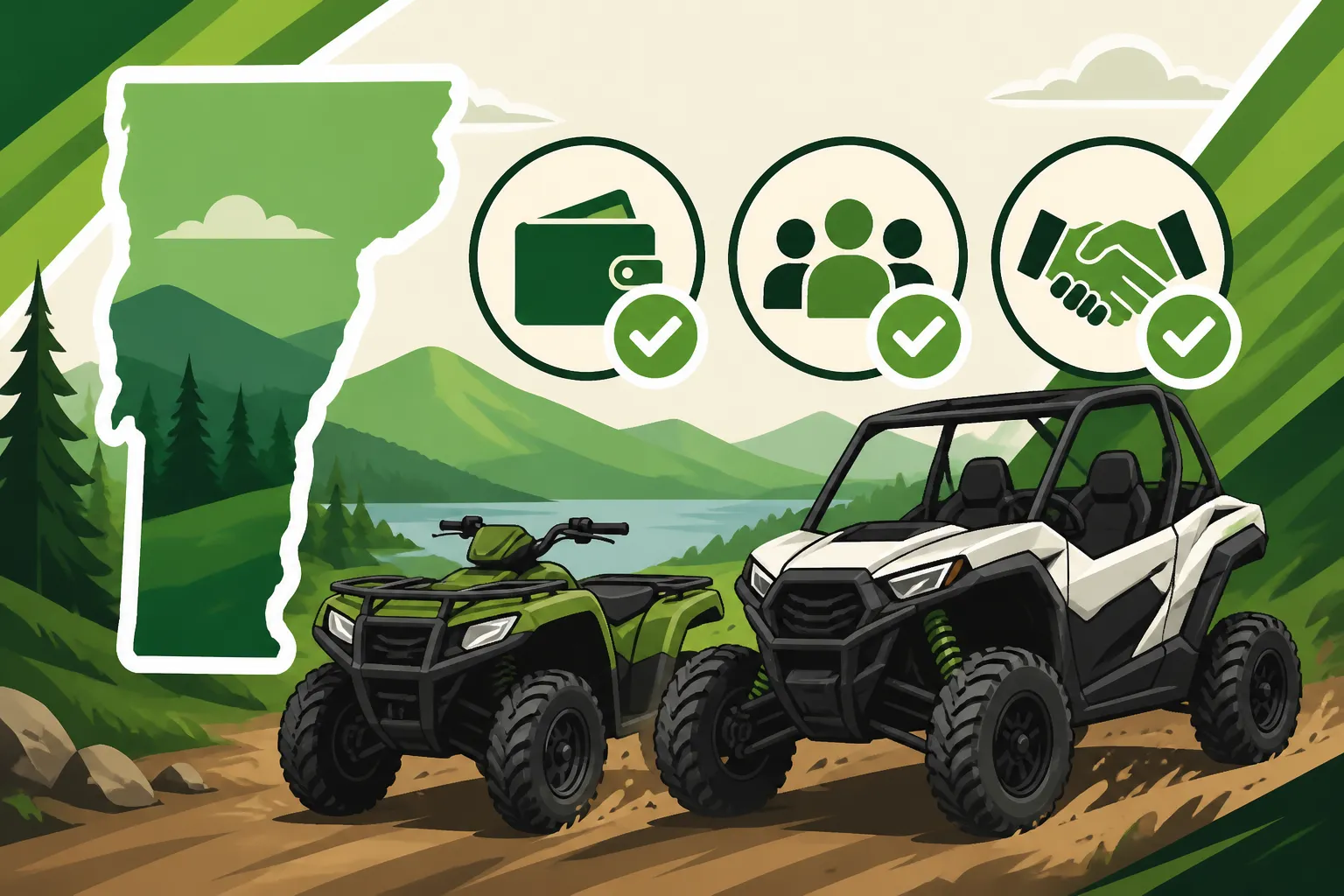
Vermont TADs Cover VASA and Club Dues
A Vermont Trail Access Decal is more than a sticker: its purchase bundles access to the VASA trail system with support for the organizations that maintain it. But “VASA and club dues included” can be easy to misunderstand. Here’s what the bundle generally covers, what it doesn’t, and what to check before buying a decal or planning a ride.
What a Vermont TAD includes
A Trail Access Decal, or TAD, is the pass required to ride on trails in Vermont’s VASA network. Buying one generally includes the associated VASA membership and dues for a participating local ATV club. Those contributions help support the trail system and the volunteer organizations behind it.
That’s why a TAD is not simply a user fee paid to enter a single trail or park. It connects your access to a statewide network of corridors maintained through club and landowner relationships. For a fuller explanation of what the decal is and where it applies, see Vermont TAD: The Trail Access Decal Explained.
The VASA portion
VASA, the Vermont ATV Sportsman’s Association, coordinates a network of trails that cross a mix of private property and designated corridors. The organization and its member clubs work on matters such as trail access, signage, route information, and coordination with landowners.
The VASA portion of the TAD bundle supports that broader network. It does not mean VASA owns every trail, nor does it give a rider permission to use any unmarked dirt road, logging road, or piece of private land. Trails are available only where access is authorized and the route is open.
The local club portion
Local clubs do much of the hands-on work that makes a trail corridor rideable. Depending on the location and conditions, that work can include maintaining signs, clearing brush, checking bridges and culverts, sharing closure information, and communicating with landowners.
The club dues included with a TAD help support that local work. The club associated with your purchase may depend on where you buy or which club is connected to the transaction. If you have a particular club in mind, ask the seller or club how the membership is assigned before completing the purchase. You can also use Finding the VASA Club That Maintains Your Local Trail to understand how clubs relate to specific areas.
What “dues included” means in practice
The bundle means you generally do not need to pay a separate VASA membership fee and a separate local-club membership fee just to satisfy the TAD requirement. The membership and dues are built into the decal purchase.
It does not necessarily mean you have joined every Vermont ATV club, gained a vote in every club, or received every benefit each organization offers its members. A club may have volunteer activities, social events, meetings, or other opportunities that are separate from the basic dues associated with a TAD. Check directly with the club if you want to participate beyond riding access.
For a closer look at the membership side of the bundle, see Vermont Club Dues Bundled With a TAD and Vermont VASA Membership Prices. The amount and current purchase details can change, so confirm them with the official seller or the organization before you order.
What the TAD bundle does not cover
A TAD is important, but it is only one part of being ready to ride. It does not replace vehicle registration, required safety training, insurance, landowner permission, or the rules that apply to a particular trail or town road.
| What you need or want | Is it covered by the TAD bundle? | What to check |
|---|---|---|
| Access to open VASA corridors | Generally, yes, when the decal is valid and displayed as required | Whether the specific route is open and included in the network |
| VASA and associated club dues | Generally included with the TAD | Which club is associated with the purchase |
| Vermont machine registration | No | Registration rules for your machine and home jurisdiction |
| ATV safety certificate, when required | No | Age and training requirements for the rider |
| Insurance | No | Legal requirements and your policy’s exclusions |
| Permission to ride any private land | No | Whether the landowner has authorized that route |
| Access to every road or trail in Vermont | No | Local designations, closures, signs, and landowner access |
| Club volunteering or all club benefits | Not necessarily | Ask the individual club what membership includes |
Registration remains a separate requirement
A TAD does not register your machine. Registration and trail access serve different purposes: registration identifies the vehicle under the applicable rules, while the TAD addresses access to the VASA system.
Before loading up, check that your machine’s registration is valid and that you have any required registration plate or documents. If you are sorting out both requirements, Vermont Requires Registration Plus a TAD explains why one does not take the place of the other.
Out-of-state riders should not assume that a TAD replaces registration in their home state or province. A visiting machine may still need valid home registration, and the rider should check the applicable reciprocity rules before traveling.
Training and insurance are separate, too
The decal does not certify that a rider has completed required safety training. Vermont’s training rules depend on the rider’s age and circumstances, so confirm the requirements for every person who will operate a machine. Keep the training certificate or other proof available if required.
The TAD also is not insurance. Review the legal insurance requirements and your own policy before riding. A policy may have conditions or exclusions for off-road use, passengers, commercial activity, or certain types of terrain. Buying a decal does not change those policy terms.
A TAD does not override closures or private-property limits
Many Vermont trails depend on permission from private landowners. That permission can be limited to specific marked corridors and can be withdrawn. A valid TAD does not authorize riding off the trail, around a gate, or along a nearby road that has not been designated for ATV use.
Before each ride, check the current trail status and follow posted signs. A route that was open on your last visit might be closed because of weather, maintenance, seasonal conditions, landowner requests, or a damaged bridge. The fact that dues help support clubs and trail access does not create a right to use a closed route. For context, see Vermont Trails Run on Private Land.
How the bundled dues support trails
It can be tempting to think of club dues as a small administrative add-on. In practice, local club work is part of what keeps corridors usable and access agreements in place.
A club may help identify a damaged culvert, coordinate a repair, replace a missing sign, or pass along a closure notice. Volunteers may also work with landowners to address concerns about noise, rutting, litter, or riders leaving marked routes. That work is not always visible to someone who arrives, rides, and leaves in a single day, but it can affect whether a corridor remains available.
The dues bundled with a TAD contribute to the organizations involved in that work. They do not necessarily pay for every repair or guarantee that every trail is open all season. Trail access depends on more than funding: it also depends on landowner permission, weather, maintenance, local decisions, and riders following the rules.
If you want to know what a particular club does with its membership support, ask the club directly. Some clubs share updates about volunteer days, trail work, and local conditions. What Your Dues Actually Fund offers more background on the role of membership support.
Why volunteer work still matters
A paid decal does not turn the trail system into a staffed recreation facility. Clubs rely on members and volunteers to help maintain corridors, communicate with riders, and respond to local needs. Some clubs welcome occasional help; others organize specific work days or request particular skills and equipment.
If you ride an area regularly, joining the club’s activities can be a practical way to understand the trails and contribute to access. You do not need to assume that every rider must volunteer, but respecting signs, gates, landowners, and closures is part of protecting the system that the dues support.
Why dues do not guarantee an open trail
Trail access can change even when the club has done its part. A landowner may withdraw permission, a storm may damage a crossing, or a corridor may need to close to prevent further damage. A local club can share information and work on a solution, but it cannot always reopen a route on its own.
That is why a current TAD should be understood as permission to use eligible, open corridors under the applicable rules, not as a promise that every mapped line will be rideable on a particular day. Check the latest club or VASA information before setting out, especially after heavy rain or during periods when trail conditions are changing.
Buying a TAD and checking the club connection
You can generally obtain a TAD through official channels and participating clubs or sellers. The buying method can affect what information you see about the club membership included in the purchase, so take a moment to verify the details rather than treating every listing or decal offer as equivalent.
For step-by-step purchase information, see How to Buy a Vermont TAD and Buying a Vermont Trail Access Decal Through a Club. Check with the official organization or seller for current availability, the current cost, accepted payment methods, delivery or pickup arrangements, and the terms that apply to your machine.
Ask these questions before you buy
Before completing a purchase, confirm:
- Is this an official TAD for the current access period? Make sure it is intended for the Vermont VASA trail system, not a souvenir, a private event pass, or an unrelated club sticker.
- Which club dues are included? Ask whether a local club is assigned through the transaction and whether you can select a club if you have a preference.
- Does the decal apply to this machine? Check whether the purchase is for one machine, a second machine, or an out-of-state vehicle. Do not assume one decal covers multiple machines.
- How and where must it be displayed? Follow the current placement instructions so it is visible and remains attached during normal riding.
- When does it expire? TADs operate on a defined access period. Confirm the expiration date before planning trips near the end of that period.
- What proof should you keep? Save the purchase confirmation or receipt until you have the decal and can verify that it is correct.
If you find an offer on Amazon or another general marketplace, do not assume that a listing or sticker is a valid TAD. Confirm that the seller and product are recognized by the appropriate Vermont organization. Amazon can be useful for general riding supplies, but buying a decal-shaped sticker there does not establish trail access.
Keep the decal in good condition
Follow the official instructions for applying the TAD. A clean, dry surface and careful placement help reduce the chance of peeling or obscuring it with mud or accessories. Avoid mounting it where a rack, body panel, or removable cover will hide it.
If you need basic cleaning supplies or a plastic scraper, Amazon may offer general options, but check that any tool or cleaner is safe for your machine’s finish. The official decal instructions take priority; an adhesive product or protective layer should not make the decal unreadable or violate placement rules. When ordering supplies from Amazon, keep in mind that those items help with mounting or care only. They do not replace the official decal.
A clear photo of the machine and its decal can be useful for your own records. Keep the purchase confirmation with your other riding documents, but do not rely on a phone photo in place of displaying the actual decal if display is required.
Multiple machines, visitors, and renewals
The bundled dues apply through a particular TAD purchase. They should not be treated as a household membership that automatically covers every ATV or side-by-side in a garage. If you ride more than one machine, check the current rules for a second decal and confirm whether it is tied to the same rider, club, or access period.
Use [Vermont TAD for a Second Machine] for the specific second-machine question. If you are bringing a group, each rider should know which machine has the required decal and whether the machine is properly registered and insured. Do not assume that a decal on a lead vehicle covers the rest of the group.
Visitors also need to plan ahead. A machine registered outside Vermont may still need a Vermont TAD to use the VASA trail system, even if its home registration is recognized for other purposes. A visiting rider should check both the TAD rules and reciprocity requirements before traveling. Buying the pass does not automatically make the machine compliant with every Vermont requirement.
Plan around the expiration date
A TAD has a defined expiration date, so buying one late in the access period may provide less riding time than expected. Check the actual expiration date before you buy, especially if you plan to travel near the end of the year. Do not assume that the decal remains valid for a full year from the date of purchase.
See [Vermont TAD Expiration Date] for more on the timing. When the access period changes, verify that you have the correct decal for the new period before riding. A previous decal, a club membership card, or a receipt for an expired pass does not automatically confer current trail access.
If your plans change
If you sell a machine, replace it, lose a decal, or discover that the wrong club or vehicle information was entered, contact the official seller or organization before attempting to transfer or replace the decal. Do not assume that it can be moved to another vehicle or that a replacement is automatic.
Keep a record of the transaction and the machine details you submitted. That makes it easier to explain the situation and ask what options are allowed. Rules for replacements, transfers, or corrections may depend on the current program terms, so verify those directly instead of relying on advice from another rider’s older purchase.
A practical checklist before riding
The dues bundle is useful, but it is only one part of a responsible trip plan. Before you head to a trailhead, confirm each item:
- The machine has the required TAD for the current access period.
- The decal is attached and readable in the required location.
- The machine’s registration is current and applicable.
- Required insurance is in force, and the policy covers the planned use.
- Each rider meets the applicable safety-training requirements.
- Your planned corridor is open and authorized for ATV use.
- You understand any local restrictions, signs, gates, and seasonal closures.
- You have the documents or proof you may need during the ride.
- Your group knows how to respond if a route is closed or conditions deteriorate.
A TAD purchase supports VASA and associated local clubs while granting access to eligible open corridors. Treating it as one piece of a larger checklist helps avoid the common mistake of confusing club dues, registration, training, insurance, and permission as if they were the same thing.
If you need current membership or purchase details, check directly with the organization or participating seller. For a broader guide to how the decal fits into a trip, Vermont Registration and the VASA Decal can help you review the access and registration pieces together.
Disclaimer
This article is for general informational purposes only and does not constitute professional advice. Laws, prices and regulations vary by location and change over time. Consult a qualified professional for guidance on your specific situation.