Vermont Cabins Near a Riding Area
A cabin that looks close to a Vermont ATV trail on a map may still leave you with a long trailer haul, a closed corridor, or no legal route from the driveway. This guide helps you choose a cabin near a riding area by checking the details that matter: trail access, parking, seasonal conditions, rider requirements, and the questions to ask before booking.
Start With the Riding Area, Not the Cabin
Choose a region that fits your trip
Vermont’s ATV riding opportunities are spread across different parts of the state, and the experience can vary from one town or club area to another. The Northeast Kingdom is a natural starting point for riders exploring around Island Pond, Newport, or Derby. Other trips may put you closer to central Vermont communities such as Barre or to riding areas farther south. These place names help narrow your lodging search, but they do not guarantee that a cabin connects directly to a trail.
Think first about the kind of day you want. Are you planning to ride for a few hours and return to the same cabin, or are you hoping to spend most of the day covering distance? Is your group bringing several machines and a large trailer? Are children or first-time riders coming along? A cabin that works beautifully for a couple with one machine may be awkward for a group that needs space to unload, park multiple vehicles, and store muddy gear.
Use a broad area as your starting point, then check the actual route and access details for your dates. [Vermont ATV Trails: The VASA System] can help you understand the statewide trail context, while [Newport as a Riding Base] and [Island Pond ATV Riding in Vermont] offer more focused starting points for planning around those communities. Treat any general mileage or “nearby trail” description as a lead to investigate, not a promise of a rideable connection.
Understand what “near the trail” really means
In a listing, “near ATV trails” might mean a cabin is close to a trail corridor, a staging area, a town route, or simply a region where people ride. Those are not interchangeable. A road or driveway between a cabin and a trail does not automatically become an approved ATV route, and a trail visible on an older map may have changed or closed.
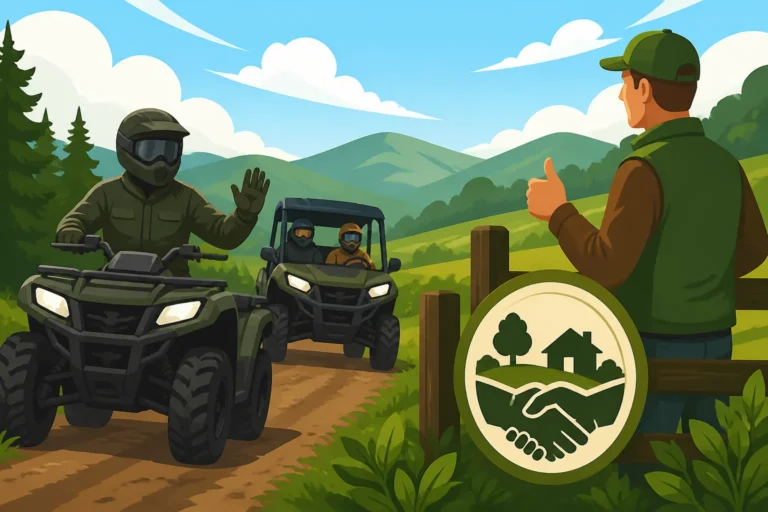
Vermont’s trail network depends heavily on landowner permission and organized club access. That means trail access can be specific to a corridor and may change when land conditions or permissions change. Ask the host exactly what they mean by trail access: Can guests ride from the property? Is there an approved route to a trailhead? Do guests need to trailer their machines? Which trail or access point are they referring to?
It is also worth checking access directly with the relevant club or trail contact before you commit to a booking. [Vermont Landowner Permission Holds the System Together] explains why an apparent route should not be treated as open simply because it appears on a map. For the same reason, a mapping app such as onX Offroad can help you examine the wider area and organize your planning, but use current official trail information and local guidance to confirm what is open and permitted.
Compare Cabins by Access and Practical Fit
Ask about direct access, staging, and trailer space
If a listing says you can “ride from the cabin,” ask what that means in practice. You want to know whether there is a legal, currently approved connection from the property to a riding route—not just a nearby road, field, or informal path. Ask which trail or staging area guests use, whether a trail access decal is needed, and whether the connection is available to all guests or only under certain conditions.
Trailer logistics deserve just as much attention as the riding route. Check whether the driveway is long and wide enough for your truck and trailer, whether the surface is suitable for turning around, and whether you can leave the trailer parked during the ride. A narrow, steep, or soft driveway can turn arrival into a stressful exercise in reversing and repositioning. If your group is bringing more than one trailer, ask for an explicit description of the available space rather than relying on a vague “ample parking” phrase.
If you need to unload at a separate trailhead, confirm the drive time and parking situation before booking. A cabin may be close to an ATV area as the crow flies but still require a substantial road trip to a legal staging point. [Vermont Trailhead Parking] can be a useful planning topic when you are comparing properties, and [Vermont Trails Connected by Town Roads] is a reminder that a connection through town does not mean every road is open to ATV travel.
Check lodging features that matter after a ride
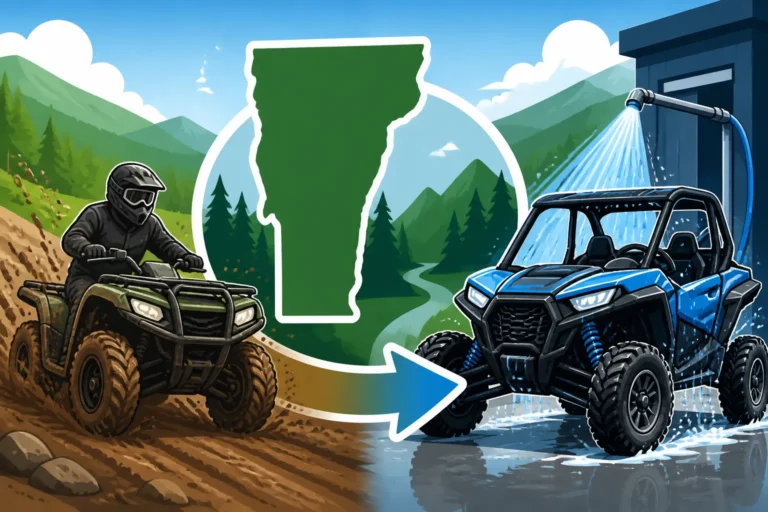
A comfortable riding stay is about more than beds and a scenic porch. Think about where wet boots, helmets, jackets, and muddy gear will go. Ask whether there is a covered area for equipment, a safe place to store valuables, and an outdoor water source or wash area. Do not assume that a cabin has permission or facilities for washing an ATV; confirm the host’s rules first, especially if the property uses a private well or has drainage restrictions.
For a multi-day trip, practical indoor details matter too. Check how many people the cabin comfortably sleeps, whether the kitchen has the equipment your group expects to use, and how the property handles trash and food storage. If you are bringing children, ask about stairs, lofts, railings, and outdoor hazards. If someone in your group has mobility needs, confirm the layout rather than relying on general descriptions such as “easy access.”
A group can also avoid friction by agreeing in advance on sleeping arrangements, quiet hours, and how machines will be parked. If the cabin shares a driveway or sits near neighboring homes, ask about noise expectations and the property’s rules for running or servicing machines. [Vermont Trail Etiquette on Private Land] is useful context for the riding side of the trip, and the same considerate approach helps keep a lodging property welcoming to future riders.
| Cabin detail | What to confirm before booking | Why it matters |
|---|---|---|
| Trail access | Whether there is a legal, current connection or whether you must trailer | “Near a trail” does not necessarily mean ride-in access |
| Trailhead distance | The actual drive time and route to a staging point | A short map distance can still mean a longer road trip |
| Parking | Space for trucks, trailers, and each machine | Tight parking can make unloading difficult |
| Surface and slope | Driveway width, grade, turning room, and ground conditions | Large trailers may struggle with steep or narrow access |
| Gear storage | A place for helmets, boots, and wet riding clothes | Helps keep the cabin cleaner and equipment organized |
| Washing rules | Whether machine washing is allowed and where | Prevents damage to property, drainage, or water systems |
| Local rules | Noise expectations, quiet hours, and machine-use restrictions | Helps avoid conflicts with hosts and neighbors |
| Current trail status | Which club or local contact can confirm access | Routes and conditions can change |
Prepare for Rules, Conditions, and Changing Access
Confirm the paperwork and trail requirements
Before your trip, check what your machine needs for the kind of riding you plan to do. Vermont registration and trail access are separate considerations: registering a machine does not automatically provide access to every trail. Riders using the VASA system generally need to understand the applicable Trail Access Decal requirements, along with any registration or proof-of-ownership requirements that apply to their situation.
If you are visiting from another state or from Quebec, check the rules that apply to your machine and where it is registered. Do not assume that a registration accepted on a public road in one place settles every trail-access requirement in Vermont. Review [Vermont Requires Registration Plus a TAD] and [Vermont Reciprocity for Out-of-State Machines] before you travel, and confirm current details with the appropriate trail organization or local club.
Make a simple pre-trip checklist for every rider. Include required documents, helmets and other safety gear, machine condition, and emergency contact information. If someone in the group is under 18, verify the training and supervision rules that apply to that rider. A host may be able to suggest a nearby riding area, but it is the rider’s responsibility to check the applicable requirements before heading out.
Check trail conditions close to departure
A route that was rideable on a previous visit may not be suitable on your travel dates. Heavy rain, mud, storm damage, seasonal closures, or landowner requests can affect access. This is one reason to check conditions shortly before leaving home and again before riding, rather than treating an old post or saved map as a guarantee.
When using onX Offroad or another mapping tool, save the areas you plan to reference before traveling and think about what you will do if cell service is limited. Use the app as a planning aid, not as the final authority on whether a corridor is open. Cross-check with the current information from the club responsible for the trail. [Vermont Trail Conditions Before You Tow] can help frame that last check, while [Vermont ATV Trail Map Downloads] may be useful when you want map information available offline.
Plan a backup activity for days when conditions do not cooperate. A cabin stay can still be worthwhile if a ride is postponed, but the group should know whether there are nearby towns, restaurants, walking options, or other activities. That small bit of planning can prevent frustration when a wet-weather closure changes the day’s itinerary.
Book With Clear Questions and a Flexible Plan
Questions to ask a cabin host
Send specific questions before you pay or confirm a booking. Short, direct questions usually get more useful answers than “Is this good for ATV riding?” You might ask:
- What trail, staging area, or riding corridor do guests use from this property?
- Is there a currently approved route from the property, or do guests trailer to the trail?
- Which local club or trail contact can confirm access and conditions?
- How many trucks and trailers can fit, and is there room to turn around?
- Is machine washing allowed on the property?
- Where can riding gear and wet clothing be stored?
- Are there quiet hours or rules about starting machines near the cabin?
- Are there any dates when access or property facilities are restricted?
If a host is unsure about legal trail access, treat that as a reason to verify independently rather than as a reason to assume the route is permitted. A clear answer may reveal that the cabin is still a good choice—you simply need to trailer to a trailhead. That is much better to learn before you arrive with a full group and loaded machines.
Build a flexible itinerary
Once you have chosen a cabin, make a basic plan that includes the confirmed access point, estimated travel time, fuel stops, and a second option in case conditions change. Share the plan with everyone in your group. For larger parties, decide who is carrying navigation and emergency supplies, and agree on a meeting point if the group becomes separated.
Use onX Offroad to organize possible routes and keep key locations handy, while checking current club information for closures and access rules. Save the host’s directions and the trail contact details somewhere you can reach without a reliable signal. A little preparation is especially helpful around rural areas where mobile coverage can be inconsistent.
Finally, leave room for the trip to be slower than expected. Trail surfaces, weather, group pace, and breaks all affect how much ground you cover. A well-chosen Vermont cabin should make the whole stay easier—not just put a roof over your head. When you verify access, parking, lodging rules, and trail conditions ahead of time, you can arrive with a realistic plan and spend less of the weekend sorting out avoidable surprises.
Disclaimer
This article is for general informational purposes only and does not constitute professional advice. Laws, prices and regulations vary by location and change over time. Consult a qualified professional for guidance on your specific situation.