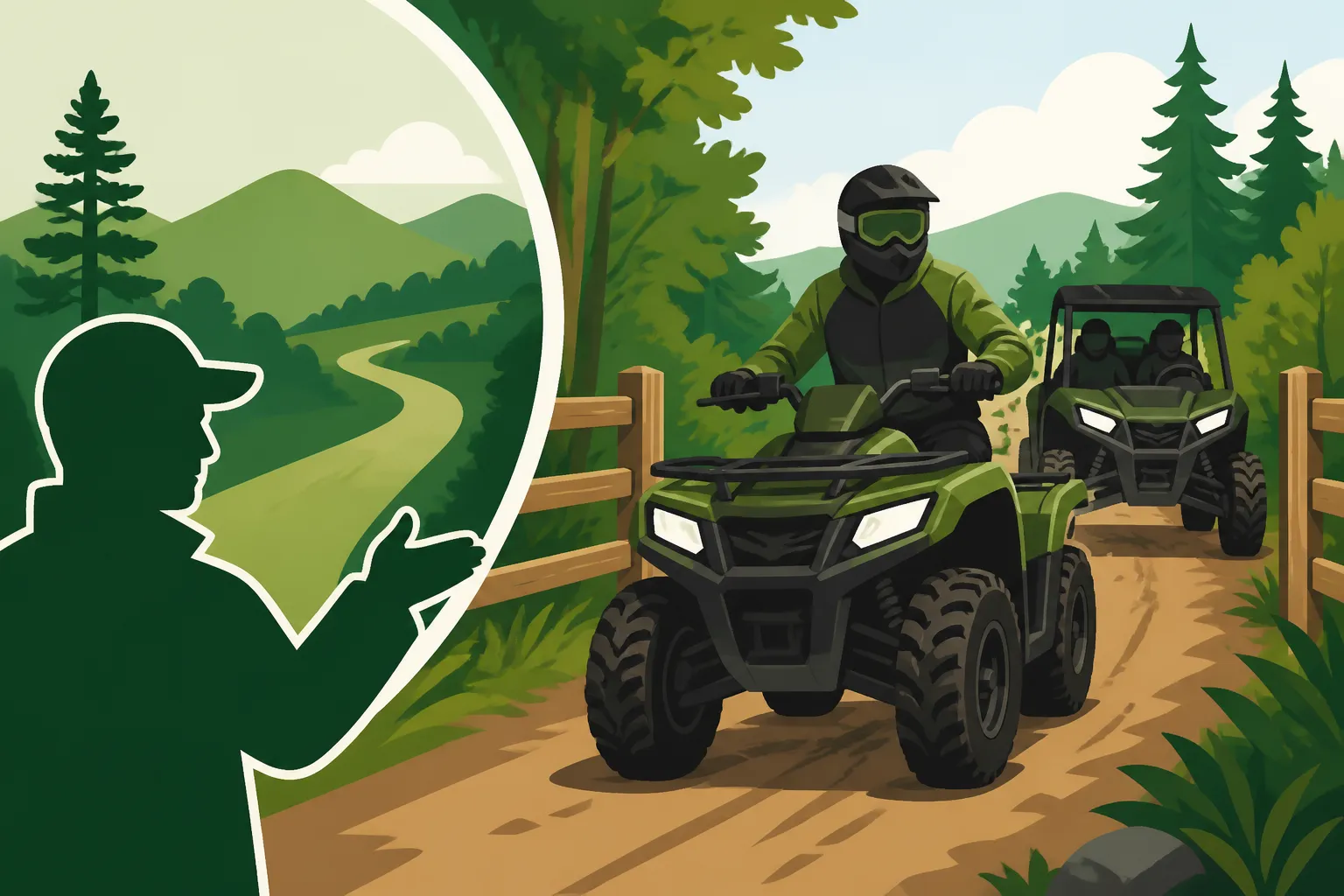
Guides Operating on Private Corridors
A guide may have a route planned, customers booked and machines ready, yet still lack permission to use a Vermont corridor. Private land is not automatically open to commercial rides, and ordinary trail access does not necessarily authorize a paid tour. Here’s how to check access, clarify responsibilities and prepare before leading riders onto a private corridor.
What permission means on a private corridor
A private corridor is a route on land that is privately owned or otherwise controlled by a private party. In Vermont, a trail may cross land with an owner’s permission and be part of a larger riding network, but that does not make it a public road or give every business the right to use it for guided trips.
That distinction matters because permission to ride and permission to operate a business are different questions. An individual rider’s access may depend on current trail rules and access credentials. A guide who organizes paid trips may also need the landowner or trail manager to agree to the commercial use, the group size and the operating plan. Do not assume that a customer’s access credential, club membership or registration covers your business.
The Vermont ATV Sportsman’s Association network depends on landowner permission. Owners can restrict access or withdraw permission, and clubs may manage corridors on their behalf. A trail shown on a map can therefore be unavailable, subject to conditions or closed. Start with the club or trail manager responsible for the route, rather than relying on an old map or a customer’s recollection. Vermont Landowner Permission Holds the System Together
Ask what kind of access the permission actually covers. For example, an agreement for recreational riding may not authorize repeated commercial trips, paid instruction, photography, a large group or a pickup and drop-off point. The owner or manager may welcome one activity and decline another. Get the answer in writing, especially if your business will return regularly.
A useful permission conversation covers these points:
- Who can authorize access? Identify the landowner, club or other trail manager with authority over each corridor segment.
- What activity is allowed? Explain that the trip is guided, whether riders are paying, and whether the service includes instruction, rentals or filming.
- When can the group ride? Confirm operating dates, hours and any seasonal or weather-related limits.
- How many machines may travel together? Agree on a maximum group size and whether the group must be split.
- Where may the group stop? Ask about staging, parking, rest stops, loading areas and turnaround points.
- What conditions apply? Clarify speed, noise, gates, signs, sensitive areas and any section riders must bypass.
- Who should be contacted if plans change? Make sure the guide knows how to report damage, a hazard, a closure or an incident.
A verbal “the trail is open” may not answer these questions. If a corridor crosses several parcels, permission from one owner may not cover the whole route. Confirm who controls each portion and whether the route remains available for the full trip.
Commercial access is also separate from access to public roads. Some Vermont towns decide whether certain roads are open to ATV use, and road designations and local restrictions can affect a planned connection between private corridors. Do not treat a town road as an automatic link just because it joins two trail segments. Check local rules and posted signs before including it in a guided route. Vermont ATV Road Rules by Town
Check the access requirements for every machine and rider
A guide should not assume that booking a tour takes care of every participant’s trail requirements. Before the ride, confirm what each machine and rider needs for the route being used. Vermont trail access, machine registration and rider qualifications are separate issues; meeting one does not necessarily meet the others.
For routes using VASA trails, check the current Trail Access Decal requirements for the machines in your group. Vermont generally distinguishes between Vermont-registered machines and machines registered elsewhere, and requirements may differ by situation. Verify the current rules before selling a package or telling a visiting customer that access is included. Vermont Requires Registration Plus a TAD
A customer’s machine may be registered in another state or province. Do not assume that out-of-state registration alone provides access to a private trail network. Confirm both whether that registration is recognized for the relevant purpose and whether the machine needs a Vermont access decal. Vermont Reciprocity for Out-of-State Machines
Use a pre-ride check that separates the issues instead of asking only, “Is the ATV legal?”
| Check | What to confirm before the ride | Why it matters |
|---|---|---|
| Corridor permission | The route and commercial activity are authorized | Land access can be limited by owner, manager, date or activity |
| Trail access credential | Each machine has the required access credential for the route | A registration plate may not be enough for private trail access |
| Registration | The machine is properly registered for its use and origin | Trail access and vehicle registration are not interchangeable |
| Insurance | Coverage applies to the machine and the planned guided activity | A policy may have exclusions or conditions that affect a paid ride |
| Rider qualification | Each rider meets applicable age, training and supervision rules | Requirements may vary by age and circumstances |
| Equipment and passenger fit | The machine is appropriate for its riders and the route | A passenger must have a proper seat, and the trip must suit the machine |
If customers are bringing their own machines, give them the requirements before they travel. Ask them to bring proof of registration, insurance and any required access credential, and make clear that you will check before departure. A booking confirmation is not proof that a rider or machine qualifies.
If you supply or rent machines, decide in advance who obtains and carries each required credential. Do not assume that a decal on a machine automatically answers every question about who is responsible for it or whether it is valid for the planned use. Review the current rules for rental machines and make the responsibility clear in your customer paperwork. Who Holds the TAD on a Vermont Rental Machine
Also check rider age, training and supervision requirements. A waiver or parent’s permission does not replace a legal qualification. Make questions about age and experience part of booking, not a surprise at the trailhead. If a group includes young riders, confirm the rules for each rider’s age and planned activity before accepting the reservation. Vermont Safety Course Required Under 18
Plan the business operation, not just the route
A well-marked route is only one part of a guided ride. The guide is responsible for managing a group in changing conditions, communicating restrictions and knowing what to do if the route is closed or a rider cannot continue. A short operating plan makes those responsibilities easier to handle.
Before offering a route, walk or ride it when access is authorized, and record the approved path and any limits. Keep a current map or navigation copy for the guide, but do not treat a digital track as proof that access is still open. Trail conditions, landowner decisions and club reroutes can change. Check with the relevant club or manager close to the trip date. Vermont Trail Conditions Before You Tow
Build a closure plan into every trip. Identify a safe point to turn around, a way to avoid a closed or damaged section and a process for notifying the group. Tell customers not to bypass a gate, move a closure sign or follow a different corridor to “catch up.” Staying on the marked route protects landowner relationships and reduces the chance that a detour becomes trespass. Staying on the Marked Corridor
Your written operating plan should cover:
- Route and permissions: List approved corridors, access contacts, conditions and any sections that are off limits.
- Group limits: Set a maximum number of machines, a spacing plan and a lead-and-sweep arrangement appropriate to the route.
- Rider briefing: Explain signs, gates, permitted stops, passing, quiet riding near homes and what to do if the group separates.
- Machine checks: Check that each machine is suitable for the route and that required documents and equipment are present.
- Communications: Decide how the group will communicate where cell service is weak, and identify a meeting point if riders lose contact.
- Incident response: Set out how to stop the group, help an injured person, contact emergency services and report damage or a route problem.
- Closure response: Name who has authority to reroute or cancel the trip and how customers will be told.
Insurance deserves particular attention. A personal ATV policy may not cover paid guiding, a rental operation or all activities connected with a tour. Ask your insurer to review the actual service: whether you lead customers on their own machines, supply machines, carry passengers, offer instruction or operate on private corridors. Ask for written confirmation of applicable coverage and exclusions. Do not assume a customer’s policy protects the guide’s business, or that a landowner’s permission includes insurance.
A written agreement with the landowner or trail manager can address insurance expectations, responsibilities for damage, allowed activities and how either party may end access. Have a qualified professional review the agreement if the business depends on it. Permission should not be treated as a substitute for insurance, and insurance should not be treated as permission to enter.
Make sure your advertising matches the access you have. Avoid promising a route, date or trail experience that depends on permission you have not confirmed. If access is conditional, describe that honestly and have a backup plan that is also authorized. This is especially important for seasonal rides, larger groups and bookings made well in advance.
A practical go-or-no-go check
Before each guided trip, run through a final check rather than relying on last month’s approval. Confirm the route is open, that commercial use remains authorized and that the machines and riders meet applicable requirements. If any answer is uncertain, pause and verify it with the landowner, club, insurer or relevant authority.
Use this sequence:
- Confirm the route. Check current conditions and closures with the trail manager or club responsible for the corridor.
- Confirm commercial permission. Make sure the landowner or authorized manager has approved the guided activity, not merely general recreational access.
- Check machine access. Verify registration and any access credential required for each machine on that route.
- Check riders. Confirm age, training, supervision, passenger seating and other relevant qualifications.
- Review insurance and documents. Ensure coverage fits the activity and that required proof is available during the ride.
- Brief the group. Explain boundaries, gates, signs, noise expectations, spacing and the closure plan.
- Cancel or reroute if needed. Do not improvise access across an unapproved parcel or around a closure.
A guide’s paperwork can be simple but should be organized. Keep permission records, route notes, insurance confirmation, customer acknowledgments and incident records in a place that can be reached when needed. Give the ride leader the current route and emergency contacts, not just the business owner.
For visiting groups, explain that access depends on the route and machine, not just where the customer lives. Out-of-state riders may need to sort out registration or access credentials before they arrive. Registering at Home Before You Visit If the group plans to use a trail network, check trail requirements separately from town-road rules and from the permission needed for a private corridor.
The safest rule is straightforward: obtain specific permission for the commercial ride, verify access for every machine and rider, and recheck the route before departure. When an owner or trail manager says no, or when a closure makes the approved route unusable, do not treat a customer booking as a reason to proceed. A guide business depends on continued access, and respecting the corridor is part of operating responsibly.
Disclaimer
This article is for general informational purposes only and does not constitute professional advice. Laws, prices and regulations vary by location and change over time. Consult a qualified professional for guidance on your specific situation.