When Your Insurance Policy Excludes Trail Riding
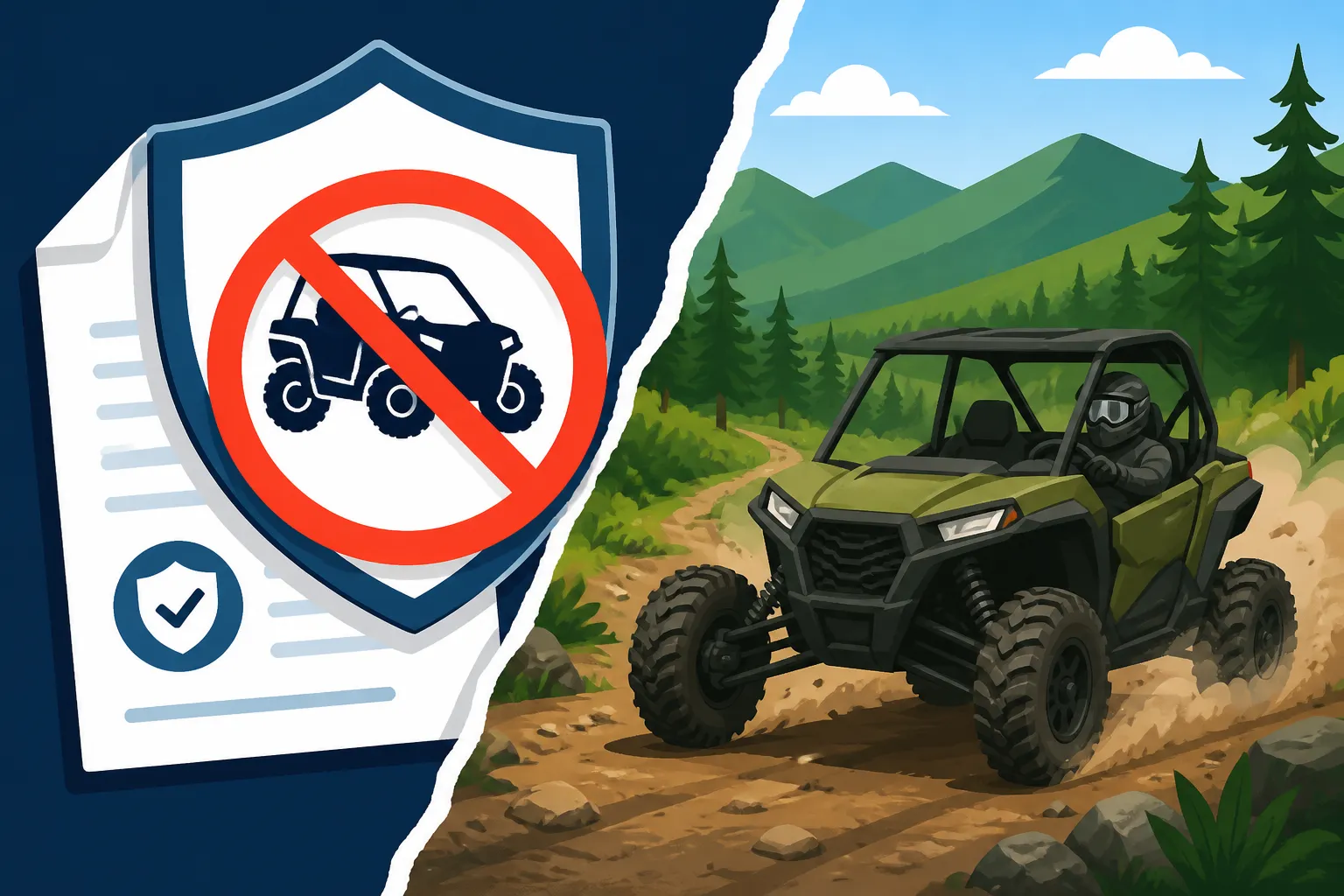
A policy that covers your ATV or UTV on a road may still exclude riding on trails. That distinction matters in Vermont, where insurance requirements and trail-access requirements are separate. Before you ride, check the policy’s exact wording, get the insurer’s answer in writing, and make sure the machine and the route are both covered.
What a trail-riding exclusion can mean
An insurance policy can cover a machine in some situations and exclude it in others. For example, a policy might cover theft or damage while the ATV is stored, but not injuries or damage caused while it is being ridden off-road. Another policy might cover riding on your property but exclude public or club-managed trails. The word “covered” is not enough: you need to know what coverage applies, where it applies, and to which machine.
An exclusion is language that removes or limits coverage for a particular use, place, person, or event. Trail riding may be named directly, or the restriction may appear under terms such as off-road use, racing, competitive events, business use, or operation on property you do not own. A policy may also use a definition of “recreational vehicle” that does not match the way you think of your ATV or side-by-side.
The consequences depend on the type of coverage involved:
- Liability coverage may not pay for injuries or property damage you cause while riding in an excluded setting.
- Collision coverage may not pay to repair your machine after a trail crash.
- Comprehensive coverage may have separate limits or exclusions for theft, fire, or other damage away from home.
- Medical payments or injury coverage may have its own restrictions, including limits related to passengers or particular riding activities.
These are not interchangeable. A policy could cover damage to your own machine while excluding liability to another person, or the reverse. Do not assume that having an insurance card means every kind of claim is covered.
In Vermont, ATV insurance requirements are a separate issue from whether a particular insurer covers trail riding. Review Vermont ATV Insurance Requirements and Insurance Required Before You Ride for the state-level obligation and what proof riders may need. Even if you satisfy a legal insurance requirement, the policy may still have limits or exclusions that matter when a claim happens.
Trail access also involves requirements beyond insurance. Registration, a Trail Access Decal, and any applicable safety rules are separate questions. A decal or registration does not change your policy, and insurance does not give you permission to ride a closed trail or private land. See Vermont Requires Registration Plus a TAD for how those access requirements fit together.
How to check whether your policy covers trails
Start with the full policy documents, not only the declarations page or an agent’s quick description. The declarations page identifies the insured machine and summarizes key limits, but exclusions and definitions are usually in the policy form or an endorsement. If you cannot find the complete documents, ask the insurer for them.
Look for sections with headings such as “Exclusions,” “Where Coverage Applies,” “Covered Vehicle,” “Off-Road Vehicle,” or “Use of the Vehicle.” Search for terms including:
- Off-road or trail use
- Public land, private land, or property not owned by you
- Organized rides, rallies, or competitions
- Racing or timed events
- Business, rental, or commercial use
- Passengers or operators who are not listed
- Use outside the policy’s territory
- Unregistered or modified vehicles
A broad phrase like “off-road use excluded” may be decisive, but narrower language can be just as important. For example, a policy might cover recreational trail use but exclude racing, or it might cover your own property but not trails maintained by a club. Read the exact wording rather than relying on a general description of the policy.
Then ask the insurer specific questions about how and where you intend to ride. “Is my ATV covered off-road?” can invite a vague answer. A more useful question describes the machine, the rider, and the setting. For example: “Does this policy cover liability and damage to my machine while I ride this listed UTV on marked recreational trails in Vermont, including trails on private land open to riders through a trail system?”
Ask about each coverage separately. Confirm liability, collision, comprehensive, and any medical or passenger coverage you expect to rely on. If more than one person will drive the machine, ask whether each operator is covered. If you plan to carry a passenger, confirm that the policy and machine configuration allow for that use.
| Policy wording or situation | What to clarify with the insurer |
|---|---|
| “Off-road use” appears in an exclusion | Whether recreational trail riding is excluded entirely or only certain activities |
| Coverage applies only on property you own | Whether marked trails on private land are treated differently |
| Racing or organized events are excluded | Whether a club ride, charity ride, or group event falls within that definition |
| Only named operators are covered | Whether every intended rider must be listed or meet a policy condition |
| The machine is described as an ATV, but you ride a UTV | Whether the listed vehicle classification matches the actual machine |
| Coverage is limited by territory | Whether riding in Vermont or across a border is within the covered area |
| You have a rental or borrowed machine | Which policy covers the machine, operator, passengers, and trail use |
When an answer is important, request it in writing from the insurer or agent and keep the response with your policy. A phone conversation may help you understand the issue, but a written answer can reduce confusion later. If the insurer says coverage requires an endorsement or a different policy, ask for the completed documents and confirm the change is in force before riding.
Do not treat a certificate of insurance, proof card, or verbal reassurance as a substitute for the contract. Those items can help show that a policy exists, but they may not list every exclusion. If the documents conflict or the answer remains unclear, ask the insurer to identify the exact policy language that applies.
Vermont access and reciprocity do not override your policy
Vermont visitors often have to consider several separate rules: whether their machine is properly registered where required, whether it qualifies for access to the trails they plan to use, and whether their insurance covers the ride. Meeting one requirement does not automatically satisfy the others.
Reciprocity concerns whether Vermont recognizes certain out-of-state registrations for applicable purposes. It does not automatically expand the insurance coverage provided by a policy issued elsewhere. A visitor’s policy may cover the machine in its home state but have a territorial restriction, a trail-use exclusion, or conditions about registration and operation. Ask the insurer whether the policy covers the actual Vermont ride, not merely travel through Vermont.
For more on the registration side, see Vermont Reciprocity for Out-of-State Machines. For trail access, check the current requirements for your machine and planned routes; Vermont Out-of-State Machines Still Need a TAD explains a separate access issue for visitors. Neither registration nor a TAD is a promise that an insurance claim will be paid.
The same distinction matters on club trails. A route may cross private land with permission, but that does not make it your property or remove restrictions in your insurance contract. If your policy only covers riding on land you own, ask whether the insurer will cover a marked trail that crosses private property with the owner’s permission. Do not assume the land’s private status makes it equivalent to your own land.
Carry whatever proof of insurance Vermont requires for the kind of riding you are doing, and keep a copy of your policy or relevant endorsements accessible. Requirements for showing proof may differ from the details of coverage. Vermont Insurance Proof at a Trailhead covers the practical proof question; for policy coverage, the insurer’s written response and the contract remain central.
If your ride crosses a state or international border, ask about coverage in every place on the route. A policy’s territory may not match trail access or registration reciprocity. Confirm whether crossing the border is covered, what documentation is required, and whether your policy has conditions for machines registered elsewhere. Do this before departure rather than assuming a Vermont policy rule applies to the other jurisdiction.
What to do if trail riding is excluded
If the insurer confirms that trail riding is excluded, do not rely on the policy for a trail ride. Ask whether the exclusion can be removed or narrowed with an endorsement, or whether the company offers another policy that covers the intended activity. Be clear about the location, type of trail, machine, riders, passengers, and any organized event. A policy meant for road use or storage is not a substitute for coverage designed for off-road riding.
If the insurer cannot offer suitable coverage, compare other providers that insure the machine and activity you actually have. Give accurate information about the machine’s classification and use. Misstating how you ride or where you ride can create problems when you make a claim, and a policy may not cover a risk the insurer was not told about.
Before relying on a replacement policy, check:
- The insured machine’s make, model, and identification details.
- Which household members or other operators are covered.
- Whether liability applies on club trails and other off-road routes.
- Whether passengers are covered and whether the machine must be designed for them.
- Whether collision and comprehensive coverage apply away from home.
- Whether events, towing, recovery, or use outside Vermont are excluded.
- The effective date and any conditions that must be met before coverage begins.
Keep the new policy documents and any endorsements. If you replace a policy or change the insured machine, confirm the old coverage has not ended before the new protection starts. For a rented ATV or UTV, ask the rental operator which coverage applies and what remains your responsibility; a personal policy may not cover a rental or may treat it differently. Who Carries the Liability Insurance on a Vermont Rental explains why it is worth clarifying that responsibility before pickup.
If a claim occurs, report it promptly under the policy’s instructions, preserve relevant records, and answer questions accurately. Keep photographs of the machine and damage, details about the trail or location, contact information for others involved, and any incident or law-enforcement report. Do not assume that a claim is covered or denied based only on a brief phone call; ask the insurer to explain its position and point to the policy language it relies on.
The safest approach is to settle the coverage question before you ride. Identify the exact machine and route, review the full policy, and get a written answer about trail use. If the policy excludes the activity, arrange appropriate coverage rather than treating registration, a trail decal, or a proof card as a replacement.
Disclaimer
This article is for general informational purposes only and does not constitute professional advice. Laws, prices and regulations vary by location and change over time. Consult a qualified professional for guidance on your specific situation.