Yielding on a Narrow Corridor
A narrow Vermont ATV corridor can turn a relaxed ride into an awkward standoff: there’s barely room to pass, the trail edge is soft, and neither group wants to damage the land. This guide explains how to approach oncoming riders, choose a safe place to yield, and get moving again without leaving the marked route.
How to handle an oncoming rider on a narrow trail
Slow down before the pinch point
When you spot another machine ahead, ease off the throttle early and take stock of the trail. A blind bend, a rise, brush, or a muddy dip can hide more riders behind the first one. Slowing down gives both groups time to communicate and find a safe place to stop. It also helps prevent the sudden braking, wheel spin, and rushed maneuvering that can turn a simple pass into a damaged trail or a close call.
Keep a safe following distance from the machine in front of you. If the rider ahead stops, you want enough room to stop without crowding them. On a group ride, pass the message back clearly so the last riders do not come around a bend at speed. A calm “riders ahead” or a hand signal can help, but don’t assume everyone heard or saw it.
Visibility can be limited on wooded corridors, especially around tight turns and dips. If you’re using a navigation tool such as onX Offroad, treat it as a planning aid, not a guarantee that the corridor ahead is clear or wide enough to pass. A mapped line can help you understand where you are, but it cannot tell you whether another group is just around the corner.
Choose a safe place to stop and communicate
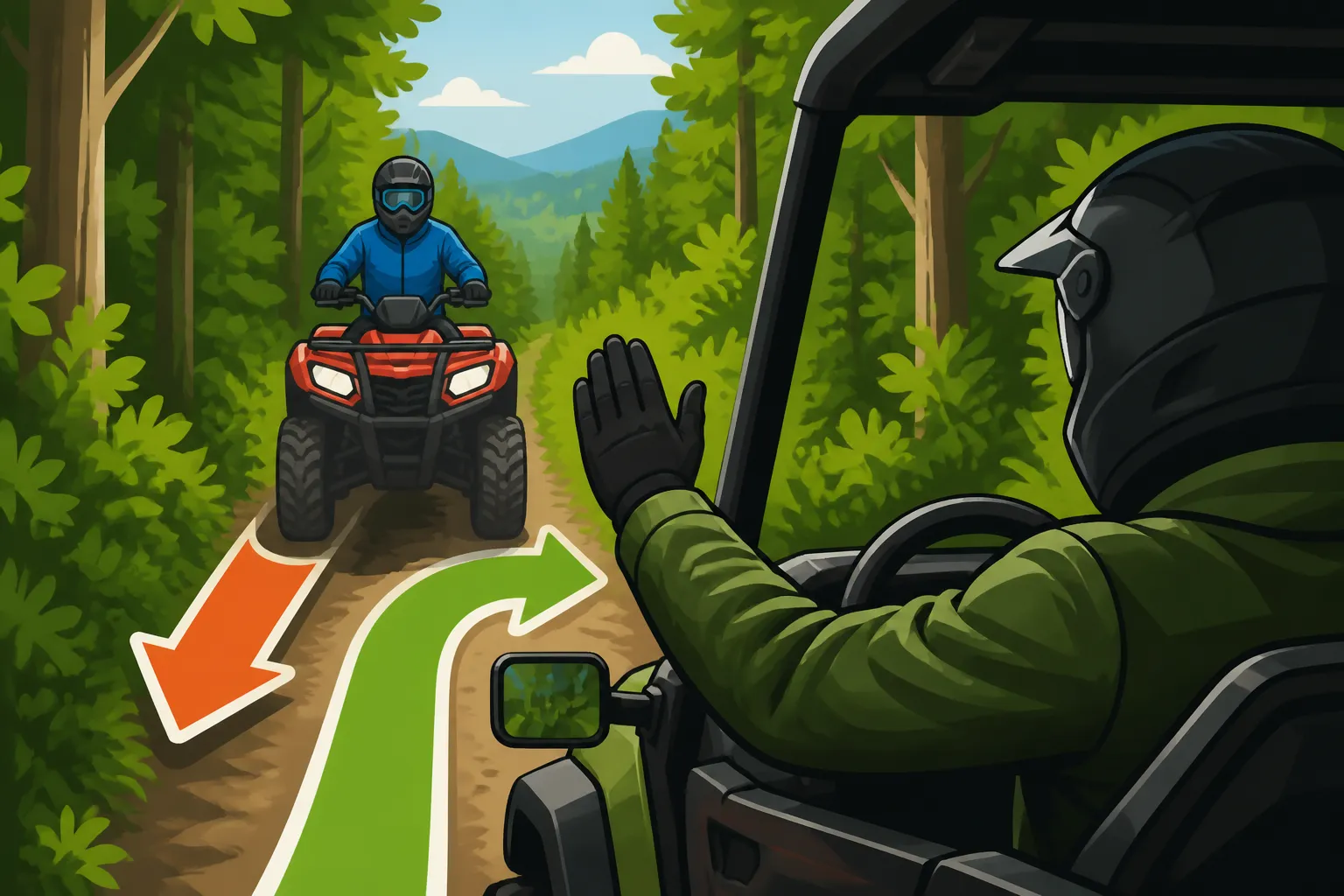
If there’s no room to pass where you meet, stop in a place where both groups can see each other. Avoid stopping directly on a blind corner, at the crest of a hill, or in a low spot where another rider may not see the machines in time. Make eye contact if possible, use a clear hand signal, and speak calmly if the riders are close enough to hear one another.
There is not a single maneuver that fits every narrow corridor. One spot may have a firm, widened area where one group can wait. Another may have a soft shoulder, exposed roots, a ditch, or a steep edge that makes moving aside unsafe. Decide based on the ground in front of you, not on an automatic assumption that one direction of travel always has to yield.
If neither group can safely pass, one group may need to back up slowly to a wider section. Agree on who will move before anyone starts reversing. Use a spotter when visibility is poor, keep people clear of the machines’ path, and make small movements. If backing up would put a machine near a drop, unstable edge, or deep rut, stop and look for another safe option rather than forcing the maneuver.
Where to pull over without damaging the corridor
Keep machines on firm, stable ground
A trail edge may look like an easy place to pull aside, but in Vermont it can be soft, rutted, sloped, or covered by vegetation that hides a ditch. Moving a machine off the marked corridor can also widen the trail or damage land that the club and landowner are trying to protect. Whenever possible, use an existing turnout or a clearly widened section rather than making a new one.
If you do need to move aside, choose ground that is firm and level enough to support the machine. Keep the wheels away from steep banks, wet soil, stream edges, and fragile vegetation. Don’t drive around a muddy patch or a stopped rider through the woods to create extra passing room. Stay within the marked route and give the other group space without creating a new track. These habits are central to Vermont Trail Etiquette on Private Land and help preserve access for everyone.
| Trail situation | Safer response | Avoid |
|---|---|---|
| A firm, widened section is nearby | Agree which group will move there and proceed slowly | Rushing past before both groups are ready |
| The shoulder looks soft or sloped | Stay on stable ground and find another safe place to wait | Pulling onto a bank, ditch edge, or wet vegetation |
| You meet around a blind bend | Stop where you can be seen and communicate before moving | Continuing into the bend at riding speed |
| A machine must reverse | Use a spotter and back up slowly, if the route is safe | Reversing blindly into a group or unstable ground |
| The trail is blocked by a fallen limb or washout | Stop, assess, and follow club guidance or turn back safely | Cutting a new path around the obstacle |
A narrow corridor is not an invitation to create a passing lane. If the only way through seems to be riding outside the marked route, wait or turn back rather than widening the trail. The corridor is part of a larger network that depends on landowner permission and careful use. Staying on the Marked Corridor matters just as much during a passing situation as it does during the rest of the ride.
Be especially careful around mud, water, and trail edges
Wet conditions can make a narrow pass much harder. A shoulder that held a machine on a dry day might collapse or slide after rain. Mud can hide ruts, rocks, or a soft edge, and spinning tires can quickly deepen damage. If one group is stopped beside a muddy section, don’t assume the open-looking side is safe to use. Pause, inspect the ground, and let the other riders explain what they can see from their position.
Water crossings and bridges deserve extra caution. Don’t push another rider to move onto an uncertain bank or bridge edge simply because your group is waiting. If the crossing or structure is too narrow for a safe pass, take turns using it. Respect any posted limits or closure signs, and leave enough room for the other group to clear the obstacle completely.
A weather change can alter the route while you’re out. A shallow puddle may become a rut; a stream crossing may be running higher; a trail edge may be slick. Checking Vermont Trail Conditions Before You Tow can help with trip planning, but conditions can still change during the ride. If you encounter a section that no longer feels safe, slow down and make a conservative decision rather than trying to keep to a schedule.
How to pass safely as part of a group
Make the plan clear to every rider
A group often takes up more space than it seems. When the first two machines stop, riders farther back may not know what is happening, especially if the corridor curves or the group is spread out. Keep your group together, pass along the information, and avoid sending individual riders through a tight gap before the rest of the group understands the plan.
Before moving, confirm who is going first and where the machines will stop after passing. Leave room between machines so each rider can steer and brake without being crowded. Keep passengers seated and secure, and make sure no one is standing in the travel line. If a rider needs extra time or help, give them time rather than trying to hurry the pass along.
Group leaders can reduce confusion by setting expectations before the ride. For example, tell everyone to stop when they see an oncoming group, wait for a clear signal, and never assume the rider in front has checked the entire corridor. If your group uses a map app, including onX Offroad, remember that navigation is not a substitute for watching the trail and communicating with other riders.
Give other trail users room
An ATV corridor may be shared with other users or pass through working land. You may meet a person walking, a landowner, a maintenance volunteer, or someone working near the route. Reduce speed well before reaching them, stop if needed, and let them move through without pressure. Be especially patient if a person is leading an animal or carrying tools.
Keep noise and dust down near homes, farms, and trail access points. Don’t rev the engine to hurry someone along, and don’t crowd a person who has stepped aside. A respectful interaction may be brief, but it helps maintain the trust that keeps trail access possible.
Follow posted signs and local club direction. Trail markers can warn about a narrow bridge, a closure, or a route change; they are not just navigational decorations. If you’re unsure whether a route is open or where to wait, Vermont Trail Signs and What They Mean and Reading a VASA Club Trail Map can help you understand the information provided along the way. Keep gates as you found them, and don’t leave the marked corridor while trying to get around another user.
A practical routine for narrow Vermont corridors
Use the same calm sequence each time
A simple routine helps when the encounter feels awkward. First, slow down and look ahead for additional riders or hazards. Second, stop somewhere visible and stable. Third, communicate with the other group and decide who will move. Fourth, check the ground and make sure the route remains within the marked corridor. Finally, proceed at walking speed until both groups are clear of the pinch point.
If you’re the group that waits, make it easy for the other riders to pass without stepping into their path. If you’re the group moving, take the route the other riders have agreed is safe and avoid accelerating sharply once you’re through. A small wave or thanks is enough; the goal is to keep the encounter courteous and predictable, not to turn it into a race to reclaim the trail.
For a larger group, count the machines before restarting. The last rider may not have heard the plan, and the group ahead may still be clearing the narrow section. A quick check prevents someone from pulling out while another machine is still maneuvering.
Know when not to continue
Sometimes there is no safe way to pass. The corridor may be blocked, the shoulder may be unstable, or a machine may be unable to turn around without risk. In that case, don’t treat persistence as the solution. Stop, talk through the options, and consider backing up to a wider section or turning around if you can do so safely.
Never create a new route around a blockage by cutting through brush, crossing private land, or driving off the marked trail. If you encounter damage, a hazard, or a section that appears closed, take note of the location and report it through the appropriate club or trail contact when practical. A trail warden may also be able to clarify what is allowed; What a Trail Warden Checks offers useful context for riders who are unsure what to expect on the corridor.
Before heading out, make sure your route and access are in order. Vermont trail access involves more than having a machine ready to ride: check the requirements that apply to your machine and the trail network, and follow the instructions for the specific route. Vermont ATV Trails: The VASA System explains the broader network, while Vermont Trail Closures Landowners Request is a reminder that access can change when a landowner or club needs to protect a property or trail section.
Finally, be patient. Narrow corridors can make even experienced riders feel exposed or pressured, particularly when there’s a group waiting behind them. A few extra minutes spent communicating and choosing stable ground is far better than damaging the trail, risking a rollover, or turning a routine pass into a confrontation. The safest pass is the one that leaves the corridor—and everyone using it—in good shape.
Disclaimer
This article is for general informational purposes only and does not constitute professional advice. Laws, prices and regulations vary by location and change over time. Consult a qualified professional for guidance on your specific situation.