Where to Stage a Group of Six
A six-rider outing can feel organized until everyone arrives at a trailhead with different directions, multiple trailers, and nowhere obvious to park. In Vermont, where many ATV corridors cross private land, choosing a staging spot takes more than finding a map pin. This guide explains how to plan a practical, respectful meetup, coordinate vehicles, and keep the group together.
Choose a staging area that can actually handle your group
Start with an authorized trailhead or club-approved access point
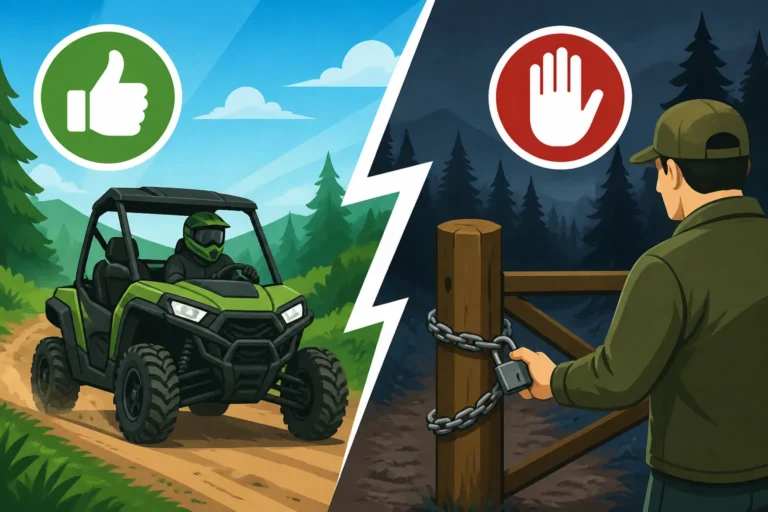
For a group of six, the best staging area is not necessarily the closest place to the trail. It is a place where your group is allowed to park, unload, and access the route. Vermont’s trail network depends heavily on permission from private landowners, and a visible track or open gate does not automatically mean a location is an approved parking area. Begin with the local club that maintains the corridor and confirm which access point it recommends for your ride.
Ask specifically whether the location can accommodate your whole group’s vehicles. Six riders might arrive in three trucks with trailers, or in one vehicle carrying several people and machines. Those scenarios need very different amounts of space. A small pull-off that works for one pickup may be unsafe or disruptive when several trailers are backing in and turning around.
The VASA network spans different regions and club territories, so do not assume that a trailhead you used on a previous trip is suitable for a different route. If your ride is near Island Pond or Newport, for example, contact the club responsible for the corridor you plan to use rather than choosing a familiar-looking lot on a map. Finding the VASA Club That Maintains Your Local Trail can help you think through that first step.
Confirm parking, unloading, and access separately
“Can we park here?” is only one of several questions to ask. A club or property contact may be able to clarify whether you can unload machines, leave tow vehicles for several hours, use a turnaround, or gather the group before riding. Ask whether there are restrictions on trailer parking, overnight parking, or the number of vehicles. A location can allow trail access without having enough room for a group’s trucks and trailers.
If the recommended staging area is a business, campground, public lot, or other facility, get permission from whoever manages it. Do not assume that customer parking, roadside space, or an empty-looking lot is available for a full day of trailer parking. A considerate call ahead can prevent a frustrating start for your group and avoid inconveniencing nearby residents or businesses.
For a broader view of how access points fit into the network, review Vermont Trailheads With Trailer Parking and Vermont Trail Maps Still Coming. Treat any map or app pin as a planning clue, not proof that parking is permitted. Confirm the details locally before setting a meetup time.
Plan the arrival before anyone hooks up a trailer
Count vehicles, trailers, and machines—not just riders
A group of six people might arrive in one vehicle, but it might also mean six separate machines and several tow rigs. Before choosing a staging point, make a simple arrival list: who is driving, how many machines each vehicle is carrying, how many trailers are involved, and whether anyone needs extra space to unload safely.
This matters because a group can run into a parking problem even when every rider is punctual. A narrow entrance may not allow a truck and trailer to turn around. A sloped shoulder may be awkward for unloading. A busy road can make it unsafe to stop and organize helmets, paperwork, and gear beside the vehicles. If you cannot get a clear answer about capacity, select a different approved location rather than hoping the space will work when you arrive.
| Planning detail | What to confirm before the ride | Why it matters for six riders |
|---|---|---|
| Parking permission | Who authorizes parking and for how long | Prevents an access conflict or tow-away problem |
| Vehicle capacity | Number of trucks, cars, trailers, and machines | A small lot may not fit the convoy |
| Unloading space | Room to unload without blocking traffic or access | Makes arrival safer and less stressful |
| Turnaround space | Whether tow vehicles can enter and leave easily | Avoids backing trailers into a road or trail entrance |
| Route access | Which corridor or trailhead the location serves | Keeps the group from starting on an unauthorized route |
| Backup plan | A second approved meetup or parking location | Helps if the first site is full or unavailable |
Share the vehicle count with the club or property contact when you ask about parking. “Six riders” may not tell them enough; “three trucks, two trailers, and four machines” is much more useful. If your plans change and an extra vehicle joins, check again rather than assuming the original arrangement still fits.
Use one arrival window and a clear meeting point
Groups often lose time because each person interprets “meet at the trailhead” differently. Choose one specific, confirmed location and describe it in plain language. Send the address or map pin, the name of the access point if available, and a short instruction such as “park in the designated trailer area, then wait beside the unloaded machines.” Do not tell riders to meet at a general road junction or gate if that could block traffic or interfere with property access.
Set an arrival window that gives the group time to unload, use the restroom if facilities are available, check equipment, and review the route. Avoid planning to roll out the instant the last truck pulls in. A late arrival can leave everyone else waiting while machines are still strapped down, helmets are being located, or someone is trying to download a map with poor service.
Send the plan the day before, then ask each driver to confirm they received it. Include a contact number for the ride leader and a simple fallback instruction if someone gets lost. In areas with spotty cell service, do not make the plan depend on a last-minute text message. Cell Dead Zones in the Kingdom is worth keeping in mind when coordinating a ride in the Northeast Kingdom.
Coordinate the route and the group before leaving staging
Prepare navigation for a group, not just one machine
A route that looks straightforward to the lead rider can be confusing for everyone behind them, especially when corridors branch or connect with roads and other trails. Review the proposed route in advance, identify turns and regroup points, and make sure each rider knows the plan. A navigation app such as onX Offroad can help you inspect mapped routes and share planning information, but a map display should not replace confirmation that a corridor is open and authorized.
Before the ride, have the group compare the route on their own devices. If you use onX Offroad to mark a starting point or review a route, send the information early enough for riders to save or download what they need. Do not wait until everyone is standing at the trailhead to discover that one phone has no signal, another has a drained battery, and a third rider has a different destination saved.
A digital route is only as useful as the assumptions behind it. Check current local trail information and follow posted signs, gates, and closures. Do not use a route line to justify entering land where access is not permitted. Vermont Trail Etiquette on Private Land and Vermont Trail Closures Landowners Request are useful reminders that access can depend on landowner permission and changing conditions.
Set a riding order and regroup points
Before departing, decide who leads and who rides last. The lead rider should know the planned route and be prepared to stop at turns or designated regroup points. The last rider should know the route too, so the group can recognize if someone falls behind. If the group is mixed in experience, place newer riders where they can follow a steady pace without feeling pressured to keep up.
Agree on what the group will do if the line separates. A simple rule works well: riders do not make an unplanned turn when they lose sight of the group; they stop at a safe, permitted place and wait for the ride leader or sweep rider to check in. This is especially important where a trail forks, crosses a road, or passes a narrow section where stopping could obstruct others.
Use onX Offroad or another navigation tool as a shared reference if it helps everyone understand the route, but choose physical regroup points too. A named junction, wide pullout where stopping is allowed, or a confirmed club location is easier to describe than “the bend after the long muddy stretch.” Keep the planned route conservative enough that a delayed rider or minor mechanical issue does not leave the rest of the group unsure where to go.
Make the staging plan comfortable, safe, and low-impact
Pack for the wait as well as the ride
The staging area is where people discover what they forgot. Keep a short pre-ride checklist for the group: helmets, eye protection, required documents, water, charged phones, basic tools, and any machine-specific items needed for the planned route. Ask riders to arrive with fuel and machines ready to unload; do not count on finding fuel or supplies at the trailhead.
Assign a few jobs so the ride leader is not trying to manage everything at once. One person can check that the parking area remains clear, another can confirm the group roster, and someone else can help a less experienced rider with gear. If the group is bringing multiple machines, make sure unloading does not block the entrance or prevent other trail users from getting through.
Keep the meetup short and tidy. Avoid loud music, revving, unnecessary idling, or spreading gear across the lot. Take trash with you, leave gates as you found them, and do not use nearby private property as a restroom or turnaround without permission. A small group can still make a big impression on a landowner or neighbor, for better or worse.
Have a fallback for a full lot or a closed route
A staging plan needs a backup because parking may be occupied, a route may be closed, or weather may change conditions. Identify a second authorized location before the trip, and agree that the group will not scatter to find informal parking if the first spot is full. The backup should be checked just as carefully as the primary site for parking permission, trailer capacity, and access to the intended corridor.
If a route is closed, do not bypass a gate or improvise a detour onto an unapproved road. Contact the relevant club or local source for guidance, then decide whether to use a confirmed alternative or call off the ride. Vermont Trail Conditions Before You Tow is a useful planning topic, particularly when several vehicles are making a long trip to the same area.
If conditions change after your group arrives, communicate the decision clearly before anyone unloads or departs. A good ride leader is willing to adjust the plan rather than press ahead because people have already driven to the trailhead. For more trip-planning context, Vermont Group Ride Planning and A Day’s Ride on the VASA Corridor System can help you think through the outing as a coordinated route rather than a collection of separate machines.
Disclaimer
This article is for general informational purposes only and does not constitute professional advice. Laws, prices and regulations vary by location and change over time. Consult a qualified professional for guidance on your specific situation.