Being Turned Around at a Gate
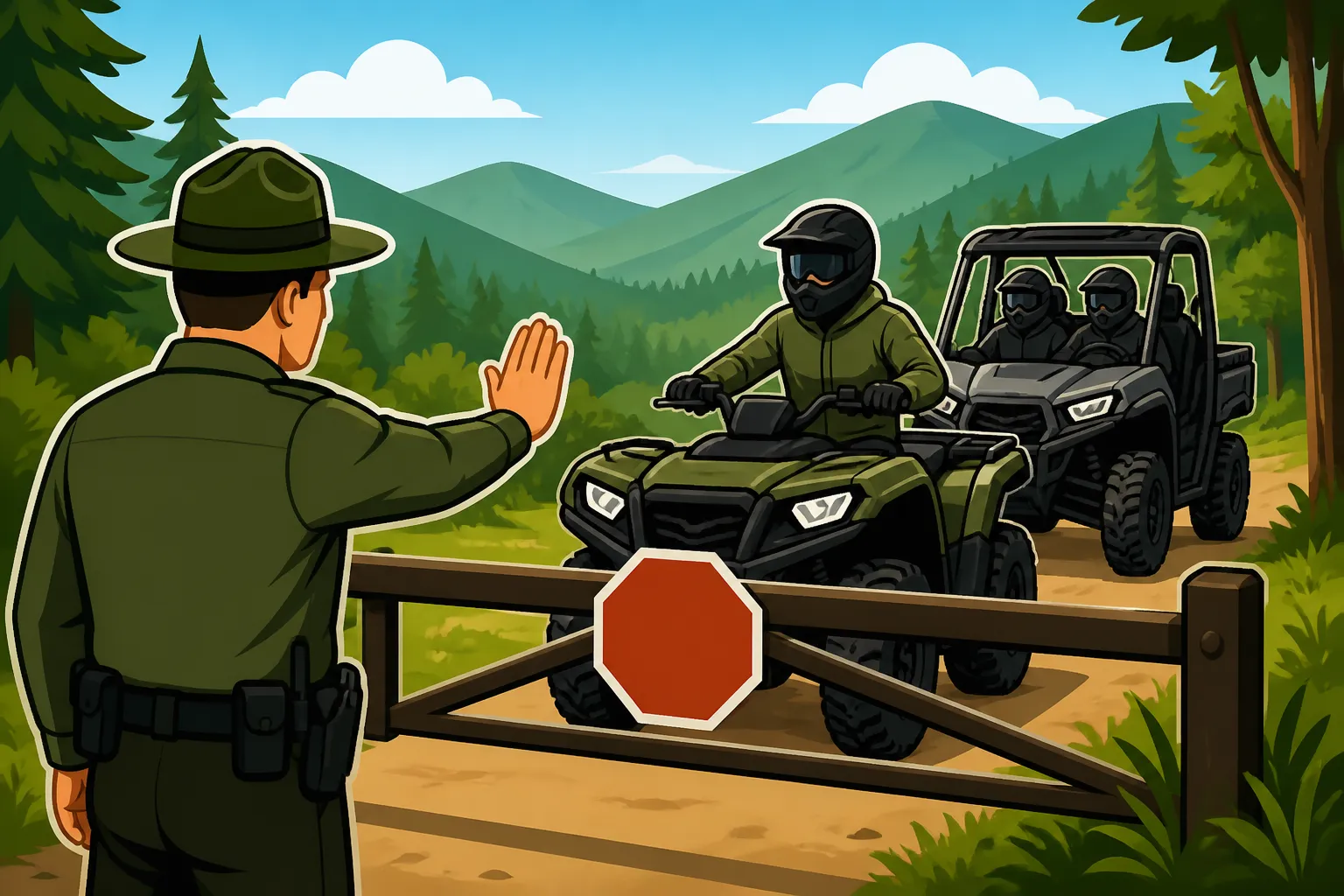
A closed gate on a Vermont ATV or UTV route can mean more than a temporary delay. It may mark a seasonal closure, a landowner’s access limit, or a route your machine is not authorized to use. Before turning around or searching for a way around it, check what the gate is telling you and whether your registration and trail access are in order.
Why a Vermont trail gate may be closed
Vermont’s ATV trail network depends on permission to cross private property. A route shown on a map is not necessarily open every day, and a gate is not an invitation to find another way through. It may be there to protect a wet section, prevent damage, control access to a working property, or enforce a closure requested by a landowner or trail club.
A gate may also separate a marked riding corridor from a road, driveway, field, or other land where riding is not allowed. Even if you can see a trail continuing on the other side, that does not establish that the route is currently open or that you have permission to use it.
| What you see | Possible meaning | Sensible response |
|---|---|---|
| Gate with a closure sign or trail notice | The route may be closed for a season, conditions, work, or another access reason | Do not pass; check current trail information |
| Closed gate with no explanation | Access may be restricted, or the route may be temporarily unavailable | Stop and look for official signs or a marked alternative |
| Open gate across a marked corridor | The route may be open, but the gate may need to be left as found | Follow signs and club guidance; do not assume every open gate grants access |
| Gate across a private driveway or field | You may be at a property boundary or off the designated corridor | Turn back unless you have explicit permission |
| Gate you cannot identify on your map | Your location or route may be uncertain | Stop, confirm your position, and avoid improvising a detour |
A closure can be temporary or longer-term. Heavy rain, mud, erosion, maintenance, a damaged bridge, or a landowner’s request may lead a club to close or reroute part of a corridor. Conditions can change after a map is published, so an old map or a route remembered from a previous visit is not proof that the gate should be open today. For background, see Vermont Trail Closures Landowners Request and Vermont Trail Conditions Before You Tow.
There is also a difference between a gate that controls access to a club corridor and a barrier that blocks a town road or other route. Vermont town-road access is governed separately from club trail access, and towns decide which roads, if any, are open to ATVs. A gate on a road does not become passable simply because a nearby trail is open. If your route uses a town road, check the local designation and posted signs as well as the trail status.
Do not force, climb over, or drive around a gate. Going around it can damage property, widen a muddy trail, or take you onto land outside the permitted corridor. It can also make the situation worse for other riders by jeopardizing access that depends on landowner cooperation. The practical rule is simple: if a gate or sign indicates that you cannot continue, stop and verify rather than treating the obstacle as a puzzle.
Check your access before assuming the gate is the problem
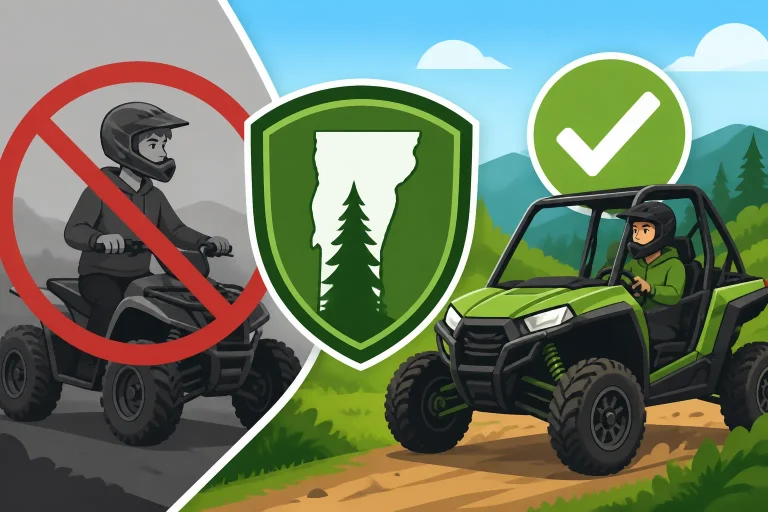
A rider can arrive at a gate with the correct machine and still lack the access required for the route. Vermont’s club trail system uses a Trail Access Decal, commonly called a TAD, in addition to machine registration. Visitors should not assume that a home-state registration alone gives them access to Vermont club trails.
The requirements can depend on where the machine is registered and what kind of route you plan to ride. Out-of-state registration may be recognized under reciprocity rules, but reciprocity is not the same thing as a Vermont trail decal. Review Vermont Out-of-State Machines Still Need a TAD and Vermont Reciprocity for Out-of-State Machines before your trip. If you are riding a Quebec-registered machine, Vermont Recognizes Quebec Registrations explains the related registration question.
A useful pre-ride check is to confirm each of these items:
- The machine is properly registered. Carry the registration document or other required proof, and make sure the machine’s plate is attached and readable.
- The required trail access decal is valid and displayed as directed. A decal is not a substitute for registration, and registration is not a substitute for the decal where trail access requires one.
- The route is currently open. Check current club information, posted notices, and any closure updates rather than relying on a saved route alone.
- Your planned route is an authorized corridor. A nearby road, private lane, or unmarked track is not automatically part of the trail system.
- You have the right equipment and documents. Keep required proof available in case a warden or other official asks to see it.
The decal’s purpose is access to the participating trail network, not a general permit to ride anywhere in Vermont. The route still needs to be open, marked, and within the access system. A visitor decal also does not give permission to cross private land outside an authorized corridor. See Which Trails a Visitor Decal Opens for You for the distinction between having a decal and having access to a particular route.
If you are unsure whether your decal is visible or attached in the right place, check Vermont TAD Placement on the Machine. A decal that is tucked away, obscured, or damaged can make it harder to show that you have the required access. Keep the registration and access requirements separate in your mind: they answer different questions, and both may matter during a ride.
Use the map as a planning aid, not a guarantee
A club map can help you identify corridors, trailheads, and connections, but it cannot promise that every section is open when you arrive. Confirm the route close to your ride date, especially after storms, during spring conditions, or when a trip depends on a particular connection. Reading a VASA Club Trail Map can help you interpret the map, while Vermont Trail Etiquette on Private Land covers the conduct that helps preserve permission to ride.
If the map and the gate appear to conflict, do not decide on the spot that the map overrides the closure. A map may be outdated, a sign may announce a short-term restriction, or you may have reached a boundary that is not obvious on a small screen. Treat the physical sign and current club guidance as important evidence, and ask the relevant club or land manager to clarify the route.
What to do when you reach a closed or uncertain gate
A calm stop is safer than a rushed decision, especially when a group is behind you or daylight is fading. Park without blocking the trail or access point, and look for a sign, closure notice, trail marker, or alternate-route instruction. Do not crowd the gate, enter private property to look for an explanation, or send a rider ahead to test whether the route is passable.
Use this process:
- Stop before the barrier. Keep the machine and group out of the way of other users and avoid blocking a driveway, work area, or emergency access.
- Read all visible signs. Note whether the message identifies a seasonal closure, a detour, a private-property boundary, or a specific restriction.
- Check your location. Compare nearby trail markings with your map or navigation device. If you cannot confirm where you are, do not ride farther in search of a better signal or a different entrance.
- Check current trail updates. Use the relevant club’s current information if you have service. If you do not, rely on posted notices and turn back when the route cannot be verified.
- Follow an official detour only if it is clearly marked and open. Do not make your own bypass through woods, fields, roads, or private lanes.
- Ask the appropriate club or land contact later if the reason remains unclear. A polite question with the location and sign details is more useful than moving or ignoring the barrier.
- Choose a known open route or end the ride. A changed plan is preferable to trespassing, getting stuck, or causing damage.
If the gate is open but a sign says the route is closed, follow the sign. If the gate is closed without a sign, do not assume that the closure is accidental. It may have been secured for a reason that is not visible from the trail. Likewise, never leave a gate open unless an instruction specifically tells you to do so. On corridors that cross working land, gates may be used to contain livestock or control vehicle access. Follow posted instructions and leave the gate in the condition in which you found it when passage is permitted.
Do not remove a sign or move a barrier to help the rest of your group through. If the group has already passed the gate, make sure everyone knows to stop and regroup rather than continuing separately. A rider who goes ahead may reach another restricted point without knowing where the others are, and a divided group is harder to direct back to a known route.
Where there is no clear safe way to turn around, stop and assess the terrain before maneuvering. Avoid backing blindly toward other riders, steep edges, or soft ground. Use a spotter if needed, keep the group clear, and do not attempt a risky turn just to save time. If the machine is stuck or the route is hazardous, prioritize people’s safety and seek appropriate help rather than damaging the barrier or surrounding property.
A warden or other official may ask to see proof of registration, access, or compliance while you are on a trail. Keep documents accessible and answer questions calmly. What a Trail Warden Checks explains what may be reviewed during a trail encounter. Having the paperwork does not authorize you to ignore a closure, but being organized can make it easier to resolve an access question.
Avoiding the same problem on your next ride
Most gate problems are easier to prevent than to solve beside a trail. Build a little flexibility into the route, and do not make the success of the whole day depend on one corridor being open. Before towing to a trailhead, check the club’s current notices and have a reasonable alternative that is also authorized. If a closure would leave you without a safe return route, choose a different starting point or postpone the trip.
Prepare a route that can change
A practical plan includes more than a line on a phone screen. Note the trailhead, intended direction, likely turnaround points, and a way back that does not depend on crossing an uncertain section. Tell the group that a gate may change the route and agree in advance that no one will go around a closure.
Carry a charged phone, but do not rely on continuous cell service. In areas with poor coverage, save the relevant map information before leaving service and identify the club contact details in advance. A device can show where a trail is drawn without showing whether a gate has been closed since the map was prepared. Treat navigation as one source of information, not permission.
For groups, set a simple rule: the lead rider stops at any unclear gate, and the rest of the group waits at a safe distance. Do not split into separate parties to search for another entrance. If the closure forces a return trip, confirm that everyone has enough fuel, daylight, and equipment for the revised plan.
Protect access for the next rider
A landowner’s willingness to permit trail use is not permanent. Riders who ignore closures, leave gates open, damage property, or create unauthorized bypasses can put future access at risk for the whole area. Stay on the marked corridor, keep noise and speed appropriate to the setting, pack out rubbish, and do not treat private fields or roads as shortcuts.
If a gate appears damaged or a sign has fallen, report the location to the relevant club when practical. Do not repair, relocate, or remove property unless the owner or club has asked you to do so. A clear report can help the people responsible for the route determine whether access is open and whether a sign needs attention.
When you are turned around, the safest response is generally the least complicated one: obey the posted restriction, verify the route, and return by a known open path. Registration, reciprocity, and a valid TAD are important, but none of them overrides a closure or grants permission to ride beyond the authorized corridor.
Disclaimer
This article is for general informational purposes only and does not constitute professional advice. Laws, prices and regulations vary by location and change over time. Consult a qualified professional for guidance on your specific situation.