Vermont Course Exception on Family Land
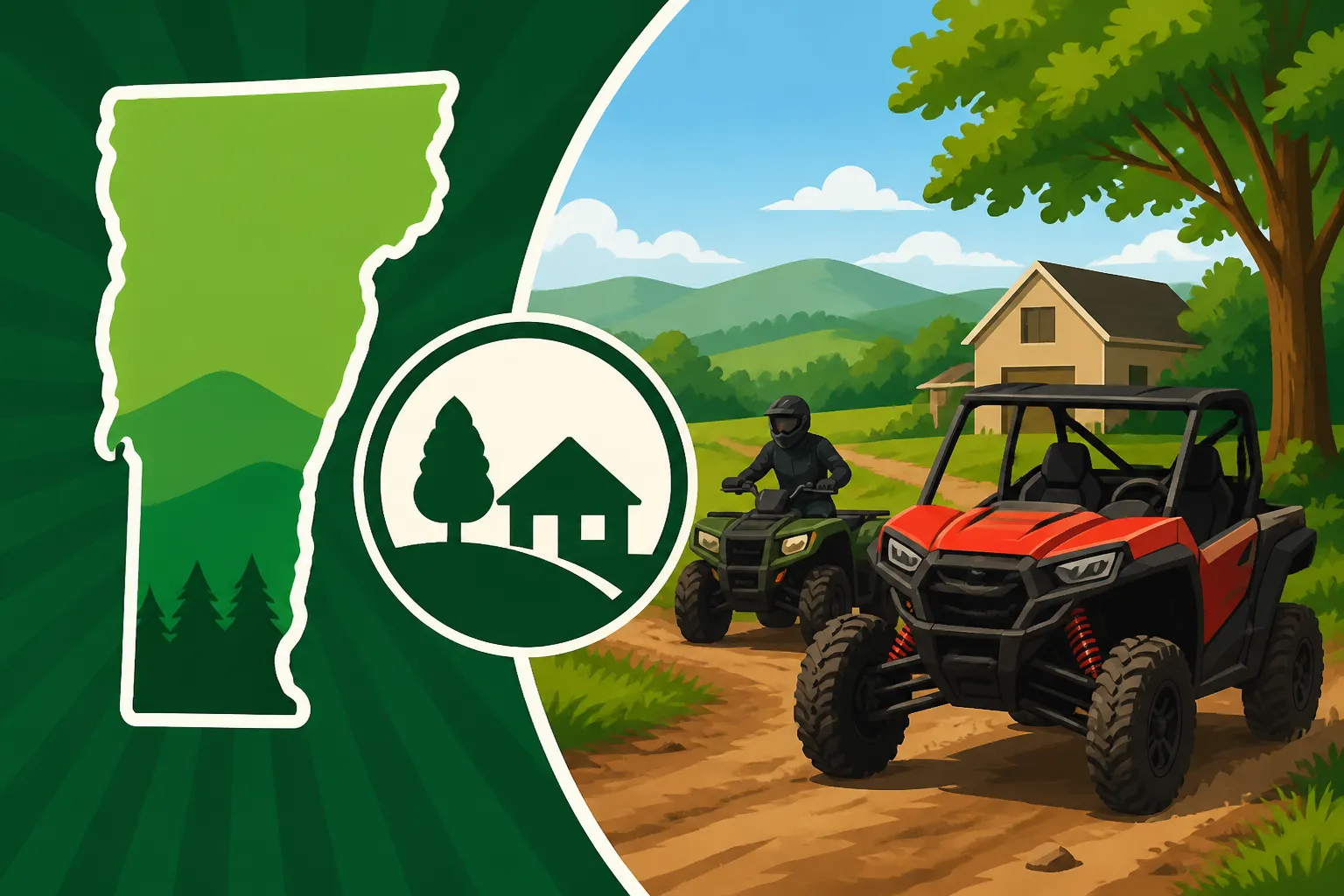
A young rider may be allowed to operate an ATV on certain family-owned property without first completing Vermont’s safety course. The exception is narrower than “riding somewhere the family has permission”: ownership, location, and what the rider does next all matter. Here’s how to think about the exception, where it stops, and what to check before letting a young rider start the machine.
What Vermont’s family-land exception means
Vermont generally requires a person under 18 to complete an approved ATV safety course before operating an ATV. The family-land exception can allow a young person to ride without that course on qualifying property owned by a parent or guardian. It is a limited exception to the training requirement, not a general exemption from Vermont ATV rules.
For the statewide requirement and how it applies by age, see Vermont ATV Safety Course Required Under 18. The key point is that the exception depends on the property where the machine is being operated. A parent’s presence, permission to ride, or family relationship to the landowner does not automatically make a location eligible.
Ownership matters more than permission
A young rider should not assume the exception applies just because the property belongs to someone in the family. Land owned by a grandparent, aunt, uncle, or other relative may not qualify under an exception framed around property owned by a parent or guardian. Likewise, a family’s permission to use a neighbor’s property is not the same as ownership.
If the property is shared, held in a trust or business name, leased, or owned by someone other than the parent or guardian, do not guess about how the exception applies. Confirm the current rule with an appropriate Vermont authority before relying on it. A property tax bill or deed may help clarify ownership, but carrying a document does not expand the legal exception.
The safest reading is narrow: unless the property clearly fits the exception, treat the course requirement as applying. Riding on Land Your Parents Own covers the ownership question in more detail.
The exception is about training, not permission to ride anywhere
Even when the exception applies on the parent’s or guardian’s property, it does not turn the whole area into an unrestricted riding zone. A young rider who leaves that property, enters a public road, or joins a trail may be subject to the usual training rules and other requirements.
That distinction matters in places where a private parcel connects to a town road or a marked trail. A rider might begin on qualifying family land and then cross onto land the family does not own. The exception should not be treated as following the rider across that boundary.
Where the exception stops
The practical question is often not just who owns a parcel, but where the rider will actually travel. Property lines can be difficult to see from a machine, especially in wooded areas or on informal paths. Before a ride, make sure the young rider knows the permitted area and has a clear plan for staying inside it.
| Situation | How to treat the course exception |
|---|---|
| Riding on property clearly owned by a parent or guardian | The family-land exception may apply to the course requirement. Confirm the current rule and any conditions. |
| Riding on a relative’s property | Do not assume family permission is enough. Check whether the property meets the ownership requirement. |
| Riding on land the family leases or uses by permission | Do not assume the exception applies. Confirm before riding. |
| Crossing a town road or riding on a public road | Treat this as outside the private-property exception and check the rules that apply to that route. |
| Riding on a marked club trail or other trail network | Do not assume the family-land exception applies. Course, registration, access, and other requirements may apply. |
| Riding on a neighbor’s or other private parcel | The owner’s permission may address access, but it does not necessarily satisfy the course exception. |
Roads and trails are a separate question
Vermont town-road access is not automatic. A road must be open to ATV use under the applicable local rules, and riders must follow the conditions for that route. The general rules are covered in Vermont ATV Road Rules: Towns Decide. A private path that reaches a road does not give a young rider permission to continue on it.
Club trails have their own access requirements. The family-land exception does not substitute for a trail access decal, registration, or any required safety certificate. Before using the trail system, review Vermont Requires Registration Plus a TAD and Out-of-State Safety Courses Vermont Will Count if the rider’s training was completed elsewhere.
Be especially careful with crossings. A short crossing may still involve a public road or a designated corridor, and the rules can depend on the exact route and the rider’s age. Do not assume that a familiar crossing is permitted simply because the ride began on family property.
Boundaries should be clear before the engine starts
If a route follows a field edge, woods road, driveway, or property line, point out the limit before the ride. A young rider may not recognize that a trail has passed onto another parcel. Marking the approved area on a paper map or walking the route together can prevent accidental trespass and an unplanned move beyond the exception.
Permission from another landowner and the course exception answer different questions. Permission may allow access to land; it does not necessarily remove a training requirement. If a route crosses multiple parcels, check the ownership and rules for each part rather than treating the route as one continuous family property.
What the exception does not waive
A course exception is not a broad waiver of safety obligations. It concerns the training requirement in a limited setting. Other laws, equipment rules, landowner conditions, and sensible riding precautions still matter.
Age and supervision rules remain separate
The safety-course exception should not be confused with the rules that apply to a rider’s age or supervision. Vermont has separate requirements for younger riders, and a family-land exception does not necessarily change who may ride, who must supervise, or what kind of machine is appropriate. See Vermont Supervision Rules Under 16 and Vermont Safety Course Minimum Age when checking those age-specific questions.
An adult’s presence is still a good safety practice even where a course exception may apply. That does not mean adult supervision replaces a required course in places where the exception does not apply. The two issues should be checked separately: whether the rider needs a course and whether the rider may operate in that setting under the applicable age and supervision rules.
A course can also be valuable even when it is not legally required for a particular ride. It teaches basic operating practices that matter on private land, including speed control, turning, braking, terrain awareness, and riding within the machine’s limits. A new rider can benefit from that instruction before using an ATV, not just before accessing a trail.
The machine and the ride still need to be appropriate
A private parcel is not automatically safe for every machine or rider. Consider the rider’s size and experience, the machine’s controls and power, the surface, visibility, nearby hazards, and whether the route has steep slopes, water, rocks, or drop-offs. Follow the manufacturer’s age and passenger guidance, and do not carry a passenger unless the machine is designed for one.
Before riding, check that the ATV is in sound operating condition and that the rider has suitable protective gear. A helmet and eye protection are important even on private land. Keep the first ride short and supervised, and choose an open, predictable area rather than a route with blind corners or obstacles.
Property owners can set conditions for use of their land. They may restrict where machines can go, limit access to certain times, or close an area. Respect those conditions even if the rider is legally eligible to operate there. Landowner permission is not a substitute for training, and the training exception is not a substitute for permission.
Registration, insurance, and trail access are different requirements
The family-land exception concerns a safety course. It does not, by itself, determine whether an ATV must be registered, whether insurance is required, or whether the machine may use a trail or road. Those questions depend on the machine and where it will be operated.
For example, a machine used only on private property can raise different questions from one taken onto a public road or club trail. Check the applicable rules rather than assuming that an exception to one requirement resolves the others. If the rider will leave the family property, review the registration and access rules before the trip.
How to use the exception carefully
A simple check before riding can prevent confusion about whether the course exception applies. If any part of the plan is uncertain, pause and verify the rule before letting a young person operate the ATV.
- Identify the exact property. Confirm who owns the land. Do not rely only on a family connection, an informal understanding, or the fact that the family has permission to use it.
- Check the route. Decide where the rider will go and whether any part crosses another parcel, a public road, or a trail.
- Confirm the rule for the rider’s age. Check the course requirement and any separate age or supervision rules. The general overview at Vermont ATV Safety Course Required Under 18 is a useful starting point.
- Ask about uncertain ownership or boundaries. If the property is leased, jointly owned, held in a trust, or otherwise not plainly owned by a parent or guardian, confirm whether the exception applies rather than relying on an assumption.
- Keep training proof if the rider has completed a course. A completed course can simplify later plans to ride outside the family property. See Vermont Safety Certificates That Never Expire for information about certificates.
- Set the limits before the ride. Explain the route, boundaries, speed expectations, and what the rider should do if unsure where they are.
- Recheck before changing locations. A ride that starts on family property may become subject to different rules as soon as it moves onto a road, trail, or another person’s land.
If the rider has completed a course, keep proof accessible when riding in settings where a certificate may be required. A small waterproof document sleeve, available from many outdoor retailers or Amazon, can help protect a paper copy from mud and rain. Do not assume a photo or digital record will satisfy every request; check what proof is accepted for the specific ride.
For a young rider who expects to use trails or roads later, taking the approved course before that first trip is often the clearest option. It avoids having to decide at a property line whether the exception still applies, and it gives the rider instruction that remains useful when the location changes. If the rider is close to an age threshold, check What Changes for a Rider Who Turns 16 rather than assuming that turning 16 removes every requirement.
The practical takeaway is straightforward: treat the family-land exception as a narrow exception tied to qualifying property, not as a general pass for a young rider to use an ATV anywhere the family has access. Confirm ownership, keep the ride within the permitted area, and check course, age, road, and trail rules separately.
Disclaimer
This article is for general informational purposes only and does not constitute professional advice. Laws, prices and regulations vary by location and change over time. Consult a qualified professional for guidance on your specific situation.