Proving Tax Was Already Paid
One of the most common snags riders hit when trying to register an ATV or UTV in Vermont is proving they've already paid the necessary taxes. It can feel like a bureaucratic maze, especially if you've bought your machine from a private seller, inherited it, or brought it in from another state. This guide is here to walk you through exactly what Vermont's Department of Motor Vehicles (DMV) looks for as proof of tax payment, helping you avoid unnecessary delays and potential double taxation.
Why Vermont Cares So Much About Your ATV's Tax History
When you purchase an ATV or UTV, whether new or used, Vermont imposes a Purchase and Use Tax. This tax is the state's way of ensuring that a percentage of the machine's value contributes to state revenue, similar to sales tax in many other places. For most new registrations, this tax is collected right there at the DMV counter. However, if you're registering a machine that's already had this tax paid (perhaps by a previous owner in Vermont, or in another state that offers reciprocity), the DMV needs clear documentation to confirm it. Without that proof, they'll assume the tax hasn't been paid yet, and you'll be on the hook for it, even if that means paying twice – a frustration no one wants to deal with.
The state's primary goal isn't to nickel-and-dime you, but to maintain a fair and consistent system for revenue collection. They want to prevent situations where a machine changes hands multiple times without ever contributing its share of tax, or conversely, where an individual unfairly pays the tax more than once. This is particularly relevant given Vermont's proximity to other states and even Canada, where tax structures can differ wildly. The process is designed to be thorough, which is why understanding the specific documents that satisfy their requirements is so crucial for any rider. You don't want to get all the way to the counter with your paperwork for [Vermont ATV Registration Cost] only to find you're missing something vital for the tax portion.
Moreover, the Purchase and Use Tax is a one-time fee tied to the initial transfer of ownership or introduction of the vehicle into Vermont for use. Once it's paid and properly documented, it shouldn't be an issue for subsequent owners if they can show the proper chain of custody and proof of prior payment. This makes your initial registration and the documentation you keep incredibly important, not just for you but for anyone who might purchase your machine down the road. It truly is about establishing a clear financial lineage for your off-road vehicle.
Accepted Documents to Prove Prior Tax Payment
The key to a smooth registration process lies in presenting the correct paperwork. The Vermont DMV is quite specific about what they consider valid proof that the Purchase and Use Tax has already been satisfied. Gathering these documents ahead of time can save you a world of headache and a return trip to the DMV office.
Bills of Sale and Their Details
A well-detailed bill of sale is often your strongest piece of evidence, especially when buying from a private seller. However, not just any scrap of paper will do. The DMV requires a bill of sale that clearly identifies the vehicle (make, model, year, VIN), the full names and addresses of both the buyer and the seller, the date of sale, and, critically, the purchase price. If the previous owner already paid the Vermont Purchase and Use Tax, or if you paid a sales tax in another state, this needs to be clearly stated on the bill of sale, or supported by other documents.
For transactions involving out-of-state purchases, the bill of sale should explicitly show the sales tax collected by the seller’s state, if applicable. Vermont has reciprocal agreements with many states, meaning if you paid a comparable sales tax in another state, Vermont will often give you credit for that amount, reducing or eliminating the Vermont Purchase and Use Tax. Services like LawDepot can provide templates for bills of sale that ensure all these necessary fields are included, minimizing the chance of rejection due to missing information. It's truly worth the extra effort to make sure every line is filled out accurately and completely. For more details on what to include, check out [Writing a Bill of Sale the Vermont DMV Accepts].
When you're dealing with a private sale, the seller might not be accustomed to providing such detailed documentation. This is where it's on you, the buyer, to request it. Insist on a comprehensive bill of sale, even if you have to draft it yourself and have both parties sign it. This foresight will prevent you from facing the [Vermont Purchase and Use Tax on an ATV] entirely at the DMV, even if the previous owner paid it years ago. Remember, the DMV clerk can only go by what's in front of them, and a professional, complete bill of sale speaks volumes.
Manufacturer's Certificate of Origin (MCO)
For brand-new ATVs or UTVs, the Manufacturer's Certificate of Origin (MCO), sometimes called a Manufacturer's Statement of Origin (MSO), is a fundamental document. This document establishes the vehicle's first ownership and is essentially its birth certificate. When you buy a new machine from a dealer, the MCO will typically indicate that the Purchase and Use Tax was either collected at the point of sale (if it's a Vermont dealer) or will be collected upon first registration.
If you bought a new machine from an out-of-state dealer, the MCO often comes with an attached sales invoice or purchase agreement that shows the sales tax you paid to that state. This is key for proving prior payment. The dealer usually handles a lot of the initial paperwork for you, but it's always good practice to double-check that you have the MCO and any associated tax documents clearly stating what you paid. Without it, the Vermont DMV will assume no tax has been collected, and you'll be responsible for paying the full Vermont Purchase and Use Tax. Keeping this document pristine and accessible is paramount; think of it as the ultimate proof of origin and initial transaction. [An MCO at the Vermont DMV Counter] explains its role in more detail.
An MCO proves that your vehicle is indeed new and is being registered for the first time. This differentiates it from a used vehicle where a title or previous registration might be the primary document. In cases where an MCO is presented without clear evidence of sales tax paid to another state, the Vermont DMV will apply its own Purchase and Use Tax. So, while the MCO is vital for establishing new ownership, always ensure it's accompanied by documentation that explicitly outlines any sales tax already collected elsewhere.
Prior Registration Records or Receipts
If you purchased a used ATV or UTV that was previously registered in Vermont, the ideal scenario is that the previous owner already paid the Purchase and Use Tax when they first registered it. To prove this, you'll need the seller to provide a copy of their prior Vermont registration certificate or a specific tax receipt from the DMV. These documents usually have clear notations indicating that the Purchase and Use Tax was collected.
Even if you don't have the original tax receipt, a Vermont registration certificate from the previous owner, especially an older one, can often serve as implicit proof that the tax was paid. The DMV typically wouldn't have issued a full registration without collecting the tax first. However, to be absolutely safe, always ask the seller for any tax-specific receipts they might have from their initial registration. If they can't provide it, the DMV may be able to look up the machine's history in their system using the VIN, but having the paperwork in hand will always expedite the process.
This scenario highlights the importance of asking for a comprehensive paper trail when buying a used machine. Don't be shy about requesting copies of previous registrations or any tax payment proofs. A transparent seller should be willing to provide these. If they can't, it might signal a potential issue that you, as the buyer, would inherit. Always ensure that the VIN on any prior registration matches the VIN on the machine you are buying exactly.
Common Scenarios and Their Proof Challenges
The method of proving tax payment often depends heavily on how and where you acquired your ATV or UTV. Different acquisition methods present unique challenges and require specific documentation.
Buying from a Private Seller in Vermont
When you buy an ATV from a private seller right here in Vermont, it often simplifies things significantly, assuming the machine was already registered in Vermont at some point. The state's Purchase and Use Tax is typically a one-time charge at the first registration. If the ATV has been continuously registered in Vermont, the tax was likely paid long ago by the original owner. Your challenge, then, is to simply prove the machine was previously registered in the state.
A valid, signed bill of sale detailing the transaction is still essential. This proves you legally acquired the machine. However, instead of proving you paid the tax, you're proving the machine is exempt because the tax has already been paid by a prior owner. If the seller can provide a copy of their old Vermont registration certificate, that's usually sufficient for the DMV to verify the tax history in their system. The DMV clerk will cross-reference the VIN with their records to confirm the tax status. This is one of the more straightforward scenarios for registration, provided you have a complete bill of sale and ideally, the previous registration. You can learn more about this process by reading [Vermont Registration After a Private Sale].
Sometimes, a private seller might have owned the machine for years, and their old registration certificate might be lost or long expired. In such cases, if you have a clear bill of sale, the DMV can often look up the vehicle's registration history by VIN. It's rare for a Vermont-registered machine to have the Purchase and Use Tax assessed twice, as long as a clear chain of ownership can be established. However, if the machine was never registered by the previous owner, or if they only rode it on private land, then you will likely be responsible for the Purchase and Use Tax upon your first attempt to register it for public trail use.
Bringing an ATV from Out of State
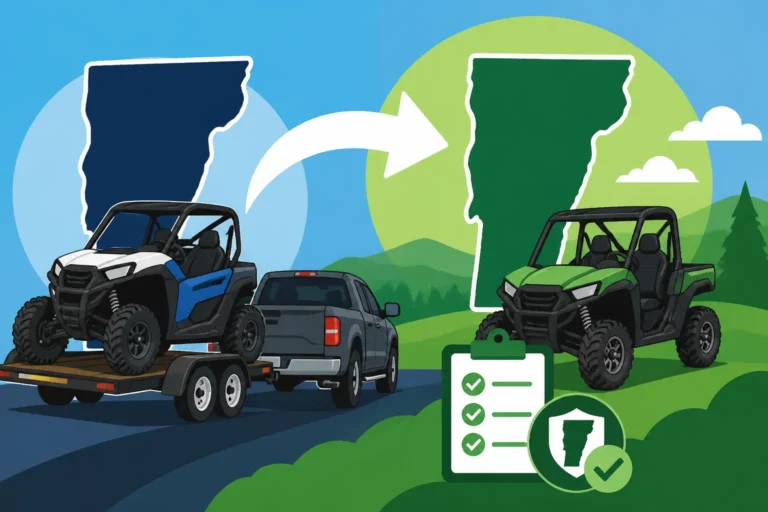
This is where things can get a bit more complex. If you're moving to Vermont and bringing your ATV with you, or if you purchased an ATV from a dealer or private seller in another state, you'll need to demonstrate what, if any, sales tax you paid in that state. Vermont offers a tax credit for sales tax paid to another state, up to the amount of Vermont's Purchase and Use Tax. For example, if you paid 6% sales tax in New York and Vermont's Purchase and Use Tax is 6%, you likely won't owe anything more in Vermont. If New York's tax was 4% and Vermont's is 6%, you'd owe the 2% difference.
To claim this credit, you absolutely must have official documentation showing the sales tax paid in the other state. This could be a sales invoice from a dealer with the tax clearly itemized, or a bill of sale from a private seller that explicitly states the sales tax collected and remitted (though private sellers rarely collect sales tax for the state). If you're relocating and already had the machine registered in your previous state, a copy of that state's registration certificate might also help, especially if it notes tax payment. Without this clear proof, Vermont will assume no tax has been paid and will charge you the full [Vermont Purchase and Use Tax Rate]. This situation is covered in detail in [Vermont Registration for a Machine Bought Out of State].
It's crucial that the documentation explicitly shows the amount of sales tax paid and to which state. Generic bills of sale simply stating "taxes included" might not be sufficient. If you're unsure, it's always best to contact the Vermont DMV beforehand or prepare to pay the Vermont tax. Sometimes, if the tax rate in the previous state was higher than Vermont's, you won't get a refund, but you won't owe anything further to Vermont. It’s all about credit for what’s already been paid, not necessarily matching the full amount.
Gifting or Inheriting a Machine
Receiving an ATV as a gift or through inheritance presents its own unique set of circumstances regarding the Purchase and Use Tax. Generally, bona fide gifts between immediate family members can be exempt from the Vermont Purchase and Use Tax. However, you'll still need proper documentation to prove it was a gift and to establish the machine's tax history.
For a gift, you'll need a signed affidavit or a gift letter from the donor clearly stating that the ATV was given as a gift, including the donor's relationship to you, the vehicle's details (VIN, make, model), and the date of the transfer. This document needs to be presented at the DMV. It's also helpful to have the donor's previous Vermont registration or title information, which can help the DMV verify that the Purchase and Use Tax was paid by a previous owner. If the machine has never been registered and is being gifted, the tax might still apply unless a specific exemption is met. You can find more information on [Vermont Purchase and Use Tax Exemptions].
For an inherited machine, you'll typically need a copy of the death certificate, the will (if applicable), and documents proving your legal right to inherit the vehicle. An executor's letter or a court order might be necessary. Again, the goal is to show a clear, legal transfer of ownership without a monetary transaction, and to demonstrate that the machine's Purchase and Use Tax was already handled by the deceased owner or a prior owner. In these scenarios, a clear chain of ownership and the non-commercial nature of the transfer are key. Using a template from a service like LawDepot for a gift affidavit can ensure all legal requirements are met.
Table: Common Scenarios and Required Proof for Vermont Purchase and Use Tax
| Scenario | Primary Proof Needed | Supporting Documents | Tax Implication |
|---|---|---|---|
| New ATV from VT Dealer | MCO / Dealer Invoice | Purchase Agreement, Sales Tax Receipt | Tax collected by dealer at sale. |
| New ATV from Out-of-State Dealer | MCO / Dealer Invoice showing sales tax paid | Purchase Agreement | VT credits out-of-state tax, may owe difference. |
| Used ATV from VT Private Seller | Detailed Bill of Sale | Previous VT Registration Certificate (if available) | Tax likely paid by prior owner; verify with DMV records. |
| Used ATV from Out-of-State Seller | Detailed Bill of Sale showing sales tax paid (rare) | Previous Out-of-State Registration/Title | VT credits out-of-state tax, may owe difference. |
| Gifted ATV (Family) | Gift Affidavit from donor | Donor's previous VT Registration/Title | Exempt if bona fide family gift and tax paid by prior owner. |
| Inherited ATV | Death Certificate, Will/Executor Letter | Deceased owner's VT Registration/Title | Exempt if legal inheritance and tax paid by prior owner. |
Navigating Issues When Proof is Difficult to Find
Sometimes, despite your best efforts, finding definitive proof of prior tax payment can feel like a scavenger hunt. Perhaps the previous owner is unreachable, the paperwork is long lost, or the machine simply has no clear paper trail. Don't fret just yet; Vermont's DMV has provisions for these situations, though they require a bit more effort on your part.
When Records Are Lost or Incomplete
It's a common story: you buy a sweet used ATV, the seller is a friend of a friend, and they swear up and down they paid taxes, but the bill of sale is just a quick scribble, or maybe they can't find their old registration. In these cases, your first step should always be to try and get a more complete bill of sale. If that's not possible, or if the machine came with absolutely no paperwork, you're not entirely out of luck, but you will need to prepare for extra steps.
The DMV may be able to help you look up the VIN (Vehicle Identification Number) in their system to see if the machine has any recorded history of registration or tax payment in Vermont. Having the VIN accurately transcribed is crucial for this. If the machine was never registered in Vermont, or if its history is too murky, then you'll likely be treated as the "first registrant" for tax purposes, meaning you'll need to pay the Purchase and Use Tax. This is often the case with older machines that were bought strictly for private land use before the owner decided to sell. While it’s not ideal to pay the tax if you suspect it’s already been covered, without concrete proof, the DMV has to operate on the assumption it hasn't.
It's always a good idea to bring any scrap of relevant information you have, no matter how minor it seems. Even an old insurance card or a repair bill with the VIN can sometimes help piece together a machine's history. The more information you can provide, the better equipped the DMV clerk will be to assist you in tracing the tax status. Remember, they want to help you register your machine, but they also have rules they must follow regarding tax collection.
Understanding the Ownership Affidavit
When you simply cannot produce a traditional bill of sale, title, or MCO to prove ownership and tax payment, the Vermont DMV may allow you to complete an Ownership Affidavit (Form VD-119). This is a sworn statement, made under penalty of perjury, declaring your ownership of the vehicle and explaining how you acquired it. While it primarily establishes ownership, it also has a section where you can declare whether any sales tax was paid.
This affidavit is typically used for older vehicles or those without clear titles, where the paper trail has simply vanished over time. However, using an ownership affidavit doesn't automatically exempt you from the Purchase and Use Tax. If you're using this document because you can't prove previous tax payment, the DMV will likely charge you the Purchase and Use Tax at the time of registration. The affidavit is more about establishing your legitimate claim to the vehicle itself, rather than proving tax history. For situations where you might need to go this route, [Filing an Ownership Affidavit at the Vermont DMV] can provide more guidance.
It’s important to be completely honest and accurate when filling out an ownership affidavit. Providing false information can lead to serious legal consequences. While a service like LawDepot offers generic affidavit forms, it's always best to use the specific Vermont DMV form (VD-119) and follow their instructions carefully. This document should be considered a last resort for proving ownership when conventional documents are unavailable, and it typically won't circumvent the Purchase and Use Tax unless clear evidence of prior payment is included or can be independently verified by the DMV.
Disclaimer
This article is for general informational purposes only and does not constitute professional advice. Laws, prices and regulations vary by location and change over time. Consult a qualified professional for guidance on your specific situation.