Vermont ATV Clubs Worth Joining
Vermont’s ATV trails can be confusing to plan: routes cross private land, conditions change, and the club that maintains a corridor may not be obvious from a map. Joining a local ATV club can help you understand where to ride, how access works, and how to support the people keeping trails open. Here’s how to find a good fit and what membership usually involves.
Why Vermont ATV clubs matter
Clubs help keep trail access working
Vermont’s riding network depends heavily on cooperation with private landowners. Clubs help maintain that relationship by working on designated corridors, communicating with landowners, posting signs, and encouraging riders to follow trail rules. In practical terms, a well-marked route and a passable bridge don’t appear by accident; volunteers and local organizers often help make them possible.
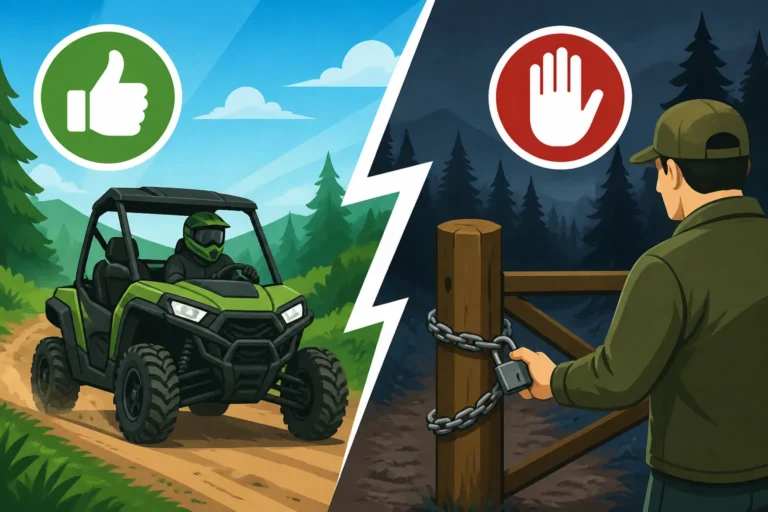
That work matters when a trail crosses a farm, timber property, or old road. A landowner may agree to allow use under particular conditions, and a club can help riders understand where the corridor goes and what behavior helps preserve access. Staying on the marked route, closing gates behind you, and respecting temporary closures are small actions that can make a real difference. For more on this shared responsibility, see [Vermont Landowner Permission Holds the System Together] and [Vermont Trail Etiquette on Private Land].
Clubs also give riders a local point of contact. If you’re visiting from outside the area, it can be hard to tell which tracks are open, which routes have changed, or where trail access begins. A nearby club may be able to point you toward the right map or explain how its corridors connect. It’s still important to confirm current access before you tow to a trailhead: landowner permission and trail conditions can change.
Membership is about more than getting out for a ride
Joining a club can be a way to support trail maintenance and learn from people who know the area. Depending on the club, members may receive updates, take part in meetings or work days, meet local riders, and find out how to volunteer. Those benefits vary, so ask each club what membership includes rather than assuming that every organization operates the same way. The guide to [Vermont Club Membership Benefits] offers a useful overview of what to ask about.
A club membership is not the same thing as permission to ride anywhere in Vermont. It doesn’t automatically open private land, create access to state land, or replace any registration or trail-access requirements that apply to your machine. Before riding, check the rules for the particular route and confirm you have the necessary documents and decals. [The Plate and the TAD Vermont Trails Require] explains why registration and trail access are separate pieces of the puzzle.
It can help to think of membership as a relationship with the local trail community, not a shortcut to unlimited access. You’re supporting the people who help care for routes, while also agreeing to follow the rules that protect them.
Vermont ATV clubs to explore
Tri-County ATV Club near Island Pond
Tri-County ATV Club is one name to look into if you’re interested in riding around Island Pond and the Northeast Kingdom. The area is known as an ATV destination, but don’t assume a trail is open simply because it appears on a general map or someone mentions it in a riding group. Confirm which club or organization maintains the route you plan to use and check for current notices before traveling.
If you’re new to the region, contacting the club can help you understand local trail access, where to find route information, and whether there are volunteer opportunities. It can also help you get a more realistic sense of a ride. A route that looks straightforward on a screen may involve narrow corridors, variable surfaces, or connections that require careful attention to signs.
For a visitor planning a weekend, it’s worth checking conditions before loading the machines. A washed-out culvert or a temporary closure can change the day’s plan, and a trailhead may not have the parking or services you expected. Use [Vermont Trail Conditions Before You Tow] as a reminder to check the practical details before you leave home.
Border Line Ridge Riders near Newport
Border Line Ridge Riders is another club to consider when exploring the Newport area. Riders looking for a local connection may find it useful to ask which corridors the club maintains, how it shares route updates, and what kind of participation it welcomes from new members.
The Newport area’s proximity to the Canadian border can make route planning especially important. A trail’s direction on a map does not by itself tell you whether it reaches a permitted crossing, remains open for the full length, or is intended for the machine you’re riding. Keep your plans within clearly authorized routes and check the club’s current information before heading out.
If you use a mapping app such as onX Offroad to plan, treat it as a planning aid rather than proof that a route is legally open. Compare what you see with current club information, posted signs, and any official access guidance. That extra check is especially useful when a ride includes several connecting corridors or unfamiliar trailheads.
Central Vermont ATV Club and West Rutland ATV Sportsman’s Club
The Central Vermont ATV Club and West Rutland ATV Sportsman’s Club are options to investigate if your riding plans are centered farther south or in central Vermont. Start by asking which communities and corridors each club currently serves. A club’s name can give you a regional clue, but the best source for its present trail area is the club itself.
For riders based near Barre, the Central Vermont ATV Club may be a natural organization to contact. For someone planning around West Rutland, the West Rutland ATV Sportsman’s Club may be a more relevant starting point. Those are starting points for research, not a guarantee that a particular trail or town route is open. Always confirm the exact corridor, access rules, and current conditions.
If your rides regularly cross between regions, you may need information from more than one club. The guide [Finding the VASA Club That Maintains Your Local Trail] can help you think through how to identify the organization connected to a route. For a broader look at club roles and maintenance, see [Vermont ATV Clubs and What They Maintain].
| Club to research | Area to ask about | Useful questions before joining |
|---|---|---|
| Tri-County ATV Club | Island Pond and the Northeast Kingdom | Which routes does the club maintain, and where are current updates posted? |
| Border Line Ridge Riders | Newport area | How should visitors confirm corridor access and border-area route information? |
| Central Vermont ATV Club | Central Vermont, including the Barre area | Which towns and trail corridors fall within the club’s current service area? |
| West Rutland ATV Sportsman’s Club | West Rutland area | What membership and volunteer options are available locally? |
How to choose the right club
Match the club to where you actually ride
The closest club by road mileage is not always the best fit. Consider where you ride most often, where you plan to ride this season, and whether your usual routes fall within the club’s area. If you’re choosing between two organizations, ask each one about its territory and the specific corridors you want to use.
A rider who lives near Barre but spends most weekends in the Northeast Kingdom may want to learn about clubs in both areas. A visitor planning a single trip should start with the club associated with the intended riding area, then check whether the club offers useful information for guests. Joining a club in one region does not necessarily provide access to routes maintained by another.
Look for clear, recent information about trail status and rider expectations. That might be posted through a club’s website, email, social channels, or another communication channel. If you use onX Offroad to sketch out a route, cross-check it with the club’s current guidance and the signs you encounter on the ground. No map app should override a posted closure or a landowner’s restriction.
Ask about membership, dues, and participation
Membership structures and costs can differ among clubs, so ask directly about current dues, renewal timing, and what membership supports. The overview [Vermont Club Membership Cost] can help frame the questions, but the club is the place to confirm its own terms. You can also ask whether membership is individual, family-based, or organized in another way.
Find out whether members are expected to volunteer or attend meetings, or whether those activities are simply encouraged. Some riders enjoy helping clear brush or support a work day; others have limited time and want to contribute through dues and responsible riding. It’s better to understand expectations at the start than to join with an assumption that doesn’t match the club’s approach.
Ask what benefits are practical for you. Does the club share trail notices? Are new members welcome at events? Is there a way to report a damaged sign or a problem on a corridor? You can learn more about the range of options in [Joining the Club Nearest You] and [Vermont Club Volunteer Work Days].
Joining and riding responsibly
Take these steps before your first club ride
Joining a club is usually straightforward, but it’s worth taking a few minutes to make sure you have the right information before planning a ride.
- Identify the riding area. Write down the towns, trailheads, or corridors you want to use. A general destination such as “the Northeast Kingdom” is a start, but a more specific plan makes it easier to find the relevant club.
- Confirm which club is connected to the route. Ask whether the club maintains or provides information for the corridors you’re considering. If your route crosses multiple club areas, check with each relevant organization.
- Ask about current membership details. Confirm dues, renewal arrangements, communications, and any volunteer expectations directly with the club.
- Check access requirements. Membership doesn’t replace machine registration, a required trail-access decal, safety requirements, insurance, or other rules that apply to you. Review [Vermont Registration Before Your First Ride] and confirm the trail-access requirements for the route.
- Review the map and conditions. Use a current club map or directions where available. If you use onX Offroad for route planning, compare it with the club’s information and obey signs and closures on the ground. [Reading a VASA Club Trail Map] has more on understanding trail maps.
- Prepare for the ride, not just the route. Check fuel, weather, parking, machine readiness, and what your group needs to carry. Let someone know your plan, especially if you’ll be riding in an area with limited cell service.
These steps help prevent a common frustration: towing a machine a long distance only to discover that the route is closed, the trailhead is unsuitable, or the group is missing a required item. A club can be a valuable source of local context, but riders still need to do their own pre-ride checks.
Be the kind of member landowners want on the trail
The habits that protect access are simple, though they take attention. Stay on marked corridors, follow posted speed and use rules, and don’t widen a muddy section by riding around it. If a gate is closed, don’t treat it as an invitation to find another way through. Respect private property and leave a site cleaner than you found it.
When you meet other trail users, slow down and give them room. A narrow corridor can bring riders, hikers, workers, and other users together unexpectedly. Keep noise under control near homes, and avoid behavior that creates a problem for the landowner or the people maintaining the route. These choices may feel small on one ride, but repeated courtesy helps support long-term access.
If you notice a damaged sign, blocked corridor, or hazard, contact the appropriate club or trail organization with a clear location and description. Avoid taking it upon yourself to move barriers or make repairs unless you have permission. Clubs can decide how to handle problems while respecting landowners and any relevant safety requirements.
A club membership is most valuable when it connects you with reliable local information and gives you a way to support responsible riding. Start with the area you know you’ll ride, ask specific questions, and verify access and conditions before every trip. Then treat the routes, signs, and landowners with care so the next ride—and the next rider—can benefit too.
Disclaimer
This article is for general informational purposes only and does not constitute professional advice. Laws, prices and regulations vary by location and change over time. Consult a qualified professional for guidance on your specific situation.