How to Register an ATV in Vermont
Navigating the ins and outs of registering an ATV or UTV in Vermont can feel like trying to find your way through a dense forest without a compass. Many riders get frustrated, unsure if their machine even needs registration, what paperwork they truly need, or where to even begin. This comprehensive guide is here to cut through the confusion, offering clear, step-by-step instructions and practical advice to help you get your off-road vehicle legally registered in the Green Mountain State.
Understanding Vermont's ATV Registration Requirements
Before you even think about hitting those beautiful Vermont trails or cruising permitted town roads, understanding the foundational rules for ATV and UTV registration is absolutely paramount. It’s not just a suggestion; it’s a legal necessity that ensures everyone's safety and keeps the trail system viable.
Do You Really Need to Register?
The short answer, for most riders, is a resounding "yes." If you plan to operate your All-Terrain Vehicle (ATV) or All-Situation Vehicle (ASV), which includes UTVs or side-by-sides, anywhere other than your own private property, it must be registered with the Vermont Department of Motor Vehicles (DMV). This isn't just about trail riding; it extends to crossing public roads, using designated town routes, or even riding on another person's private land with their permission if that land is part of the larger trail network. The state relies on registration fees to help maintain those very trails and support the infrastructure that makes riding possible. Skipping registration, even for a quick spin, can lead to fines and a lot of unnecessary hassle if you're caught. The peace of mind alone is worth the process.
What Vermont Considers an ATV and ASV
Vermont has specific definitions for what constitutes an ATV and an ASV, and these definitions directly impact how you register your machine and what fees you'll pay. Generally, an ATV (or quad) is a motorized vehicle designed to travel on four low-pressure tires, with a seat designed to be straddled by the operator, and handlebars for steering. It's meant for off-road use.
The ASV category is where most UTVs and side-by-sides fall. These are often wider, heavier, and typically have a steering wheel, foot pedals, and bucket or bench seating, much like a car, but designed for off-road terrain. Vermont has specific criteria, including maximum width and dry weight, that distinguish an ATV from an ASV. For instance, machines wider than a certain threshold or heavier than a specified weight are typically classified as ASVs. It's crucial to know which category your machine falls into because ASVs generally have a slightly higher registration fee than standard ATVs. For more detailed information on specific dimensions and weight limits, you'll want to review [Vermont's 72-Inch, 2,500-Pound ATV Definition]. Knowing this upfront can save you from filling out the wrong paperwork or paying an incorrect fee.
Residency and Non-Residency
Vermont welcomes riders from all over, but the registration rules apply universally. Whether you're a long-time Vermonter or visiting from out of state, if you want to ride an ATV or ASV on designated trails or roads, your machine needs a current Vermont registration. This means that even if your ATV is registered in New York, New Hampshire, or Quebec, you'll still need to register it in Vermont to ride here. The good news is that the process and the fees are generally the same for both residents and non-residents, so there isn't a separate, more complicated track for visitors. You're not alone if you're a visitor trying to figure this out; many people come to Vermont specifically for its incredible riding opportunities, so the DMV handles nonresident registrations regularly. You can find more specific details on this aspect by looking into [Vermont ATV Registration for Nonresidents]. Just ensure you're prepared with the necessary documentation, regardless of where your primary residence is.
Gathering Your Essential Paperwork and Information
The key to a smooth registration process in Vermont is being prepared. Nothing is more frustrating than making a trip to the DMV or mailing off your application, only to have it returned because you missed a crucial document or piece of information. Taking the time to gather everything beforehand will save you immense headaches down the road.
Proof of Ownership
This is perhaps the most critical piece of the puzzle. The Vermont DMV needs to know that you are the rightful owner of the ATV or ASV you're trying to register. What constitutes acceptable proof can vary depending on where and how you acquired your machine:
- Manufacturer's Statement of Origin (MSO) or Manufacturer's Certificate of Origin (MCO): If you bought a brand-new machine from a dealer, it will come with an MSO or MCO. This document essentially serves as the birth certificate for your ATV/ASV and is usually transferred directly from the dealer to you. The dealer often handles much of the initial paperwork, including the MCO, for you.
- Certificate of Title: For used machines, especially those bought from a private seller or an out-of-state dealer, a valid Certificate of Title from Vermont or another state is generally required. The title formally lists the legal owner. Ensure the title is properly signed over to you by the previous owner. If the previous owner never titled the machine, you might have extra steps. [Vermont Title for an Off-Road Vehicle] can provide more context here.
- Bill of Sale: While a bill of sale alone isn't always sufficient for proof of ownership for a vehicle that has been titled, it's absolutely essential for machines that are old enough not to require a title (usually pre-1999, but always verify current rules) or for private sales where a title might not have been issued. A comprehensive bill of sale should include:
- The full names and addresses of both buyer and seller.
- The make, model, year, and Vehicle Identification Number (VIN) of the ATV/ASV.
- The purchase price.
- The date of sale.
- Signatures of both buyer and seller.
A well-drafted bill of sale is your legal record of the transaction. If you're buying privately and the seller doesn't have a robust bill of sale ready, consider using a template from a service like LawDepot to ensure all necessary information is captured. This can prevent future headaches with the DMV. You can learn more about what the DMV looks for in a bill of sale by checking out [Writing a Bill of Sale the Vermont DMV Accepts].
- Ownership Affidavit: In rare cases where traditional proof of ownership is impossible to obtain (e.g., an inherited machine without a title or MCO, or a very old machine with lost paperwork), you might need to complete an Ownership Affidavit (form VD-119i or similar, depending on the situation). This is a sworn statement detailing how you acquired the machine. This is often a last resort and might require additional review by the DMV.
For a general overview of all acceptable documents, refer to [Proof of Ownership Vermont's DMV Will Accept].
The All-Important Application Form
The primary form you'll need to complete is Form VD-119, Vermont Application for Registration and Title. This form gathers all your personal information, details about your ATV/ASV, and your choices for registration duration. It's crucial to fill this out accurately and completely, paying close attention to every field.
- Owner Information: Your full legal name, address, date of birth, and contact information. If there are multiple owners, all information for each owner must be included.
- Vehicle Information: The make, model, year, VIN, engine size, fuel type, and current odometer reading (if applicable). Double-check the VIN; even one digit off can cause delays.
- Registration Period: You'll typically have the option to register for one year or two years. A two-year registration often offers a slight cost savings and reduces the frequency of renewals.
- Title Application: If your machine requires a Vermont title (most newer machines do), you'll also apply for that on the same form. There's an additional fee for the title.
- Signature: Don't forget to sign and date the application! An unsigned form will be rejected.
Take your time with [Filling Out Vermont's Form VD-119] and consult the instructions (often VD-119i) carefully.
Dealing with Purchase and Use Tax
Vermont levies a "Purchase and Use Tax" on most vehicles, including ATVs and ASVs, at the time of first registration in the state. This tax is similar to a sales tax and is calculated as a percentage of the purchase price or the current market value of the machine.
- When It's Due: This tax is typically paid when you first register the machine in Vermont, even if you bought it out of state. If you paid sales tax in another state with a lower rate than Vermont's, you might owe the difference.
- How It's Calculated: The tax is a percentage of the sale price. Be honest about the purchase price on your bill of sale, as the DMV can challenge unusually low stated prices for newer machines.
- Exemptions: There are certain exemptions to the Purchase and Use Tax. For instance, if the ATV/ASV was a genuine gift (not a sale disguised as a gift), or if it was inherited, you might be exempt. Family transfers can also sometimes qualify for exemptions. You'll usually need to complete an affidavit or a specific form to claim an exemption. Understanding [Vermont Purchase and Use Tax Exemptions] is key if you believe you qualify.
- Proving Prior Payment: If you bought the machine from a Vermont dealer, they would have collected the tax, and you'll have proof of payment. If you bought it in another state and paid sales tax there, bring proof of that payment to the Vermont DMV to potentially receive a credit.
Always be prepared to pay this tax unless you have clear documentation for an exemption. For more information, see [Vermont Purchase and Use Tax on an ATV].
Proof of Insurance
Another non-negotiable requirement for registering an ATV or ASV in Vermont is proof of liability insurance. This isn't just a suggestion; it's the law. Your policy must meet Vermont's minimum liability coverage requirements, which typically involve specific amounts for bodily injury per person, bodily injury per accident, and property damage.
- Minimum Coverage: While the exact numbers can change, generally you'll need at least $25,000 for bodily injury to one person, $50,000 for bodily injury to two or more people, and $10,000 for property damage. Always verify the most current minimums with the Vermont DMV or your insurance provider.
- What to Bring: You'll need to provide your insurance company's name, your policy number, and the policy's effective and expiration dates on the VD-119 form. While you might not need to show the actual insurance card at the time of initial registration, having it handy (or a printout of your policy declaration page) is always a good idea. The DMV clerk may ask for it.
- Why It's Essential: This insurance protects you and others in case of an accident. Riding uninsured carries significant legal and financial risks. [Vermont Requires ATV Liability Insurance] goes into more detail about these critical requirements.
Make sure your insurance policy specifically covers your ATV or ASV. Some general vehicle policies may not extend to off-road vehicles.
Navigating the Registration Process Step-by-Step
Once you've diligently gathered all your paperwork, the next step is to submit your application. Vermont offers a few different avenues for this, each with its own advantages.
Where to Go: Mail, In-Person, or Online
Choosing how to submit your application can depend on your preference for speed, convenience, and whether you anticipate needing direct assistance.
- In-Person at a DMV Office: This is often the quickest way to get your registration processed and walk out with your new plate and temporary registration. It allows you to address any issues or missing information on the spot with a DMV clerk. You can find DMV offices throughout Vermont, from Newport to Rutland to Bennington. Be sure to check office hours and consider making an appointment, especially during peak seasons, to minimize wait times. This is the best option if you have complex ownership issues or are unsure about any part of your paperwork.
- By Mail: If you're not in a hurry, mailing your completed application, proof of ownership, and payment is a convenient option. Just make sure to send copies of important documents and retain the originals. Enclose a check or money order for the total fees. Be aware that processing by mail can take several weeks, so plan accordingly if you want to ride soon. The DMV will mail your plate and registration documents to you. For a deeper dive into the pros and cons, see [Registering by Mail Versus in Person].
- Online (Limited): While some registration renewals can be done online, initial ATV/ASV registrations with new titles often require in-person or mail submission because original documents (like MSOs or signed titles) need to be physically presented or reviewed. Always check the Vermont DMV website for the most current options available for initial registrations.
Fees and Payment
Registering an ATV or ASV in Vermont involves a few different fees. These are subject to change, so always verify the latest amounts on the official Vermont DMV website, but generally, you can expect the following:
- Registration Fee:
- ATV (Quad): This is the base fee. You typically have an option for a one-year registration or a two-year registration. For example, a one-year fee might be around [The $45 One-Year Fee], while a two-year option could be close to [The $90 Two-Year Fee]. Buying the two-year period upfront can often save you a little money compared to two separate one-year renewals.
- ASV (Side-by-Side/UTV): ASVs generally have a slightly higher registration fee than ATVs due to their classification. For instance, a one-year ASV registration might be around $108, and a two-year around $211.
- Title Fee: If your machine requires a Vermont title (most new and newer used machines do), there will be an additional fee for processing the title application. This is typically a flat fee, often around [The $27 Title Fee].
- Purchase and Use Tax: As discussed earlier, this tax is based on the sale price of your machine and is paid at the time of registration, unless an exemption applies.
- Payment Methods: When submitting in person, you can usually pay with cash, check, money order, or credit/debit card. For mail-in applications, checks or money orders are the standard.
It's a good practice to total up all your estimated fees beforehand to ensure you have the correct amount, especially for mail-in applications. Details on the full cost breakdown can be found at [Vermont ATV Registration Costs and Terms].
What Happens Next: Plates and Paperwork
Once your application is successfully processed, the Vermont DMV will issue you your official registration documents and an ATV/ASV registration plate.
- Registration Certificate: This is a paper document that serves as your proof of registration. It will list your name, the machine's details, and the expiration date of your registration. Always keep this document with you or on your machine when riding.
- Title (if applicable): If you applied for a title, it will be mailed to you separately from your registration certificate and plate. Keep this in a safe place, as you'll need it when you eventually sell the machine.
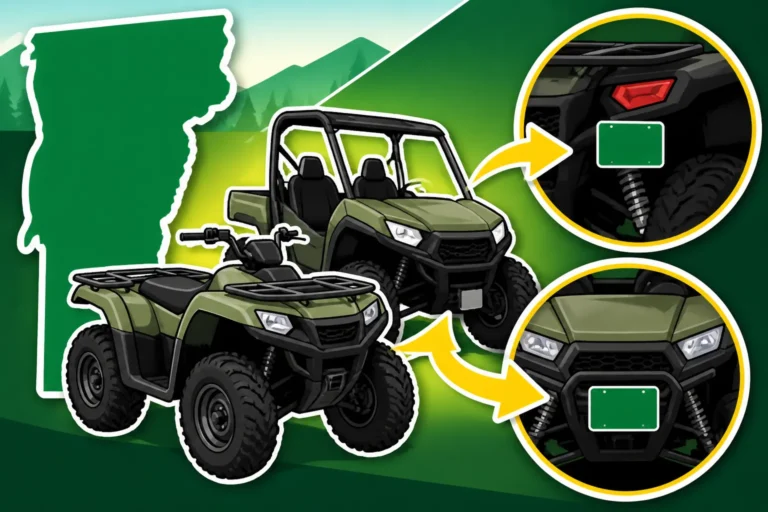
- ATV/ASV Plate: You will receive a small, distinct license plate specifically for your ATV or ASV. Vermont law requires this plate to be securely mounted on the rear of your machine, visible and legible at all times. Failure to display it properly can result in a ticket. For guidance on placement, check [Vermont ATV Plates and Where They Go].
Remember, having your physical plate and registration certificate means you're good to go legally, at least concerning state registration. Don't forget that a Trail Access Decal (TAD) from the Vermont Association of Snow Travelers (VASA) is also required for riding on the VASA trail system.
Special Circumstances and Common Hurdles
While the basic process is straightforward, sometimes you encounter situations that throw a wrench in the works. Vermont's DMV has procedures for many common "what-if" scenarios, and knowing about them can save you a lot of grief.
Registering a Machine Bought Out-of-State
Many riders find a great deal on an ATV or UTV just over the border in New Hampshire or New York, or even further afield. Bringing that machine into Vermont to register requires a few extra considerations, but it's a very common scenario.
- Proof of Ownership: You'll need the original Certificate of Title (if the other state titles ATVs/ASVs) or an MSO/MCO from the dealer. Ensure it's properly signed over to you.
- Bill of Sale: A comprehensive bill of sale is crucial, especially if no title was issued in the selling state. Make sure it contains all the details discussed earlier, including the VIN, sale price, and buyer/seller information. Using a reliable template from a service like LawDepot can ensure you have all the necessary legal clauses for your purchase.
- Out-of-State Sales Tax Credit: If you paid sales tax in the state where you purchased the machine, bring proof of that payment (usually noted on the bill of sale or dealer invoice). Vermont will typically give you a credit for the tax paid, meaning you'll only owe the difference if Vermont's rate is higher, or nothing if the rates are similar or lower. Without proof, you'll be charged Vermont's full Purchase and Use Tax.
- Emissions and Inspections: Unlike cars, ATVs and ASVs generally don't have emissions testing or annual safety inspections as a prerequisite for registration in Vermont. However, the machine must meet Vermont's definition of an ATV or ASV to be registered as such.
The process for [Vermont Registration for a Machine Bought Out of State] is well-trodden, but careful attention to your paperwork is key.
Registering an Inherited or Gifted ATV
Receiving an ATV as a gift or inheriting one after a loved one passes away are wonderful, but they present unique challenges when it comes to registration and the Purchase and Use Tax.
- Gifted Machines: If an ATV/ASV is truly a gift (meaning no money or services exchanged hands), you may be exempt from the Purchase and Use Tax. However, you'll need to clearly document this with the DMV. This typically involves an affidavit or a specific gift transfer form signed by both the donor and the recipient, stating that it was a bona fide gift. A standard bill of sale noting a "gift" value or "zero" purchase price may not be enough on its own; sometimes a notarized statement is required. The DMV is vigilant about preventing people from fraudulently claiming "gift" status to avoid paying tax. For specific guidance on this, look into [Gift Transfers Between Family].
- Inherited Machines: When an ATV/ASV is inherited, the process depends on whether the estate went through probate and whether the deceased owner had a title.
- Probate: If the estate went through probate, you'll usually need a court order or executor's letter stating that you are the rightful recipient of the vehicle.
- No Probate: If the estate was small and didn't go through formal probate, you might need to present the death certificate, the previous owner's title (if available), and an affidavit of heirship, signed by all legal heirs, relinquishing their claim to the ATV/ASV. The DMV has specific forms for this.
There is usually an exemption for the Purchase and Use Tax on inherited vehicles. Navigating [Vermont Registration for an Inherited ATV] can be complex, so gathering all death certificates, wills, or probate documents is essential.
In both gift and inheritance scenarios, clear documentation is your best friend. The more details you can provide, the smoother the process will be.
When You Don't Have a Title
It's not uncommon to buy an older ATV or ASV, especially in a private sale, only to find out the previous owner never had a title, or the title is lost. This can be a sticky situation, but it's not always a deal-breaker.
- Vermont's Titling Requirements: Historically, Vermont did not title all ATVs, especially older models. Currently, most newer ATVs and ASVs require a title. If your machine is very old (e.g., pre-1999), it might fall into a category that never required a title in Vermont. In such cases, a complete bill of sale, perhaps notarized, might suffice as proof of ownership.
- Ownership Affidavit: If your machine should have a title but doesn't, and you can't get one from the previous owner (e.g., they lost it, or it was never transferred properly), you might need to apply for a bonded title or file an Ownership Affidavit. This usually involves signing a sworn statement that you own the vehicle and explaining how you acquired it. The DMV might require you to advertise your ownership in a local newspaper to ensure no other claims exist.
- Consult the DMV: If you are in this situation, your best first step is to contact the Vermont DMV directly to explain your specific circumstances. They can guide you on the exact forms and procedures needed, which might include completing a specific affidavit (like form VD-119i instructions) or even obtaining a surety bond. It's a more involved process than a standard registration, but it's often doable. For more on this, see [Vermont Registration Without a Bill of Sale].
Here's a quick look at the documents you'll typically need for registration, depending on how you acquired your machine:
| Acquisition Method | Primary Proof of Ownership | Additional Documents Often Needed | Tax Implications (Generally) |
|---|---|---|---|
| New from Dealer | Manufacturer's Statement/Certificate of Origin (MSO/MCO) | Dealer Invoice, Form VD-119, Proof of Insurance | Purchase and Use Tax (collected by dealer) |
| Used from Dealer (VT) | VT Title (signed over) | Dealer Invoice, Form VD-119, Proof of Insurance | Purchase and Use Tax (collected by dealer) |
| Used from Dealer (Out-of-State) | Out-of-State Title or MSO/MCO | Dealer Invoice, Form VD-119, Proof of Insurance, Proof of Out-of-State Sales Tax | Purchase and Use Tax (owed if not paid/credit) |
| Private Sale (with VT Title) | VT Title (properly signed over by seller) | Bill of Sale (recommended), Form VD-119, Proof of Insurance | Purchase and Use Tax (paid to DMV) |
| Private Sale (no VT Title, older machine) | Comprehensive Bill of Sale | Form VD-119, Proof of Insurance, possibly Ownership Affidavit | Purchase and Use Tax (paid to DMV) |
| Gift from Family | Previous Title (if applicable) | Gift Affidavit/Statement, Form VD-119, Proof of Insurance | Tax Exempt (with proper documentation) |
| Inherited | Death Certificate, Will/Probate Documents, Previous Title (if any) | Heirship Affidavit (if no probate), Form VD-119, Proof of Insurance | Tax Exempt (with proper documentation) |
| Lost/Missing Title | Comprehensive Bill of Sale, VIN | Ownership Affidavit, Form VD-119, Proof of Insurance (DMV guidance needed) | Purchase and Use Tax (paid to DMV) |
Remember, while this table provides a general overview, specific situations can always require additional documentation or different steps. It's always a good idea to double-check with the Vermont DMV for the most up-to-date and specific requirements for your unique scenario.
Successfully registering your ATV or UTV in Vermont isn't just about following rules; it's about being a responsible rider and ensuring you can enjoy the fantastic trails and routes the state has to offer without worry. With your machine properly registered, titled, and insured, you're all set to explore.
Disclaimer
This article is for general informational purposes only and does not constitute professional advice. Laws, prices and regulations vary by location and change over time. Consult a qualified professional for guidance on your specific situation.