Vermont Lodging That Welcomes Machines
Finding Vermont lodging that welcomes ATV and UTV riders takes more than spotting a cabin near a trail on a map. You also need to confirm that the property accepts machines and trailers, offers suitable parking, and fits the routes you’re allowed to ride. This guide explains what to ask, where to start looking, and how to plan a stay without assuming trail access comes with the room.
What machine-friendly lodging should provide
“Welcomes machines” can mean different things from one property to another. An owner might be happy to host riders but have nowhere for a trailer, or allow trailers but not permit machines to be unloaded on the grounds. Confirm the practical details before you book, especially if you’re traveling with a group or arriving after a long tow.
Check parking, unloading, and storage
Start with the space you need. A pickup and a trailer take up considerably more room than a car, and a group traveling with several machines may need more than one parking area. Ask whether the property can accommodate your vehicle and trailer together, whether there is room to turn around, and whether the parking surface is firm enough for the equipment you’re towing.
Then ask exactly where you can unload and park the machines. Some properties may allow machines to be stored on a trailer but not ridden around the grounds. Others may have a designated area or a garage, but those arrangements should never be assumed. If you’re carrying helmets, riding gear, tools, or spare parts, ask whether there’s a dry place to keep them overnight.
Security matters, too. Find out whether parking is in a well-lit or visible area, whether a trailer can be locked to a vehicle or fixed point, and whether the property has rules about leaving equipment outside. These questions are especially worthwhile when you’re staying multiple nights or carrying expensive gear.
Ask about the route from the property to a legal riding area
A property can be close to a trail on a map without having a legal connection to it. In Vermont, many ATV trails cross private land, and trail access depends on permissions, club rules, and designated routes. A nearby road is not automatically open to ATVs, either. Town decisions determine whether particular roads are open, and those designations can change.
Ask the lodging host whether riders may leave the property on their machines and, if so, where the approved route begins. Request the name of the trailhead or corridor rather than relying on a vague description such as “the trail is just up the road.” Then check the route with the relevant club and current trail information before unloading.
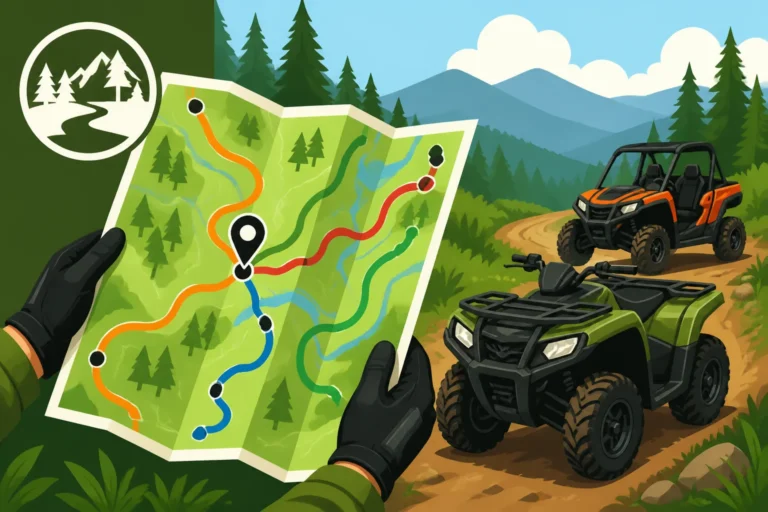
A map app can help you understand the area, but a line on a screen is not proof that a route is open or that you have permission to use it. onX Offroad may be useful for planning and orienting yourself, but confirm trail status and access with the responsible local club. For broader route-planning context, see [Vermont Trails Connected by Town Roads] and [Reading a VASA Club Trail Map].
Use this lodging checklist before you reserve
A quick conversation can prevent a frustrating arrival. Rather than asking only, “Are ATVs welcome?”, describe your setup and ask about the exact details that affect your stay.
| What to confirm | Why it matters | A useful question |
|---|---|---|
| Trailer parking | A trailer may need more room than the lodging’s regular parking area | “Can I park my truck and trailer together, and how much turning space is available?” |
| Unloading location | Permission to park does not necessarily mean permission to unload or ride on the grounds | “Where may we unload and store the machines?” |
| Overnight security | Machines and gear may be left outside for several nights | “Is there a secure or well-lit place to keep the equipment?” |
| Trail access | Nearby routes may be private, closed, or not legally connected to the property | “What approved route or trailhead should we use?” |
| Decals and registration | Riding a Vermont trail system may require more than lodging permission | “What registration, decal, or club requirements should visiting riders check?” |
| Quiet hours | Machine noise can affect other guests and nearby residents | “Are there specific hours when machines must be off the property?” |
| Group size | Parking, room arrangements, and local rules may limit how many riders a property can host | “Can you accommodate our group and the number of machines and trailers we’re bringing?” |
Get important details in writing when possible. A short email confirming parking, unloading, and any trail directions gives you something reliable to refer to if the person you spoke with is not on site when you arrive.
Where to look for a Vermont riding stay
Your best lodging base depends on the riding area you plan to use, not simply on which town has the most visible accommodation listings. In the Northeast Kingdom, Island Pond, Newport, and Derby can make useful starting points for researching nearby lodging and club corridors. Elsewhere, riders may be planning around Central Vermont, Rutland County, or another local club’s system.
Before booking, identify the area where you expect to ride and contact the club that maintains the relevant trails. That conversation can help you distinguish a convenient base from a place that only appears close on a general map. For regional context, explore [Vermont Riding in Island Pond] and [Newport as a Riding Base].
Choose a base around the ride you actually want
If your group wants several days on connected trails, lodging near the intended riding area may reduce towing and daily setup. That convenience still depends on access: the machine may need to be transported to a trailhead, and a town road between lodging and the trail might not be open to ATV use. Treat “near the trail” as a starting point for questions, not a guarantee of ride-in access.
For a first visit, choosing one manageable area can make the trip easier. You can spend less time moving equipment between towns and more time learning the corridor system, checking signs, and following current club guidance. If you’re considering a stay around the Northeast Kingdom, [Northeast Kingdom ATV Riding in Vermont] offers useful regional context; for a different kind of base, [Barre as a Riding Base] may help with Central Vermont planning.
Compare lodging styles with your equipment in mind
Cabins can appeal to riders looking for a private place to relax after a day out, but check driveway width, trailer access, and the rules for keeping machines on the property. A narrow gravel lane, steep approach, or limited turnaround can be a bigger problem than the distance to town. Review [Vermont Cabins Near the Trail] as you compare the type of stay you want, then confirm the property’s specific machine policies directly.
Campgrounds and RV properties may have more room for tow vehicles, but capacity, surface conditions, hookups, quiet hours, and machine rules vary. A campground that accommodates a trailer may still restrict unloading or riding around the grounds. For a tent or RV trip, ask whether the site is level enough for your setup and whether there is a separate place to park the trailer.
Inns, motels, and other conventional lodging may work well if they have adequate parking and clear rules for trailers. Do not assume that a large parking lot means the property can store several machines or accept a group with multiple rigs. If you’re comparing options, [Vermont ATV Camping With Trail Access] can help you think through the camping angle, while direct calls to each property will answer the details that listings often leave out.
Build in a backup plan
Trail access and property arrangements can be affected by weather, seasonal closures, road conditions, or a landowner’s decision to withdraw permission. Before traveling, check trail conditions with the local club and confirm that your lodging still expects your trailer and machines. Leave time for a backup plan, such as towing to a permitted trailhead rather than riding directly from the property.
It’s also useful to identify nearby fuel, food, and repair options before the ride. Don’t assume a machine-friendly lodging property can provide mechanical help, fuel, or transportation. Plan your route and daily range around what you can verify, and save the property’s phone number and the club’s contact details somewhere you can access without mobile service.
Handle trail access, decals, and local rules
Lodging permission and trail permission are separate things. A host can agree to let you park a machine, but that does not authorize you to ride across neighboring land, use a closed trail, or take an unapproved town road. Responsible planning means checking the requirements for your machine and rider, as well as the access rules for the specific route.
Confirm what visiting riders need
Before leaving home, check the registration and trail-access requirements that apply to your machine. Visiting riders should not assume an out-of-state registration alone covers every requirement for riding Vermont trails. Review [Vermont Reciprocity for Out-of-State Machines] and [Vermont TAD for a Visitor's Machine] well before your trip so you have time to arrange anything needed.
Also make sure the machine is properly identified and that you can carry the required proof while riding. Requirements can depend on the machine, where you ride, and the applicable rules. If you are unsure whether your ATV or side-by-side falls into a particular category, check the relevant Vermont guidance rather than guessing based on its size or how you use it.
Riders traveling with children should check training and supervision rules in advance. Helmets, passenger seating, and other safety requirements are also important parts of trip planning. A group can lose valuable riding time if one person arrives without required documentation or equipment, so make a checklist for everyone rather than relying on the most experienced rider to remember it all.
Keep routes and permissions straight
Use official signs and club information to stay on permitted corridors. Trails may pass through working farms, timber land, or private property, and access depends on landowner cooperation. Stay on the marked route, close gates as directed, and do not create a shortcut around a wet or closed section. [Vermont Trail Etiquette on Private Land] explains why small choices by riders can affect access for everyone.
When using a mapping tool such as onX Offroad, treat it as a planning aid, not a substitute for current local information. Check whether the trail is open, whether the route is approved for your type of machine, and whether it connects legally to the place you’re staying. A road shown on a map may be private, closed to ATVs, or subject to a town restriction.
It is sensible to carry a second way to check essential information. Save directions and contact details before you leave lodging, especially in areas where cell service may be limited. If you encounter a closure or an unclear intersection, stop and verify the route rather than following another rider onto an unmarked path.
Respect the property and the neighborhood
Keep machines off lawns, garden areas, and unapproved access roads. Follow the host’s instructions for where to park and when to start or return. A property may welcome riders while still needing quiet evenings for other guests and nearby residents. If the lodging has a posted quiet period, plan fueling, loading, and gear preparation so they do not create unnecessary noise during those hours.
Clean mud and debris from machines in a place where the host permits it. Do not wash a vehicle near a storm drain, stream, or sensitive area unless the property explicitly provides an appropriate wash space. Ask before using outdoor hoses, electrical outlets, or garages. These may seem like small courtesies, but they make it more likely that the property will continue hosting riders.
If you’re arriving with a large group, agree on a few basic expectations before the trip: no riding around the lodging grounds unless expressly allowed, no revving engines late at night, and no opening gates or crossing fields without permission. Respectful behavior helps protect the relationships between riders, lodging owners, and Vermont landowners.
Plan a smoother stay from booking to checkout
A little preparation reduces the risk of arriving with a trailer and discovering that the driveway is too tight or the route you expected to ride is not open. Make one person responsible for confirming lodging details and another for checking trail information, or use a shared checklist if the group is large.
Ask the right questions when you call
Be specific about what you’re bringing. A helpful opening might be: “We’re traveling with two side-by-sides, a truck, and a trailer. Can you confirm where we can park, whether we may unload, and whether there is a permitted route from your property to a trailhead?” That gives the host a clear picture and is more useful than asking whether the property is generally ATV-friendly.
Follow up with questions about surface and access. Is the driveway paved, gravel, steep, or narrow? Is there room for a trailer to turn around without backing into traffic? If the property is on a road, are guests allowed to ride there, or should machines be transported to a designated staging point? If you are unsure, ask the host to describe the route and then verify it with the local club.
If a host says “you can ride right from here,” ask where that access begins and whether it applies to your planned dates and machine type. The phrase may refer to a nearby trailhead rather than a legal route from the property. A polite follow-up protects both you and the host from a misunderstanding.
Prepare for arrival and the return trip
Pack the documents and essentials you may need on the trail: registration information, any required decal or access proof, safety gear, a first-aid kit, basic tools, and a way to contact your group. Check your machine before loading it, and make sure the trailer and tie-downs are ready for the trip home. A problem discovered in a lodging parking lot is much easier to deal with before checkout morning.
On arrival, confirm where the host wants vehicles and machines parked. Walk the area before unloading if there is any uncertainty, and avoid blocking other guests or access for emergency vehicles. If the property’s instructions differ from what you understood during booking, pause and clarify rather than assuming the original arrangement still applies.
Before departure, remove mud and gear from the area, check that nothing has been left behind, and secure the machines for transport. Let the host know about any access issue or damage promptly. Thoughtful communication helps the next group of riders have a smoother stay, too.
Disclaimer
This article is for general informational purposes only and does not constitute professional advice. Laws, prices and regulations vary by location and change over time. Consult a qualified professional for guidance on your specific situation.