Vermont Black Bear Encounters While Riding
A black bear stepping onto a Vermont ATV trail can turn a relaxed ride into a tense few seconds, especially when the group is spread out or the trail bends out of sight. The safest response is to slow down, give the animal room, and leave it an open escape route. This guide explains how to prepare for an encounter and what to do if one happens.
Prepare for bears before you ride
Expect wildlife without treating every trail as a bear sighting
Black bears live across Vermont, in forested areas from the Northeast Kingdom to the Green Mountains. A ride near Island Pond, Brighton, or Newport may pass through woods, brush, and other habitat where wildlife can move unseen. That does not mean you should expect to meet a bear on every trip. It does mean it is sensible to ride with your attention on the trail rather than assuming the next bend is clear.
Bears often try to avoid people. The noise of an ATV may alert one to your presence before you see it, but dense vegetation, curves, and changing wind can limit what either you or the animal notices. Keep speeds appropriate for visibility and trail conditions, and avoid riding so close together that the person in front cannot signal a hazard to the rest of the group.
A bear sighting is also a reminder to respect where you are riding. Many Vermont corridors cross private land, and access depends on following the marked route and any posted instructions. Review [Vermont ATV Trail Etiquette on Private Land] and check [Vermont Trail Conditions Before You Tow] before heading out. A trail that appears on a screen or map is not, by itself, proof that it is open.
Plan the route and carry essentials thoughtfully
Know where your group is going, how to return, and what to do if someone becomes separated. Use current information from the club or trail manager responsible for the corridor, and keep a paper or offline navigation option if cell service drops. In the Northeast Kingdom, for example, signal can be limited in remote areas; [Cell Dead Zones in the Kingdom] is a useful reminder to plan before you leave coverage.
Navigation tools such as onX Offroad can help riders orient themselves, but use them alongside local trail information and posted signs. Conditions and access can change, so do not assume an app alone confirms a corridor is open. Check the map before you set out, and tell someone who is not riding with you where you plan to go and when you expect to return.
Pack water, a basic first-aid kit, a charged phone, and weather-appropriate layers. If you carry bear spray, keep it readily accessible and learn how to use it before the ride; a can buried in a cargo box is unlikely to help in a fast-moving situation. Bear spray is a backup, not a reason to approach wildlife. For a broader packing checklist, see [Packing for a Full Day Out] and [First Aid Worth Carrying].
What to do when you see a bear
Stop, stay calm, and give it space
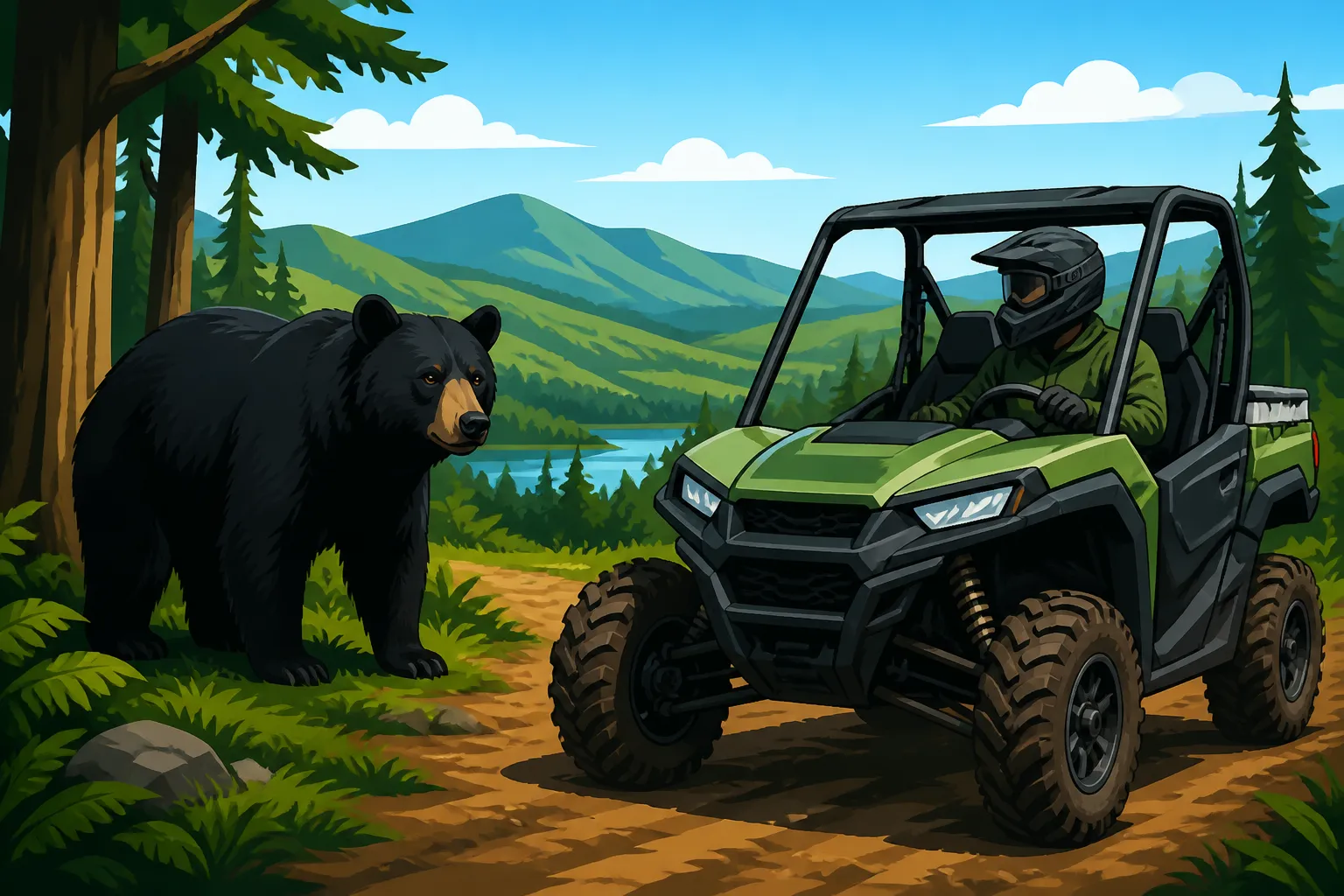
If a bear appears ahead, ease off the throttle and stop at a safe distance. Keep the machine pointed in a direction that allows you to leave without having to drive toward the animal. Do not crowd it, try to pass close by, or use the ATV to push it off the trail. Give the bear time and room to move away on its own.
Tell the rest of your group to stop too. A second rider suddenly coming around a bend can surprise both the bear and the people in front. Speak in a calm, firm voice so the animal can identify you as human. Do not scream, rev repeatedly, or make sudden movements. If the bear looks toward you, that does not automatically mean it is about to charge; keep watching its behavior while maintaining distance.
If it moves away, wait until it has gone and you can see a clear route before continuing. If it stays near the trail, turn back slowly or wait from a safe distance rather than trying to squeeze past. Do not chase it for a photo, follow it into the woods, or stop in a place that blocks its escape.
Read the situation without overinterpreting it
A bear standing on its hind legs may be trying to get a better look or smell, not necessarily preparing to attack. Huffs, jaw popping, or a short movement toward you can be signs the animal is uncomfortable and wants more space. Treat any close approach seriously, but do not respond by accelerating toward it or making a sudden dash past.
| What you notice | Safer response |
|---|---|
| Bear is on the trail at a distance | Stop, stay together, speak calmly, and give it time to leave |
| Bear moves into the brush | Wait until the route is clearly open, then continue slowly |
| Bear remains near the route | Back away or turn around; do not try to pass close |
| Bear appears agitated or approaches | Stay calm, keep the group together, and increase distance if possible |
| Bear is with cubs | Do not approach or get between them; retreat and leave the area |
| Bear makes contact or attacks | Fight back; do not play dead when dealing with a black bear |
Use the table as a guide, not as a substitute for judgment. The terrain, distance, and animal’s behavior all matter. If you are unsure whether the bear has left the corridor, choose the more cautious option and give it additional time.
Special situations that need extra care
A bear with cubs or a bear near food
If you see cubs, assume the adult bear may be nearby even if you cannot see it. Never move closer to get a better look, and do not position yourself between the cubs and the adult. Back away slowly, keep the group together, and leave the area using the route that gives the bears the most room.
A bear lingering near a trailhead, campsite, or vehicle may have found food or a strong food smell. Do not approach it to recover a cooler or bag. Leave the area and contact the appropriate local authority or land manager when it is safe to do so. Feeding bears—intentionally or through careless storage—can draw them toward people and make future encounters more likely.
Keep snacks, rubbish, and scented items secured. Do not leave food in an open trailer or unattended at a staging area. If you are stopping for a break, take your rubbish with you and avoid leaving food scraps behind. A quick snack stop can become an avoidable wildlife problem if wrappers or leftovers are abandoned.
If a bear approaches or an attack occurs
If a bear approaches, do not run. Running can trigger pursuit, and an ATV is not a reliable escape plan on a narrow, rough, or unfamiliar trail. Keep the group together, speak firmly, and slowly increase distance when you can do so without moving toward the animal. If you have bear spray, use it only as directed on its label and when the bear is within the effective range specified by the product.
Black bear behavior can vary, so there is no single gesture that guarantees an encounter will end safely. If the bear makes contact or attacks, fight back rather than playing dead. Use whatever is immediately available to defend yourself, focusing on creating an opportunity to get away. If someone is injured, move to a safer location if possible and seek emergency help.
After a close or aggressive encounter, do not ride back toward the same spot to investigate. Record the location as accurately as you can once you are safe, and report the incident to the appropriate local authority, wildlife office, or land manager. If you need to describe the route, a saved map or a location note from onX Offroad may help your group communicate where the encounter happened. Do not post a precise location publicly if doing so could encourage others to approach the animal.
Reduce the chance of a stressful encounter
Ride with awareness and keep the group coordinated
Leave enough space between machines for riders to react to a stopped vehicle or wildlife ahead. Agree on a simple signal for “stop” before the ride, and make sure the last rider knows the group has paused. If someone spots a bear, the first priority is stopping safely—not reaching for a camera or trying to guide the animal toward a clearer view.
Be especially attentive where visibility is limited by vegetation, a sharp turn, a hill, or a narrow corridor. Slow down before blind corners rather than braking hard at the last moment. Keep the machine on the marked route, and avoid driving into brush to go around a bear. Local signs and closures matter; [Vermont Trail Signs and What They Mean] can help riders understand why staying on the designated corridor is part of responsible riding.
Use navigation as a backup rather than an excuse to take an unmarked shortcut. onX Offroad can be one part of a rider’s route-planning setup, but check it against information from the relevant club or land manager. The same is true of printed maps and other apps: confirm access and conditions before you go, then follow posted instructions on the ground. You can also review [Vermont ATV Trail Map Downloads] and [Vermont Landowner Permission Holds the System Together] when planning a ride.
Keep wildlife encounters from becoming a group problem
Before the ride, decide who will communicate with a trail manager or local authorities if the group encounters an injured animal, a bear that repeatedly approaches people, or a route obstruction. Do not assume another rider has already made the report. When you do report an incident, stick to useful details: approximate location, time, number of animals, their direction of travel, and whether anyone was injured.
Afterward, talk through what happened. Was the group moving too quickly for the sightline? Did riders know the stop signal? Was food left out at a break? A short, honest review can make the next ride safer without turning a normal wildlife sighting into a reason to panic.
Above all, treat the bear as a wild animal that needs distance, not as a roadside attraction. Stop, stay together, give it an exit, and turn around when the route does not feel safe. That approach protects riders, helps prevent the animal from becoming habituated to people, and keeps the corridor more welcoming for everyone who shares it.
Disclaimer
This article is for general informational purposes only and does not constitute professional advice. Laws, prices and regulations vary by location and change over time. Consult a qualified professional for guidance on your specific situation.