Vermont Riding in Spring Mud
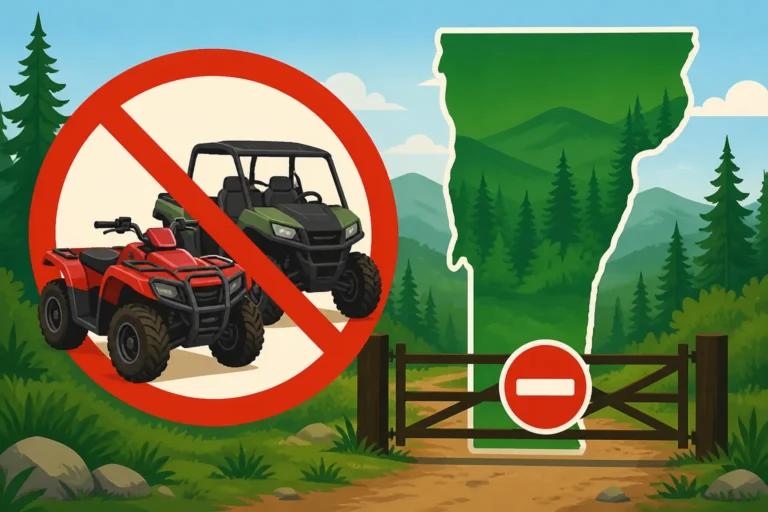
Spring mud can turn a Vermont ATV ride into a frustrating mix of ruts, stuck machines, and trails that were never ready for traffic in the first place. The safest plan is to check whether a route is actually open, respect temporary closures, and choose firm, permitted ground instead of trying to power through soft spots. Here’s how to plan a responsible spring ride.
Why spring mud is a special challenge in Vermont
Thawing ground can be fragile even when a trail looks passable
Vermont’s spring thaw does not happen evenly. A sunny afternoon may dry a section near an open field while a shaded stretch in the woods remains wet and soft. Snowmelt, rain, frost coming out of the ground, and poor drainage can leave a trail surface vulnerable long after the roadside looks dry.
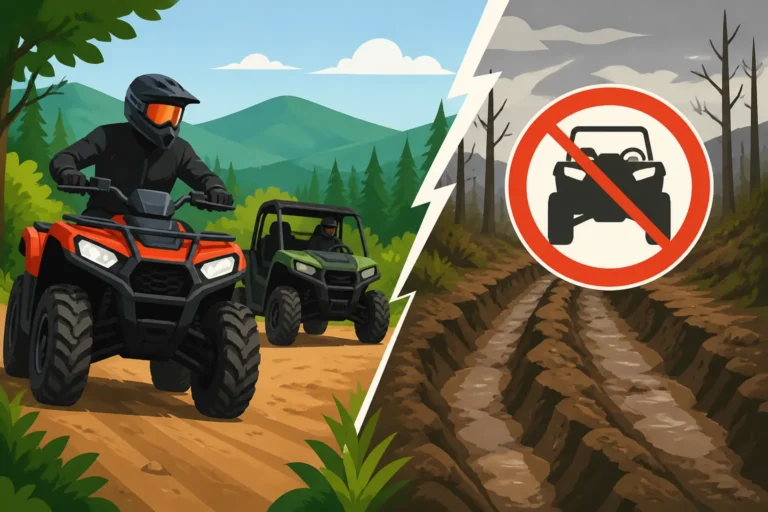
That matters because a machine can cause lasting damage in a short time. Deep tire lugs may cut into soft soil, turning a shallow wet patch into a rut that channels more water and grows deeper with each pass. On a narrow corridor, riders may also widen the trail by steering around the first set of ruts. What seems like a quick detour can damage vegetation or cross onto land that is not part of the permitted route.
Spring conditions can also change over the course of a ride. A firm entrance does not guarantee that a low spot, hill, or bridge approach farther along will be safe. If you cannot tell whether the ground will support your machine without spinning or digging in, treat that as a reason to turn around rather than test it.
Seasonal trail status is not the same as road access
A trail or corridor may be closed during a wet period even if it appears on a map or was open during a previous ride. Vermont’s trail network relies heavily on access across private land, and landowners or clubs may ask riders to stay off a route when conditions are especially vulnerable. A mapped route is useful for planning, but it is not proof that the route is open today.
Town roads are a separate question. Road access depends on local designations and rules, and spring road conditions may bring their own restrictions. Don’t assume that a route you rode last year remains open, or that a town road is a substitute for a closed trail. Check [Vermont Mud Season Closures] and [Vermont ATV Road Rules: Towns Decide] before you leave.
A good habit is to confirm conditions with the club responsible for the corridor and review local notices close to departure. This is especially useful when planning in the Northeast Kingdom, around Island Pond or Derby, where a route may connect corridors maintained by different groups. One open section does not mean every adjoining section is open.
How to check whether a route is ready
Confirm access with the people who maintain the corridor
Start with the relevant local club or trail organization. Ask whether the specific route is open, not simply whether the area is generally riding. “Are trails open near Island Pond?” can lead to a vague answer; “Is this corridor open from the staging area to the marked junction?” is more useful.
Look for current closure notices and pay attention to signs at the trailhead or along the route. A closure sign or gate should be treated as decisive even if an app, printed map, or older social post shows the corridor as rideable. Conditions can change after rain, snowmelt, or a landowner request, so information from an earlier date may no longer apply.
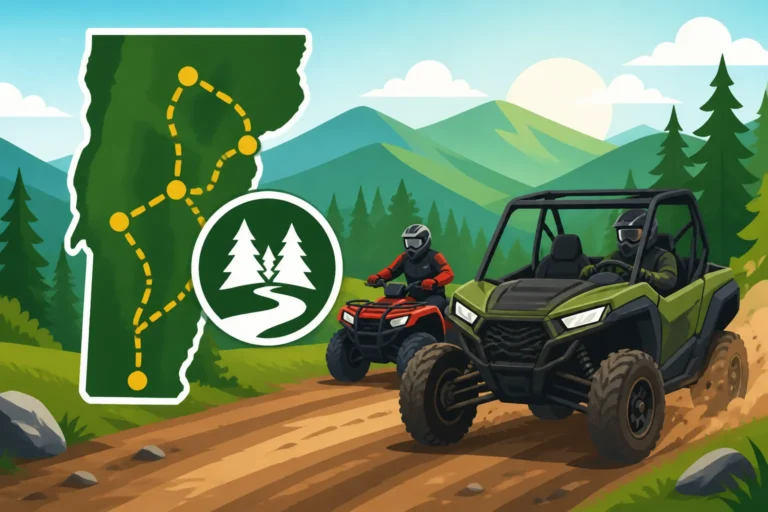
Mapping tools can help you understand where corridors, roads, and staging areas are in relation to one another. For example, onX Offroad can support route planning, but a digital map should not be treated as the final word on access or current trail status. Pair it with club updates, posted signs, and permission requirements. For more on the local network, see [Vermont ATV Trails: The VASA System] and [Who to Call About Vermont Trail Conditions].
Use a simple go-or-no-go check before unloading
Before you tow to a trailhead, check recent weather and ask yourself whether the route is likely to have had time to drain and firm up. A warm, sunny day after a wet week can still leave shaded woods and low areas saturated. If the club reports closures or asks riders to wait, postpone the outing rather than searching for an unofficial way around the notice.
At the staging area, look at the entrance and the ground underfoot. If the soil is already soft, water is pooling, or existing tire tracks are deep and sharply cut, the route may not be ready. Don’t use your machine to “test” a closed trail. If you encounter unexpectedly wet conditions after starting, turn around where it is safe and retrace your route without creating a new bypass.
| What you notice | What it may mean | Safer response |
|---|---|---|
| Closure sign, gate, or club notice | The corridor is not open for riding | Stop and choose a confirmed open route |
| Deep tire ruts or water-filled tracks | The soil may be soft and easily damaged | Turn around without widening the trail |
| Wet ground at a low point or bridge approach | Conditions may worsen beyond the visible section | Avoid pushing through; reassess and retreat |
| Map shows a route but no recent status | The map may not reflect a temporary closure | Confirm with the maintaining club |
| Conditions are unclear before travel | The trip may involve wasted hauling or unauthorized access | Call or message the club before setting out |
A little preparation can save a long tow, a recovery effort, and damage to a corridor. If you use onX Offroad to organize a route, save the relevant club contact information and a return option separately. Do not rely on the map alone to decide whether a trail is open.
Riding responsibly when conditions are firm enough
Stay on the marked corridor and keep your machine under control
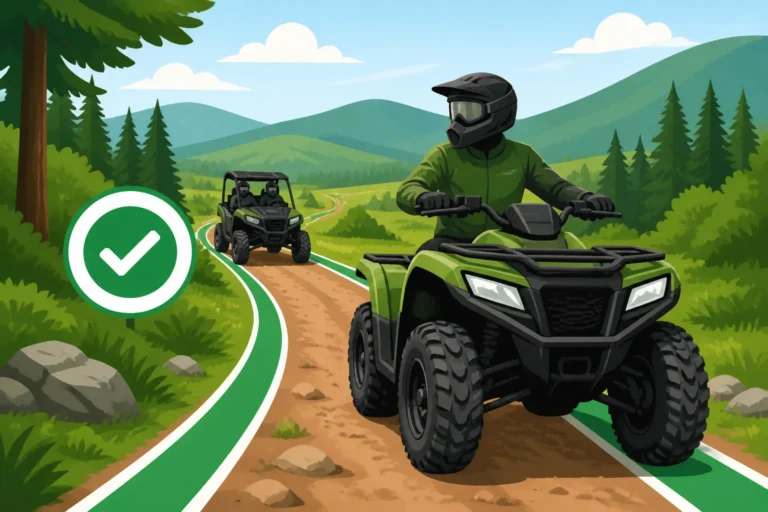
When a route is open, stay on the marked corridor rather than steering around mud, puddles, or an obstacle onto the adjoining land. A muddy section is not an invitation to create a new route along its edge. If the trail is too soft to travel without spinning, digging, or leaving the marked path, turn around.
Use steady, controlled throttle and avoid sudden acceleration that makes the tires spin. Spinning tires can dig quickly, especially on a grade or in wet clay. Keep enough distance from the rider ahead so you are not forced to stop in a soft spot or follow directly through their rut. On a group ride, agree in advance that anyone can call for a turnaround if the ground is deteriorating.
Mud can hide hazards, including rocks, roots, washed-out edges, and drainage channels. Approach unfamiliar wet sections slowly, and do not enter water if you cannot judge its depth or the surface beneath it. If there is a clear route around a hazard that remains within the marked corridor, use it carefully; if the only alternative leaves the corridor, do not take it.
For more on protecting shared access, review [Vermont Trail Etiquette on Private Land] and [Vermont Landowner Permission Holds the System Together]. A landowner’s continued willingness to allow access is part of what keeps the trail network available. A careful decision to turn back is often more valuable than completing a planned loop.
Choose equipment and a route that fit the conditions
Before leaving home, check tires, brakes, steering, lights, and the machine’s recovery points. Make sure you have a suitable tow strap and know how it attaches, but remember that carrying recovery gear does not make a closed or unsuitable trail safe to enter. A winch or tow strap can help with an unexpected problem; it should not become a reason to attempt a route you already suspect is too wet.
For a spring outing, shorter and simpler plans are easier to adjust. Tell someone where you expect to ride, keep enough fuel for an unplanned return, and carry basic communication and first-aid supplies. Cell coverage can be inconsistent in wooded areas and in parts of the Northeast Kingdom, so don’t assume you can call for help from every section.
Use a current route plan as a planning aid, then confirm access independently. onX Offroad can be one part of that process, alongside club information and signs. If you are still learning how Vermont corridors connect, [Reading a VASA Club Trail Map] can help you understand how to follow a marked route rather than improvising a detour.
Planning a spring ride around closures and changing weather
Build flexibility into the day
A spring ride should have a backup plan that does not depend on finding another unverified trail. If your first-choice corridor is closed, choose another route only after confirming that it is open and permitted. Otherwise, use the day for machine maintenance, a shorter outing on confirmed access, or a later ride when conditions improve.
It helps to set a turnaround point before you start. For example, if a route becomes noticeably softer after a junction, the group can agree to return rather than debate it while machines are already spinning. The same approach works when weather changes: persistent rain, new runoff, or worsening ruts are reasons to stop and reassess, not challenges to overcome.
Keep the group together and make sure everyone understands the plan. A rider who moves ahead to “check the trail” can inadvertently end up past a closure sign or on a corridor the rest of the group did not intend to use. If someone reaches a gate or sign, stop the group there and follow the direction given.
Treat closures as part of responsible trail access
A closure is not just a temporary inconvenience for riders. It can prevent trail damage, protect drainage and surrounding land, and help maintain the trust that makes access possible. Respecting a wet-weather closure also reduces the chance that clubs or landowners will face expensive repairs or decide that a corridor is too difficult to keep open.
If a route is closed, don’t move a gate, ride around a barrier, or assume that a quiet section is unmonitored. Let other riders know about the closure if you are sharing trip information, and direct them to confirm conditions with the responsible club. Avoid posting old route details as if they were current access guidance.
When conditions improve, check again before heading out. Spring thaw can leave one area ready while another remains fragile, and a route that was closed last week may have a different status now. Use [Vermont Trail Conditions Before You Tow] to make your pre-trip check more complete. A little patience helps preserve the corridors riders hope to enjoy all season.
Disclaimer
This article is for general informational purposes only and does not constitute professional advice. Laws, prices and regulations vary by location and change over time. Consult a qualified professional for guidance on your specific situation.