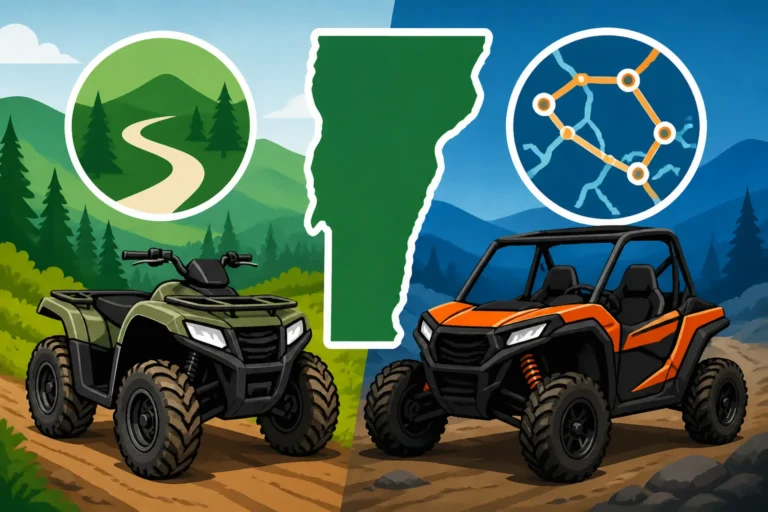
Vermont ATV Trails Open in October
October can be a beautiful time to ride in Vermont, but fall color does not mean every trail is open. Club corridors may close on different dates, and wet ground, hunting activity, and changing weather can affect access. This guide explains how to find October riding opportunities, check a route before towing, and prepare for a safer day out.
How to find Vermont ATV trails open in October
Treat every trail’s status as local
Vermont does not have one October opening calendar that applies to every ATV trail. Much of the VASA trail network crosses private land, and access depends on landowner permission and the local club that maintains the corridor. A trail that is open in one area may be closed a short drive away.
That matters especially in the Northeast Kingdom, where riders may plan around places such as Island Pond, Newport, and Derby. These towns can be useful starting points for researching a ride, but being nearby does not mean a particular corridor is open. Check the club responsible for the route and confirm its posted season dates before you load the machines.
Some trails may remain open into October, while others close earlier because of landowner requests, trail conditions, or local club decisions. The best starting point is [Vermont Trail Season Dates by Club]. You can also review [Vermont Trails Open Past October] and [Vermont Trails That Close Early] to understand why access varies rather than assuming the whole state follows one schedule.
Check the route, not just the riding area
A map can show where a corridor goes, but it may not tell you whether it is open today. Before leaving home, look for recent notices from the local ATV club, closure signs, and information about temporary reroutes. If a route crosses more than one club’s territory, check each section. One open segment does not make the entire planned loop rideable.
Mapping tools can help you plan and keep track of a route, but don’t treat a displayed line as permission to ride. onX Offroad can be useful for reviewing your planned route and keeping your navigation organized; pair it with current club information and on-the-ground signs. If an access point is gated or marked closed, turn around even if your map still shows the corridor.
For a local route, make a short verification list before you go:
- Identify the club or clubs responsible for the corridor.
- Check their latest trail notices and posted season dates.
- Confirm that the start, middle, and return sections are open.
- Look for temporary closures or reroutes.
- Recheck conditions before unloading at the trailhead.
This extra check can save a long drive with a trailer, especially when the plan involves several connected corridors. For help interpreting route information, see [Reading a VASA Club Trail Map] and [Who to Call About Vermont Trail Conditions].
What changes on an October ride
Mud, rain, and early freeze-thaw
Autumn trails can change quickly. A dry stretch of packed ground may become slick after rain, while shaded areas and low spots can stay wet long after the sun comes out. In colder weather, a surface that seems firm early in the day may soften as temperatures rise. Deep ruts can damage a trail and make it harder for other riders to get through.
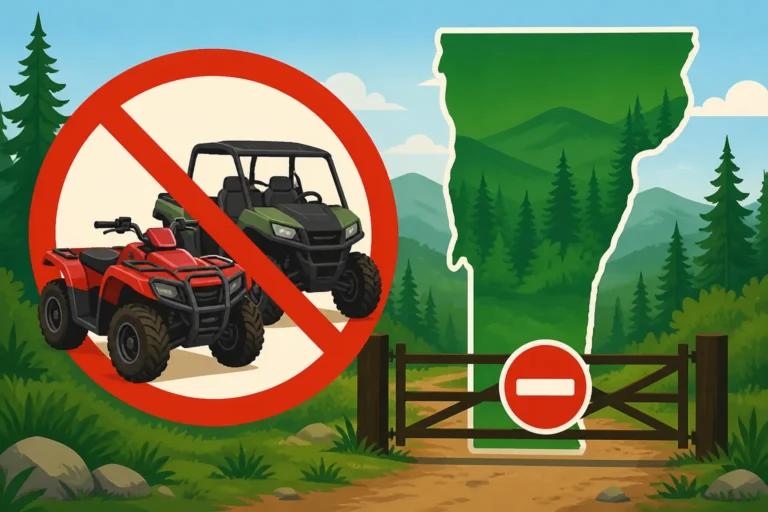
Ride around a wet or fragile section when the marked route allows a safe alternative; don’t create a new bypass through woods or across private land. If there is no suitable option, turn back. Clubs may close a corridor when conditions make continued use harmful, and a closure is not an invitation to squeeze through a gate or follow tire tracks around it. [Vermont Mud Season Closures] explains why vulnerable trail conditions can lead to access restrictions.
A map app, including onX Offroad, may help you understand where you are relative to your planned route, but it can’t tell you that a soft section is safe to cross. Slow down, avoid aggressive throttle, and be ready to stop rather than forcing a machine through mud. If a group is traveling together, agree on a turnaround point before the ride so nobody feels pressured to keep going when conditions worsen.
Shorter days and colder weather
October daylight is limited compared with midsummer, and a ride can take longer than expected when the trail is wet or a group has to backtrack. Start early enough to leave a comfortable margin before dusk. A working headlight and tail light are helpful, but they are not a substitute for planning to finish before visibility becomes poor.
Bring layers that work if you stop moving: a warm midlayer, rain protection, gloves, and dry socks can make a real difference after a breakdown or an unexpected delay. Carry water, snacks, and a basic first-aid kit. For a longer ride, tell someone where you are going and when you expect to return. Mobile coverage can be inconsistent in remote parts of the Northeast Kingdom, so don’t rely on being able to call from every stretch of trail.
Before setting out, check the machine itself. Look at tire condition, brakes, lights, fuel, and any equipment needed for your route. A spare belt or tow strap may be useful on a longer ride, but only carry gear you know how to use. For more preparation ideas, see [Packing for a Full Day Out] and [Vermont Trail Conditions Before You Tow].
October access, trail rules, and route planning
A trail ride is not the same as a road ride
An open ATV trail does not automatically authorize riding on nearby town roads. Road access depends on local designation and town rules, and a road that connects two trail sections may still be closed to ATVs. Do not use a road shoulder or an unmarked lane as an improvised connector just because it appears convenient on a map.
Keep trail permission and road permission separate when planning. Check [Vermont ATV Road Rules by Town] if your route may involve a town road, and review [How a Vermont Selectboard Opens a Road to ATVs] to understand why road access is handled locally. If the route is unclear, ask the responsible club or town rather than guessing at a junction.
Trail access also has requirements beyond an open gate. Vermont riders using the VASA trail system generally need to pay attention to registration, trail access, and the applicable rules for their machine and situation. Review [Vermont Requires Registration Plus a TAD] before planning a VASA ride. Visitors should also check [Vermont Out-of-State Machines Still Need a TAD] rather than assuming an out-of-state registration alone covers trail access.
Be considerate during hunting season
October overlaps with hunting activity in Vermont. That does not mean every trail is closed, but it is a good reason to be especially alert and respectful. Follow posted signs, stay on the marked corridor, and avoid stopping in a way that blocks a gate or access point. Keep noise and speed under control near homes, farms, and other trail users.
Wear visible clothing appropriate to the conditions, particularly if you are walking away from the machine or stopping near a trail junction. If a landowner or club has posted a closure, respect it. Permission can change, and continuing past a closure can jeopardize access for everyone who uses that corridor.
Build a flexible itinerary
For an October trip, plan a shorter primary route and identify a reasonable alternative before you tow. That way, if a club reports a closure or a trail is too wet, you can adapt without wandering onto an unmarked path. onX Offroad can help you keep your intended route in view, but use it alongside current club updates and signs at the trail. Don’t assume the app or any map has the final word on access.
| Before you ride | What to confirm | Why it matters in October |
|---|---|---|
| Trail status | The local club’s current notice and season dates | Open dates vary by corridor and can change |
| Route connections | Every segment, including any return route | A single closed section can interrupt a loop |
| Surface conditions | Recent rain, standing water, and soft ground | Wet trails can rut easily and may be unsafe |
| Road access | Town designations and local restrictions | A nearby road is not automatically open to ATVs |
| Daylight and weather | Start time, forecast, and expected return | Shorter days leave less room for delays |
| Required access items | Registration, trail access, and machine documents | Trail access requirements still apply in fall |
Before leaving, save the number or contact details for the club that maintains your planned corridor. If conditions deteriorate, the sensible choice may be to turn around or choose another day. That can feel disappointing after arranging a group and towing machines north, but a closed or damaged trail is not worth risking access for future riders.
For more seasonal planning, read [Vermont Trail Riding After Mud Season] and [Vermont Trail Etiquette on Private Land]. Both reinforce a useful habit for fall riding: use only confirmed routes, leave gates as you found them, and give landowners and other trail users a reason to keep access open.
Disclaimer
This article is for general informational purposes only and does not constitute professional advice. Laws, prices and regulations vary by location and change over time. Consult a qualified professional for guidance on your specific situation.